Monographie Open Access Vollzugriff
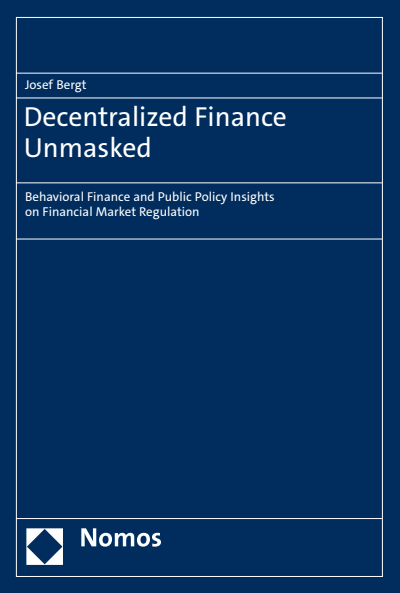
Decentralized Finance Unmasked
Behavioral Finance and Public Policy Insights on Financial Market Regulation- Autor:innen:
- Verlag:
- 2023
Zusammenfassung
Decentralized Finance (DeFi) ist eine Form der Finanzwirtschaft ohne zentrale Finanzintermediäre. Dieses Werk analysiert das Zusammenspiel von Behavioral Finance und Public Policy im aufkommenden Bereich des DeFi. Das Werk erklärt die zugrundeliegenden Mechanismen von DeFi aus sozial-, wirtschafts- und rechtswissenschaftlicher Sicht untersucht den potenziellen Einfluss von DeFi auf Finanzsysteme und die damit verbundenen Risiken, einschließlich Schwachstellen bei Smart Contracts und Vertrauensmechanismen, liefert Einblicke in finanzielle Entscheidungsprozesse in DeFi, bietet Vorschläge zur Verbesserung regulatorischer Rahmenbedingungen.
Schlagworte
Publikation durchsuchen
Bibliographische Angaben
- Copyrightjahr
- 2023
- ISBN-Print
- 978-3-7560-0715-8
- ISBN-Online
- 978-3-7489-4301-3
- Verlag
- Nomos, Baden-Baden
- Sprache
- Englisch
- Seiten
- 227
- Produkttyp
- Monographie
Inhaltsverzeichnis
KapitelSeiten
- Titelei/InhaltsverzeichnisSeiten 1 - 20 Download Kapitel (PDF)
- 2.1 Interdisciplinarity of law and economics, sociology, psychology and information technology with regard to financial markets
- 2.2 Sciences vs Humanities – the lost sociology of law in Europe?
- 2.3 Scope & Research Subject
- 2.4 Methodology
- 3.1.1 Representativeness bias
- 3.1.2 Familiarity bias
- 3.1.3 Cognitive dissonance
- 3.1.4 Endowment effect
- 3.1.5 Overconfidence bias
- 3.1.6 Status quo bias
- 3.1.7 Law of small numbers
- 3.1.8 Anchoring
- 3.1.9 Mental accounting
- 3.1.10 Disposition effect
- 3.1.11 Attachment bias
- 3.1.12 Prospect Theory – loss aversion and risk seeking
- 3.1.13 Social norming
- 3.1.14 Interim conclusion
- 3.2.1 Investor decision making process and consumer biases
- 3.2.2 Interim conclusion
- 3.2.3 Behavioral corporate finance and managerial biases
- 3.2.4 Interim conclusion
- 3.2.5 Behavioral biases, financial literacy and demographic variables
- 3.3.1 How attention and presentation impact information processing and memory retention
- 3.3.2 The impact of omission bias on decision making, social norms and procyclical behavior
- 3.3.3 How ideological dimensions may shape financial regulation
- 3.3.4 Interim conclusion
- 3.4.1 Diversification and the value of financial intermediation
- 3.4.2 Regulation of investors? Balancing investor protection and diversification in regulatory frameworks
- 3.4.3 Negative implications of the fix-it-fallacy on social policymaking
- 3.4.4 Exploring the role of regulatory ideologies in shaping economic public policy
- 3.4.5 Advancing policy instruments research: Addressing key gaps and enhancing public policy outcomes on the crossroads of behavioral finance and neuroscience
- 3.4.6 Interim conclusion
- 3.5.1 Considerations when applying behavioral economic findings in real-world situations and policymaking
- 3.5.2 Who does banking regulation protect?
- 3.5.3 Case study 1
- 3.5.4 Case study 2
- 3.5.5 Case study 3
- 3.5.6 Interim conclusions
- 4.1.1 Types of blockchains
- 4.1.2 The decentralization promise of DeFi
- 4.1.3 DeFi architecture
- 4.1.4 Decentralization shams and other supervisory challenges
- 4.1.5 Interim conclusion
- 4.2.1.1 Evolution of the theory of the firm, social economy organizations and decentralized autonomous organizations
- 4.2.1.2 Public policy goals of MiCAR and classification of crypto assets
- 4.2.1.3 Interim conclusion
- 4.2.2.1 Traditional regulated markets
- 4.2.2.2 Trust in intermediating technology platforms
- 4.2.2.3 Lateral exchange markets in the form of blockchain-based decentralized exchanges (DEX)
- 4.2.2.4 DLT Pilot Regime
- 4.2.2.5 Interim conclusion
- 4.2.3 Crowdfunding Services & emerging markets of DeFi lending
- 4.2.4 Decentralized derivatives – a growing trend in the DeFi ecosystem
- 4.2.5 DeFi portfolio management and investment schemes
- 4.2.6 The role of crypto asset mixers as privacy enhancing protocols and financial intermediaries
- 4.2.7 DORA – digital operational resilience
- 4.2.8 Global financial regulation?
- 4.3.1 Perceived risk and uncertainty in decision research and implications for public policy and behavioral finance
- 4.3.2 Choice architecture, framing effects, and default options in DeFi policy
- 4.3.3 Potential for herding and mass contagion in AI-driven investment decisions
- 4.3.4 The role of behavioral economics in public policy and its challenges
- 4.4.1 Decentralized organizations, tokenization as well as centralized and decentralized market infrastructures under the EU digital finance package
- 4.4.2 DeFi lending, derivatives, portfolios and privacy enhancing protocols
- 4.4.3 Additional EU digital finance packages
- 4.4.4 Behavioral finance and regulatory public policy implications
- 5.1 Interpretation and classification of the results
- 5.2 Implications in practice
- 5.3 Implications in theory and research
- 5.4 Limitations and future research
- 5.5 Conclusion
- 6 List of sourcesSeiten 205 - 227 Download Kapitel (PDF)
Literaturverzeichnis (351 Einträge)
Es wurden keine Treffer gefunden. Versuchen Sie einen anderen Begriff.
- Adato, M., Carter, M. R., & May, J. (2006). Exploring poverty traps and social exclusion in South Africa using qualitative and quantitative data. The Journal of Development Studies, 42(2), 226-247. Google Scholar öffnen DOI: 10.5771/9783748943013
- Aikman, D., Galesic, M., Gigerenzer, G., Kapadia, S., Katsikopoulos, K., Kothiyal, A., Murphy, E. & Neumann, T. (2021). Taking uncertainty seriously: simplicity versus complexity in financial regulation. Industrial and Corporate Change, 30(2), 317-345. Google Scholar öffnen DOI: 10.5771/9783748943013
- Akerlof, G. A., & Dickens, W. T. (1982). The economic consequences of cognitive dissonance. The American economic review, 72(3), 307-319. Google Scholar öffnen DOI: 10.5771/9783748943013
- Akerlof, G. A., & Shiller, R. J. (2009). Animal spirits: How human psychology drives the economy, and why it matters for global capitalism. Princeton university press. Google Scholar öffnen DOI: 10.5771/9783748943013
- Al-mansour, B. Y. (2020). Cryptocurrency market: Behavioral finance perspective. The Journal of Asian Finance, Economics and Business, 7(12), 159-168. Google Scholar öffnen DOI: 10.5771/9783748943013
- Al-mansour, B. Y., & Arabyat, Y. A. (2017). Investment decision making among Gulf investors: behavioural finance perspective. International Journal of Management Studies, 24(1), 41-71. Google Scholar öffnen DOI: 10.5771/9783748943013
- Altman, M. (2012). Implications of behavioural economics for financial literacy and public policy. The Journal of Socio-Economics, 41(5), 677-690. Google Scholar öffnen DOI: 10.5771/9783748943013
- Anson, C. M., Schwegler, R. A. (2000). The Longman Handbook for Writers and Readers, . Google Scholar öffnen DOI: 10.5771/9783748943013
- Arner, D. W., & Taylor, M. W. (2009). The Global Financial Crisis and the Financial Stability Board: Hardening the Soft Law of International Financial Regulation?. University of New South Wales Law Journal, The, 32(2), 488-513. Google Scholar öffnen DOI: 10.5771/9783748943013
- Aronson, E., Wilson, T. D., Akert, R. M., & Sommers, S. R. (2020). Social psychology. Pearson Higher Ed. Google Scholar öffnen DOI: 10.5771/9783748943013
- Ashraf, N., Camerer, C. F., & Loewenstein, G. (2005). Adam Smith, behavioral economist. Journal of economic perspectives, 19(3), 131-145. Google Scholar öffnen DOI: 10.5771/9783748943013
- Ateş, S., Coşkun, A., Şahin, M. A., & Demircan, M. L. (2016). Impact of Financial Literacy on the Behavioral Biases of Individual Stock Investors: Evidence from Borsa Istanbul. Business & Economics Research Journal, 7(3). Google Scholar öffnen DOI: 10.5771/9783748943013
- Baker, H. K., & Nofsinger, J. R. (2002). Psychological biases of investors. Financial services review, 11(2), 97-116. Google Scholar öffnen DOI: 10.5771/9783748943013
- Baker, H. K., Kumar, S., Goyal, N., & Gaur, V. (2019). How financial literacy and demographic variables relate to behavioral biases. Managerial Finance, 45(1), 124-146. Google Scholar öffnen DOI: 10.5771/9783748943013
- Banerjee, A. V. (1992). A simple model of herd behavior. The quarterly journal of economics, 107(3), 797-817. Google Scholar öffnen DOI: 10.5771/9783748943013
- Barber, B. M., & Odean, T. (2001a). Boys will be boys: Gender, overconfidence, and common stock investment. The quarterly journal of economics, 116(1), 261-292. Google Scholar öffnen DOI: 10.5771/9783748943013
- Barber, B. M., & Odean, T. (2001b). The internet and the investor. Journal of Economic Perspectives, 15(1), 41-54. Google Scholar öffnen DOI: 10.5771/9783748943013
- Barber, B. M., & Odean, T. (2002). Online investors: do the slow die first?. The Review of financial studies, 15(2), 455-488. Google Scholar öffnen DOI: 10.5771/9783748943013
- Barberis, N., & Huang, M. (2001). Mental accounting, loss aversion, and individual stock returns. the Journal of Finance, 56(4), 1247-1292. Google Scholar öffnen DOI: 10.5771/9783748943013
- Barberis, N., Thaler, R. (2003). A survey of behavioral finance. G. Constantinides, M. Harris, R. Stulz, eds. Handbook of the Economics of Finance, 1052-1121. Google Scholar öffnen DOI: 10.5771/9783748943013
- Barros, L. A., & Di Miceli da Silveira, A. (2007). Overconfidence, managerial optimism and the determinants of capital structure. Available at SSRN 953273. Google Scholar öffnen DOI: 10.5771/9783748943013
- Bauer, R. A. (1960). Consumer Behavior as risk taking in RS Hancock (Ed.) Dynamic marketing for a changing world (pp. 389-398). Chicago: American Marketing Association. Google Scholar öffnen DOI: 10.5771/9783748943013
- Beck, A.T., Prisoners of Hate: The Cognitive Basis of Anger, Hostility, and Violence. HarperCollins, New York, 1999. Google Scholar öffnen DOI: 10.5771/9783748943013
- Becker, M. (2012). Hinweise zur Anfertigung eines Literatur-Reviews. Leipzig: Universität Leipzig. Google Scholar öffnen DOI: 10.5771/9783748943013
- Béland, D., & Howlett, M. (2016). How solutions chase problems: Instrument constituencies in the policy process. Governance, 29(3), 393-409. Google Scholar öffnen DOI: 10.5771/9783748943013
- Belk, R. (2014a). Sharing versus pseudo-sharing in Web 2.0. The anthropologist, 18(1), 7-23. Google Scholar öffnen DOI: 10.5771/9783748943013
- Belk, R. (2014b). You are what you can access: Sharing and collaborative consumption online. Journal of business research, 67(8), 1595-1600. Google Scholar öffnen DOI: 10.5771/9783748943013
- Belsky, G., & Gilovich, T. (2010). Why smart people make big money mistakes and how to correct them: Lessons from the life-changing science of behavioral economics. Simon and Schuster. Google Scholar öffnen DOI: 10.5771/9783748943013
- Benartzi, S. (2001). Excessive extrapolation and the allocation of 401 (k) accounts to company stock. The Journal of Finance, 56(5), 1747-1764. Google Scholar öffnen DOI: 10.5771/9783748943013
- Benartzi, S., & Thaler, R. H. (1995). Myopic loss aversion and the equity premium puzzle. The quarterly journal of Economics, 110(1), 73-92. Google Scholar öffnen DOI: 10.5771/9783748943013
- Berentsen, A., & Schär, F. (2018). A short introduction to the world of cryptocurrencies. FRB of St. Louis Working Review. Google Scholar öffnen DOI: 10.5771/9783748943013
- Berentsen, A., & Schär, F. (2019). Stablecoins: The quest for a low-volatility cryptocurrency. The economics of Fintech and digital currencies, 65-75. Google Scholar öffnen DOI: 10.5771/9783748943013
- Bergt, J. (2020). Token als Wertrechte und Token Offerings und dezentrale Handelsplätze: Eine wertpapierzivilrechtliche und wertpapieraufsichtsrechtliche Analyse aus der Perspektive Liechtensteins unter besonderer Berücksichtigung einschlägiger Unionsrechtsakte (Vol. 1). BoD–Books on Demand. Google Scholar öffnen DOI: 10.5771/9783748943013
- *also published under the following translations Google Scholar öffnen DOI: 10.5771/9783748943013
- Bergt, J. (2020). Les Tokens comme Droits de Valeur & Offres de Tokens et Centres Commerciaux Décentralisés: Une analyse du droit civil des valeurs mobilières et du droit de la surveillance des valeurs mobilières du point de vue du Liechtenstein, avec une référence particulière aux actes pertinents de l'Union (Vol. 1). BoD–Books on Demand. Google Scholar öffnen DOI: 10.5771/9783748943013
- Bergt, J. (2020). Token als Waarderechten & Tokenanbiedingen en Gedecentraliseerde Handelscentra: Een analyse van het burgerlijk effectenrecht en het recht inzake effectentoezicht vanuit het oogpunt van Liechtenstein, met bijzondere aandacht voor de desbetreffende besluiten van de Unie (Vol. 1). BoD–Books on Demand. Google Scholar öffnen DOI: 10.5771/9783748943013
- Bergt, J. (2020). Token als Wertrechte und Token Offerings und dezentrale Handelsplätze: Eine wertpapierzivilrechtliche und wertpapieraufsichtsrechtliche Analyse aus der Perspektive Liechtensteins unter besonderer Berücksichtigung einschlägiger Unionsrechtsakte (Vol. 1). BoD–Books on Demand. Google Scholar öffnen DOI: 10.5771/9783748943013
- Bergt, J. (2020). Token as Value Rights & Token Offerings and decentralized Trading Venues (Japanese): An analysis of securities civil law and securities supervision law from the perspective of Liechtenstein, with particular reference to relevant Union acts (Vol. 1). BoD–Books on Demand. Google Scholar öffnen DOI: 10.5771/9783748943013
- Bergt, J. (2020). Token as value rights & Token offerings and decentralized trading venues (English): An analysis of securities civil law and securities supervision law from the perspective of Liechtenstein, with particular reference to relevant Union acts (Vol. 1). BoD–Books on Demand, ISBN 9783751937962. Google Scholar öffnen DOI: 10.5771/9783748943013
- Bergt, J. (2020). Token as Value Rights & Token Offerings and decentralized Trading Venues (Russian): An analysis of securities civil law and securities supervision law from the perspective of Liechtenstein, with particular reference to relevant Union acts (Vol. 1). BoD–Books on Demand, ISBN 9783751935968. Google Scholar öffnen DOI: 10.5771/9783748943013
- Bergt, J. (2020). Token as Value Rights & Token Offerings and decentralized Trading Venues (Chinese simplified): An analysis of securities civil law and securities supervision law from the perspective of Liechtenstein, with particular reference to relevant Union acts (Vol. 1). BoD–Books on Demand. Google Scholar öffnen DOI: 10.5771/9783748943013
- Bergt, J. (2020). Token come Diritti di Valore &Offerte a Token e Centri Commerciali Decentralizzati: Un'analisi del diritto civile dei titoli e del diritto di vigilanza sui titoli dal punto di vista del Liechtenstein, con particolare rifer-imento ai pertinenti atti dell'Unione europea (Vol. 1). BoD–Books on Demand. Google Scholar öffnen DOI: 10.5771/9783748943013
- Bergt, J. (2020). Token como Derechos de Valor & Ofertas de Token y Centros de Comercio Descentralizados: Un análisis del derecho civil de valores y la legislación de su-pervisión de valores desde la perspectiva de Liechtenstein, con especial referencia a los actos pertinentes de la Unión (Vol. 1). BoD–Books on Demand. Google Scholar öffnen DOI: 10.5771/9783748943013
- Bergt, J. (2020). Token como Direitos de Valor & Token Offerings e Centros Comerciais Descentralizados: Uma análise do direito civil e do direito de supervisão dos valores mobiliários na perspectiva do Liechtenstein, com especial referência aos actos relevantes da União (Vol. 1). BoD–Books on Demand. Google Scholar öffnen DOI: 10.5771/9783748943013
- Bergt, J. (2020). Tokenowe Prawa do Wartosci & Oferty Tokenowe i Zdecentralizowane Centra Handlowe: Analiza prawa cywilnego w zakresie papierów wartosciowych i prawa nadzoru nad papierami wartosciowymi z perspektywy Liechtensteinu, ze szczegolnym uwzglednieniem odpowiednich aktow Unii (Vol. 1). BoD–Books on Demand. Google Scholar öffnen DOI: 10.5771/9783748943013
- Bergt, J. (2021a). Trust in Blockchain-Technology in a Sharing Economy. DOI: 10.13140/RG.2.2.16079.56480/6. Google Scholar öffnen DOI: 10.5771/9783748943013
- Bergt, J. (2021b). Token als Wertrechte - Podium Recht. DOI: 10.13140/RG.2.2.11046.40000/2. Google Scholar öffnen DOI: 10.5771/9783748943013
- Bergt, J., Esneault, A., Feldkircher, T., & Nägele, T. (2019). National legal & regulatory frameworks in select European countries. Country Analysis Liechtenstein in The Regulation of Tokens in Europe Parts A & B: The EU legal and regulatory framework, 117. Google Scholar öffnen DOI: 10.5771/9783748943013
- Beyer, S., & Bowden, E. M. (1997). Gender differences in seff-perceptions: Convergent evidence from three measures of accuracy and bias. Personality and Social Psychology Bulletin, 23(2), 157-172. Google Scholar öffnen DOI: 10.5771/9783748943013
- Bhandari, G., & Deaves, R. (2006). The demographics of overconfidence. The Journal of Behavioral Finance, 7(1), 5-11. Google Scholar öffnen DOI: 10.5771/9783748943013
- Bhargava, S., & Loewenstein, G. (2015). Behavioral economics and public policy 102: Beyond nudging. American Economic Review, 105(5), 396-401. Google Scholar öffnen DOI: 10.5771/9783748943013
- Biela, J., Kaiser, A., & Hennl, A. (2013). Policy Making in Multilevel Systems: Federalism, Decentralisation, and performance in the OECD countries. ECPR Press. Google Scholar öffnen DOI: 10.5771/9783748943013
- Bikhchandani, S., Hirshleifer, D., & Welch, I. (1992). A theory of fads, fashion, custom, and cultural change as informational cascades. Journal of political Economy, 100(5), 992-1026. Google Scholar öffnen DOI: 10.5771/9783748943013
- Bilgehan, T. (2014). Psychological biases and the capital structure decisions: a literature review. Theoretical & Applied Economics, 21(12). Google Scholar öffnen DOI: 10.5771/9783748943013
- Blank, H., & Launay, C. (2014). How to protect eyewitness memory against the misinformation effect: A meta-analysis of post-warning studies. Journal of Applied Research in Memory and Cognition, 3, 77–88. Google Scholar öffnen DOI: 10.5771/9783748943013
- Blau, P. (2017). Exchange and power in social life. Routledge. Google Scholar öffnen DOI: 10.5771/9783748943013
- Böhme, R., Christin, N., Edelman, B., & Moore, T. (2015). Bitcoin: Economics, technology, and governance. Journal of economic Perspectives, 29(2), 213-238. Google Scholar öffnen DOI: 10.5771/9783748943013
- Boissay, F., & Collard, F. (2016). Macroeconomics of bank capital and liquidity regulations. Google Scholar öffnen DOI: 10.5771/9783748943013
- Boissay, F., Collard, F., & Smets, F. (2016). Booms and banking crises. Journal of Political Economy, 124(2), 489-538. Google Scholar öffnen DOI: 10.5771/9783748943013
- Bolleyer, N., & Börzel, T. A. (2010). Non-hierarchical policy coordination in multilevel systems. European Political Science Review, 2(2), 157-185. Google Scholar öffnen DOI: 10.5771/9783748943013
- Borrás, S., & Edquist, C. (2013). The choice of innovation policy instruments. Technological forecasting and social change, 80(8), 1513-1522. Google Scholar öffnen DOI: 10.5771/9783748943013
- Borzaga, C., & Tortia, E. (2008). Social economy organisations in the theory of the firm. Google Scholar öffnen DOI: 10.5771/9783748943013
- Brenner, L. A., Koehler, D. J., & Tversky, A. (1996). On the evaluation of one‐sided evidence. Journal of Behavioral Decision Making, 9(1), 59-70. Google Scholar öffnen DOI: 10.5771/9783748943013
- Bressers, H., & Klok, P. J. (1988). Fundamentals for a theory of policy instruments. International journal of social economics. Google Scholar öffnen DOI: 10.5771/9783748943013
- Brewer, M. B. (1979). In-group bias in the minimal intergroup situation: A cognitive-motivational analysis. Psychological bulletin, 86(2), 307. Google Scholar öffnen DOI: 10.5771/9783748943013
- Brunnermeier, M. K., & Sannikov, Y. (2014). A macroeconomic model with a financial sector. American Economic Review, 104(2), 379-421. Google Scholar öffnen DOI: 10.5771/9783748943013
- Buterin, V. (2018). https://twitter.com/VitalikButerin/status/1051160932699770882?ref_src=twsrc%5Etfw. Google Scholar öffnen DOI: 10.5771/9783748943013
- Camerer, C. F. (2003). Behavioral game theory: Experiments in strategic interaction. Princeton university press. Google Scholar öffnen DOI: 10.5771/9783748943013
- Camerer, C., Issacharoff, S., Loewenstein, G., O'donoghue, T., & Rabin, M. (2003). Regulation for conservatives: behavioral economics and the case for" asymmetric paternalism". University of Pennsylvania law review, 151(3), 1211-1254. Google Scholar öffnen DOI: 10.5771/9783748943013
- Cameron, L., & Shah, M. (2015). Risk-taking behavior in the wake of natural disasters. Journal of human resources, 50(2), 484-515. Google Scholar öffnen DOI: 10.5771/9783748943013
- Campbell, H. E., Johnson, R. M., & Larson, E. H. (2004). Prices, devices, people, or rules: the relative effectiveness of policy instruments in water conservation 1. Review of policy research, 21(5), 637-662. Google Scholar öffnen DOI: 10.5771/9783748943013
- Capano, G., & Howlett, M. (2020). The knowns and unknowns of policy instrument analysis: Policy tools and the current research agenda on policy mixes. Sage Open, 10(1), 2158244019900568. Google Scholar öffnen DOI: 10.5771/9783748943013
- Capano, G., Howlett, M., & Ramesh, M. (Eds.). (2015). Varieties of governance: Dynamics, strategies, capacities. Springer. Google Scholar öffnen DOI: 10.5771/9783748943013
- Caplan, B. (2001). Rational ignorance versus rational irrationality. Kyklos, 54(1), 3-26. Google Scholar öffnen DOI: 10.5771/9783748943013
- Cassar, A., & Wydick, B. (2010). Does social capital matter? Evidence from a five-country group lending experiment. Oxford Economic Papers, 62(4), 715-739. Google Scholar öffnen DOI: 10.5771/9783748943013
- Cassar, A., Crowley, L., & Wydick, B. (2007). The effect of social capital on group loan repayment: evidence from field experiments. The Economic Journal, 117(517), F85-F106. Google Scholar öffnen DOI: 10.5771/9783748943013
- Chantarat, S., & Barrett, C. B. (2012). Social network capital, economic mobility and poverty traps. The Journal of Economic Inequality, 10, 299-342. Google Scholar öffnen DOI: 10.5771/9783748943013
- Chetty, R. (2015). Behavioral economics and public policy: A pragmatic perspective. American Economic Review, 105(5), 1-33. Google Scholar öffnen DOI: 10.5771/9783748943013
- Chohan, U. W. (2017). The decentralized autonomous organization and governance issues. Available at SSRN 3082055. Google Scholar öffnen DOI: 10.5771/9783748943013
- Christensen, Clayton M. (1997). The Innovator's Dilemma: When New Technologies Cause Great Firms to Fail. Boston, MA: Harvard Business School Press. Google Scholar öffnen DOI: 10.5771/9783748943013
- Cifuentes, R., Ferrucci, G., & Shin, H. S. (2005). Liquidity risk and contagion. Journal of the European Economic association, 3(2-3), 556-566. Google Scholar öffnen DOI: 10.5771/9783748943013
- Coase, R. H. (1991). The nature of the firm (1937). The nature of the firm, 18-33. Google Scholar öffnen DOI: 10.5771/9783748943013
- Comer, J. M., Plank, R. E., Reid, D. A., & Pullins, E. B. (1999). Methods in sales research: perceived trust in business-to-business sales: a new measure. Journal of Personal Selling & Sales Management, 19(3), 61-71. Google Scholar öffnen DOI: 10.5771/9783748943013
- Cooper, H. M. (1988). Organizing knowledge syntheses: A taxonomy of literature reviews. Knowledge in society, 1(1), 104-126. Google Scholar öffnen DOI: 10.5771/9783748943013
- Corbitt, B. J., Thanasankit, T., & Yi, H. (2003). Trust and e-commerce: a study of consumer perceptions. Electronic commerce research and applications, 2(3), 203-215. Google Scholar öffnen DOI: 10.5771/9783748943013
- Costello, J. P., & Reczek, R. W. (2020). Providers versus platforms: Marketing communications in the sharing economy. Journal of Marketing, 84(6), 22-38. Google Scholar öffnen DOI: 10.5771/9783748943013
- Counsel of the European Union. (2022). INFORMATION NOTE. Proposal for a Regulation of the European Parliament and of the Council on Markets in Crypto-assets, and amending Directive (EU) 2019/1937 (MiCA), incl compromise text, 13198/22, EF 293, ECOFIN 965, CODEC 1428. https://data.consilium.europa.eu/doc/document/ST-13198-2022-INIT/en/pdf). Google Scholar öffnen DOI: 10.5771/9783748943013
- Coval, J. D., & Moskowitz, T. J. (1999). Home bias at home: Local equity preference in domestic portfolios. The Journal of Finance, 54(6), 2045-2073. Google Scholar öffnen DOI: 10.5771/9783748943013
- Cox, D. F., & Rich, S. U. (1964). Perceived risk and consumer decision-making—the case of telephone shopping. Journal of marketing research, 1(4), 32-39. Google Scholar öffnen DOI: 10.5771/9783748943013
- Cronqvist, H., & Siegel, S. (2014). The genetics of investment biases. Journal of Financial Economics, 113(2), 215-234. Google Scholar öffnen DOI: 10.5771/9783748943013
- Cummins, R. A., & Nistico, H. (2002). Maintaining life satisfaction: The role of positive cognitive bias. Journal of Happiness studies, 3(1), 37. Google Scholar öffnen DOI: 10.5771/9783748943013
- D'Acunto, F., Prokopczuk, M., & Weber, M. (2015). The long shadow of Jewish persecution on financial decisions. Available at SSRN 2368073. Google Scholar öffnen DOI: 10.5771/9783748943013
- Dakduk, S., Santalla-Banderali, Z., & Siqueira, J. R. (2020). Acceptance of mobile commerce in low-income consumers: evidence from an emerging economy. Heliyon, 6(11), e05451. Google Scholar öffnen DOI: 10.5771/9783748943013
- Daniel, K., Hirshleifer, D., & Teoh, S. H. (2002). Investor psychology in capital markets: Evidence and policy implications. Journal of monetary economics, 49(1), 139-209. Google Scholar öffnen DOI: 10.5771/9783748943013
- Dawkins, R. (1976). The Selfish Gene. Oxford University Press. Google Scholar öffnen DOI: 10.5771/9783748943013
- De Bondt, W. F., & Thaler, R. (1985). Does the stock market overreact?. The Journal of finance, 40(3), 793-805. Google Scholar öffnen DOI: 10.5771/9783748943013
- De Bondt, W. F., Muradoglu, Y. G., Shefrin, H., & Staikouras, S. K. (2008). Behavioral finance: Quo vadis?. Journal of Applied Finance (Formerly Financial Practice and Education), 18(2). Google Scholar öffnen DOI: 10.5771/9783748943013
- De Bondt, W. P. (1993). Betting on trends: Intuitive forecasts of financial risk and return. International Journal of forecasting, 9(3), 355-371. Google Scholar öffnen DOI: 10.5771/9783748943013
- Deaves, R., Lüders, E., & Schröder, M. (2010). The dynamics of overconfidence: Evidence from stock market forecasters. Journal of Economic Behavior & Organization, 75(3), 402-412. Google Scholar öffnen DOI: 10.5771/9783748943013
- Debreu, G. (1954). Valuation equilibrium and Pareto optimum. Proceedings of the national academy of sciences, 40(7), 588-592. Google Scholar öffnen DOI: 10.5771/9783748943013
- Del Guercio, D. (1996). The distorting effect of the prudent-man laws on institutional equity investments. Journal of Financial Economics, 40(1), 31-62. Google Scholar öffnen DOI: 10.5771/9783748943013
- Dhar, R., & Zhu, N. (2006). Up close and personal: Investor sophistication and the disposition effect. Management science, 52(5), 726-740. Google Scholar öffnen DOI: 10.5771/9783748943013
- Drexler, K. E., & Miller, M. S. (1988). Incentive engineering for computational resource management. The ecology of Computation, 2, 231-266. Google Scholar öffnen DOI: 10.5771/9783748943013
- Dunbar, R. I. (1993). Coevolution of neocortical size, group size and language in humans. Behavioral and brain sciences, 16(4), 681-694. Google Scholar öffnen DOI: 10.5771/9783748943013
- Eagly, A. H., & Carli, L. L. (1981). Sex of researchers and sex-typed communications as determinants of sex differences in influenceability: a meta-analysis of social influence studies. Psychological Bulletin, 90(1), 1. Google Scholar öffnen DOI: 10.5771/9783748943013
- Easterly, W., & Levine, R. (1997). Africa's growth tragedy: policies and ethnic divisions. The quarterly journal of economics, 1203-1250. Google Scholar öffnen DOI: 10.5771/9783748943013
- Eckel, C. C., El-Gamal, M. A., & Wilson, R. K. (2009). Risk loving after the storm: A Bayesian-Network study of Hurricane Katrina evacuees. Journal of Economic Behavior & Organization, 69(2), 110-124. Google Scholar öffnen DOI: 10.5771/9783748943013
- Ecker, U. K., Lewandowsky, S., & Tang, D. T. (2010). Explicit warnings reduce but do not eliminate the continued influence of misinformation. Memory & Cognition, 38, 1087–1100. Google Scholar öffnen DOI: 10.5771/9783748943013
- ECLI:AT:OGH0002:2006:0010OB00142.06Y.1017.000 Google Scholar öffnen DOI: 10.5771/9783748943013
- ECLI:EU:C:2004:606 Google Scholar öffnen DOI: 10.5771/9783748943013
- ECLI:EU:C:2021:249 Google Scholar öffnen DOI: 10.5771/9783748943013
- ECLI:AT:OGH0002:2007:0010OB00269.06Z.0327.000 Google Scholar öffnen DOI: 10.5771/9783748943013
- ECLI:AT:OGH0002:2022:0010OB00091.22X.0714.000 Google Scholar öffnen DOI: 10.5771/9783748943013
- Edler, J., Cunningham, P., & Gök, A. (Eds.). (2016). Handbook of innovation policy impact. Edward Elgar Publishing. Google Scholar öffnen DOI: 10.5771/9783748943013
- Ehrlich, E., Grundlegung der Soziologie des Rechts. Duncker & Humblot, München, Leipzig 1913. Google Scholar öffnen DOI: 10.5771/9783748943013
- Ellison, G., & Fudenberg, D. (1993). Rules of thumb for social learning. Journal of political Economy, 101(4), 612-643. Google Scholar öffnen DOI: 10.5771/9783748943013
- Ellison, G., & Fudenberg, D. (1995). Word-of-mouth communication and social learning. The Quarterly Journal of Economics, 110(1), 93-125. Google Scholar öffnen DOI: 10.5771/9783748943013
- Elster, J. (1991). Envy in social life. Strategy and choice, 49-82. Google Scholar öffnen DOI: 10.5771/9783748943013
- ESMA. (2019). Legal qualification of crypto-assets – survey to NCAs, Annex 1, ESMA50-157-1384, Ref. 16, 20, 23 2019, https://web.archive.org/web/20220201184635/https://www.esma.europa.eu/sites/default/files/library/esma50-157-1384_annex.pdf. Google Scholar öffnen DOI: 10.5771/9783748943013
- European Commission. (2020). Proposal for a REGULATION OF THE EUROPEAN PARLIAMENT AND OF THE COUNCIL on Markets in Crypto-assets, and amending Directive (EU) 2019/1937 including EXPLANATORY MEMORANDUM. https://eur-lex.europa.eu/resource.html?uri=cellar:f69f89bb-fe54-11ea-b44f-01aa75ed71a1.0001.02/DOC_1&format=PDF. Google Scholar öffnen DOI: 10.5771/9783748943013
- Fairchild, R. (2009). Managerial overconfidence, moral hazard problems, and excessive life cycle debt sensitivity. Investment Management and Financial Innovations, 6(3), 35-42. Google Scholar öffnen DOI: 10.5771/9783748943013
- Fama, E. F. (1970). Efficient capital markets: A review of theory and empirical work. The journal of Finance, 25(2), 383-417. Google Scholar öffnen DOI: 10.5771/9783748943013
- Feldmann, M. (2021). Hans Kelsens Soziologieverständnis in den 1920er Jahren: Auch eine Geschichte einer Hinwendung?. Zeitschrift für Rechtssoziologie, 41(2), 316-337. https://doi.org/10.1515/zfrs-2021-0015 Google Scholar öffnen DOI: 10.5771/9783748943013
- Fernandes, D., Lynch Jr, J. G., & Netemeyer, R. G. (2014). Financial literacy, financial education, and downstream financial behaviors. Management science, 60(8), 1861-1883. Google Scholar öffnen DOI: 10.5771/9783748943013
- Filbeck, G., Ricciardi, V., Evensky, H. R., Fan, S. Z., Holzhauer, H. M., & Spieler, A. (2017). Behavioral finance: A panel discussion. Journal of Behavioral and Experimental Finance, 15, 52-58. Google Scholar öffnen DOI: 10.5771/9783748943013
- Foster, A. D., & Rosenzweig, M. R. (1995). Learning by doing and learning from others: Human capital and technical change in agriculture. Journal of political Economy, 103(6), 1176-1209. Google Scholar öffnen DOI: 10.5771/9783748943013
- Francis, B. B., Hasan, I., Wu, Q., & Yan, M. (2014). Are female CFOs less tax aggressive? Evidence from tax aggressiveness. The Journal of the American Taxation Association, 36(2), 171-202. Google Scholar öffnen DOI: 10.5771/9783748943013
- French, K. R., & Poterba, J. M. (1991). Investor diversification and international equity markets. Google Scholar öffnen DOI: 10.5771/9783748943013
- Frey, B. (1997). Not Just for the Money: An Economic Theory of Personal Motivation. Cheltenham: Elgar. Google Scholar öffnen DOI: 10.5771/9783748943013
- Friedman, B. M. (2010). Is our financial system serving us well?. Daedalus, 139(4), 9-21. Google Scholar öffnen DOI: 10.5771/9783748943013
- Friedman, M. (1953). The methodology of positive economics. Google Scholar öffnen DOI: 10.5771/9783748943013
- Friedman, M. (1975). An economist's protest. T. Horton. Google Scholar öffnen DOI: 10.5771/9783748943013
- Frydman, C., & Camerer, C. F. (2016). The psychology and neuroscience of financial decision making. Trends in cognitive sciences, 20(9), 661-675. Google Scholar öffnen DOI: 10.5771/9783748943013
- Garcia, M. J. R. (2013). Financial education and behavioral finance: new insights into the role of information in financial decisions. Journal of economic surveys, 27(2), 297-315. Google Scholar öffnen DOI: 10.5771/9783748943013
- Gärling, T., Kirchler, E., Lewis, A., & Van Raaij, F. (2009). Psychology, financial decision making, and financial crises. Psychological Science in the Public Interest, 10(1), 1-47. Google Scholar öffnen DOI: 10.5771/9783748943013
- Gefen, D. (2000). E-commerce: the role of familiarity and trust. Omega, 28(6), 725-737. Google Scholar öffnen DOI: 10.5771/9783748943013
- Gefen, D., & Straub, D. W. (2004). Consumer trust in B2C e-Commerce and the importance of social presence: experiments in e-Products and e-Services. Omega, 32(6), 407-424. Google Scholar öffnen DOI: 10.5771/9783748943013
- Gertler, M., & Kiyotaki, N. (2015). Banking, liquidity, and bank runs in an infinite horizon economy. American Economic Review, 105(7), 2011-2043. Google Scholar öffnen DOI: 10.5771/9783748943013
- Gertler, M., Kiyotaki, N., & Prestipino, A. (2016). Wholesale banking and bank runs in macroeconomic modeling of financial crises. In Handbook of macroeconomics (Vol. 2, pp. 1345-1425). Elsevier. Google Scholar öffnen DOI: 10.5771/9783748943013
- Gertler, M., Kiyotaki, N., & Queralto, A. (2012). Financial crises, bank risk exposure and government financial policy. Journal of monetary economics, 59, S17-S34. Google Scholar öffnen DOI: 10.5771/9783748943013
- Giese, J., Nelson, B., Tanaka, M., & Tarashev, N. (2013). How could macroprudential policy affect financial system resilience and credit? Lessons from the literature. SSRN. Google Scholar öffnen DOI: 10.5771/9783748943013
- Giglio, S., Maggiori, M., Stroebel, J., & Utkus, S. (2021). Five facts about beliefs and portfolios. American Economic Review, 111(5), 1481-1522. Google Scholar öffnen DOI: 10.5771/9783748943013
- Giné, X., Jakiela, P., Karlan, D., & Morduch, J. (2010). Microfinance games. American Economic Journal: Applied Economics, 2(3), 60-95. Google Scholar öffnen DOI: 10.5771/9783748943013
- Glaser, F. (2017). Pervasive decentralisation of digital infrastructures: a framework for blockchain enabled system and use case analysis. Google Scholar öffnen DOI: 10.5771/9783748943013
- Glaser, M., Nöth, M. and Weber, M. (2004), “Behavioral finance”, in Koehler, D.J. and Harvey, N. (Eds), Blackwell Handbook of Judgment and Decision-Making, Blackwell, Hoboken, NJ, pp. 527-546. Google Scholar öffnen DOI: 10.5771/9783748943013
- Gluth, S., Sommer, T., Rieskamp, J., & Büchel, C. (2015). Effective connectivity between hippocampus and ventromedial prefrontal cortex controls preferential choices from memory. Neuron, 86(4), 1078-1090. Google Scholar öffnen DOI: 10.5771/9783748943013
- Goetzmann, W. N., & Peles, N. (1997). Cognitive dissonance and mutual fund investors. Journal of financial Research, 20(2), 145-158. Google Scholar öffnen DOI: 10.5771/9783748943013
- Goo, Y. J., Chen, D. H., Chang, S. H. S., & Yeh, C. F. (2010). A study of the disposition effect for individual investors in the Taiwan stock market. Emerging Markets Finance and Trade, 46(1), 108-119. Google Scholar öffnen DOI: 10.5771/9783748943013
- Gooding, A. E. (1973). INVESTORS'EVALUATIONS OF COMMON STOCKS: PERCEPTIONS AND INFORMATION PROCESSED. The Ohio State University. Google Scholar öffnen DOI: 10.5771/9783748943013
- Graham, B., Dodd, D. L. F., & Cottle, S. (1934). Security analysis (Vol. 452). New York: McGraw-Hill. Google Scholar öffnen DOI: 10.5771/9783748943013
- Gregory, R. L. (2001). Perceptions of knowledge. Nature, 410(6824), 21-21. Google Scholar öffnen DOI: 10.5771/9783748943013
- Griffin, J. M., & Shams, A. (2020). Is Bitcoin really untethered?. The Journal of Finance, 75(4), 1913-1964. Google Scholar öffnen DOI: 10.5771/9783748943013
- Grinblatt, M., & Keloharju, M. (2001). What makes investors trade?. The journal of Finance, 56(2), 589-616. Google Scholar öffnen DOI: 10.5771/9783748943013
- Grosse, R. (2012). Bank regulation, governance and the crisis: a behavioral finance view. Journal of financial regulation and compliance. Google Scholar öffnen DOI: 10.5771/9783748943013
- Guiso, L., Sapienza, P., & Zingales, L. (2006). Does culture affect economic outcomes?. Journal of Economic perspectives, 20(2), 23-48. Google Scholar öffnen DOI: 10.5771/9783748943013
- Guiso, L., Sapienza, P., & Zingales, L. (2009). Cultural biases in economic exchange?. The quarterly journal of economics, 124(3), 1095-1131. Google Scholar öffnen DOI: 10.5771/9783748943013
- Hall, P. A. (1993). Policy paradigms, social learning, and the state: the case of economic policymaking in Britain. Comparative politics, 275-296. Google Scholar öffnen DOI: 10.5771/9783748943013
- Hamilton, W. D. (1964). The genetical evolution of social behaviour. II. Journal of theoretical biology, 7(1), 17-52. Google Scholar öffnen DOI: 10.5771/9783748943013
- Han, B. (2008). Investor sentiment and option prices. The Review of Financial Studies, 21(1), 387-414. Google Scholar öffnen DOI: 10.5771/9783748943013
- Haselton, M. G., & Nettle, D. (2006). The paranoid optimist: An integrative evolutionary model of cognitive biases. Personality and social psychology Review, 10(1), 47-66. Google Scholar öffnen DOI: 10.5771/9783748943013
- Hatfield, E., Cacioppo, J., & Rapson, R. (1994). Emotional Contagion Cambridge University Press. Google Scholar öffnen DOI: 10.5771/9783748943013
- Hawlitschek, F., Notheisen, B., & Teubner, T. (2018). The limits of trust-free systems: A literature review on blockchain technology and trust in the sharing economy. Electronic commerce research and applications, 29, 50-63. Google Scholar öffnen DOI: 10.5771/9783748943013
- Hawlitschek, F., Teubner, T., & Gimpel, H. (2016a, January). Understanding the sharing economy--Drivers and impediments for participation in peer-to-peer rental. In 2016 49th Hawaii International Conference on System Sciences (HICSS) (pp. 4782-4791). IEEE. Google Scholar öffnen DOI: 10.5771/9783748943013
- Hawlitschek, F., Teubner, T., & Weinhardt, C. (2016b). Trust in the sharing economy. Die Unternehmung, 70(1), 26-44. Google Scholar öffnen DOI: 10.5771/9783748943013
- Hawlitschek, F., Teubner, T., Adam, M. T. P.; Borchers, N. S., Möhlmann, M., Weinhardt, C. (2016c). Trust in the Sharing Economy: An Experimental Framework, In Proceedings of the Thirty-Seventh International Conference on Information Systems (ICIS), Dublin, IE, December 11-14, 2016. Google Scholar öffnen DOI: 10.5771/9783748943013
- Hayek, F. A. (1945). The Use of Knowledge in Society. American Economic Review, 35(4), 520-529. Google Scholar öffnen DOI: 10.5771/9783748943013
- Hayek, F. A., Law, Legislation and Liberty, Volume 1: Rules and Order. University of Chicago Press, Chicago, IL, 1978. Google Scholar öffnen DOI: 10.5771/9783748943013
- Heath, C., Bell, C., & Sternberg, E. (2001). Emotional selection in memes: the case of urban legends. Journal of personality and social psychology, 81(6), 1028. Google Scholar öffnen DOI: 10.5771/9783748943013
- Heath, C., Huddart, S., & Lang, M. (1999). Psychological factors and stock option exercise. The Quarterly Journal of Economics, 114(2), 601-627. Google Scholar öffnen DOI: 10.5771/9783748943013
- Heffernan, S. A. (1990). A characteristics definition of financial markets. Journal of Banking & Finance, 14(2-3), 583-609. Google Scholar öffnen DOI: 10.5771/9783748943013
- Herbruck, W. (1928). Forestalling, regrating and engrossing. Mich. L. Rev., 27, 365. Google Scholar öffnen DOI: 10.5771/9783748943013
- Hirshleifer, D. (2008). Psychological bias as a driver of financial regulation. European financial management, 14(5), 856-874. Google Scholar öffnen DOI: 10.5771/9783748943013
- Hirshleifer, D., & Teoh, S. H. (2009). The psychological attraction approach to accounting and disclosure policy. Contemporary Accounting Research, 26(4), 1067-1090. Google Scholar öffnen DOI: 10.5771/9783748943013
- Hirshleifer, D., & Teoh, S. H. (2017). How psychological bias shapes accounting and financial regulation. Behavioural Public Policy, 1(1), 87-105. Google Scholar öffnen DOI: 10.5771/9783748943013
- Hirshleifer, D., Peng, L., & Wang, Q. (2023). News diffusion in social networks and stock market reactions (No. w30860). National Bureau of Economic Research. Google Scholar öffnen DOI: 10.5771/9783748943013
- Hirshleifer, J. (1987). On the emotions as guarantors of threats and promises. The Dark Side of the Force, 198-219. Google Scholar öffnen DOI: 10.5771/9783748943013
- Hodder, L., Koonce, L., & McAnally, M. L. (2001). SEC market risk disclosures: Implications for judgment and decision making. Accounting horizons, 15(1), 49-70. Google Scholar öffnen DOI: 10.5771/9783748943013
- Hoffer, E., The Ordeal of Change (New York: Harper and Row, 1963). Google Scholar öffnen DOI: 10.5771/9783748943013
- Howlett, M. (2000). Managing the “hollow state”: Procedural policy instruments and modern governance. Canadian Public Administration, 43(4), 412-431. Google Scholar öffnen DOI: 10.5771/9783748943013
- Howlett, M. (2019). Designing public policies: Principles and instruments. Routledge. Google Scholar öffnen DOI: 10.5771/9783748943013
- Huberman, G. (2001). Familiarity breeds investment. The Review of Financial Studies, 14(3), 659-680. Google Scholar öffnen DOI: 10.5771/9783748943013
- Hume, D. (1739) A Treatise of Human Nature. Google Scholar öffnen DOI: 10.5771/9783748943013
- International Organization of Securities Commissions (IOSCO) Research Report on Financial Technologies (Fintech). (2017). Accessed under https://www.iosco.org/library/pubdocs/pdf/IOSCOPD554.pdf on 03/01/2023. Google Scholar öffnen DOI: 10.5771/9783748943013
- Ittelson, W. H., & Kilpatrick, F. P. (1951). Experiments in perception. Scientific American, 185(2), 50-56. Google Scholar öffnen DOI: 10.5771/9783748943013
- Iyengar, S. S., & Lepper, M. R. (2000). When choice is demotivating: Can one desire too much of a good thing?. Journal of personality and social psychology, 79(6), 995. Google Scholar öffnen DOI: 10.5771/9783748943013
- Jacoby, J., & Kaplan, L. B. (1972). The components of perceived risk. ACR special volumes. Google Scholar öffnen DOI: 10.5771/9783748943013
- Jeanne, O., & Korinek, A. (2020). Macroprudential regulation versus mopping up after the crash. The Review of Economic Studies, 87(3), 1470-1497. Google Scholar öffnen DOI: 10.5771/9783748943013
- Jones, R. W., Bizzaro, P., & Selfe, C. L. (1997). The harcourt brace guide to writing in the disciplines. Harcourt College Pub. Google Scholar öffnen DOI: 10.5771/9783748943013
- Jordan, A., & Matt, E. (2014). Designing policies that intentionally stick: Policy feedback in a changing climate. Policy Sciences, 47, 227-247. Google Scholar öffnen DOI: 10.5771/9783748943013
- Kahneman, D. (2003). Maps of bounded rationality: Psychology for behavioral economics. American economic review, 93(5), 1449-1475. Google Scholar öffnen DOI: 10.5771/9783748943013
- Kahneman, D., & Riepe, M. W. (1998). Aspects of investor psychology. Journal of portfolio management, 24(4), 52-+. Google Scholar öffnen DOI: 10.5771/9783748943013
- Kahneman, D., & Tversky, A. (1979). Prospect theory: An analysis of decision under risk. Econometrica, 47(2), 363-391. Google Scholar öffnen DOI: 10.5771/9783748943013
- Kahneman, D., Knetsch, J. L., & Thaler, R. H. (1990). Experimental tests of the endowment effect and the Coase theorem. Journal of political Economy, 98(6), 1325-1348. Google Scholar öffnen DOI: 10.5771/9783748943013
- Kahneman, D., Knetsch, J. L., & Thaler, R. H. (1991). Anomalies: The endowment effect, loss aversion, and status quo bias. Journal of Economic perspectives, 5(1), 193-206. Google Scholar öffnen DOI: 10.5771/9783748943013
- Kaminski, K. M., & Lo, A. W. (2014). When do stop-loss rules stop losses?. Journal of Financial Markets, 18, 234-254. Google Scholar öffnen DOI: 10.5771/9783748943013
- Kamstra, M. J., Kramer, L. A., & Levi, M. D. (2003). Winter blues: A SAD stock market cycle. American economic review, 93(1), 324-343. Google Scholar öffnen DOI: 10.5771/9783748943013
- Kant, I. (1900). Ausgabe der Preußischen Akademie der Wissenschaften, Berlin 1900 et seqq. Google Scholar öffnen DOI: 10.5771/9783748943013
- Kashyap, A. K., Tsomocos, D. P., & Vardoulakis, A. P. (2014). How does macroprudential regulation change bank credit supply? (No. w20165). National Bureau of Economic Research. Google Scholar öffnen DOI: 10.5771/9783748943013
- Keister, T., & Bech, M. L. (2012). On the liquidity coverage ratio and monetary policy implementation. BIS Quarterly Review December. Google Scholar öffnen DOI: 10.5771/9783748943013
- Kelsen, H. (2017). Reine Rechtslehre: Mit einem Anhang: Das Problem der Gerechtigkeit. (Studienausgabe der 2. Auflage 1934). Mohr Siebeck. Google Scholar öffnen DOI: 10.5771/9783748943013
- Kelsen, H. (2020). Reine Rechtslehre: Einleitung in die rechtswissenschaftliche Problematik (Studienausgabe der 1. Auflage 1934). Mohr Siebeck. Google Scholar öffnen DOI: 10.5771/9783748943013
- Kelsen, H., Ringhofer, K., & Walter, R. (1979). Allgemeine Theorie der Normen: im Auftrag des Hans-Kelsen-Instituts aus dem Nachlass. Manzsche Verlag. Google Scholar öffnen DOI: 10.5771/9783748943013
- Kim, Y. I., & Lee, J. (2012, April). Long run impact of traumatic experience on attitudes toward risk: study of korean war and its impact on risk aversion. In paper delivered at the 4th Annual Meeting on the Economics of Risky Behaviors, Bahçesehir University, Istanbul (April 2012) (Vol. 43). Google Scholar öffnen DOI: 10.5771/9783748943013
- Klecatsky, H. R., Marcic, R., Schambeck, H., Kelsen, H., & Merkl, A. (1968). Die Wiener rechtstheoretische Schule. Google Scholar öffnen DOI: 10.5771/9783748943013
- Klijn, E. H., Koppenjan, J., & Termeer, K. (1995). Managing networks in the public sector: a theoretical study of management strategies in policy networks. Public administration, 73(3), 437-454. Google Scholar öffnen DOI: 10.5771/9783748943013
- Knight, F. H. (1921). Risk, uncertainty and profit (Vol. 31). Houghton Mifflin. Google Scholar öffnen DOI: 10.5771/9783748943013
- Koonce, L., McAnally, M. L., & Mercer, M. (2005). How do investors judge the risk of financial items?. The Accounting Review, 80(1), 221-241. Google Scholar öffnen DOI: 10.5771/9783748943013
- Kuhnen, C. M., & Miu, A. C. (2017). Socioeconomic status and learning from financial information. Journal of Financial Economics, 124(2), 349-372. Google Scholar öffnen DOI: 10.5771/9783748943013
- Kumar, A., & Dhar, R. (2001). A non-random walk down the main street: Impact of price trends on trading decisions of individual investors (No. ysm208). Yale School of Management. Google Scholar öffnen DOI: 10.5771/9783748943013
- Kumar, S., & Goyal, N. (2016). Evidence on rationality and behavioural biases in investment decision making. Qualitative Research in Financial Markets, 8(4), 270-287. Google Scholar öffnen DOI: 10.5771/9783748943013
- Kuran, T. and Sunstein, C., ‘Availability cascades and risk regulation’, Stanford Law Review, Vol. 51, 1999, pp. 683–768. Google Scholar öffnen DOI: 10.5771/9783748943013
- Lacko, J., & Pappalardo, J. (2004). The Effect of Mortgage Broker Compensation on Consumers and Competition: A Controlled Experiment. Report, Federal Trade Commission. Google Scholar öffnen DOI: 10.5771/9783748943013
- Lakonishok, J., Shleifer, A., & Vishny, R. W. (1994). Contrarian investment, extrapolation, and risk. The journal of finance, 49(5), 1541-1578. Google Scholar öffnen DOI: 10.5771/9783748943013
- Lamb, S. E. (2006). How to write it: A complete guide to everything you'll ever write. Random House Digital, Inc.. Google Scholar öffnen DOI: 10.5771/9783748943013
- Lancaster, K. J. (1966). A new approach to consumer theory. Journal of political economy, 74(2), 132-157. Google Scholar öffnen DOI: 10.5771/9783748943013
- Lascoumes, P., & Le Galès, P. (2007). Introduction: Understanding public policy through its instruments—From the nature of instruments to the sociology of public policy instrumentation. Governance, 20(1), 1-21. Google Scholar öffnen DOI: 10.5771/9783748943013
- Launch of the European Blockchain Regulatory Sandbox. (2023, February 14). Shaping Europe’s Digital Future. https://digital-strategy.ec.europa.eu/en/news/launch-european-blockchain-regulatory-sandbox. Google Scholar öffnen DOI: 10.5771/9783748943013
- Le Galès, P. (2011). Policy instruments and governance. The SAGE handbook of governance, 142-159. Google Scholar öffnen DOI: 10.5771/9783748943013
- Lei, A. Y., & Li, H. (2009). The value of stop loss strategies. Financial Services Review, 18(1), 23-51. Google Scholar öffnen DOI: 10.5771/9783748943013
- Lessig, L. (2008). Remix: Making art and commerce thrive in the hybrid economy (p. 352). Bloomsbury Academic. Google Scholar öffnen DOI: 10.5771/9783748943013
- Lewandowsky, S., Ecker, U. K., Seifert, C. M., Schwarz, N., & Cook, J. (2012). Misinformation and its correction: Continued influence and successful debiasing. Psychological science in the public interest, 13(3), 106-131. Google Scholar öffnen DOI: 10.5771/9783748943013
- Lin, H. W. (2011). Elucidating rational investment decisions and behavioral biases: Evidence from the Taiwanese stock market. African Journal of Business Management, 5(5), 1630. Google Scholar öffnen DOI: 10.5771/9783748943013
- Lindenfors, P., Wartel, A., & Lind, J. (2021). ‘Dunbar's number’deconstructed. Biology Letters, 17(5), 20210158. Google Scholar öffnen DOI: 10.5771/9783748943013
- Ling, D. C., Naranjo, A., & Scheick, B. (2014). Investor sentiment, limits to arbitrage and private market returns. Real Estate Economics, 42(3), 531-577. Google Scholar öffnen DOI: 10.5771/9783748943013
- Liu, X. (2016). A literature review on the definition of corruption and factors affecting the risk of corruption. Open Journal of Social Sciences, 4(6), 171-177. Google Scholar öffnen DOI: 10.5771/9783748943013
- Luhmann, N. (2018). Trust and power. John Wiley & Sons (original release 1979). Google Scholar öffnen DOI: 10.5771/9783748943013
- Luu, Y. V. L., & Velner, Y. (2017). Kybernetwork: A trustless decentralized exchange and payment service. URl: https://whitepaper.io/document/43/kyber-network-whitepaper. Google Scholar öffnen DOI: 10.5771/9783748943013
- Maines, L. A., & McDaniel, L. S. (2000). Effects of comprehensive‐income characteristics on nonprofessional investors' judgments: The role of financial‐statement presentation format. The accounting review, 75(2), 179-207. Google Scholar öffnen DOI: 10.5771/9783748943013
- Malmendier, U., & Nagel, S. (2016). Learning from inflation experiences. The Quarterly Journal of Economics, 131(1), 53-87. Google Scholar öffnen DOI: 10.5771/9783748943013
- Malmendier, U., Tate, G., & Yan, J. (2011). Overconfidence and early‐life experiences: the effect of managerial traits on corporate financial policies. The Journal of finance, 66(5), 1687-1733. Google Scholar öffnen DOI: 10.5771/9783748943013
- May, P. J., Jones, B. D., Beem, B. E., Neff‐Sharum, E. A., & Poague, M. K. (2005). Policy coherence and component‐driven policymaking: Arctic policy in Canada and the United States. Policy Studies Journal, 33(1), 37-63. Google Scholar öffnen DOI: 10.5771/9783748943013
- McAuley, I. (2013). Behavioural economics and public policy: Some insights. International Journal of Behavioural Accounting and Finance, 4(1), 18-31. Google Scholar öffnen DOI: 10.5771/9783748943013
- McCaffery, E. J., & Baron, J. (2006). Isolation effects and the neglect of indirect effects of fiscal policies. Journal of Behavioral Decision Making, 19(4), 289-302. Google Scholar öffnen DOI: 10.5771/9783748943013
- Mehrwald, P., Treffers, T., Titze, M., & Welpe, I. M. (2019, January). Application of blockchain technology in the sharing economy: A model of trust and intermediation. In Proceedings of the 52nd Hawaii International Conference on System Sciences (pp. 4585-4594). Google Scholar öffnen DOI: 10.5771/9783748943013
- Merry, S. E. (1988). Legal Pluralism. Law & Society Review, 22(5), 869. https://doi.org/10.2307/3053638 Google Scholar öffnen DOI: 10.5771/9783748943013
- Miller, M. S., & Drexler, K. E. (1988). Markets and computation: Agoric open systems. The ecology of computation, 1. Google Scholar öffnen DOI: 10.5771/9783748943013
- Mintzberg, H., & McHugh, A. (1985). Strategy formation in an adhocracy. Administrative science quarterly, 160-197. Google Scholar öffnen DOI: 10.5771/9783748943013
- Modigliani, F., & Miller, M. H. (1958). The cost of capital, corporation finance and the theory of investment. The American economic review, 48(3), 261-297. Google Scholar öffnen DOI: 10.5771/9783748943013
- Montier, J., & Strategy, G. E. (2002). Applied behavioural finance: Insights into irrational minds and market. New York. Wiley Finance. Google Scholar öffnen DOI: 10.5771/9783748943013
- Morris, S., & Shin, H. S. (1998). Unique equilibrium in a model of self-fulfilling currency attacks. American Economic Review, 587-597. Google Scholar öffnen DOI: 10.5771/9783748943013
- Morris, S., & Shin, H. S. (2001). Global games: Theory and applications. Google Scholar öffnen DOI: 10.5771/9783748943013
- Nadler, M., & Schär, F. (2020). Decentralized finance, centralized ownership? an iterative mapping process to measure protocol token distribution. arXiv preprint arXiv:2012.09306. Google Scholar öffnen DOI: 10.5771/9783748943013
- Nadler, M., & Schär, F. (2023). Tornado Cash and Blockchain Privacy: A Primer for Economists and Policymakers. Available at SSRN 4352337. Google Scholar öffnen DOI: 10.5771/9783748943013
- Nägele, T., & Bergt, J. (2018). Cryptocurrencies and Blockchain Technology in Liechtenstein Supervisory Law. Regulatory Grey Zone. Liechtensteinische Juristenzeitung (LJZ). 63. Google Scholar öffnen DOI: 10.5771/9783748943013
- Nisbett, R. E., & Ross, L. (1980). Human inference: Strategies and shortcomings of social judgment. Google Scholar öffnen DOI: 10.5771/9783748943013
- Noctor, M., Stoney, S., & Stradling, R. (1992). Financial literacy: a discussion of concepts and competences of financial literacy and opportunities for its introduction into young people’s learning. National Foundation for Educational Research. Google Scholar öffnen DOI: 10.5771/9783748943013
- Nofsinger, J. (2002b). Investment blunders. Upper Saddle River, NJ: Financial Times Prentice Hall. Google Scholar öffnen DOI: 10.5771/9783748943013
- Nofsinger, J. R. (2002a). Do optimists make the best investors. Corporate Finance Review, 6(4), 11-17. Google Scholar öffnen DOI: 10.5771/9783748943013
- Odean, T. (1998). Are investors reluctant to realize their losses?. The Journal of finance, 53(5), 1775-1798. Google Scholar öffnen DOI: 10.5771/9783748943013
- Olsen, R. A. (1997). Investment risk: The experts' perspective. Financial Analysts Journal, 53(2), 62-66. Google Scholar öffnen DOI: 10.5771/9783748943013
- Olsen, R. A. (2007). Investors' Predisposition for Annuities: A Psychological Perspective. Journal of Financial Service Professionals, 61(5). Google Scholar öffnen DOI: 10.5771/9783748943013
- Ostrom, E. (2003). How types of goods and property rights jointly affect collective action. Journal of theoretical politics, 15(3), 239-270. Google Scholar öffnen DOI: 10.5771/9783748943013
- Otuteye, E., & Siddiquee, M. (2015). Overcoming cognitive biases: A heuristic for making value investing decisions. Journal of Behavioral Finance, 16(2), 140-149. Google Scholar öffnen DOI: 10.5771/9783748943013
- Oved, M., & Mosites, D. (2017). Swap: A peer-to-peer protocol for trading ethereum tokens. URI: https://www.airswap.io/whitepaper.htm. Google Scholar öffnen DOI: 10.5771/9783748943013
- Park, H., & Sohn, W. (2013). Behavioral Finance: A Survey of the Literature and Recent Development. Seoul Journal of Business, 19(1). Google Scholar öffnen DOI: 10.5771/9783748943013
- Perotti, E. C., & Suarez, J. (2011). A Pigovian approach to liquidity regulation. Google Scholar öffnen DOI: 10.5771/9783748943013
- Perren, R., & Kozinets, R. V. (2018). Lateral exchange markets: How social platforms operate in a networked economy. Journal of Marketing, 82(1), 20-36. Google Scholar öffnen DOI: 10.5771/9783748943013
- Peter, J. P., & Tarpey Sr, L. X. (1975). A comparative analysis of three consumer decision strategies. Journal of consumer research, 2(1), 29-37. Google Scholar öffnen DOI: 10.5771/9783748943013
- Petersen, N. (2010). Braucht die Rechtswissenschaft eine empirische Wende. Der Staat, 49, 435. Google Scholar öffnen DOI: 10.5771/9783748943013
- Peterson, J., Krug, J., Zoltu, M., Williams, A. K., & Alexander, S. (2019). Augur: a decentralized oracle and prediction market platform (v2. 0). Whitepaper, https://augur. net/whitepaper. pdf. Google Scholar öffnen DOI: 10.5771/9783748943013
- Pigou, A. C. (1920). The economics of welfare Macmillan and Co. London, United Kingdom. Google Scholar öffnen DOI: 10.5771/9783748943013
- Pipes, D. (1999). Conspiracy: How the paranoid style flourishes and where it comes from. Simon and Schuster. Google Scholar öffnen DOI: 10.5771/9783748943013
- Pompian, M. M. (2011). Behavioral finance and wealth management: how to build investment strategies that account for investor biases. John Wiley & Sons. Google Scholar öffnen DOI: 10.5771/9783748943013
- Presson, P. K., & Benassi, V. A. (1996). Illusion of control: A meta-analytic review. Journal of social behavior and personality, 11(3), 493. Google Scholar öffnen DOI: 10.5771/9783748943013
- Proposal for a REGULATION OF THE EUROPEAN PARLIAMENT AND OF THE COUNCIL on a pilot regime for market infrastructures based on distributed ledger technology. (2020). COM/2020/594 final (Proposal DLT-Pilot-Regime), 2020/0267 (COD). https://eur-lex.europa.eu/legal-content/EN/TXT/PDF/?uri=CELEX:52020PC0594&from=DE). Google Scholar öffnen DOI: 10.5771/9783748943013
- Prosad, J. M., Kapoor, S., & Sengupta, J. (2015). Behavioral biases of Indian investors: a survey of Delhi-NCR region. Qualitative research in financial markets. Google Scholar öffnen DOI: 10.5771/9783748943013
- Prusty, N. (2017). Building blockchain projects. Packt Publishing Ltd. Google Scholar öffnen DOI: 10.5771/9783748943013
- Rabin, M. (2002). Inference by believers in the law of small numbers. The Quarterly Journal of Economics, 117(3), 775-816 Google Scholar öffnen DOI: 10.5771/9783748943013
- Regulation (EU) 2022/2554 of the European Parliament and of the Council of 14 December 2022 on digital operational resilience for the financial sector (DORA). (2022). ELI: http://data.europa.eu/eli/reg/2022/2554/oj). Google Scholar öffnen DOI: 10.5771/9783748943013
- Regulation (EU) 2022/858 of the European Parliament and of the Council of 30 May 2022 on a pilot regime for market infrastructures based on distributed ledger technology, and amending Regulations (EU) No 600/2014 and (EU) No 909/2014 and Directive 2014/65/EU (Text with EEA relevance). (2022). DLT Pilot Regime. ELI: http://data.europa.eu/eli/reg/2022/858/oj. Google Scholar öffnen DOI: 10.5771/9783748943013
- Renn, O. (1989). Risk perception and risk management. Google Scholar öffnen DOI: 10.5771/9783748943013
- Ricciardi, V. (2004). A risk perception primer: A narrative research review of the risk perception literature in behavioral accounting and behavioral finance. Available at SSRN 566802. Google Scholar öffnen DOI: 10.5771/9783748943013
- Ricciardi, V. (2005). A research starting point for the new scholar: A unique perspective of behavioral finance. Available at SSRN 685685. Google Scholar öffnen DOI: 10.5771/9783748943013
- Ricciardi, V. (2008). The psychology of risk: The behavioral finance perspective. Google Scholar öffnen DOI: 10.5771/9783748943013
- Ritov, I., & Baron, J. (1990). Reluctance to vaccinate: Omission bias and ambiguity. Journal of behavioral decision making, 3(4), 263-277. Google Scholar öffnen DOI: 10.5771/9783748943013
- Ritter, J. R. (2003). Behavioral finance. Pacific-Basin finance journal, 11(4), 429-437. Google Scholar öffnen DOI: 10.5771/9783748943013
- Rosen, L. J. (2000). Instructor's Manual for Rosen and Behrens the Allyn & Bacon Handbook Fourth Edition. Allyn and Bacon. Google Scholar öffnen DOI: 10.5771/9783748943013
- Roth, J., Schär, F., & Schöpfer, A. (2021). The Tokenization of assets: using blockchains for equity crowdfunding. Theories of change: Change leadership tools, models and applications for investing in sustainable development, 329-350. Google Scholar öffnen DOI: 10.5771/9783748943013
- Rousseau, J. J. (1762). Du contrat social, ou, Principes du droit politique. Google Scholar öffnen DOI: 10.5771/9783748943013
- Rubin, P. H. (2002). Darwinian politics: the evolutionary origin of freedom. Rutgers University Press. Google Scholar öffnen DOI: 10.5771/9783748943013
- Sacchetti, S., & Sugden, R. (2003). The governance of networks and economic power: the nature and impact of subcontracting relationships. Journal of economic surveys, 17(5), 669-692. Google Scholar öffnen DOI: 10.5771/9783748943013
- Sagan, C. (1996). The demon-haunted world: Science as a candle in the dark. Ballantine books. Google Scholar öffnen DOI: 10.5771/9783748943013
- Sagan, C. (1996). The dragon in my garage. The demon-haunted world: Science as a candle in the dark. Also cp the excerpt under http://www.godlessgeeks.com/LINKS/Dragon.htm accessed on 02.02.2023. Google Scholar öffnen DOI: 10.5771/9783748943013
- Sahi, S. K., & Arora, A. P. (2012). Individual investor biases: A segmentation analysis. Qualitative Research in Financial Markets. Google Scholar öffnen DOI: 10.5771/9783748943013
- Sahi, S. K., Arora, A. P., & Dhameja, N. (2013). An exploratory inquiry into the psychological biases in financial investment behavior. Journal of behavioral finance, 14(2), 94-103. Google Scholar öffnen DOI: 10.5771/9783748943013
- Samuelson, W., & Zeckhauser, R. (1988). Status quo bias in decision making. Journal of risk and uncertainty, 1, 7-59. Google Scholar öffnen DOI: 10.5771/9783748943013
- Schär, F. (2021). Decentralized finance: On blockchain-and smart contract-based financial markets. FRB of St. Louis Review. Google Scholar öffnen DOI: 10.5771/9783748943013
- Schär, F. (2022). DeFi’s promise and pitfalls. FINANCE & DEVELOPMENT. Google Scholar öffnen DOI: 10.5771/9783748943013
- Schmeling, M. (2009). Investor sentiment and stock returns: Some international evidence. Journal of empirical finance, 16(3), 394-408. Google Scholar öffnen DOI: 10.5771/9783748943013
- Schneider, A., & Sidney, M. (2009). What is next for policy design and social construction theory? 1. Policy studies journal, 37(1), 103-119. Google Scholar öffnen DOI: 10.5771/9783748943013
- Schwartz, H. (1998). Rationality Gone Awry?: decision making inconsistent with economic and financial theory (No. 330.01 SCHr). Google Scholar öffnen DOI: 10.5771/9783748943013
- Schwartz, H. H. (1987). Perception, judgment, and motivation in manufacturing enterprises: findings and preliminary hypotheses from in-depth interviews. Journal of Economic Behavior & Organization, 8(4), 543-565. Google Scholar öffnen DOI: 10.5771/9783748943013
- Schwarz, N., Newman, E., & Leach, W. (2016). Making the truth stick & the myths fade: Lessons from cognitive psychology. Behavioral Science & Policy, 2(1), 85-95. Google Scholar öffnen DOI: 10.5771/9783748943013
- Schwarz, N., Sanna, L. J., Skurnik, I., & Yoon, C. (2007). Metacognitive experiences and the intricacies of setting people straight: Implications for debiasing and public information campaigns. Advances in experimental social psychology, 39, 127-161. Google Scholar öffnen DOI: 10.5771/9783748943013
- SEC v. W. J. Howey Co., 328 U.S. 293, 1946 Google Scholar öffnen DOI: 10.5771/9783748943013
- Shadlen, M. N., & Shohamy, D. (2016). Decision making and sequential sampling from memory. Neuron, 90(5), 927-939. Google Scholar öffnen DOI: 10.5771/9783748943013
- Sharma, A., & Kumar, A. (2020). A review paper on behavioral finance: study of emerging trends. Qualitative Research in Financial Markets, 12(2), 137-157. Google Scholar öffnen DOI: 10.5771/9783748943013
- Shefrin, H. (2002). Beyond greed and fear: Understanding behavioral finance and the psychology of investing. Oxford University Press on Demand. Google Scholar öffnen DOI: 10.5771/9783748943013
- Shefrin, H., & Statman, M. (1985). The disposition to sell winners too early and ride losers too long: Theory and evidence. The Journal of finance, 40(3), 777-790. Google Scholar öffnen DOI: 10.5771/9783748943013
- Shefrin, H., & Statman, M. (2000). Behavioral portfolio theory. Journal of financial and quantitative analysis, 35(2), 127-151. Google Scholar öffnen DOI: 10.5771/9783748943013
- Shiller, R. J. (2000). Irrational exuberance princeton. Prunceton University Paper. Google Scholar öffnen DOI: 10.5771/9783748943013
- Shiller, R. J. (2005). Irrational exuberance. New York: Currency. Google Scholar öffnen DOI: 10.5771/9783748943013
- Shiller, R. J. (2008). The subprime solution. In The Subprime Solution. Princeton University Press. Google Scholar öffnen DOI: 10.5771/9783748943013
- Shiller, R. J., & Pound, J. (1989). Survey evidence on diffusion of interest and information among investors. Journal of Economic Behavior & Organization, 12(1), 47-66. Google Scholar öffnen DOI: 10.5771/9783748943013
- Shleifer, A. (2000). Inefficient markets: An introduction to behavioural finance. Oup Oxford. Google Scholar öffnen DOI: 10.5771/9783748943013
- Simon, H. A. (1957). A behavioral model of rational choice. Models of man, social and rational: Mathematical essays on rational human behavior in a social setting, 241-260. Google Scholar öffnen DOI: 10.5771/9783748943013
- Simon, H. A. (1987). Behavioral economics. The new Palgrave: A dictionary of economics, 1, 221-24. Google Scholar öffnen DOI: 10.5771/9783748943013
- Simon, H. A. (1978). Rationality as a process and as a product of thought. American Economic Review 70, 1–16. Google Scholar öffnen DOI: 10.5771/9783748943013
- Sitkin, S. B., & Weingart, L. R. (1995). Determinants of risky decision-making behavior: A test of the mediating role of risk perceptions and propensity. Academy of management Journal, 38(6), 1573-1592. Google Scholar öffnen DOI: 10.5771/9783748943013
- Sjöberg, L., & Engelberg, E. (2009). Attitudes to economic risk taking, sensation seeking and values of business students specializing in finance. The Journal of Behavioral Finance, 10(1), 33-43. Google Scholar öffnen DOI: 10.5771/9783748943013
- Slovic, P. (1988). Risk perception. Carcinogen risk assessment, 171-181. Google Scholar öffnen DOI: 10.5771/9783748943013
- Slovic, P., M. Finucan, E. Peters and D. G. MacGregor (2002), The Affect Heuristic, in Gilovich, T., Griffin, D., & Kahneman, D. (Eds.). (2002). Heuristics and biases: The psychology of intuitive judgment. Cambridge university press. Google Scholar öffnen DOI: 10.5771/9783748943013
- Smith, A. (1759) The Theory of Moral Sentiments. Google Scholar öffnen DOI: 10.5771/9783748943013
- Starmer, C. (2000). Developments in non-expected utility theory: The hunt for a descriptive theory of choice under risk. Journal of economic literature, 38(2), 332-382. Google Scholar öffnen DOI: 10.5771/9783748943013
- Starmer, C., & Sugden, R. (1989). Violations of the independence axion in common ratio problems: An experimental test of some competing hypotheses. Annals of Operations Research, 19(1), 79-102. Google Scholar öffnen DOI: 10.5771/9783748943013
- Statman, M. (1995, December). Behavioral finance versus standard finance. In AIMR conference Proceedings (Vol. 7, pp. 14-22). Google Scholar öffnen DOI: 10.5771/9783748943013
- Stern, T. (2021). Unionsrechtliche Ziele und Instrumente der Bankenaufsicht. Zeitschrift für Finanzmarktrecht (ZFR), 10, 480-486. Google Scholar öffnen DOI: 10.5771/9783748943013
- Stern, T. (2022). Schutzzweck des SPG: Anmerkungen zu OGH 05 CG.2017.107 LES 2020 156. Liechtensteinische Juristenzeitung (LJZ), 04, 279-281. Google Scholar öffnen DOI: 10.5771/9783748943013
- Stiglitz, J. E. (1989). Using tax policy to curb speculative short-term trading. Regulatory Reform of Stock and Futures Markets: A Special Issue of the Journal of Financial Services Research, 3-17. Google Scholar öffnen DOI: 10.5771/9783748943013
- Stone, R. N., & Grønhaug, K. (1993). Perceived risk: Further considerations for the marketing discipline. European Journal of marketing, 27(3), 39-50. Google Scholar öffnen DOI: 10.5771/9783748943013
- Strader, T. J., & Ramaswami, S. N. (2002). The value of seller trustworthiness in C2C online markets. Communications of the ACM, 45(12), 45-49. Google Scholar öffnen DOI: 10.5771/9783748943013
- Suchman, M. C., & Mertz, E. (2010). Toward a new legal empiricism: empirical legal studies and new legal realism. Annual Review of Law and Social Science, 6, 555-579. Google Scholar öffnen DOI: 10.5771/9783748943013
- Sugden, R., & Wilson, J. R. (2002). Economic development in the shadow of the consensus: a strategic decision‐making approach. Contributions to political economy, 21(1), 111-134. Google Scholar öffnen DOI: 10.5771/9783748943013
- Summers, L. H., & Summers, V. P. (1989). When financial markets work too well: A cautious case for a securities transactions tax. Journal of financial services research, 3, 261-286. Google Scholar öffnen DOI: 10.5771/9783748943013
- Sunstein, C. R., & Thaler, R. H. (2003). Libertarian paternalism is not an oxymoron. The University of Chicago law review, 1159-1202. Google Scholar öffnen DOI: 10.5771/9783748943013
- Szabo, N. (1994). Smart contracts. URI: https://web.archive.org/web/20011102030833/http://szabo.best.vwh.net/smart.contracts.html. Google Scholar öffnen DOI: 10.5771/9783748943013
- Takeda, K., Takemura, T., & Kozu, T. (2013). Investment literacy and individual investor biases: survey evidence in the Japanese stock market. The Review of Socionetwork Strategies, 7, 31-42. Google Scholar öffnen DOI: 10.5771/9783748943013
- Taleb, N. N. (2007). The black swan: The impact of the highly improbable (Vol. 2). Random house. Google Scholar öffnen DOI: 10.5771/9783748943013
- Taylor, D. M., & Doria, J. R. (1981). Self-serving and group-serving bias in attribution. The Journal of Social Psychology, 113(2), 201-211. Google Scholar öffnen DOI: 10.5771/9783748943013
- Tekçe, B., Yılmaz, N., & Bildik, R. (2016). What factors affect behavioral biases? Evidence from Turkish individual stock investors. Research in International Business and Finance, 37, 515-526. Google Scholar öffnen DOI: 10.5771/9783748943013
- Thaler, R. (1980). Toward a positive theory of consumer choice. Journal of economic behavior & organization, 1(1), 39-60. Google Scholar öffnen DOI: 10.5771/9783748943013
- Thaler, R. H. (2005). Advances in behavioral finance (Vol. 2). R. H. Thaler (Ed.). New York: Russell Sage Foundation. Google Scholar öffnen DOI: 10.5771/9783748943013
- Thaler, R. H., & Johnson, E. J. (1990). Gambling with the house money and trying to break even: The effects of prior outcomes on risky choice. Management science, 36(6), 643-660. Google Scholar öffnen DOI: 10.5771/9783748943013
- Thaler, R. H., & Sunstein, C. R. (2003). Libertarian paternalism. American economic review, 93(2), 175-179. Google Scholar öffnen DOI: 10.5771/9783748943013
- Thaler, R.T. and Sunstein, C.R. (2008) Nudge: Important Decisions About Health, Wealth and Happiness, Yale University Press Google Scholar öffnen DOI: 10.5771/9783748943013
- Thompson, K. (1984). Reflections on trusting trust. Communications of the ACM, 27(8), 761-763. Google Scholar öffnen DOI: 10.5771/9783748943013
- Townsend, R. M. (1994). Risk and insurance in village India. Econometrica: journal of the Econometric Society, 539-591. Google Scholar öffnen DOI: 10.5771/9783748943013
- Travica, B. (1999). New organizational designs: Information aspects. Greenwood Publishing Group. Google Scholar öffnen DOI: 10.5771/9783748943013
- Troyka, L. Q. (2002). Simon and Schuster Handbook for Writers with APA Updates and Companion Website Subscription. Prentice Hall. Google Scholar öffnen DOI: 10.5771/9783748943013
- Tversky, A., & Kahneman, D. (1973). Availability: A heuristic for judging frequency and probability. Cognitive psychology, 5(2), 207-232. Google Scholar öffnen DOI: 10.5771/9783748943013
- Tversky, A., & Kahneman, D. (1974). Judgment under Uncertainty: Heuristics and Biases: Biases in judgments reveal some heuristics of thinking under uncertainty. science, 185(4157), 1124-1131. Google Scholar öffnen DOI: 10.5771/9783748943013
- Tversky, A., & Kahneman, D. (1992). Advances in prospect theory: Cumulative representation of uncertainty. Journal of Risk and uncertainty, 5, 297-323. Google Scholar öffnen DOI: 10.5771/9783748943013
- Tversky, A., & Shafir, E. (1992). Choice under conflict: The dynamics of deferred decision. Psychological science, 3(6), 358-361. Google Scholar öffnen DOI: 10.5771/9783748943013
- Ullah, Z., Jamil, M., Qamar, E. U., & Waheed, U. (2012). Manager's risk taking behaviour for adjusting capital structure. World Applied Sciences Journal, 20(11), 1478-1483. Google Scholar öffnen DOI: 10.5771/9783748943013
- Voß, J. P., & Simons, A. (2014). Instrument constituencies and the supply side of policy innovation: The social life of emissions trading. Environmental Politics, 23(5), 735-754. Google Scholar öffnen DOI: 10.5771/9783748943013
- Warren, W., & Bandeali, A. (2017). 0x: An open protocol for decentralized exchange on the Ethereum blockchain. URl: https://0x.org/pdfs/0x_white_paper.pdf. Google Scholar öffnen DOI: 10.5771/9783748943013
- Waymire, G. B., & Basu, S. (2008). Accounting is an evolved economic institution. Foundations and Trends® in Accounting, 2(1–2), 1-174. Google Scholar öffnen DOI: 10.5771/9783748943013
- Weber, E. U. (2004). Perception matters: Psychophysics for economists. The psychology of economic decisions, 2(163-176), 14-41. Google Scholar öffnen DOI: 10.5771/9783748943013
- Williams, G. (2007). Some determinants of the socially responsible investment decision: A cross-country study. Journal of Behavioral Finance, 8(1), 43-57. Google Scholar öffnen DOI: 10.5771/9783748943013
- Wilson, R. S., Arvai, J. L., & Arkes, H. R. (2006). Evaluating my own and others’ gains and losses: extensions of prospect theory’. Organizational Behavior and Human Decision Processes. Google Scholar öffnen DOI: 10.5771/9783748943013
- Zak, P. J., & Knack, S. (2001). Trust and growth. The economic journal, 111(470), 295-321. Google Scholar öffnen DOI: 10.5771/9783748943013