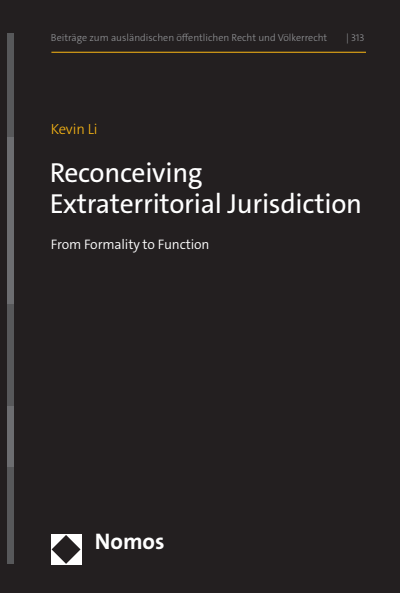
Reconceiving Extraterritorial Jurisdiction
From Formality to Function- Autor:innen:
- Reihe:
- Beiträge zum ausländischen öffentlichen Recht und Völkerrecht, Band 313
- Verlag:
- 2022
Zusammenfassung
Trotz der beharrlichen Bekräftigung der territorialen Souveränität üben Staaten zunehmend extraterritoriale Jurisdiktion aus. In diesem Buch wird dieses Phänomen anhand der US-amerikanischen und europäischen Praxis in den Bereichen Wirtschaftssanktionen, Exportkontrolle, Korruptionsbekämpfung sowie „Business and Human Rights“ vergleichend untersucht. Es wird dargelegt, dass das auf dem Territorialitätsprinzip basierende Jurisdiktionssystem in der völkerrechtlichen Praxis unzulänglich für die zwischenstaatliche Verteilung von Regelungskompetenzen ist. Infolgedessen schlägt dieses Buch einen neuen Ansatz zur Zuschreibung von Jurisdiktion vor, das statt dem formalen Territorialitätsprinzip eine funktionale Betrachtung in den Mittelpunkt rückt.
Schlagworte
Publikation durchsuchen
Bibliographische Angaben
- Copyrightjahr
- 2022
- ISBN-Print
- 978-3-8487-8984-9
- ISBN-Online
- 978-3-7489-3321-2
- Verlag
- Nomos, Baden-Baden
- Reihe
- Beiträge zum ausländischen öffentlichen Recht und Völkerrecht
- Band
- 313
- Sprache
- Englisch
- Seiten
- 368
- Produkttyp
- Monographie
Inhaltsverzeichnis
- Titelei/InhaltsverzeichnisSeiten 1 - 12 Download Kapitel (PDF)
- I. Purpose and Scope of the Study
- II. Structure of the Argument
- 1. State Jurisdiction and State Sovereignty
- 2. Extraterritoriality and Extraterritorial Jurisdiction
- 3. The Concept of Jurisdiction in International Human Rights Treaties
- 4. Categories of State Jurisdiction
- 5. Regulation, Public Law and Jurisdiction
- 1. The Case of the S.S. Lotus
- aa) The Territoriality Principle and Cross-border Criminal Offenses
- bb) The US Presumption against Extraterritoriality
- aa) The Effects Principle in Competition Law
- bb) The Effects Principle in Other Areas of Substantive Law
- c) Active Personality
- d) Passive Personality
- e) The Protective Principle
- f) The Universality Principle
- 3. Treaty-based Extensions of Jurisdiction
- 4. Territoriality-based Jurisdiction and the Internet
- a) Genuine Link
- b) Abuse of Rights
- c) Proportionality
- 2. Comity
- 3. Reasonableness
- I. Focus and Structure
- a) Economic Sanctions under International Law
- b) Primary and Secondary Sanctions
- aa) US Sanctions against Cuba
- bb) US Sanctions against Iran
- cc) US Sanctions against Russia
- a) Practice in the United States
- aa) The Personal Scope of EU Restrictive Measures
- bb) Diplomatic Protest against US Assertions of Control-based Jurisdiction
- cc) Jurisprudence with regard to US Assertions of Control-based Jurisdiction
- c) Comparative Normative Analysis
- a) Practice in the United States
- b) Practice in Europe
- c) Comparative Normative Analysis
- a) Practice in the United States
- b) Practice in Europe
- c) Comparative Normative Analysis
- a) Practice in the United States
- b) Practice in Europe
- 6. Conclusion
- 1. Introduction
- a) International Treaties
- b) Informal Multilateral Regimes
- c) Security Council Resolutions
- a) Practice in the United States
- b) Practice in China
- c) Practice in Europe
- d) Comparative Normative Analysis
- a) Practice in the United States
- b) Practice in Europe
- c) Comparative Normative Analysis
- 5. Conclusion
- 1. Introduction
- 2. Foundations of Transnational Anti-Corruption Regulation
- a) The Jurisdictional Provisions of the OECD Anti-Bribery Convention
- b) The Jurisdictional Provisions of the UN Convention Against Corruption
- aa) The Jurisdictional Scope of the FCPA
- bb) Parent and Subsidiary Liability Based on the Accounting Provisions
- cc) Parent and Subsidiary Liability Based on the Agency Theory
- aa) The UK Bribery Act 2010
- bb) The French Law Regarding Transparency, the Fight against Corruption and the Modernization of Economic Life
- aa) The Assertion of Jurisdiction in respect of Corporate Group Policies
- bb) The Assertion of Control-based Jurisdiction under the FCPA
- 5. Correspondent Account Jurisdiction under the FCPA
- a) Practice in the United States
- aa) The UK Bribery Act 2010
- bb) The French Law Regarding Transparency, the Fight Against Corruption and the Modernization of Economic Life
- c) Comparative Normative Analysis
- 7. Conclusion
- 1. Introduction
- a) Corporate Social Responsibility and Business and Human Rights
- b) Historic Development of Business and Human Rights at the International Level
- c) The UN Guiding Principles
- a) Extraterritorial Jurisdiction as a Matter of Permission
- b) Extraterritorial Jurisdiction as a Matter of Obligation
- aa) Practice in the United States
- bb) Practice in Europe
- aa) Practice in the United States
- bb) Practice in Europe
- aa) Practice in the United States
- bb) Practice in Europe
- d) Comparative Normative Analysis
- a) Practice in the United States
- aa) Amicus Curiae Briefs in the Kiobel Proceedings
- bb) Transnational Human Rights Litigation in Europe
- aa) Jurisdiction over Corporations Domiciled in the Forum State
- bb) Jurisdiction over Corporations Domiciled in Third States
- 6. Conclusion
- a) Market Access Regulation Conditioned on Extraterritorial Circumstances
- b) Parent-based Regulation of Multinational Corporations
- c) Regulation of Conduct Based on Only Fleeting Territorial Connections or Based on Territorial ‘Presence’
- 2. The Restriction to Considerations of State Sovereignty
- 3. Conclusion
- a) Substantive Harmonization
- b) Cooperation
- 2. The History of the Territoriality Principle
- 3. Extraterritorial Jurisdiction regulated by the Principle of Non-Intervention
- 4. Extraterritorial Jurisdiction as an Exercise of Public Authority
- aa) Territoriality
- bb) Nationality
- cc) Conclusion
- b) Universality and Community Interests
- c) Proximity, Community Interests and the Rule of Law
- a) The Potential for Individuals to Shape State Jurisdiction
- b) Individual Fairness as a Principle Restraining the Exercise of Jurisdiction
- c) Individual Rights Catalysing the Exercise of Jurisdiction
- 3. Conclusion
- 1. Practical Requirements and Objectives of the New Framework
- a) Proximity and Substantial Connection
- b) Legitimate Interest and the Subject Matter of Regulation
- c) The Intrusiveness of the Measure
- a) The Abuse of Rights Test
- aa) True Conflicts
- bb) False Conflicts
- 4. Procedural Safeguards, Reasoning and Participation
- a) Market Access Regulation Conditioned on Extraterritorial Circumstances
- b) Parent-based Regulation of Multinational Corporations
- c) Regulation Based on Individual Consent of the Affected
- 6. Pre-empting Some Potential Objections
- E. ConclusionSeiten 325 - 329 Download Kapitel (PDF)
- A. Einleitung
- B. Die Regelungshoheit im Völkerrecht
- C. Fallstudien zur Staatenpraxis
- D. Ein neuer Ansatz
- E. Ausblick
- Permanent Court of International Justice
- International Court of Justice
- Human Rights Committee
- International Criminal Tribunal for the former Yugoslavia
- International Criminal Tribunal for Rwanda
- African Commission on Human and People’s Rights
- European Court of Human Rights
- Inter-American Commission on Human Rights
- Inter-American Court of Human Rights
- Court of Justice of the European Union
- European Commission
- WTO Appellate Body and WTO Panel
- US Supreme Court
- US Federal Appeals Court
- US Federal District Court
- US State Courts
- Other US Case Documents
- British Cases
- German Cases
- French Cases
- Dutch Cases
- Israeli Cases
- Hong Kong Cases
- BibliographySeiten 351 - 368 Download Kapitel (PDF)
Literaturverzeichnis (224 Einträge)
Es wurden keine Treffer gefunden. Versuchen Sie einen anderen Begriff.
- Cooreman B, Global Environmental Protection through Trade: A Systematic Approach to Extraterritoriality (Edward Elgar Publishing 2017). Google Scholar öffnen DOI: 10.5771/9783748933212
- Cossart S, Chaplier J and Beau de Lomenie T, ‘The French Law on Duty of Care: A Historic Step Towards Making Globalization Work for All’ (2017) 2(2) Business and Human Rights Journal 317. Google Scholar öffnen DOI: 10.5771/9783748933212
- Coughlan SG and others, Law Beyond Borders: Extraterritorial Jurisdiction in an Age of Globalization (Irwin Law; Canadian Electronic Library 2014). Google Scholar öffnen DOI: 10.5771/9783748933212
- Crawford J and Brownlie I, Brownlie's Principles of Public International Law (Eighth edition, Oxford University Press 2012). Google Scholar öffnen DOI: 10.5771/9783748933212
- Criminal Division of the U.S. Department of Justice and the Enforcement Division of the U.S. Securities and Exchange Commission, ‘A Resource Guide to the U.S. Foreign Corrupt Practices Act: Second Edition’ (2020). Google Scholar öffnen DOI: 10.5771/9783748933212
- Currie RJ, ‘Cross-Border Evidence Gathering in Transnational Criminal Investigation: Is the Microsoft Ireland Case the “Next Frontier”?’ (2017) 54 Canadian Yearbook of international Law/ 63. Google Scholar öffnen DOI: 10.5771/9783748933212
- de la Torre, Mateo J. ‘The Foreign Corrupt Practices Act: Imposing an American Definition of Corruption on Global Markets’ (2016) 49 Cornell International Law Journal 469. Google Scholar öffnen DOI: 10.5771/9783748933212
- De Schutter O, ‘Extraterritorial Jurisdiction as a Tool for Improving the Human Rights Accountability of Transnational Corporations’ (2006). Google Scholar öffnen DOI: 10.5771/9783748933212
- Deva S, ‘Corporate Human Rights Violations: A Case for Extraterritorial Regu lation’ in Christoph Luetge (ed), Handbook of the Philosophical Foundations of Business Ethics (Springer Netherlands 2013). Google Scholar öffnen DOI: 10.5771/9783748933212
- Diamant MS, Sullivan CW and Smith Jason H. ‘FCPA Enforcement Against U.S. and Non-U.S. Companies’ (2019) 8 Michigan Business & Entrepreneurial Law Review 353. Google Scholar öffnen DOI: 10.5771/9783748933212
- Dietrich T, Die Erstreckung der Strafbarkeit auf Auslandssachverhalte nach § 35 AWG: Die Vereinbarkeit von §35 AWG mit dem Völkerrecht (Zugl.: München, Univ. Google Scholar öffnen DOI: 10.5771/9783748933212
- Diss. 2013. Schriftenreihe Studien zum Völker- und Europarecht vol 121, Kovač 2014). Google Scholar öffnen DOI: 10.5771/9783748933212
- Dimant E and Schulte Thorben, ‘The Nature of Corruption: An Interdisciplinary Perspective’ (2016) 17(1) German Law Journal 53. Google Scholar öffnen DOI: 10.5771/9783748933212
- Dobson NL and Ryngaert C, ‘Provocative Climate Protection: EU "Extraterritorial" Regulation of Maritime Emissions’ (2017) 66(02) ICLQ 295. Google Scholar öffnen DOI: 10.5771/9783748933212
- Donovan DF and Roberts A, ‘The Emerging Recognition of Universal Civil Juris diction’ (2006) 100 AJIL 142. Google Scholar öffnen DOI: 10.5771/9783748933212
- Drobak J, ‘Personal Jurisdiction in a Global World: The Impact of the Supreme Court's Decisions in Goodyear Dunlop Tires and Nicastro’ (2013) 90 Washing ton University Law Review 1707. Google Scholar öffnen DOI: 10.5771/9783748933212
- Eckert S, ‘The Business Transparency on Trafficking and Slavery Act: Fighting Forced Labor in Complex Global Supply Chains’ (2013) 12(2) Journal of Inter national Business and Law. Google Scholar öffnen DOI: 10.5771/9783748933212
- Bibliography Edoardo Varisco A, Brockmann K and Robin L, ‘Post-shipment Control Measures: European Approaches to On-site Inspections of Exported Military Materiel’ (2020), https://www.sipri.org/sites/default/files/2020-12/bp_2012_post-ship ment_controls.pdf. Google Scholar öffnen DOI: 10.5771/9783748933212
- Elagab OY, The Legality of Non-Forcible Counter-Measures in International Law (Ox ford Monographs in International Law, Clarendon Press 1988). Google Scholar öffnen DOI: 10.5771/9783748933212
- Emmenegger S, ‘Extraterritorial Economic Sanctions and Their Foundation in International Law’ (2016) 33 Arizona Journal of International & Comparative Law 631. Google Scholar öffnen DOI: 10.5771/9783748933212
- Engelhart M, ‘Der britische Bribery Act 2010’ (2016) 128(3) Zeitschrift für die gesamte Strafrechtswissenschaft. Google Scholar öffnen DOI: 10.5771/9783748933212
- Enneking LFH, Foreign Direct Liability and Beyond: Exploring the Role of Tort Law in Promoting International Corporate Social Responsibility and Accountability (Zugl.: Utrecht, Univ. Diss. 2012, Eleven Internat. Publ 2012). Google Scholar öffnen DOI: 10.5771/9783748933212
- Erman E, ‘Global Political Legitimacy beyond Justice and Democracy?’ (2016) 8(1) Int Theory 29. Google Scholar öffnen DOI: 10.5771/9783748933212
- Fassbender B, ‘Targeted Sanctions Imposed by the UN Security Council and Due Process Rights’ (2006) 3 International Organizations Law Review 437. Google Scholar öffnen DOI: 10.5771/9783748933212
- Faure M and Zhang X, ‘Towards an Extraterritorial Application of the Chinese Anti-Monopoly Law that Avoids Trade Conflicts’ (2013) 45 The George Wash ington International Law Review 101. Google Scholar öffnen DOI: 10.5771/9783748933212
- Ford RT, ‘Law's Territory (a History of Jurisdiction)’ (1999) 97 Michigan Law Review 843. Google Scholar öffnen DOI: 10.5771/9783748933212
- Fornara C, ‘Plutarch and the Megarian Decree’ in Donald Kagan (ed), Studies in the Greek historians: In memory of Adam Parry (Yale classical studies vol 24. Cambridge University Press 1975). Google Scholar öffnen DOI: 10.5771/9783748933212
- Forwick C, Extraterritoriale US-amerikanische Exportkontrollen: Folgen für die Vertrags gestaltung (Abhandlungen zum Recht der Internationalen Wirtschaft vol 25, Verlag Recht und Wirtschaft (c)1992). Google Scholar öffnen DOI: 10.5771/9783748933212
- Friedberg J, ‘The Arab League Boycott of Israel: Warring Histories, International Trade, and Human Rights’ in Jena Martin and Karen E Bravo (eds), The Business and Human Rights Landscape: Moving Forward, Looking Back (Cambridge Univer sity Press 2015). Google Scholar öffnen DOI: 10.5771/9783748933212
- Genard Q, ‘European Union Response to Extraterritorial Claims by the United States: Lessons from Trade Control Cases’ [2014] Non-Proliferation Papers 1. Google Scholar öffnen DOI: 10.5771/9783748933212
- George E, ‘Influencing the Impact of Business on Human Rights: Corporate Social Responsibility through Transparency and Reporting’ in Lara Blecher, Nancy K Stafford and Gretchen C Bellamy (eds), Corporate Responsibility for Human Rights Impacts: New Expectations and Paradigms (American Bar Association 2014). Google Scholar öffnen DOI: 10.5771/9783748933212
- Gerber DJ, ‘The Extraterritorial Application of the German Antitrust Laws’ (1983) 77(4) AJIL 756. Google Scholar öffnen DOI: 10.5771/9783748933212
- Gibney MP, ‘The Extraterritorial Application of U.S. Law: The Perversion of Democratic Governance, the Reversal of Institutional Roles, and the Imperative of Establishing Normative Principles’ (1996) 19(2) Boston College International and Comparative Law Review 297. Google Scholar öffnen DOI: 10.5771/9783748933212
- Goldhaber MD, ‘Corporate Human Rights Litigation in Non-U.S. Courts: A Com parative Scorecard (Human Rights Litigation in State Courts and Under State Laws)’ (2013) 3 University of California Irvine Law Review 127. Google Scholar öffnen DOI: 10.5771/9783748933212
- Goldsmith JL, ‘Against Cyberanarchy’ (1998) 65(4) The University of Chicago Law Review 1199. Google Scholar öffnen DOI: 10.5771/9783748933212
- Grossfeld B and Rogers CP, ‘A Shared Values Approach to Jurisdictional Conflicts in International Economic Law’ (1983) 32(4) ICLQ 931. Google Scholar öffnen DOI: 10.5771/9783748933212
- Grosswald Curran V, ‘Harmonizing Multinational Parent Company Liability for Foreign Subsidiary Human Rights Violations’ (2016) 17 Chicago Journal of Interanational Law 403. Google Scholar öffnen DOI: 10.5771/9783748933212
- Grosswald Curran V and Sloss D, ‘Reviving Human Rights Litigation After Kiobel’ (2013) 107 AJIL 858. Google Scholar öffnen DOI: 10.5771/9783748933212
- Gruson M, ‘The U.S. Jurisdiction over Transfers of U.S. Dollars between Foreign ers and over Ownership of U.S. Dollar Accounts in Foreign Banks’ [2004] Columbia Business Law Review 721. Google Scholar öffnen DOI: 10.5771/9783748933212
- Handl G, ‘Extra-Territoriality and Transnational Legal Authority’ in Günther Han dl, Joachim Zekoll and Peer Zumbansen (eds), Beyond Territoriality: Transnation al Legal Authority in an Age of Globalization (Queen Mary studies in international law. Martinus Nijhofff Publishers 2012). Google Scholar öffnen DOI: 10.5771/9783748933212
- Happold M, ‘Economic Sanctions and International Law: An Introduction’ in Matthew Happold and Paul Eden (eds), Economic Sanctions and International Law (Studies in international law volume 62. Hart Publishing 2016). Google Scholar öffnen DOI: 10.5771/9783748933212
- Harris KD, ‘The California Transparency in Supply Chains Act: A Resource Guide’. Google Scholar öffnen DOI: 10.5771/9783748933212
- ‘Harvard Research Draft Convention on Jurisdiction with Respect to Crime’ (1935) 29 Supp AJIL 439. Google Scholar öffnen DOI: 10.5771/9783748933212
- Hatcher SL, ‘Circuit Board Jurisdiction: Electronic Payments and the Presumption against Extraterritoriality’ (2020) 48 Georgia Journal of International and Com parative Law 591. Google Scholar öffnen DOI: 10.5771/9783748933212
- Hertogen A, ‘Sovereignty as Decisional Independence over Domestic Affairs: The Dispute over Aviation in the EU Emissions Trading System’ (2012) 1(02) TEL 281. Google Scholar öffnen DOI: 10.5771/9783748933212
- Hertogen A, ‘Letting Lotus Bloom’ (2015) 26(4) EJIL 901. Google Scholar öffnen DOI: 10.5771/9783748933212
- Hills L, ‘Universal Anti-Bribery Legislation Can Save International Business: A Comparison of the FCPA and the UKBA in an Attempt to Create Universal Legislation to Combat Bribery around the Globe’ (2014) 13 Richmond Journal of Global Law and Business 469. Google Scholar öffnen DOI: 10.5771/9783748933212
- Hocke E and others, Außenwirtschaftsrecht (Heidelberger Kommentar, C.F. Müller 2017). Google Scholar öffnen DOI: 10.5771/9783748933212
- Hoffman PL, ‘Kiobel v. Royal Dutch Petroleum Co: First Impressions’ [2013] Columbia Journal of Transnational Law 28. Google Scholar öffnen DOI: 10.5771/9783748933212
- Holthausen D, ‘Die Strafbarkeit von Auslandstaten Deutscher und das völker rechtliche Interventionsverbot’ [1992] NJW 214. Google Scholar öffnen DOI: 10.5771/9783748933212
- Hovell D, ‘The Authority of Universal Jurisdiction’ (2018) 29(2) EJIL 427. Google Scholar öffnen DOI: 10.5771/9783748933212
- Huntington SP, Political Order in Changing Societies (11. printing, Yale Univ. Press 1976). Google Scholar öffnen DOI: 10.5771/9783748933212
- Illingworth P, ‘Global Need: Rethinking Business Norms’ in Jena Martin and Karen E Bravo (eds), The Business and Human Rights Landscape: Moving Forward, Looking Back (Cambridge University Press 2015). Google Scholar öffnen DOI: 10.5771/9783748933212
- International Bar Association, Report of the Task Force on Extraterritorial Jurisdiction (International Bar Association 2008). Google Scholar öffnen DOI: 10.5771/9783748933212
- International Law Commission, Report of the International Law Commission on the Work of its Fifty-eighth Session (UN Doc A 61/10, 2006). Google Scholar öffnen DOI: 10.5771/9783748933212
- Ireland-Piper D, ‘Prosecutions of Extraterritorial Criminal Conduct and the Abuse of Rights Doctrine’ (2013) 9(4) ULR 68. Google Scholar öffnen DOI: 10.5771/9783748933212
- Ireland-Piper D, Accountability in Extraterritoriality: A Comparative and International Law Per spective (Edward Elgar Publishing 2017). Google Scholar öffnen DOI: 10.5771/9783748933212
- Jackson JH, ‘Sovereignty – Modern: A new Approach to an Outdated Concept’ (2003) 97(4) AJIL 782. Google Scholar öffnen DOI: 10.5771/9783748933212
- Jankowitsch-Prevor O and Michel Q (eds), European Dual-Use Trade Controls: Be yond Materiality and Borders (Peter Lang 2014). Google Scholar öffnen DOI: 10.5771/9783748933212
- Johnson DR and Post D, ‘Law and Borders: The Rise of Law in Cyberspace’ (1996) 48 Stanford Law Review 1367. Google Scholar öffnen DOI: 10.5771/9783748933212
- Joyner DH, ‘International Legal Limits on the Ability of States to Lawfully Impose International Economic/Financial Sanctions’ in Ali Z Marossi and Marisa R Bassett (eds), Economic Sanctions under International Law (T.M.C. Asser Press 2015). Google Scholar öffnen DOI: 10.5771/9783748933212
- Kaeb C and Scheffer DJ, ‘The Paradox of "Kiobel" in Europe’ (2013) 107 AJIL 852. Google Scholar öffnen DOI: 10.5771/9783748933212
- Kämmerer JA, ‘Comity’ in R. Wolfrum (ed), The Max Planck Encyclopedia of Public International Law (Oxford University Press). Google Scholar öffnen DOI: 10.5771/9783748933212
- Kamminga MT, ‘Extraterritoriality’ in R. Wolfrum (ed), The Max Planck Encyclope dia of Public International Law (Oxford University Press). Google Scholar öffnen DOI: 10.5771/9783748933212
- Kappel J and Lagodny O, ‘Der UK Bribery Act – Ein Strafgesetz erobert die Welt: Ein kritischer Diskussionsanstoß’ [2012] StV 695. Google Scholar öffnen DOI: 10.5771/9783748933212
- Kassan S, ‘Extraterritorial Jurisdiction in the Ancient World’ (1935) 29 AJIL 237. Google Scholar öffnen DOI: 10.5771/9783748933212
- Katz Cogan J, ‘The Regulatory Turn in International Law’ (2011) 52(2) HarvIntlLJ 322. Google Scholar öffnen DOI: 10.5771/9783748933212
- Katzenstein S, ‘Dollar Unilateralism: The New Frontline of National Security’ (2015) 90 Indiana Law Journal 293. Google Scholar öffnen DOI: 10.5771/9783748933212
- Kelsen H, Principles of international law (Rinehart and Co 1952). Google Scholar öffnen DOI: 10.5771/9783748933212
- Kingsbury B, Krisch N and Stewart RB, ‘The Emergence of Global Administrative Law’ (2005) 68(3) Law and Contemporary Problems 15. Google Scholar öffnen DOI: 10.5771/9783748933212
- Kinley D and Chambers R, ‘The UN Human Rights Norms for Corporations: The Private Implications of Public International Law’ (2006) 6(3) HRLRev 447. Google Scholar öffnen DOI: 10.5771/9783748933212
- Kiss A, ‘Abuse of Rights’ in R. Wolfrum (ed), The Max Planck Encyclopedia of Public International Law (Oxford University Press). Google Scholar öffnen DOI: 10.5771/9783748933212
- Koehler M, ‘The Facade of FCPA Enforcement’ (2010) 41 Georgetown Journal of International Law 907. Google Scholar öffnen DOI: 10.5771/9783748933212
- Koehler M, ‘The Foreign Corrupt Practices Act under the Microscope’ (2012) 15 Universi ty of Pennsylvania Journal of Business Law 1. Google Scholar öffnen DOI: 10.5771/9783748933212
- Kohl U, ‘Corporate Human Rights Accountability: The Objections Of Western Governments To The Alien Tort Statute’ (2014) 63(03) ICLQ 665. Google Scholar öffnen DOI: 10.5771/9783748933212
- Kohl U, ‘Jurisdiction in Cyberspace’ in Nikolaos K Tsagourias and Russell Buchan (eds), Research Handbook on International Law and Cyberspace (Research hand books in international law, Paperback edition 2017. Edward Elgar Publishing 2015). Google Scholar öffnen DOI: 10.5771/9783748933212
- Kokott J and Sobotta C, ‘The Kadi Case – Constitutional core values and interna tional law – finding the balance?’ (2013) 23(4) EJIL 1015–1014. Google Scholar öffnen DOI: 10.5771/9783748933212
- Koskenniemi M, ‘What Use for Sovereignty Today?’ (2011) 1(1) Asian Journal of International Law 61. Google Scholar öffnen DOI: 10.5771/9783748933212
- Krisch N, ‘The Decay of Consent: International Law in an Age of Global Public Goods’ (2014) 108 AJIL 1. Google Scholar öffnen DOI: 10.5771/9783748933212
- Krisch N and Kingsbury B, ‘Introduction: Global Governance and Global Adminis trative Law in the International Legal Order’ (2006) 17(1) EJIL 1. Google Scholar öffnen DOI: 10.5771/9783748933212
- Layton A and Parry AM, ‘Extraterritorial Jurisdiction: European Responses’ (2004) 26 Houston Journal of International Law 309. Google Scholar öffnen DOI: 10.5771/9783748933212
- Leff NH, ‘Economic Development Through Bureaucratic Corruption’ (1964) 8(3) American Behavioral Scientist 8. Google Scholar öffnen DOI: 10.5771/9783748933212
- Leibold A, ‘Extraterritorial Application of the FCPA under International Law’ (2015) 51 Willemette Law Review 223. Google Scholar öffnen DOI: 10.5771/9783748933212
- Letzien C, Internationale Korruption und Jurisdiktionskonflikte: Die Sanktionierung von Unternehmen im Fall der Bestechung ausländischer Amtsträger (Juridicum – Schriftenreihe zum Strafrecht, Springer Fachmedien Wiesbaden 2018). Google Scholar öffnen DOI: 10.5771/9783748933212
- Liivoja R, ‘Review of "Jurisdiction in International Law" by Cedric Ryngaert’ (2008) 19 Finnish Yearbook of International Law 397. Google Scholar öffnen DOI: 10.5771/9783748933212
- Loomis W, ‘The Responsibility of Parent Corporations for the Human Rights Violations of their Subsidiaries’ in Michael K Addo (ed), Human rights standards and the responsibility of transnational corporations (Kluwer 1999). Google Scholar öffnen DOI: 10.5771/9783748933212
- Lordi JA, ‘The U.K. Bribery Act: Endless Jurisdictional Liability on Corporate Violaters’ (2012) 44 Case Western Reserve Journal of International Law 955. Google Scholar öffnen DOI: 10.5771/9783748933212
- Lowe A, ‘Blocking Extraterritorial Jurisdiction: The British Protection of Trading Interests Act, 1980’ (1981) 75 AJIL 257. Google Scholar öffnen DOI: 10.5771/9783748933212
- Lowe V, ‘US Extraterritorial Jurisdiction: The Helms-Burton and d'Amato Acts’ (1997) 46 ICLQ 378. Google Scholar öffnen DOI: 10.5771/9783748933212
- Lowe V and Staker C, ‘Jurisdiction’ in Malcolm D Evans (ed), International Law (5th ed. Oxford University Press 2018). Google Scholar öffnen DOI: 10.5771/9783748933212
- Lowenfeld AF, International Economic Law (International Economic Law Series, 2nd ed. Oxford University Press 2008). Google Scholar öffnen DOI: 10.5771/9783748933212
- Luo W, ‘Research Guide to Export Control and WMD Nonproliferation Law’ (2007) 35 International Journal of Legal Information 447. Google Scholar öffnen DOI: 10.5771/9783748933212
- Magnuson W, ‘International Corporate Bribery and Unilateral Enforcement’ (2013) 51(2) Columbia Journal of Transnational Law 360. Google Scholar öffnen DOI: 10.5771/9783748933212
- Magnuson W, ‘Unilateral Corporate Regulation’ (2016) 17 Chicago Journal of Interanation al Law 521. Google Scholar öffnen DOI: 10.5771/9783748933212
- Maier HG, ‘Jurisdictional Rules in Customary International Law’ in Karl M Meessen (ed), Extraterritorial Jurisdiction in Theory and Practice (Kluwer Law Internat 1996). Google Scholar öffnen DOI: 10.5771/9783748933212
- Maine HS, Ancient Law: Its Connection with the Early History of Society, and its Relation to Modern Ideas (3rd American, from 5th London ed. H. Holt 1873). Google Scholar öffnen DOI: 10.5771/9783748933212
- Mann FA, ‘The Doctrine of Jurisdiction in International Law’ (1964) 111 Recueil des Cours 1. Google Scholar öffnen DOI: 10.5771/9783748933212
- Marauhn T, ‘Global Governance of Dual-Use Trade: The Contribution of Inter national Law’ in Oliver Meier (ed), Technology Transfers and Non-Proliferation: Between Control and Cooperation (Routledge global security studies. Routledge/ Taylor & Francis Group 2014). Google Scholar öffnen DOI: 10.5771/9783748933212
- Marceau JF, ‘A Little Less Conversation, A Little More Action: Evaluating and Forecasting the Trend of More Frequent and Severe Prosecutions Under the Foreign Corrupt Practices Act’ (2007) 12 Fordham Journal of Corporate & Finance Law 285. Google Scholar öffnen DOI: 10.5771/9783748933212
- Marcuss S, ‘Jurisdiction with Respect to Foreign Branches and Subsidiaries: Judi cial Power in the Foreign Affairs Context under Section 414 of the Foreign Relations Restatement’ (1992) 26 The International Lawyer 1. Google Scholar öffnen DOI: 10.5771/9783748933212
- Marcuss S and Mathias Stephen, ‘U.S. Foreign Policy Export Controls: Do They Pass Muster under International Law’ (1984) 2 Berkeley Journal of International Law 1. Google Scholar öffnen DOI: 10.5771/9783748933212
- Martyniszyn M, ‘Japanese Approaches to Extraterritoriality in Competition Law’ (2017) 66(03) ICLQ 747. Google Scholar öffnen DOI: 10.5771/9783748933212
- Massey DB, ‘How the American Law Institute Influences Customary Law: The Rea sonableness Requirement of the Restatement of Foreign Relations Law’ (1997) 22 YaleJIntLaw 419. Google Scholar öffnen DOI: 10.5771/9783748933212
- Massoud S, Menschenrechtsverletzungen im Zusammenhang mit wirtschaftlichen Aktiv itäten von transnationalen Unternehmen (Interdisziplinäre Studien zu Menschen rechten vol 2, 1. Auflage 2018, Springer Berlin; Springer 2018). Google Scholar öffnen DOI: 10.5771/9783748933212
- Mauro P, ‘Corruption and Growth’ (1995) 110(3) The Quarterly Journal of Eco nomics 681. Google Scholar öffnen DOI: 10.5771/9783748933212
- McCorquodale R, ‘Corporate Social Responsibility and International Human Rights Law’ (2009) 87 (2009) JOBE 385. Google Scholar öffnen DOI: 10.5771/9783748933212
- McCorquodale R, ‘International Human Rights Law Perspectives on the UN Framework and Guiding Principles on Business and Human Rights’ in Lara Blecher, Nancy K Stafford and Gretchen C Bellamy (eds), Corporate Responsibility for Human Rights Impacts: New Expectations and Paradigms (American Bar Association 2014). Google Scholar öffnen DOI: 10.5771/9783748933212
- Meeran R, ‘Access to Remedy: the United Kingdom Experience of MNC Tort Litigation for Human Rights Violations’ in Surya Deva and David Bilchitz (eds), Human Rights Obligations of Business: Beyond the Corporate Responsibility to Respect? (Cambridge University Press 2013). Google Scholar öffnen DOI: 10.5771/9783748933212
- Meeran R, ‘Multinational Human Rights Litigation in the UK: A Retrospective’ (2021) 6(2) Business and Human Rights Journal 255. Google Scholar öffnen DOI: 10.5771/9783748933212
- Meessen KM, ‘Antitrust Jurisdiction under Customary International Law’ (1984) 78 AJIL 783. Google Scholar öffnen DOI: 10.5771/9783748933212
- Meessen KM, ‘Extraterritoriality of Export Control: A German Lawyer Analysis of the Pipeline Case’ (1985) 27 German Yearbook of International Law 97. Google Scholar öffnen DOI: 10.5771/9783748933212
- Mehle B and Mehle V, ‘Die notwendige Einhaltung von EU-Embargoregelungen durch Unternehmen mit Sitz in Drittstaaten’ (2015) 61(7) Recht der interna tionalen Wirtschaft 397. Google Scholar öffnen DOI: 10.5771/9783748933212
- Meier O, ‘Dual-Use Technology Transfers and the Legitimacy of Non-Prolifera tion Regimes’ in Oliver Meier (ed), Technology Transfers and Non-Proliferation: Between Control and Cooperation (Routledge global security studies. Routledge/ Taylor & Francis Group 2014). Google Scholar öffnen DOI: 10.5771/9783748933212
- Meijer H, Trading with the Enemy: The Making of US Export Control Policy toward the People's Republic of China (First edition, Oxford University Press 2016). Google Scholar öffnen DOI: 10.5771/9783748933212
- Meng W, Extraterritoriale Jurisdiktion im öffentlichen Wirtschaftsrecht: Extraterritorial Jurisdiction in Public Economic Law (Beiträge zum ausländischen öffentlichen Recht und Völkerrecht vol 119, Springer 1994). Google Scholar öffnen DOI: 10.5771/9783748933212
- Meng W, ‘Wirtschaftssanktionen und staatliche Jurisdiktion – Grauzonen im Völker recht’ (1997) 47 ZaöRV 269. Google Scholar öffnen DOI: 10.5771/9783748933212
- Mestral AL de and Gruchalla-Wesierski T, Extraterritorial application of export control legislation: Canada and the USA (Research study/ Canadian Council of Interna tional Law vol 1, Nijhoff 1990). Google Scholar öffnen DOI: 10.5771/9783748933212
- Meyer JA, ‘Second Thoughts on Secondary Sanctions’ (2009) 30(3) University of Pennsylvania Journal of International Law 905. Google Scholar öffnen DOI: 10.5771/9783748933212
- Meyer JA, ‘Dual Illegality and Geoambiguous Law: A New Rule for Extraterritorial Application of U.S. Law’ (2010) 95 Minnesota Law Review 110. Google Scholar öffnen DOI: 10.5771/9783748933212
- Meyer K, Grenzen und Entwicklungsmöglichkeiten des Souveränitätsprinzips in transnationalen Handelsbeziehungen: Zur Legitimation grenzüberschreitender Ver waltungszusammenarbeit am Beispiel des Lebensmittelhandels zwischen der Europä ischen Union und Drittstaaten (Jus Internationale et Europaeum, 1. Auflage, Mohr Siebeck 2018). Google Scholar öffnen DOI: 10.5771/9783748933212
- Milanovic M, ‘From Compromise to Principle: Clarifying the Concept of State Jurisdiction in Human Rights Treaties’ (2008) 8(3) HRLRev 411. Google Scholar öffnen DOI: 10.5771/9783748933212
- Mills A, ‘Rethinking Jurisdiction in International Law’ (2014) 84 BYIL 187. Google Scholar öffnen DOI: 10.5771/9783748933212
- Ministry of Justice, ‘The Bribery Act 2010: Guidance about Procedures which Relevant Commercial Organisations Can Put into Place to Prevent Persons Associated with them from Bribing (Section 9 of the Bribery Act 2010)’ (2011). Google Scholar öffnen DOI: 10.5771/9783748933212
- Mora PD, ‘The Alien Tort Statute After Kiobel: The Possibility For Unlawful Assertions Of Universal Civil Jurisdiction Still Remains’ (2014) 63(03) ICLQ 699. Google Scholar öffnen DOI: 10.5771/9783748933212
- Moreno-Lax V and Costello C, ‘The Extraterritorial Application of the EU Charter of Fundamental Rights: From Territoriality to Facticity, the Effectiveness Mod el’, The EU Charter of Fundamental Rights: A Commentary (Hart Publishing 2014). Google Scholar öffnen DOI: 10.5771/9783748933212
- Nash JR, ‘The Curious Legal Landscape of the Extraterritoriality of US Environ mental Laws’ in Günther Handl, Joachim Zekoll and Peer Zumbansen (eds), Beyond Territoriality: Transnational Legal Authority in an Age of Globalization (Queen Mary studies in international law. Martinus Nijhofff Publishers 2012). Google Scholar öffnen DOI: 10.5771/9783748933212
- Niestedt M, ‘Die Geltung des EU-Sanktionsrechts für Tochtergesellschaften und Niederlassungen’ in Arnold Wallraff, Dirk Ehlers and Hans-Michael Wolffgang (eds), Recht der Exportkontrolle: Bestandsaufnahme und Perspektiven: Handbuch zum Exportkontrollrecht. zugleich Festgabe für Dr. Arnold Wallraff zum 65. Geburtstag (Schriften zum Aussenwirtschaftsrecht 2015). Google Scholar öffnen DOI: 10.5771/9783748933212
- Nolan J, ‘From Principles to Practice: Implementing Corporate Responsibility for Human Rights’ in Jena Martin and Karen E Bravo (eds), The Business and Human Rights Landscape: Moving Forward, Looking Back (Cambridge University Press 2015). Google Scholar öffnen DOI: 10.5771/9783748933212
- Note, ‘Developments in the Law – Extraterritoriality’ (2011) 124 HarvLRev 1226. Google Scholar öffnen DOI: 10.5771/9783748933212
- Note, ‘Clarifying Kiobel's "Touch and Concern" Test’ (2017) 130 HarvLRev 1902. Google Scholar öffnen DOI: 10.5771/9783748933212
- Nowrot K, ‘Steuerungssubjekt und -mechanismen im Internationalen Wirtschaft srecht (einschließlich regionale Wirtschaftsintegration)’ in Christian Tietje (ed), Internationales Wirtschaftsrecht (2. Aufl. De Gruyter 2015). Google Scholar öffnen DOI: 10.5771/9783748933212
- Nuyts A, ‘Study on Residual Jurisdiction: Review of the Member States’ Rules concerning the “Residual Jurisdiction” of their Courts in Civil and Commercial Matters pursuant to the Brussels I and II Regulations’ (2007). Google Scholar öffnen DOI: 10.5771/9783748933212
- Nwapi C, ‘A Necessary Look at Necessity Jurisdiction’ (2014) 47 UBC Law Review 211. Google Scholar öffnen DOI: 10.5771/9783748933212
- Obidairo S, Transnational Corruption and Corporations: Regulating Bribery through Corporate Liability (Taylor and Francis 2016). Google Scholar öffnen DOI: 10.5771/9783748933212
- O'Brien CM, ‘The Home State Duty to Regulate TNCs Abroad’ (2016). Google Scholar öffnen DOI: 10.5771/9783748933212
- O'Brien CM, Vander Meulen N and Mehra A, ‘Public Procurement and Human Rights: A Survey of Twenty Jurisdictions’ (2016). Google Scholar öffnen DOI: 10.5771/9783748933212
- O'Keefe R, ‘Universal Jurisdiction: Clarifying the Basic Concept’ (2004) 2(3) JICJ 735. Google Scholar öffnen DOI: 10.5771/9783748933212
- Oxman BH, ‘Jurisdiction of States’ in R. Wolfrum (ed), The Max Planck Encyclope dia of Public International Law (Oxford University Press). Google Scholar öffnen DOI: 10.5771/9783748933212
- Pantaleo L, ‘Sanctions Cases in the European Courts’ in Matthew Happold and Paul Eden (eds), Economic Sanctions and International Law (Studies in interna tional law volume 62. Hart Publishing 2016). Google Scholar öffnen DOI: 10.5771/9783748933212
- Parrish AL, ‘The Effects Test: Extraterritoriality’s Fifth Business’ (2008) 61 Vander bilt Law Review 1455. Google Scholar öffnen DOI: 10.5771/9783748933212
- Parrish AL, ‘Reclaiming International Law from Extraterritoriality’ (2009) 93 Minnesota Law Review 815. Google Scholar öffnen DOI: 10.5771/9783748933212
- Parrish AL, ‘Evading Legislative Jurisdiction’ (2012) 87 Notre Dame Law Review 1673. Google Scholar öffnen DOI: 10.5771/9783748933212
- Peters A, Jenseits der Menschenrechte: Die Rechtsstellung des Individuums im Völkerrecht (Jus Internationale et Europaeum vol 88, Mohr Siebeck 2014). Google Scholar öffnen DOI: 10.5771/9783748933212
- Peters A, ‘Verhältnismäßigkeit als globales Verfassungsprinzip’ in Björnstjern Baade and others (eds), Verhältnismässigkeit im Völkerrecht (Jus Internationale et Eu ropaeum vol 116. Mohr Siebeck 2016). Google Scholar öffnen DOI: 10.5771/9783748933212
- Pieth M, Low LA and Bonucci N, The OECD Convention on Bribery: A Commentary on the Convention on Combating Bribery of Foreign Public Officials in International Business Transactions of 21 November 1997 (2. ed. Cambridge University Press 2014). Google Scholar öffnen DOI: 10.5771/9783748933212
- Planitzer J, ‘Trafficking in Human Beings for the Purpose of Labour Exploitation: Can Obligatory Reporting by Corporations Prevent Trafficking?’ (2016) 34(4) Netherlands Quarterly of Human Rights 318. Google Scholar öffnen DOI: 10.5771/9783748933212
- Posadas A, ‘Corruption under International Law’ (2000) 10 Duke Journal of Com parative and International Law 345. Google Scholar öffnen DOI: 10.5771/9783748933212
- Pottmeyer K, ‘Die Strafbarkeit von Auslandstaten nach dem Kriegswaffenkontroll- und dem Außenwirtschaftsrecht’ [1992] Neue Zeitschrift für Strafrecht 57. Google Scholar öffnen DOI: 10.5771/9783748933212
- Prete L, ‘On Implementation and Effects: The Recent Case-law on the Territorial (or Extraterritorial?) Application of EU Competition Rules’ [2018] Journal of European Competition Law & Practice 1. Google Scholar öffnen DOI: 10.5771/9783748933212
- Putnam TL, Courts without Borders: Law, Politics, and U.S. Extraterritoriality (Cam bridge University Press 2016). Google Scholar öffnen DOI: 10.5771/9783748933212
- Ramasastry A, ‘Closing the Governance Gap in the Business and Human Rights Arena: lessons from the anti-corruption movement’ in Surya Deva and David Bilchitz (eds), Human Rights Obligations of Business: Beyond the Corporate Respon sibility to Respect? (Cambridge University Press 2013). Google Scholar öffnen DOI: 10.5771/9783748933212
- Rathbone M, Jeydel P and Lentz A, ‘Sanctions, sanctions everywhere: Forging a path through complex transnational sanctions laws’ (2013) 44(3) Georgetown Journal of International Law 1055. Google Scholar öffnen DOI: 10.5771/9783748933212
- Raustiala K, ‘The Geography of Justice’ (2005) 73 FordhamLR 101. Google Scholar öffnen DOI: 10.5771/9783748933212
- Raustiala K, Does the Constitution Follow the Flag?: The Evolution of Territory in American law (Oxford University Press 2009). Google Scholar öffnen DOI: 10.5771/9783748933212
- Rehbinder E, ‘Extra-Territoriality of Pollution Control Laws from a European Per spective’ in Günther Handl, Joachim Zekoll and Peer Zumbansen (eds), Beyond Territoriality: Transnational Legal Authority in an Age of Globalization (Queen Mary studies in international law. Martinus Nijhofff Publishers 2012). Google Scholar öffnen DOI: 10.5771/9783748933212
- Reinisch A, ‘Human Rights Extraterritoriality: Controlling Companies Abroad’ in Eyal Benvenisti and Georg Nolte (eds), Community Interests Across International Law (First edition. Oxford University Press 2018). Google Scholar öffnen DOI: 10.5771/9783748933212
- Reisman M and Stevick DL, ‘The Applicability of International Law Standards to United Nations Economic Sanctions Programmes’ (1998) 9 EJIL 86. Google Scholar öffnen DOI: 10.5771/9783748933212
- Rennack DE, ‘Iran: U.S. Economic Sanctions and the Authority to Lift Restric tions’ (May 2018), https://fas.org/sgp/crs/mideast/R43311.pdf. Google Scholar öffnen DOI: 10.5771/9783748933212
- Rensmann T, ‘Völkerrechtliche Grenzen extraterritorialer Wirtschaftssanktionen’ in Arnold Wallraff, Dirk Ehlers and Hans-Michael Wolffgang (eds), Recht der Exportkontrolle: Bestandsaufnahme und Perspektiven: Handbuch zum Exportkontroll recht. zugleich Festgabe für Dr. Arnold Wallraff zum 65. Geburtstag (Schriften zum Aussenwirtschaftsrecht 2015). Google Scholar öffnen DOI: 10.5771/9783748933212
- Restatement (Fourth) of the Foreign Relations Law of the United States (American Law Inst. Publ 2018). Google Scholar öffnen DOI: 10.5771/9783748933212
- Restatement (Third) of the Foreign Relations Law of the United States (American Law Inst. Publ 1987). Google Scholar öffnen DOI: 10.5771/9783748933212
- Rice S, ‘Discriminating for World Peace’ in Jeremy M Farrall and Kim Rubenstein (eds), Sanctions, Accountability and Governance in a Globalised World (Connecting international law with public law. Cambridge University Press 2009). Google Scholar öffnen DOI: 10.5771/9783748933212
- Ronzitti N, ‘Sanctions as Instruments of Coercive Diplomacy: An International Law Perspective’ in Natalino Ronzitti (ed), Coercive Diplomacy, Sanctions and International Law (Brill Nijhoff 2016). Google Scholar öffnen DOI: 10.5771/9783748933212
- Rose C, International Anti-Corruption Norms: Their Creation and Influence on Domes tic Legal Systems (Oxford University Press 2015). Google Scholar öffnen DOI: 10.5771/9783748933212
- Rose-Ackerman S and Palifka BJ, Corruption and Government: Causes, Consequences, and Reform (Second edition, Cambridge University Press 2016). Google Scholar öffnen DOI: 10.5771/9783748933212
- Ruggie JG, Just business: Multinational corporations and human rights (Amnesty inter national global ethics series, First edition, W.W. Norton & Company 2013). Google Scholar öffnen DOI: 10.5771/9783748933212
- Ruys T and Ryngaert C, ‘Secondary Sanctions: A Weapon out of Control? The International Legality of, and European Responses to, US Secondary Sanctions’ [2020] BYIL. Google Scholar öffnen DOI: 10.5771/9783748933212
- Ryngaert C, Jurisdiction in International Law (Oxford Monographs in International Law, Second edition.). Google Scholar öffnen DOI: 10.5771/9783748933212
- Ryngaert C, ‘Extraterritorial Export Controls (Secondary Boycotts)’ (2008) 7 Chinese Jour nal of International Law 625. Google Scholar öffnen DOI: 10.5771/9783748933212
- Ryngaert C, Unilateral Jurisdiction and Global Values: Oratie in verkorte vorm uitgesproken bij de aanvaarding van het ambt van hoogleraar Internationaal Publiekrecht aan de Faculteit Recht, Economie, Bestuur en Organisatie van de Univ. Utrecht op maandag 30 maart 2015 (Eleven International 2015). Google Scholar öffnen DOI: 10.5771/9783748933212
- Ryngaert C, ‘Whither Territoriality?: The European Union's Use of Territoriality to set Norms with Universal Effects’ in Cedric Ryngaert and others (eds), What's Wrong with International Law?: Liber amicorum A.H.A. Soons (Nova et vetera iuris gentium. Brill Nijhoff 2015). Google Scholar öffnen DOI: 10.5771/9783748933212
- Ryngaert C, ‘From Universal Civil Jurisdiction To Forum Of Necessity: Reflections On The Judgment Of The European Court Of Human Rights In Nait-Liman’ [2017] Rivista di Diritto Internazionale 782. Google Scholar öffnen DOI: 10.5771/9783748933212
- Ryngaert C, Selfless intervention: Exercising jurisdiction in the common interest (Oxford schol arship online, First edition, Oxford University Press 2020). Google Scholar öffnen DOI: 10.5771/9783748933212
- Ryngaert C and Koekkoek M, ‘Extraterritorial Regulation of Natural Resources: a Functional Approach’ in Jan Wouters and others (eds), Global Governance through Trade: EU Policies and Approaches (Leuven Global Governance. Edward Elgar Publishing 2015). Google Scholar öffnen DOI: 10.5771/9783748933212
- Ryngaert C and Ringbom H, ‘Introduction: Port State Jurisdiction: Challenges and Potential’ (2016) 31(3) The International Journal of Marine and Coastal Law 379. Google Scholar öffnen DOI: 10.5771/9783748933212
- Sagafi-nejad T and Dunning JH, The UN and Transnational Corporations: From Code of Conduct to Global Compact (United Nations Intellectual History Project, Indiana University Press 2008). Google Scholar öffnen DOI: 10.5771/9783748933212
- Salbu SR, ‘Extraterritorial Restriction of Bribery: A Premature Evocation of the Normative Global Village’ (1999) 24(1) YaleJIntLaw 223. Google Scholar öffnen DOI: 10.5771/9783748933212
- Sarfaty GA, ‘Shining Light on Global Supply Chains’ (2015) 56 HarvIntlLJ 419. Google Scholar öffnen DOI: 10.5771/9783748933212
- Schaefer ME, ‘Should a Parent Company Be Liable for the Misdeeds of Its Sub sidiary?: Agency Theories Under the Foreign Corrupt Practices Act’ (2019) 94 New York University Law Review 1654. Google Scholar öffnen DOI: 10.5771/9783748933212
- Schalber R, Der UK Bribery Act und seine Bedeutung im Rahmen von Criminal Com pliance (Schriften zu Compliance v.13, 1st ed. Nomos Verlagsgesellschaft 2018). Google Scholar öffnen DOI: 10.5771/9783748933212
- Schmahl S, ‘Zwischenstaatliche Kompetenzabgrenzung im Cyberspace’ (2009) 47 Archiv des Völkerrechts 284. Google Scholar öffnen DOI: 10.5771/9783748933212
- Schöppner T, Wirtschaftssanktionen durch Bereitstellungsverbote (Zugl.: Münster, Univ. Diss, 2013. Schriftenreihe des Europäischen Forums für Aussenwirtschaft, Verbrauchsteuern und Zoll e.V. an der Westfälischen Wilhelms-Universität Münster vol 51, Mendel 2013). Google Scholar öffnen DOI: 10.5771/9783748933212
- Schultz T, ‘Carving up the Internet: Jurisdiction, Legal Orders, and the Pri vate/Public International Law Interface’ (2008) 19(4) EJIL 799. Google Scholar öffnen DOI: 10.5771/9783748933212
- Schuster G, Die internationale Anwendung des Börsenrechts (Beiträge zum ausländis chen öffentlichen Recht und Völkerrecht, Springer 1996). Google Scholar öffnen DOI: 10.5771/9783748933212
- Scott C, ‘Analysing Regulatory Space: Fragmented Resources and Institutional Design’ [2001] PL 329. Google Scholar öffnen DOI: 10.5771/9783748933212
- Scott J, ‘Extraterritoriality and Territorial Extension in EU Law’ (2013) 62 AJCL 87. Google Scholar öffnen DOI: 10.5771/9783748933212
- Scully EP, Bargaining with the State from Afar: American Citizenship in Treaty Port China, 1844–1942 (Columbia University Press 2012). Google Scholar öffnen DOI: 10.5771/9783748933212
- Second Annual International Business Law Symposium, ‘Trading with Cuba: The Cuban Democracy Act and Export Rules’ (1993) 8 Florida Journal of Interna tional Law 335. Google Scholar öffnen DOI: 10.5771/9783748933212
- Sève M, ‘Sapin II: Is the Era of Compliance and Criminal Settlements upon France?’ [2017] RTDF 2. Google Scholar öffnen DOI: 10.5771/9783748933212
- Simma B, ‘From Bilateralism to Community Interest in International Law’ (1994) 250 Recueil des Cours 217. Google Scholar öffnen DOI: 10.5771/9783748933212
- Skinner G, ‘Rethinking Limited Liability of Parent Corporations for Foreign Sub sidiaries’ Violations of International Human Rights Law’ (2015) 72 Washington and Lee Law Review 1769. Google Scholar öffnen DOI: 10.5771/9783748933212
- Spiro PJ, ‘Perfecting Political Diaspora’ (2006) 81(1) New York University Law Review 207. Google Scholar öffnen DOI: 10.5771/9783748933212
- Stephens B, ‘The Amorality of Profit: Transnational Corporations and Human Rights’ (2002) 20 Berkeley Journal of International Law 45. Google Scholar öffnen DOI: 10.5771/9783748933212
- Stigall DE, ‘International Law and Limitations on the Exercise of Extraterritorial Jurisdiction in U. S. Domestic Law’ (2012) 35 Hastings International and Com parative Law Review 323. Google Scholar öffnen DOI: 10.5771/9783748933212
- Stilz A, ‘Why do States have Territorial Rights?’ (2009) 1(2) Int Theory 185. Google Scholar öffnen DOI: 10.5771/9783748933212
- Svantesson DJB, Solving the Internet Jurisdiction Puzzle (Oxford University Press 2017). Google Scholar öffnen DOI: 10.5771/9783748933212
- Sweet AS and Mathews J, ‘Proportionality Balancing and Global Constitutional ism’ (2008) 47(1) Columbia Journal of Transnational Law 72. Google Scholar öffnen DOI: 10.5771/9783748933212
- Thoms A, ‘Offenlegungspflichten für Konfliktmineralien in den USA und der EU’ in Arnold Wallraff, Dirk Ehlers and Hans-Michael Wolffgang (eds), Recht der Exportkontrolle: Bestandsaufnahme und Perspektiven: Handbuch zum Exportkontroll recht. zugleich Festgabe für Dr. Arnold Wallraff zum 65. Geburtstag (Schriften zum Aussenwirtschaftsrecht 2015). Google Scholar öffnen DOI: 10.5771/9783748933212
- Thorhauer NI, Jurisdiktionskonflikte im Rahmen transnationaler Kriminalität (Nomos Verlagsgesellschaft mbH & Co. KG 2019). Google Scholar öffnen DOI: 10.5771/9783748933212
- Turner R, ‘Transnational Supply Chain Regulation: Extraterritorial Regulation as Corporate Law's new Frontier’ (2016) 17 MelbJIntLaw 1. Google Scholar öffnen DOI: 10.5771/9783748933212
- Uecker P, Extraterritoriale Regelungshoheit im Datenschutzrecht (Frankfurter Studien zum Datenschutz vol 52, 1. Auflage, Nomos 2017). Google Scholar öffnen DOI: 10.5771/9783748933212
- Vagts DF, ‘Extraterritoriality and the Corporate Governance Law’ (2003) 97(2) AJIL 289. Google Scholar öffnen DOI: 10.5771/9783748933212
- Vázquez CM, ‘Trade Sanctions and Human Rights: Past, Present and Future’ (2003) 6 JIEL 797. Google Scholar öffnen DOI: 10.5771/9783748933212
- Verdier P-H, ‘Transnational Regulatory Networks and their Limits’ (2009) 34(1) YaleJIntLaw 113. Google Scholar öffnen DOI: 10.5771/9783748933212
- Volz M, Extraterritoriale Terrorismusbekämpfung (Tübinger Schriften zum interna tionalen und europäischen Recht Bd. 86, Duncker & Humblot 2007). Google Scholar öffnen DOI: 10.5771/9783748933212
- Wade R, ‘The System of Administrative and Political Corruption: Canal Irrigation in South India’ (1982) 18(3) The Journal of Development Studies 287. Google Scholar öffnen DOI: 10.5771/9783748933212
- Wagner-von Papp F, ‘Competition Law and Extraterritoriality’ in Ariel Ezrachi (ed), Research handbook on international competition law (Elgar 2012). Google Scholar öffnen DOI: 10.5771/9783748933212
- Wallace CD, The Multinational Enterprise and Legal Control: Host State Sovereignty in an Era of Economic Globalization ([2. ed.], Martinus Nijhoff 2002). Google Scholar öffnen DOI: 10.5771/9783748933212
- Walter C, ‘Grundlagen und Rahmenbedingungen für die Steuerungskraft des Völkerrechts’ (2016) 76(2) ZaöRV 363. Google Scholar öffnen DOI: 10.5771/9783748933212
- Weissbrodt DS and Kruger M, ‘Norms on the Responsibilities of Transnational Corporations and Other Business Enterprises with Regard to Human Rights’ (2003) 97 AJIL 901–922. Google Scholar öffnen DOI: 10.5771/9783748933212
- Whang C, ‘The Challenges of Enforcing International Military-Use Technology Export Control Regimes: An Analysis of the United Nations Arms Trade Treaty’ (2015) 33(1) Wisconsin international law journal 114. Google Scholar öffnen DOI: 10.5771/9783748933212
- White ND and Abass A, ‘Countermeasures and Sanctions’ in Malcolm D Evans (ed), International Law (5th ed. Oxford University Press 2018). Google Scholar öffnen DOI: 10.5771/9783748933212
- Wilson N, ‘Pushing the Limits of Jurisdiction Over Foreign Actors Under the Foreign Corrupt Practices Act’ (2014) 91 Washington University Law Review 1063. Google Scholar öffnen DOI: 10.5771/9783748933212
- Windholz EL, Governing through Regulation: Public Policy, Regulation and the Law (Routledge critical studies in public management, Routledge Taylor & Francis Group 2018). Google Scholar öffnen DOI: 10.5771/9783748933212
- Woody KE, ‘Conflict Minerals Legislation: The SEC’s New Role as Diplomatic and Humanitarian Watchdog’ (2013) 81 FordhamLR 1315. Google Scholar öffnen DOI: 10.5771/9783748933212
- Woody KE, ‘No Smoke and no Fire: The Rise of internal Controls absent anti-bribery Violations in FCPA Enforcement’ (2017) 38 Cardozo Law Review 1727. Google Scholar öffnen DOI: 10.5771/9783748933212
- Wouters J, Ryngaert C and Cloots AS, ‘The International Legal Framework against Corruption: Achievements and Challenges’ (2013) 14 MelbJIntLaw 1–76. Google Scholar öffnen DOI: 10.5771/9783748933212
- Wu Z, ‘Perspectives on the Chinese Anti-Monopoly Law’ (2008) 75(1) Antitrust Law Journal 73. Google Scholar öffnen DOI: 10.5771/9783748933212
- Yee S, ‘Universal Jurisdiction: Concept, Logic, and Reality’ (2011) 10(3) Chinese Journal of International Law 503. Google Scholar öffnen DOI: 10.5771/9783748933212
- Yihdego Z, The Arms Trade and International Law (Studies in international law vol. 15, Hart Pub 2007). Google Scholar öffnen DOI: 10.5771/9783748933212
- Yilmaz Vastardis A and Chambers R, ‘Overcoming the Corporate Veil Challenge: Could Investment Law Inspire the Proposed Business and Human Rights Treaty?’ (2018) 67(02) ICLQ 389. Google Scholar öffnen DOI: 10.5771/9783748933212
- Zagaris B, International White Collar Crime: Cases and Materials (2. ed. Cambridge University Press 2015). Google Scholar öffnen DOI: 10.5771/9783748933212
- Zerk JA, Extraterritorial Jurisdiction: Lessons for the Business and Human Rights Sphere from Six Regulatory Areas (A Report for the Harvard Corporate Social Responsibility Initiative to Help Inform the Mandate of the Unsg's Special Rep resentative on Business and Human Rights. Working paper/ Corporate Social Responsibility Initiative vol 59, Harvard University, John F. Kennedy School of Government 2010). Google Scholar öffnen DOI: 10.5771/9783748933212
- Ziegenhain H-J, Extraterritoriale Rechtsanwendung und die Bedeutung des GenuineLink-Erfordernisses: Eine Darstellung der deutschen und amerikanischen Staatenpraxis (Zugl.: München, Univ. Diss. 1991/92. Münchener Universitätsschriften Reihe der Juristischen Fakultät vol 92, Beck 1992). Google Scholar öffnen DOI: 10.5771/9783748933212