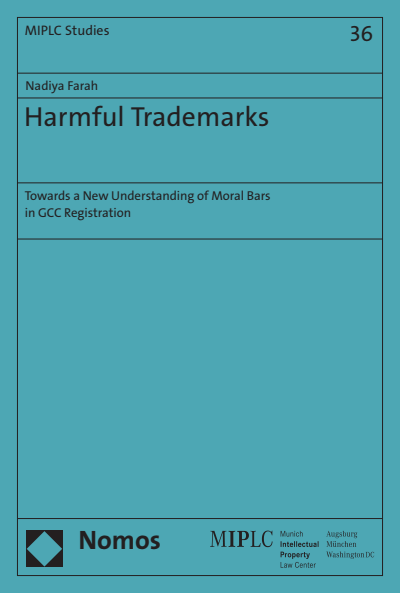
Harmful Trademarks
Towards a New Understanding of Moral Bars in GCC Registration- Autor:innen:
- Reihe:
- Munich Intellectual Property Law Center - MIPLC Studies, Band 36
- Verlag:
- 2019
Zusammenfassung
Zwischen 2013 und 2017 wurden rund 115 EU-Markenanmeldungen aus Gründen der Moral und der öffentlichen Ordnung abgelehnt. Im Golf-Kooperationsrat (GKR; sechs arabische und islamische Länder) deuten Anekdoten darauf hin, dass einige dieser Ablehnungen ausländische Bewerber verwirrt und kulturelle blinde Flecken hervorgehoben haben. In diesem Zusammenhang wird in dieser Arbeit untersucht, wie drei arabische Golfstaaten, deren Hauptgesetzgeber das islamische Recht ist und die große Auswanderergemeinschaften haben, ein moralisches Verbot der Markenregistrierung auferlegen. Die Autorin stellt Vergleiche mit westlichen Rechtsordnungen an und untersucht drei Hauptfragen: 1) In welchem Umfang werden unmoralische oder grenzüberschreitende Marken/Waren in konservativen islamischen Ländern, die Markenrecht in Übereinstimmung mit dem Scharia-Recht anwenden, registriert? 2) Durch welche Argumentation werden Entscheidungen in dieser Hinsicht gesteuert? 3) Kann ein Begriff des „Schadens“ unser Verständnis der Macht von Marken und damit die von den Ländern festgelegten moralischen Schwellenwerte verbessern?
Die Autorin ist Expertin für Innovation und IP-Vermarktung. Während ihres Master-Studiums im Bereich des Gewerblichen Rechtsschutzes und des Wettbewerbsrechts in München entdeckte sie ihre Leidenschaft für das Markenrecht. Sie strebt nun eine Karriere im Bereich Markenrecht in Großbritannien an.
Schlagworte
Publikation durchsuchen
Bibliographische Angaben
- Auflage
- 1/2019
- Copyrightjahr
- 2019
- ISBN-Print
- 978-3-8487-5283-6
- ISBN-Online
- 978-3-8452-9456-8
- Verlag
- Nomos, Baden-Baden
- Reihe
- Munich Intellectual Property Law Center - MIPLC Studies
- Band
- 36
- Sprache
- Englisch
- Seiten
- 103
- Produkttyp
- Monographie
Inhaltsverzeichnis
- Titelei/InhaltsverzeichnisSeiten 1 - 10 Download Kapitel (PDF)
- 1. Background
- 2. Scope and geographical focus
- 3. Legal focus
- 4. Methodology
- 5. Chapter outline
- A. A concept of harm
- 1. Are trademarks property?
- 2. Are trademarks tools of expression?
- C. The uncertainty of legal certainty
- Conclusion
- A. Development of trademark law
- a) Paris Convention
- b) National laws
- 2. Trademark functions
- 3. Registering trademarks
- 1. Legal origins
- 2. Understanding ‘morality’ and ‘public order’
- 3. Tackling the terminology
- Conclusion
- A. Legal system, Shari’a law
- B. GCC IP Treaty Memberships
- C. Harmonisation
- 1. Boycott (“prohibition to deal’) clause
- 2. Banned items: products and services that cannot be trademarked
- E. Prospects for registrability in the GCC
- Conclusion
- 1. Concern that the public would be offended by the mark
- 2. Direct application of the law
- 3. A deeper concern about the power of a mark to erode the morals of society
- 4. The government should not provide official sanction to offensive marks
- 5. The government should not expend its time or financial resources to support marks that are contrary to the values of society
- B. The problem of deceptively innocuous marks: trademarks accepted in error
- Conclusion
- 1. Inciting trademarks
- 2. Offensive, Debasing or Erosionary trademarks
- 3. Divisive trademarks
- B. Case examples – marks refused on morality or public order grounds in the GCC
- Conclusion
- ConclusionSeiten 93 - 94 Download Kapitel (PDF)
- Appendix 1 – Survey of GCC law firmsSeiten 95 - 96 Download Kapitel (PDF)
- List of Works CitedSeiten 97 - 103 Download Kapitel (PDF)
Literaturverzeichnis (63 Einträge)
Es wurden keine Treffer gefunden. Versuchen Sie einen anderen Begriff.
- Abdel-khalik J, ‘Disparaging Trademarks: Who Matters’ (2015) 20(2) Michigan Journal of Race and Law 288 Google Scholar öffnen DOI: 10.5771/9783845294568
- Alemanno A and Bonadio E, ‘Do you Mind my Smoking? Plain Packaging of Cigarettes under the TRIPS Agreement' (2011) J.Marshall Rev. Intell. Prop. L. 450, 462 Google Scholar öffnen DOI: 10.5771/9783845294568
- Baird S, ‘Moral Intervention in the Trademark Arena: Banning the Registration of Scandalous and Immoral Trademarks’ (1993) 83(5) Trademark Reporter 661 Google Scholar öffnen DOI: 10.5771/9783845294568
- Bonadio E, ‘Brands, Morality and Public Policy: Some Reflections on the Ban on Registration of Controversial Trademarks’ (2015) 19 Marquette Intellectual Property Law Review 43 Google Scholar öffnen DOI: 10.5771/9783845294568
- Bonadio E, ‘Bans and Restrictions on the Use of Trade Marks and Consumers’ Health’ (2014) 4 Intellectual Property Quarterly 326 Google Scholar öffnen DOI: 10.5771/9783845294568
- Bone RG,‘Hunting Goodwill: A History of the Concept of Goodwill in Trademark Law’ (2006) 86 Boston University Law Review 547 Google Scholar öffnen DOI: 10.5771/9783845294568
- Brown Jr. RS, ‘Advertising and the Public Interest: Legal Protection of Trade Symbols’ (1948) 57 Yale Law Journal 1165 Google Scholar öffnen DOI: 10.5771/9783845294568
- Carpenter M and Murphy K, ‘Calling Bullshit on the Lanham Act: The 2 (a) Bar for Immoral, Scandalous, and Disparaging Marks’(2010) 49 U. Louisville L. Rev. 465 Google Scholar öffnen DOI: 10.5771/9783845294568
- Cohen FS, ‘Dialogue on Private Property’ (1954), IX Rutgers Law Review 357 Google Scholar öffnen DOI: 10.5771/9783845294568
- Dar HA and Presley JR, ‘The Gulf Co-Operation Council: A Slow Path to Integration? ’ (2001) 24(9) The World Economy 1161 Google Scholar öffnen DOI: 10.5771/9783845294568
- Duff R and Marshall S, ‘‘Abstract Endangerment’, Two Harm Principles, and Two Routes to Criminalisation’ (2015) 3(2) Bergen Journal of Criminal Law and Criminal Justice Google Scholar öffnen DOI: 10.5771/9783845294568
- Ehteshami A, ‘GCC Foreign policy: From the Iran-Iraq War to the Arab Awakening’ in LSE Middle East Centre Collected Papers 1 (April 2015) Google Scholar öffnen DOI: 10.5771/9783845294568
- Fershtman C, Gneezy U, and Hoffman M, ‘Taboos and Identity: Considering the Unthinkable’ (2011) 3 American Economic Journal: Microeconomics 139 Google Scholar öffnen DOI: 10.5771/9783845294568
- Fletcher A and Kera D, ‘The forty-Fourth Year of Administration of the Trademark Act of 1946’ (1991) 81 TMR 601 Google Scholar öffnen DOI: 10.5771/9783845294568
- Gerhardt DM, ‘Trademarks as Entrepreneurial Change Agents for Legal Reform’ (2017) 95(5) North Carolina Law Review, 1519 Google Scholar öffnen DOI: 10.5771/9783845294568
- Gibbons LJ, ‘Semiotics of the Scandalous and the Immoral and the Disparaging: Section 2(A) Trademark Law after Lawrence v. Texas.’ (2005) 9(2) Marquette Intellectual Property Law Review Google Scholar öffnen DOI: 10.5771/9783845294568
- Gilson Lalonde A & Gilson J, ‘Trademarks laid bare: Marks that may be scandalous or immoral’ (2011) Trademark Reporter 1476 Google Scholar öffnen DOI: 10.5771/9783845294568
- Goble GW, ‘Where and What a Trade-Mark Protects’ (1927) 22 U. ILL. L. REV. 379, 388 Google Scholar öffnen DOI: 10.5771/9783845294568
- Habachy S, ‘Protection of Trademarks and Patent Rights in the Middle East History, Geography and Economics’ (1962) 6 Patent, Trademark and Copyright Journal of Research and Education Google Scholar öffnen DOI: 10.5771/9783845294568
- Khoury AH, ‘Ancient and Islamic Sources of Intellectual Property Protection in the Middle East: A Focus on Trademarks’ (2003) 43(2) IDEA – The Journal of Law and Technology 151 Google Scholar öffnen DOI: 10.5771/9783845294568
- Marks T and Betancourt JC, ‘Rethinking public policy and alternative dispute resolution: negotiability, mediability and arbitrability’ (2012) 78(1) Arbitration 19 Google Scholar öffnen DOI: 10.5771/9783845294568
- McKenna MP, ‘Testing Modern Trademark Law’s Theory of Harm’ (2009) 95 Iowa Law Review 63 Google Scholar öffnen DOI: 10.5771/9783845294568
- Oswald L, ‘Challenging the Registration of Scandalous and Disparaging Marks under the Lanham Act: Who has Standing to Sue?’ (2004) 41 American Bus. L. J. 251 Google Scholar öffnen DOI: 10.5771/9783845294568
- Palmer B, 'Saudi Arabia’s Trademark Law' (1986) 1(3) Arab Law Quarterly 323 Google Scholar öffnen DOI: 10.5771/9783845294568
- Pollack M, ‘Your Image Is My Image: When Advertising Dedicates Trademarks to the Public Domain-with an example from the Trademark Counterfeiting Act of 1984’ (1993) 14 Cardozo L. Rev. 1391 Google Scholar öffnen DOI: 10.5771/9783845294568
- Ramsey LP, ‘A Free Speech Right To Trademark Protection?’ (2016) 106(1) Trademark Reporter 797 Google Scholar öffnen DOI: 10.5771/9783845294568
- Scassa T, ‘Antisocial Trademarks’ (2013) 103(5) Trademark Reporter 1172 Google Scholar öffnen DOI: 10.5771/9783845294568
- Schechter F, ‘The Rational Basis of Trademark Protection’ (1927) 40 Harvard Law Review 813 Google Scholar öffnen DOI: 10.5771/9783845294568
- Shaoping G and Lin Z, ‘Human Dignity as a Right’ (2009) 4(3) Frontiers of Philosophy in China 370 Google Scholar öffnen DOI: 10.5771/9783845294568
- Snow N, ‘Free Speech & Disparaging Trademarks’ (2016) 57 Boston College Law Review 1675 Google Scholar öffnen DOI: 10.5771/9783845294568
- Spence M, ‘The Mark as Expression/The Mark as Property’ (2005) 58 Current Legal Problems 491 Google Scholar öffnen DOI: 10.5771/9783845294568
- Stolte KM, 'How Early Did Anglo-American Trademark Law Begin ? An Answer to Schechter’s Conundrum' (1997) 8 Fordham Intellectual Property, Media and Entertainment Law Journal 505 Google Scholar öffnen DOI: 10.5771/9783845294568
- Swann, Sr. JB, ‘The Trademark Reporter as Catalyst’ (2011) 101(1) Trade Mark Reporter 81 Google Scholar öffnen DOI: 10.5771/9783845294568
- Wasserman DI, ‘Trading Sex, Marking Bodies: Pornographic Trademarks and the Lanham Act’ (2010) 23 National Black Law Journal Google Scholar öffnen DOI: 10.5771/9783845294568
- Allan TRS, Constitutional Justice: A Liberal Theory of the Rule of Law (OUP 2001) Google Scholar öffnen DOI: 10.5771/9783845294568
- Allan TRS, The Sovereignty of Law, Freedom, Constitution and Common Law (OUP 2013) Google Scholar öffnen DOI: 10.5771/9783845294568
- Ballantyne WM, Essays and Addresses on Arab Laws (Curzon Press 2000) Google Scholar öffnen DOI: 10.5771/9783845294568
- Batey M, Brand Meaning (Routledge 2008) Google Scholar öffnen DOI: 10.5771/9783845294568
- Bently L, ‘The Making of Modern Trade Marks Law: The Construction of the Legal Concept of Trade Mark (1860-80)’ in Bently L, Davis J, and Ginsburg C (eds), Trade Marks and Brands.. An Interdisciplinary Critique (CUP 2010) Google Scholar öffnen DOI: 10.5771/9783845294568
- Bently L, ‘From Communication to Thing: Historical Aspects of the Conceptualisation of Trade Marks as Property‘ in Dinwoodie GB and Janis MD (eds), Trademark Law and Theory: A Handbook of Contemporary Research (Cheltenham: Edward Elgar Publishing 2008) Google Scholar öffnen DOI: 10.5771/9783845294568
- Bently L, and Davis J, and Ginsburg JC (eds), Trade Marks and Brands. An Interdisciplinary Critique (CUP 2010) Google Scholar öffnen DOI: 10.5771/9783845294568
- Bodenhausen GHC, Guide to the Application of the Paris Convention for the Protection of Industrial Property (as revised at Stockholm in 1967) Google Scholar öffnen DOI: 10.5771/9783845294568
- Davison MD, Horak I, and The Hon. Justice Gummow WMC, Shanahan’s Australian Law of Trade Marks and Passing Off (5th edn, Thomson Reuters 2012) Google Scholar öffnen DOI: 10.5771/9783845294568
- de Carvalho NP, The TRIPS Regime of Trademarks and Designs (2nd edn, Kluwer Law International 2011) Google Scholar öffnen DOI: 10.5771/9783845294568
- Galligan DJ, Discretionary powers: A Legal Study of Official Discretion (Clarendon Press 1986) Google Scholar öffnen DOI: 10.5771/9783845294568
- Gibbons LJ, ‘Trademarking the Immoral and the Scandalous: Section 2(a) of the Lanham Act’ in Peter K. Yu (ed), Intellectual Property and Information Wealth: Issues and Practices in the Digital Age (Volume 3, Ch 4, Praeger Publishers 2007) Google Scholar öffnen DOI: 10.5771/9783845294568
- Hansen PW, Intellectual Property Law and Practice of the United Arab Emirates (OUP 2009) Google Scholar öffnen DOI: 10.5771/9783845294568
- Landolt PL, Modernised EC Competition Law in International Arbitration (Kluwer Law International 2008) Google Scholar öffnen DOI: 10.5771/9783845294568
- Lloyd D, Public Policy: A Comparative Study in English and French Law (London: Athlone Press, 1953) Google Scholar öffnen DOI: 10.5771/9783845294568
- Mill JS, On Liberty (J. W. Parker and Son 1859) Google Scholar öffnen DOI: 10.5771/9783845294568
- Phillips J, Trade Mark Law; A Practical Anatomy (OUP 2003) Google Scholar öffnen DOI: 10.5771/9783845294568
- Price D, The Development of Intellectual Property Regimes in the Arabian Gulf States. Infidels at the Gates (Routledge 2012) Google Scholar öffnen DOI: 10.5771/9783845294568
- Ramadan T, Radical Reform: Islamic Ethics and Liberation (OUP 2009) Google Scholar öffnen DOI: 10.5771/9783845294568
- Schechter FI, ‘The Genesis of the Modern Law Relating to Trade-Marks’ in Dinwoodie GB and Janis MD (eds), Trade mark and Unfair Competition Law: Themes and Theories (Critical Concepts in Intellectual Property Series) (Volume I, Edward Elgar Publishing 2014, and as reviewed by Hyland G, Columbia Legal Studies (2011)) Google Scholar öffnen DOI: 10.5771/9783845294568
- Turner JH, Revolt from the Middle. Emotional Stratification and Change in Post-Industrial Societies (Routledge 2017) Google Scholar öffnen DOI: 10.5771/9783845294568
- CIA, World Factbook, www.cia.gov/library/publications/the-world-factbook/geos/sa.html Google Scholar öffnen DOI: 10.5771/9783845294568
- Edward Smith (2009), Absolute Grounds paper submitted by United Kingdom for SCT Assistant Principal Hearing, available at: www.wipo.int/export/sites/www/sct/en/comments/pdf/sct21/ref_uk.pdf Google Scholar öffnen DOI: 10.5771/9783845294568
- EUIPO, ‘Guidelines for examination Trade mark, Part B Examination – Absolute Grounds of Refusal’ (24 May 2016). Google Scholar öffnen DOI: 10.5771/9783845294568
- Gulf Labour Markets and Migration, available at: http://gulfmigration.eu/glmm-database/demographic-and-economic-module/?search=1&cmct=Saudi+Arabia Google Scholar öffnen DOI: 10.5771/9783845294568
- Johnson, ‘Swearing: The Last Taboos’ (Blog: Prospero, 21 January 2015), available at: https://www.economist.com/blogs/prospero/2015/01/johnson-swearing. Google Scholar öffnen DOI: 10.5771/9783845294568
- WTR Yearbook 2017 - Trade mark procedures and strategies: France (World Trade mark Review, available at: www.worldtrademarkreview.com/Intelligence/Yearbook/2017/Country-chapters/France) Google Scholar öffnen DOI: 10.5771/9783845294568
- WTR Yearbook 2017 - Trade mark procedures and strategies: Germany (World Trade mark Review, available at: www.worldtrademarkreview.com/Intelligence/Yearbook/2017/Country-chapters/Germany). Google Scholar öffnen DOI: 10.5771/9783845294568
- WTR Yearbook 2017 - Trade mark procedures and strategies: Italy (World Trade mark Review, available at: www.worldtrademarkreview.com/Intelligence/Yearbook/2017/Country-chapters/Italy) Google Scholar öffnen DOI: 10.5771/9783845294568