, to see if you have full access to this publication.
Edited Book No access
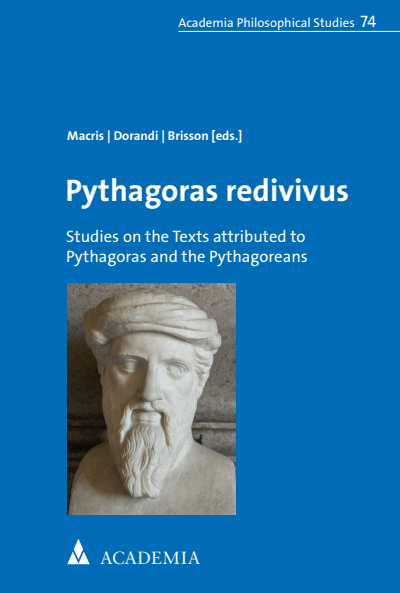
Pythagoras redivivus
Studies on the Texts attributed to Pythagoras and the Pythagoreans- Editors:
- | |
- Series:
- Academia Philosophical Studies, Volume 74
- Publisher:
- 2021
Summary
This original collection of essays by some of the best world specialists of ancient Greek philosophy focuses on the philosophical texts written during the Hellenistic and Imperial times under the names of Pythagoras and the Pythagoreans. Their unknown authors claimed to convey the positions of the pristine Pythagorean School on metaphysics, theology, number philosophy, physics, logic, political philosophy, ethics, and the proper way to live. The most audacious among them presented themselves as the sources from which Plato and Aristotle drew inspiration for the Timaeus and the Categories, and they were considered authoritative by most ancient thinkers, thus leading to a renaissance of the Platonic and Pythagorean tradition.
Keywords
Search publication
Bibliographic data
- Edition
- 1/2021
- Copyright year
- 2021
- ISBN-Print
- 978-3-89665-958-3
- ISBN-Online
- 978-3-89665-959-0
- Publisher
- Academia, Baden-Baden
- Series
- Academia Philosophical Studies
- Volume
- 74
- Language
- English
- Pages
- 509
- Product type
- Edited Book
Table of contents
ChapterPages
- Titelei/Inhaltsverzeichnis No access Pages 1 - 22
- Bibliography No access
- Authors:
- 1 La fonte No accessAuthors:
- 2 I materiali No accessAuthors:
- 3 I lemmi No accessAuthors:
- 4 Concatenazioni e confluenze No accessAuthors:
- Authors:
- Stob. Anthol. I ed. Wachsmuth (= Eclogae I) No accessAuthors:
- No accessAuthors:
- Anthol. II ed. Wachsmuth (= Eclogae II) No accessAuthors:
- Anthol. III ed. Hense (= Florilegium I) No accessAuthors:
- Anthol. IV ed. Hense (= Florilegium II) No accessAuthors:
- Authors:
- Stob. Anthol. III ed. Hense (= Florilegium I) No accessAuthors:
- Stob. Anthol. IV ed. Hense (= Florilegium II) No accessAuthors:
- Authors:
- I. Edizioni dell’Anthologion No accessAuthors:
- II. Letteratura secondaria No accessAuthors:
- Authors:
- 1 Introduction No accessAuthors:
- Authors:
- Authors:
- 1- Le fragment d’Archytas dans les Fragmente der Vorsokratiker de Diels-Kranz No accessAuthors:
- 2- Le fragment d’Archytas chez Porphyre No accessAuthors:
- 3- Le fragment d’Archytas chez Jamblique No accessAuthors:
- 4- Le fragment d’Archytas chez Nicomaque No accessAuthors:
- Authors:
- 1- Le fragment de Philolaos dans les Vorsokratiker No accessAuthors:
- 2- Une nouvelle source du fragment de Philolaos : Nicomaque No accessAuthors:
- Authors:
- Authors:
- 1- L’hypothèse de Wackernagel No accessAuthors:
- 2- Proposition d’extension de l’hypothèse de Wackernagel à une autre forme verbale No accessAuthors:
- Authors:
- 1- Georges Pachymère, lecteur de Nicomaque au tournant des XIIIe et XIVe siècles No accessAuthors:
- 2- Un lecteur médiéval de Jamblique : Théodore Métochite No accessAuthors:
- 3- Isaac Argyros, lecteur de Porphyre et de Nicomaque No accessAuthors:
- Authors:
- 1- La grammaire de Grégoire de Corinthe No accessAuthors:
- 2- La grammaire de Manuel Moschopoulos No accessAuthors:
- Authors:
- 4a Les néoplatoniciens, lecteurs antiques de Nicomaque No accessAuthors:
- Authors:
- 1- Le commentaire d’Asclépius au fragment d’Archytas No accessAuthors:
- 2- Le commentaire de Philopon au fragment d’Archytas No accessAuthors:
- 3- Un indice surprenant sur le dialecte d’Archytas No accessAuthors:
- 5 Conclusion No accessAuthors:
- Bibliographie No accessAuthors:
- Authors:
- 1 ‘Author-Inflected’ Approaches to Archytas: Some Methodological Concerns with ‘Pseudo-Archytas’ No accessAuthors:
- 2 ‘Authority-Inflected’ Approaches to Archytas: Nicomachus, Porphyry, and Olympiodorus No accessAuthors:
- 3 Conclusions No accessAuthors:
- Appendix 1: The ‘Corpus Archyteum’ No accessAuthors:
- Bibliography No accessAuthors:
- Authors:
- 1 La loi comme distribution No accessAuthors:
- 2 La fusion entre les champs sémantiques du pastorat et de la distribution en relation à la loi No accessAuthors:
- 3 La formation du bon législateur et les effets de la loi bien établie No accessAuthors:
- 4 Conclusions No accessAuthors:
- Bibliographie No accessAuthors:
- Authors:
- 1 Author, title and date No accessAuthors:
- 2 Social purpose No accessAuthors:
- 3 The Golden Verses as pseudo-Pythagorean text? No accessAuthors:
- Bibliography No accessAuthors:
- Authors:
- Bibliografia No accessAuthors:
- Authors:
- 1 La thèse du pseudo-Timée No accessAuthors:
- 2 Antécédents pythagoriciens et platoniciens No accessAuthors:
- 3 Parallèles anti-pythagoriciens et néo-pythagoriciens No accessAuthors:
- 4 Quelques hypothèses interprétatives No accessAuthors:
- Bibliographie No accessAuthors:
- Authors:
- Authors:
- 1a Le nom : « Pempélos », le « vieillard » No accessAuthors:
- 1b La patrie : Thourioi No accessAuthors:
- Authors:
- 2a La transmission No accessAuthors:
- 2b Le texte No accessAuthors:
- 2c Commentaire et comparaison No accessAuthors:
- 3 Remarques conclusives No accessAuthors:
- Bibliographie No accessAuthors:
- Authors:
- 1 Androcydes the Pythagorean? No accessAuthors:
- Authors:
- 2.1 Testimonia and fragments of Androcydes’ commentary No accessAuthors:
- 2.2 Possible sources of Androcydes’ commentary No accessAuthors:
- 2.3 Characteristics of the commentary No accessAuthors:
- 2.4 Other texts based on Androcydes? No accessAuthors:
- 2.5 Open questions No accessAuthors:
- 3 Androcydes’ commentary as a pseudo-Pythagorean text? No accessAuthors:
- Bibliography No accessAuthors:
- Authors:
- 1 Early studies in the Anonymus No accessAuthors:
- 2 The remains of the Anonymus No accessAuthors:
- 3 Arithmology as a genre No accessAuthors:
- 4 Platonic-Academic number philosophy and the perfect ten No accessAuthors:
- 5 The Anonymus and kindred Neopythagorean writings No accessAuthors:
- 6 The Anonymus and the Vetusta placita No accessAuthors:
- 7 The pseudo-Pythagorean oath and tetractys No accessAuthors:
- 8 The most generative six No accessAuthors:
- 9 The number five and Aristotle’s Against the Pythagoreans, fr. 13 Ross No accessAuthors:
- 10 The ungenerated seven No accessAuthors:
- Bibliography No accessAuthors:
- Authors:
- 1 La Lettre II No accessAuthors:
- 2 Lettre VI No accessAuthors:
- 3 Lettre XIII No accessAuthors:
- 4 Lettre IX No accessAuthors:
- 5 Lettre XII No accessAuthors:
- Bibliographie No accessAuthors:
- Authors:
- Authors:
- 1a Le dossier No accessAuthors:
- 1b La piste du Discours sacré No accessAuthors:
- 1c La piste de l’Hymne au nombre No accessAuthors:
- 1d Quels rapports entre le Discours sacré en dorien et l’Hymne orphique au nombre No accessAuthors:
- Authors:
- 2a Le rôle intermédiaire de la Tétrade No accessAuthors:
- 2b Les états de l’intelligible No accessAuthors:
- 2c La convergence des théologies No accessAuthors:
- 2d Le témoignage d’Hiéroclès No accessAuthors:
- 2e Niveaux de formes et successions de monades No accessAuthors:
- 3 Conclusions No accessAuthors:
- Bibliographie No accessAuthors:
- Authors:
- Authors:
- 1a Timée de Locres, source du Timée No accessAuthors:
- 1b Timée de Locres et les préplatoniciens No accessAuthors:
- 1c Timée de Locres chez Proclus No accessAuthors:
- Authors:
- 2a L’hypothèse géométrique No accessAuthors:
- 2b La nature géométrique des éléments No accessAuthors:
- 2c La Terre, élément le plus ancien No accessAuthors:
- 3 Timée et l’atomisme, à nouveau No accessAuthors:
- 4 Une autorité pour harmoniser No accessAuthors:
- Bibliographie No accessAuthors:
- Authors:
- 1 The symbola transmitted by Porphyry No accessAuthors:
- 2 Pythagorean symbola in the Syriac Letter of Theodosius No accessAuthors:
- 3 The symbola of Socrates? No accessAuthors:
- 4 Concluding remarks No accessAuthors:
- Authors:
- 1. A Socratic Dialogue in Arabic No accessAuthors:
- 2. Comparison of Socratic Symbola in Arabic No accessAuthors:
- Bibliography No accessAuthors: