, to see if you have full access to this publication.
Edited Book No access
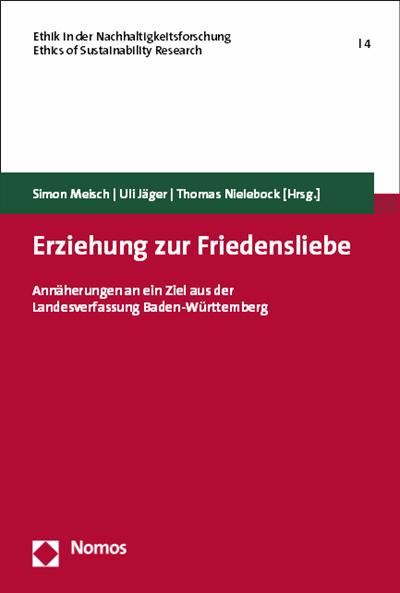
Erziehung zur Friedensliebe
Annäherungen an ein Ziel aus der Landesverfassung Baden-Württemberg- Editors:
- | |
- Publisher:
- 2018
Search publication
Bibliographic data
- Edition
- 1/2018
- Copyright Year
- 2018
- ISBN-Print
- 978-3-8487-4396-4
- ISBN-Online
- 978-3-8452-8658-7
- Publisher
- Nomos, Baden-Baden
- Series
- Ethik in der Nachhaltigkeitsforschung | Ethics of Sustainability Research
- Volume
- 4
- Language
- German
- Pages
- 346
- Product Type
- Edited Book
Table of contents
ChapterPages
- Titelei/Inhaltsverzeichnis No access Pages 1 - 4
- Vorwort No access Pages 5 - 10Authors: | |
- Authors:
- 1. Ziel des Sammelbands No accessAuthors:
- 2. Die Auseinandersetzung mit dem Friedensbegriff No accessAuthors:
- 3. Frieden und Nachhaltige Entwicklung No accessAuthors:
- 4. Friedensliebe No accessAuthors:
- 5. Der kulturgeschichtliche Kontext No accessAuthors:
- 6. Erziehung zur Friedensliebe No accessAuthors:
- 7. Ausblick No accessAuthors:
- 8. Literatur No accessAuthors:
- Der Friedensbegriff in deutschen Landesverfassungen No access Pages 31 - 38Authors:
- Authors:
- 1. Einleitung No accessAuthors:
- 2. Vor- und Frühgeschichte No accessAuthors:
- 3. Augustinus No accessAuthors:
- 4. Vom Hochmittelalter bis zum Zeitalter der Aufklärung No accessAuthors:
- 5. Kant No accessAuthors:
- 6. Nach Kant No accessAuthors:
- 7. Literatur No accessAuthors:
- Authors:
- 1. Einleitung No accessAuthors:
- 2. Friedenslogische Prämissen No accessAuthors:
- Authors:
- 3.1. Was ist das Problem? Das Prinzip der Gewaltprävention No accessAuthors:
- 3.2. Wie entsteht das Problem? Das Prinzip der Konflikttransformation No accessAuthors:
- 3.3. Was sind angemessene Mittel? Das Prinzip der Dialogverträglichkeit No accessAuthors:
- 3.4. Welche Ethik gilt? Das Prinzip der Interessenentwicklung No accessAuthors:
- 3.5. Welche Reaktionen erfolgen im Fall von Misserfolg? Das Prinzip der Reflexivität No accessAuthors:
- 4. Ermutigung zum friedenslogischen Denken und Handeln No accessAuthors:
- 5. Literatur No accessAuthors:
- Authors:
- Authors:
- 1.1. Fundstellen No accessAuthors:
- 1.2. Insbesondere Vorspruch No accessAuthors:
- Authors:
- 1.3.1. Motive des Verfassungsgebers No accessAuthors:
- 1.3.2. Christliche Nächstenliebe No accessAuthors:
- Authors:
- 2.1. Verfassungsmäßigkeit staatlicher Erziehungsziele No accessAuthors:
- 2.2. Immanente verfassungsrechtliche Grenzen für Erziehungsziele No accessAuthors:
- Authors:
- 2.3.1. Träger der Erziehung No accessAuthors:
- 2.3.2. Rangfolge der Erziehungsträger No accessAuthors:
- Authors:
- Authors:
- 3.1.1. Begriff No accessAuthors:
- 3.1.2. Reichweite No accessAuthors:
- Authors:
- 3.2.1. Rechtsstaat No accessAuthors:
- 3.2.2. Nächstenliebe und Brüderlichkeit No accessAuthors:
- 3.2.3. Toleranzgebot No accessAuthors:
- 3.2.4. Gerechtigkeit No accessAuthors:
- 4. Verantwortlicher Träger des Erziehungsziels Friedensliebe No accessAuthors:
- 5. Zusammenfassende Thesen No accessAuthors:
- Authors:
- Zur Erinnerung an den polnischen Unternehmer und Pazifisten, No accessAuthors:
- Kriegstheoretiker und Friedensaktivisten No accessAuthors:
- Authors:
- 1. Einleitung No accessAuthors:
- 2. Johann von Bloch – der Eisenbahnmagnat als Waffenspezialist prognostiziert Verlauf und Ende des künftigen Krieges No accessAuthors:
- 3. Im Stellungskrieg entscheidet die Artillerie No accessAuthors:
- 4. Erfolglose Friedensbemühungen No accessAuthors:
- 5. Literatur No accessAuthors:
- Authors:
- Authors:
- 1.1. August ʾ14 – „ein zündender Blitz“ No accessAuthors:
- 1.2. Von der Balkan-Krise zum Weltkrieg No accessAuthors:
- 1.3. Vorahnungen No accessAuthors:
- 1.4. Die Militarisierung des Wilhelminischen Bürgertums No accessAuthors:
- 1.5. Die mentale Militarisierung in Schule, Jugendpflege und Jugendbewegung No accessAuthors:
- 2. Friedensbewegungen No accessAuthors:
- 3. Der Untergang des wilhelminischen Bürgertums No accessAuthors:
- 4. Jugendführung als Jugendverführung No accessAuthors:
- 5. Rückblick No accessAuthors:
- 6. Literatur No accessAuthors:
- Authors:
- 1. Make Peace... No accessAuthors:
- 2. Warum entsteht Krieg? No accessAuthors:
- 3. Zurück zur Moderne No accessAuthors:
- 4. Kassandra No accessAuthors:
- 5. Abbildungen No accessAuthors:
- 6. Literatur No accessAuthors:
- Authors:
- 1. Einleitung No accessAuthors:
- 2. Aspekte der Geschichte der Friedenspädagogik von Karl Ernst Nipkow No accessAuthors:
- 3. Marc Antoine Jullien de Paris, die Idee des Friedens und die komparatistische Begründung der Pädagogik No accessAuthors:
- 4. Friedenserziehung als Beispiel für das Spannungsfeld von Politik und Pädagogik No accessAuthors:
- 5. Ausblick: Bedarf einer weltgeschichtlichen Perspektive auf die Idee des Friedens in der Pädagogik No accessAuthors:
- 6. Literatur No accessAuthors:
- Authors:
- 1. Kriegserziehung als historische Last No accessAuthors:
- 2. Nach Hitler: Abkehr von der tradierten Kriegsmetaphysik No accessAuthors:
- 3. Eine stille Revolution: Wandlungen der Deutschen nach 1945 No accessAuthors:
- 4. Ein Bundespräsident spricht vom „Frieden als Ernstfall“ No accessAuthors:
- 5. Kritische Friedenserziehung No accessAuthors:
- 6. Der Kampf gegen die Nachrüstung (1979-1984) und das Ende des Kalten Krieges No accessAuthors:
- 7. Von der militärischen Zurückhaltung zur militarisierten Außenpolitik No accessAuthors:
- 8. Erinnern für die Zukunft: Die Rolle der historisch-politischen Bildung No accessAuthors:
- 9. Literatur No accessAuthors:
- Authors:
- 1. Einleitung No accessAuthors:
- Authors:
- 2.1. Aristoteles‘ Tugenden als Grundhaltungen für ein gelingendes Leben No accessAuthors:
- 2.2. Wie kann man zur Tugend erziehen? No accessAuthors:
- Authors:
- 3.1. Ethik in der universitären Ausbildung No accessAuthors:
- 3.2. Konkretes Unterrichtsthema: Humanitäre Interventionen als Mittel zum Frieden? No accessAuthors:
- 4. Literatur No accessAuthors:
- Authors: |
- 1. Friedensliebe – zur Relevanz eines Erziehungsziels No accessAuthors: |
- Authors: |
- 2.1. Was verstehen wir unter Frieden? No accessAuthors: |
- 2.2. Was verstehen wir unter Liebe? No accessAuthors: |
- 2.3. Was verstehen wir unter Friedensliebe? No accessAuthors: |
- 2.4. Was verstehen wir unter Erziehung zur Friedensliebe? No accessAuthors: |
- 3. Erläuterung des Analysevorgehens No accessAuthors: |
- Authors: |
- Authors: |
- 4.1.1. Analyse des Fachs Chemie No accessAuthors: |
- 4.1.2. Zwischenfazit für das Fach Chemie No accessAuthors: |
- 4.1.3. Unterrichtsentwurf für das Fach Chemie zu 3.3.1./3.4.2.: „Chemische Gleichgewichte“ No accessAuthors: |
- 4.1.4. Analyse des Fachs Physik No accessAuthors: |
- 4.1.5. Zwischenfazit für das Fach Physik No accessAuthors: |
- 4.1.6 Unterrichtsentwurf für das Fach Physik No accessAuthors: |
- Authors: |
- 4.2.1. Analyse des Fachs Gemeinschaftskunde No accessAuthors: |
- 4.2.2. Zwischenfazit für das Fach Gemeinschaftskunde No accessAuthors: |
- 4.2.3. Unterrichtsentwurf für das Fach Gemeinschaftskunde zur „3.2.2.2 Politische Teilhabe” No accessAuthors: |
- 4.2.4. Analyse des Fachs Geographie No accessAuthors: |
- 4.2.5. Zwischenfazit für das Fach Geographie No accessAuthors: |
- 4.2.6. Unterrichtsentwurf für das Fach Geographie No accessAuthors: |
- . Ergebnisse, Implikationen und Reflexion des Forschungsprojekts: Zur Verankerung und zum Potenzial der EzFL, zu den Handlungsfeldern beteiligter Bildungsinstitutionen und zu den Schwierigkeiten der A... No accessAuthors: |
- 6. Literaturverzeichnis No accessAuthors: |
- Authors:
- 1. Vorbemerkungen No accessAuthors:
- 2. Rückblick: Friedensbewegung und Soziale Arbeit No accessAuthors:
- 3. Strukturelle Kontexte No accessAuthors:
- Authors:
- 4.1. Exkurs No accessAuthors:
- Authors:
- 5.1. Mediation No accessAuthors:
- 5.2. Mobile Jugendarbeit und Streetwork No accessAuthors:
- 5.3. Beratung No accessAuthors:
- 5.4. Hilfeplanverfahren No accessAuthors:
- 6. Institutionalisierte Teilhabe: Beteiligung und Beschwerde No accessAuthors:
- 7. Zusammenfassung und Schluss No accessAuthors:
- 8. Literatur No accessAuthors:
- Authors: |
- 1. Ausgangslage – Bildung im Kontext einer Nachhaltigen Entwicklung im Spannungsfeld von freier Entfaltung und offener Zukunft vs. Ausrichtung an gesellschaftlichen Anforderungen No accessAuthors: |
- 2. Nachhaltigkeit – regulative Idee und/oder deren Konkretisierung als Legitimationsgrundlagen von Bildung No accessAuthors: |
- 3. Vermittlung spezifischer Kompetenzen – Umsetzung und Beitrag von BNE zu übergeordneten Zielen von Bildung No accessAuthors: |
- 4. Fazit No accessAuthors: |
- 5. Literatur No accessAuthors: |
- Authors:
- 1. Friedenspädagogik als globale Aufgabe No accessAuthors:
- Authors:
- 2.1. Ermöglichungsdidaktische Grundlagen No accessAuthors:
- 2.2. Ermöglichen von friedenspädagogischen Lernprozessen No accessAuthors:
- Authors:
- 3.1. Friedenspädagogik als Bildung über, für und durch Frieden No accessAuthors:
- 3.2. Friedenspädagogik auf verschiedenen Kompetenzebenen No accessAuthors:
- 3.3. Friedenspädagogik als Bildung von Geburt an No accessAuthors:
- 4. Si vis pacem, para pacem – Friedensliebe ermöglichen No accessAuthors:
- 5. Literatur No accessAuthors:
- Authors:
- 1. Einleitung No accessAuthors:
- 2. Friedenspädagogik, Friedenserziehung, Friedensbildung No accessAuthors:
- 3. Grundlagen und Erfahrungen der Friedenspädagogik No accessAuthors:
- 4. Friedensbildung 2020: Systematisches Vorgehen No accessAuthors:
- 5. Friedensbildungsland Baden-Württemberg? No accessAuthors:
- 6. Blick über die Grenzen No accessAuthors:
- 7. Literatur No accessAuthors:
- Autorinnen und Autoren No access Pages 345 - 346