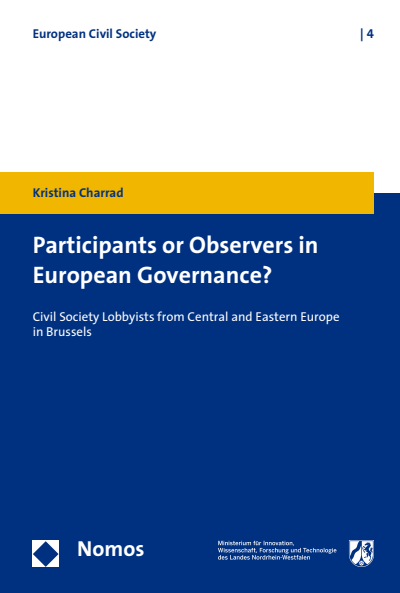
Participants or Observers in European Governance?
Civil Society Lobbyists from Central and Eastern Europe in Brussels- Authors:
- Series:
- International Civil Society, Volume 4
- Publisher:
- 2010
Summary
2004 hat die EU zehn neue Mitgliedsstaaten aufgenommen. Der Akteurskreis in Brüssel hat sich erweitert. Es gibt aber nur wenige Untersuchungen, wie die neuen Akteure beschaffen sind und was für Strategien sie entwickeln, um ihre Interessen durchzusetzen. Die Lücke versucht dieses Buch zu schließen.
Es wird am Beispiel der Dienstleistungsrichtlinie untersucht, in welchem Maße zivilgesellschaftliche Akteure aus Visegrád Länder in das System der Interessenrepräsentation auf europäischer Ebene integriert sind, welche Strategien sie anwenden und welchen Problemen sie dabei ausgesetzt sind. Die Netzwerkanalyse und die qualitativen Interviews werden als Methoden angewendet. Damit lässt sich die Untersuchung im breiten Spektrum der Europaforschung verorten; sie weist Schnittstellen insbesondere mit der Zivilgesellschaftsforschung, der Demokratietheorie und zur Forschung zum Lobbying in der EU auf.
Studenten, Wissenschaftler sowie alle an Interessenvertretung und Lobbying in Brüssel Interessierte erfahren über die Besonderheiten der neuen Akteure in der EU und ihre Strategien.
Search publication
Bibliographic data
- Edition
- 1/2010
- Copyright Year
- 2010
- ISBN-Print
- 978-3-8329-5509-0
- ISBN-Online
- 978-3-8452-2236-3
- Publisher
- Nomos, Baden-Baden
- Series
- International Civil Society
- Volume
- 4
- Language
- English
- Pages
- 200
- Product Type
- Monograph
Table of contents
- Titelei/Inhaltsverzeichnis No access Pages 2 - 14Authors:
- Civil society: Normative and analytical dimensions No access Pages 15 - 19Authors:
- Lobbying: Communication and information exchange No access Pages 19 - 21Authors:
- Research questions and research design No access Pages 21 - 24Authors:
- Methods No access Pages 24 - 26Authors:
- The normative perspective: Legitimacy and interest groups No access Pages 27 - 31Authors:
- Pluralism: Competition among equal interests No access Pages 31 - 33Authors:
- Corporatism: Structured interest intermediation No access Pages 33 - 34Authors:
- Policy networks: Focus on complex relationships No access Pages 34 - 39Authors:
- Applicability to the EU interest intermediation system No access Pages 39 - 43Authors:
- What added value do lobbyists bring into the system? No access Pages 43 - 45Authors:
- The vertical dimension: Multi-level governance No access Pages 45 - 49Authors:
- The horizontal dimension: Network governance No access Pages 49 - 52Authors:
- Europeanisation as a process challenging governance No access Pages 52 - 55Authors:
- Summary: What interest intermediation system exists in the EU and how are interests promoted in this system? No access Pages 55 - 56Authors:
- How many lobbyists really work in Brussels? No access Pages 57 - 60Authors:
- Accreditation and transparency No access Pages 60 - 65Authors:
- European Commission No access Pages 65 - 67Authors:
- European Parliament No access Pages 67 - 68Authors:
- Council of Ministers No access Pages 68 - 69Authors:
- Advisory Bodies No access Pages 69 - 69Authors:
- Lobbying strategies and resources No access Pages 69 - 72Authors:
- Summary: What is a good lobbyist? No access Pages 72 - 74Authors:
- Communist heritage No access Pages 75 - 76Authors:
- New beginnings No access Pages 76 - 82Authors:
- Czech Republic: Divided and invisible No access Pages 82 - 83Authors:
- Hungary: Strong services, weak advocacy No access Pages 83 - 83Authors:
- Poland: Small, but strategic No access Pages 83 - 84Authors:
- Slovakia: Lessons learned No access Pages 84 - 86Authors:
- Interest intermediation systems in the Visegrád countries No access Pages 86 - 88Authors:
- Complying with the EU No access Pages 88 - 90Authors:
- Summary: What national experience and what expectations do the CEE interest groups bring to Brussels? No access Pages 90 - 90Authors:
- Setting the scene: Boundary specification and sampling No access Pages 91 - 94Authors:
- Actors and relations No access Pages 94 - 95Authors:
- Data collection techniques No access Pages 95 - 97Authors:
- Pre-test No access Pages 97 - 98Authors:
- Response rate and data set No access Pages 98 - 99Authors:
- Cohesion No access Pages 99 - 100Authors:
- Centrality No access Pages 100 - 101Authors:
- Prestige No access Pages 101 - 102Authors:
- Stakeholders and their interests No access Pages 102 - 107Authors:
- What did stakeholders do in order to change the proposal of the directive? No access Pages 107 - 110Authors:
- Authors:
- Cohesion measures: The information flow No accessAuthors:
- Centrality: Main players, outsiders and brokers No accessAuthors:
- Mapping the information exchange network No accessAuthors:
- Centrality: Who is the most expansive in the network? No accessAuthors:
- Prestige: Who is the most prestigious in the network? No accessAuthors:
- Summary: The location of stakeholders from Visegrád countries in the issue network and their opportunities to make inputs to the formulation of the Services Directive No access Pages 127 - 129Authors:
- Selection of interview partners No accessAuthors:
- Interview guide No access Pages 133 - 133Authors:
- Organisational form and history No access Pages 133 - 136Authors:
- Perception of mission and functions No access Pages 136 - 139Authors:
- Actors on the national level are not conscious of European politics No access Pages 139 - 142Authors:
- Authors:
- Co-operation with the Permanent Representation No accessAuthors:
- Co-operation with other stakeholders on the European level No accessAuthors:
- Affiliation with organised civil society No access Pages 147 - 150Authors:
- Attitude to lobbying in the Visegrád countries No access Pages 150 - 151Authors:
- Financial reasons No access Pages 151 - 155Authors:
- Personnel resources No access Pages 155 - 156Authors:
- Summary: Why are the Visegrád organisations passive on the European level? No access Pages 156 - 158Authors:
- Overview of results No access Pages 159 - 167Authors:
- Implications for the democratic legitimacy of European governance No access Pages 167 - 169Authors:
- Outlook: Recommendations for the organisations and future perspectives No access Pages 169 - 171Authors:
- Conclusion No access Pages 171 - 173Authors:
- Bibliography No access Pages 174 - 190Authors:
- Appendix 1: Questionnaire No access Pages 191 - 197Authors:
- Appendix 2: List of interview partners No access Pages 197 - 198Authors:
- Appendix 3: Interview guide No access Pages 198 - 200Authors:
- Appendix 4: Network data set No access Pages 200 - 200Authors: