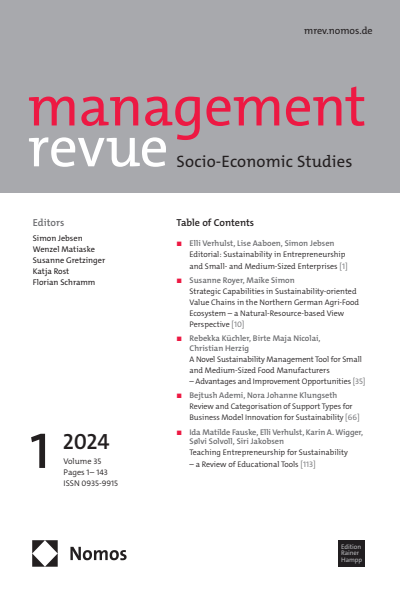
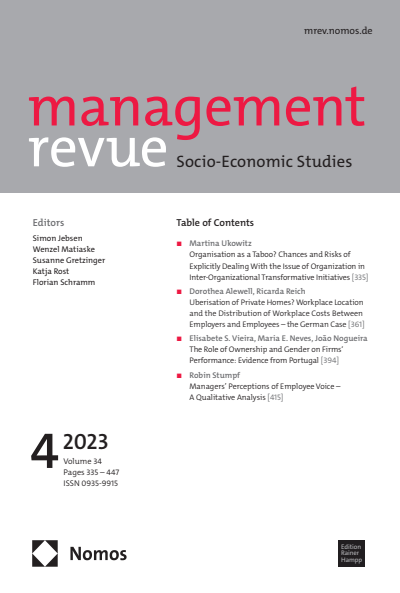
The management revue is a peer-reviewed interdisciplinary European journal publishing both qualitative and quantitative work as well as purely theoretical papers that advance the study of management, organisation and industrial relations.The management revue publishes articles that contribute to theory from a number of disciplines, including business and public administration, organizational behavior, economics, sociology and psychology. Reviews of books relevant to management and organisation studies are a regular feature.Special issues provide a unique and rich insight into the issue's research field. The journal offers insights into selected research topics by providing potentially controversial perspectives, new theoretical insights, valuable empirical analyses and brief reviews of key publications. The aim is to establish the management revue as a top quality symposium journal for the international academic community.The journal is available online via the Nomos eLibrary, ABI/INFORM Global and JSTOR. The management revue is indexed in the Web of Science™ Emerging Sources Citation Index (ESCI), Elesevier's Scopus and the RePEc services IDEAS and EconPapers.
This paper examines the past, present and future trajectory of unions and the union movement in Britain to analyse whether collectively they remain on the margins of influence in the economy and society or whether, given and because of the crisis of...
This article investigates the transformations of the French unionism and of the French system of industrial relations over the last years and their probable future. It shows: an evolution from a militant unionism to a professionalized trade unionist...
The Greek industrial relations system for the past decades, mainly in the private sector, has been based on Law 1876 of 1990, which introduced free collective bargaining and independent dispute resolution. Due to the financial crisis, new...
Hungarian trade unions face both the direct consequences of economic downturn and the political challenges that are implied by the deterioration in employees’ and unions’ bargaining positions with regard to employers. This article presents the...
This article discusses the current characteristics of trade unionism in Italy. First, however, attention is paid to the initial imprinting of the model, which stemmed from the circumstances in which the trade unions were reconstituted at the end of...