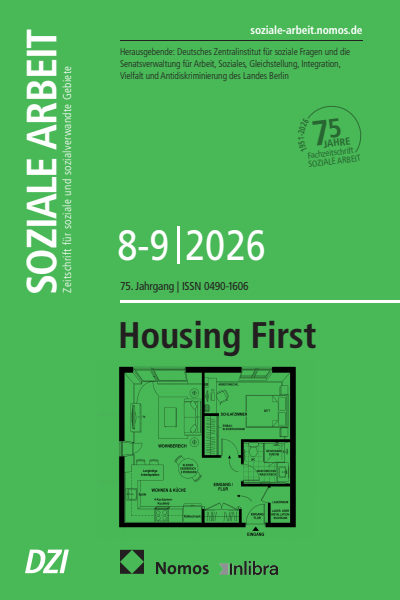
Soziale Arbeit, founded in 1951, is an independent academic journal which addresses developments in the context of social work. It is one of the most important publication media in its field and is read by teachers, students and researchers in social work and social pedagogy as well as by professionals and managers from associations and institutions. The journal’s aim is to promote professional development in social work fields by presenting methods and new concepts, in addition to subject-specific practical reports. In the ‘Rundschau’ (Review) section, information from all social fields is compiled. The ‘Tagungskalender’ (Conference Calendar) refers to important events, and the ‘Zeitschriftenbibliographie’ (Bibliography of Journals) lists current articles from professional journals. Soziale Arbeit is published 11 times a year with an annual focus issue published as a double issue. All scholarly articles submitted for publication in the journal undergo a double-blind peer review process. The editorial board is supported in an advisory capacity by a professional advisory board consisting of individuals from associations, universities, politics and administrative bodies. The journal cooperates with the academic societies of social work from Germany (DGSA) and Austria (OGSA). All social work contributions are indexed in the literature database DZI SoLit.
Daycare social work is a new field of social work that originated from local projects and pilot programs and has seen increasing expansion. As part of the preparations for the Quality Development Act („Qualitätsentwicklungsgesetz“), which aims...
Since the end of the pandemic at the very latest, there has been a partial paradigmatic shift in the public perception of school social work. It is now anchored in the new German Child and Youth Welfare Act, more valued in schools and promoted and...
The article examines the significance of network structures for the school-to-work transition, with a focus on peripheral regions. It analyzes the specific logics and interconnections of vocational orientation and youth welfare networks,...
Digitalization is transforming social spaces and merging analog and digital dimensions. Existing social-spatial approaches often treat digital spaces merely as an add-on, disregarding their fluid transitions. To conceptually capture these...