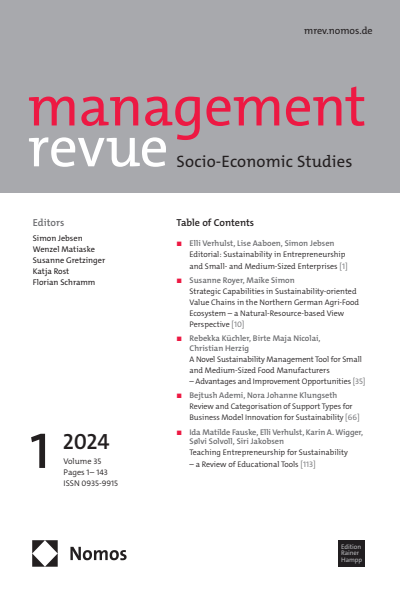
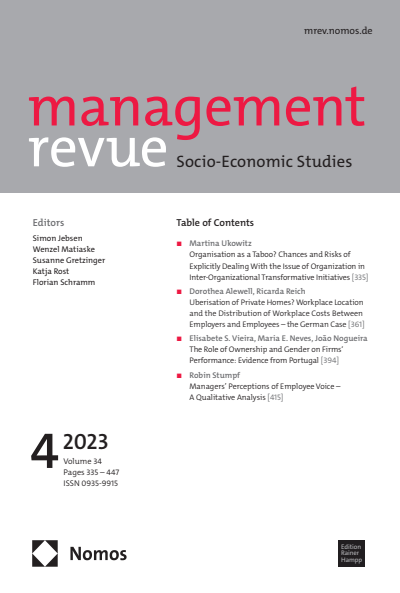
The management revue is a peer-reviewed interdisciplinary European journal publishing both qualitative and quantitative work as well as purely theoretical papers that advance the study of management, organisation and industrial relations. The management revue publishes articles that contribute to theory from a number of disciplines, including business and public administration, organizational behavior, economics, sociology and psychology. Reviews of books relevant to management and organisation studies are a regular feature. Special issues provide a unique and rich insight into the issue's research field. The journal offers insights into selected research topics by providing potentially controversial perspectives, new theoretical insights, valuable empirical analyses and brief reviews of key publications. The aim is to establish the management revue as a top quality symposium journal for the international academic community. The journal is available online via the Nomos eLibrary, ABI/INFORM Global and JSTOR. The management revue is indexed in the Web of Science™ Emerging Sources Citation Index (ESCI), Elesevier's Scopus and the RePEc services IDEAS and EconPapers.
In times of digital transformation, the voice and participation of employees become increasingly important since employees and the knowledge they provide are recognised to be the main asset of every firm, driving innovation. Hereby, digital...
Social media offers individuals and organisations new opportunities for speaking up. The receiver's valuation of the sender's voice is a prerequisite for resulting change. However, the influence of modern communication channels like social media on...
Digital transformation goes hand in hand with profound changes to company structures. One aspect of digital transformation are algorithm-based decisions which strongly affect decision-making processes in general but also those between the company...
Flexible work arrangements that are enabled by digital technologies, such as telecommuting and virtual teams, are proposed to increase employees', teams', and organisations' ability to accomplish their aims in dynamic and ambiguous environments....
How employees think about their work after the end of their working day has received renewed emphasis recently. Work-related rumination could affect employees' voice behaviour. Some employees could prefer to speak up about ideas or concerns that...
Social media has transformed various aspects of daily life, particularly influencing communication and interaction in both physical and digital spaces. The South African employment relationship is no exception. Social media also creates...