, to see if you have full access to this publication.
Textbook No access
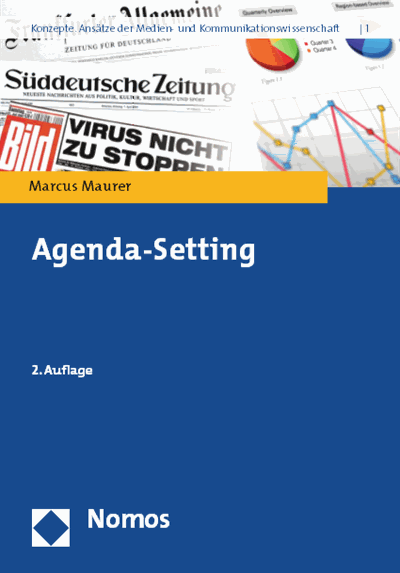
Agenda-Setting
- Authors:
- Series:
- Konzepte. Ansätze der Medien- und Kommunikationswissenschaft, Volume 1
- Publisher:
- 2017
Search publication
Bibliographic data
- Edition
- 2/2017
- Copyright Year
- 2017
- ISBN-Print
- 978-3-8487-4022-2
- ISBN-Online
- 978-3-8452-8304-3
- Publisher
- Nomos, Baden-Baden
- Series
- Konzepte. Ansätze der Medien- und Kommunikationswissenschaft
- Volume
- 1
- Language
- German
- Pages
- 110
- Product Type
- Textbook
Table of contents
ChapterPages
- Titelei/Inhaltsverzeichnis No access Pages 1 - 8
- Ausgangsüberlegungen und Kernbegriffe No access
- Explizite und implizite Grundannahmen No access
- Theoretische Modelle No access
- Agenda-Setting: Theorie, Metapher oder Modell? No access
- Die Vorgeschichte No access
- Einordnung des Ansatzes in die Geschichte der Medienwirkungsforschung No access
- Die Pionierstudien No access
- Die sechs Phasen der Agenda-Setting-Forschung No access
- Die Abgrenzung von Themen No access
- Die Erhebung von Medien- und Publikumsagenda No access
- Untersuchungsdesigns: Die Verknüpfung von Medien- und Publikumsagenda No access
- Eine Abschlussbemerkung zur Forschungslogik No access
- Auftreten und Stärke des Effekts No access
- Randbedingungen des Effekts No access
- Individuelle Agenda-Setting-Effekte No access
- Die Rolle interpersonaler Kommunikation No access
- Nonlineare Wirkungsannahmen No access
- Agenda-Building: Einflüsse auf die Medienagenda No access
- Second-Level Agenda-Setting No access
- Third-Level Agenda-Setting No access
- Priming No access
- Framing No access
- Fazit: Die gesellschaftliche Relevanz des Agenda-Setting- Effekts No access Pages 90 - 93
- „Top Ten“ der Forschungsliteratur No access Pages 94 - 96
- Literatur No access Pages 97 - 108
- Bisher in der Reihe erschienene Bände No access Pages 109 - 110
Bibliography (146 entries)
No match found. Try another term.
- Ader, C. (1995). A longitudinal study of agenda-setting for the issue of environmental pollution. Journalism & Mass Communication Quarterly, 72, 300–311. Open Google Scholar DOI: 10.5771/9783845283043
- Althaus, S. L., & Tewksbury, D. (2002). Agenda setting and the “new” news. Patterns of issue importance on the paper and online versions of the New York Times. Communication Research, 29, 180–207. Open Google Scholar DOI: 10.5771/9783845283043
- Asp, K. (1983). The struggle for the agenda. Party agenda, media agenda, and voter agenda in the 1979 Swedish election campaign. Communication Research, 10, 333–355. Open Google Scholar DOI: 10.5771/9783845283043
- Atkinson, M. L., Lovett, J., & Baumgartner, F. R. (2014). Measuring the media agenda. Political Communication, 31, 355–380. Open Google Scholar DOI: 10.5771/9783845283043
- Behr, R. L., & Iyengar, S. (1985). Television news, real world cues and changes in the public agenda. Public Opinion Quarterly, 49, 38–57. Open Google Scholar DOI: 10.5771/9783845283043
- Brosius, H.-B. (1994). Agenda-Setting nach einem Vierteljahrhundert Forschung. Methodischer und theoretischer Stillstand? Publizistik, 39, 269–288. Open Google Scholar DOI: 10.5771/9783845283043
- Brosius, H.-B., & Kepplinger, H. M. (1995). Killer and victim issues. Issue competition in the agenda-setting process of German television. International Journal of Public Opinion Research, 7, 211–231. Open Google Scholar DOI: 10.5771/9783845283043
- Bulkow, K., Urban, J., & Schweiger, W. (2013). The duality of agenda-setting: The role of information processing. International Journal of Public Opinion Research, 25, 43–63. Open Google Scholar DOI: 10.5771/9783845283043
- Bushman, B. J. (1998). Priming effects of media violence on the accessibility of aggressive contructs in memory. Personality and Social Psychology Bulletin, 24, 537–545. Open Google Scholar DOI: 10.5771/9783845283043
- Capella, J. N., & Jamieson, K. H. (1997). The spiral of cynicism. The press and the public good. Oxford: University Press. Open Google Scholar DOI: 10.5771/9783845283043
- Chong, D., & Druckman, J. N. (2007). A theory of framing and opinion formation in competitive elite environments. Journal of Communication, 57, 99–118. Open Google Scholar DOI: 10.5771/9783845283043
- Cohen, B. (1963). The press and foreign policy. Princeton: Princeton University Press. Open Google Scholar DOI: 10.5771/9783845283043
- Coleman, R., & Banning, S. (2006). Network TV news’ affective framing of the presidential candidates: Evidence for a second-level agenda-setting effect through visual framing. Journalism & Mass Communication Quarterly, 83, 313–328. Open Google Scholar DOI: 10.5771/9783845283043
- Coleman, R., & McCombs, M. E. (2007). The young and agenda-less? Exploring age-related differences in agenda setting on the youngest generation, baby boomers, and the civic generation. Journalism & Mass Communication Quarterly, 84, 495–508. Open Google Scholar DOI: 10.5771/9783845283043
- Conway, M. & Patterson, J. R. (2008). Today’s top story? An agenda-setting and recall experiment involving television and internet news. Southwestern Mass Communication Journal, 24, 31–48. Open Google Scholar DOI: 10.5771/9783845283043
- Danielian, L. H., & Reese, S. D. (1989). A closer look at intermedia influences on agenda-setting: The cocaine issue of 1986. In P. J. Shoemaker (Hrsg.), Communication campaigns about drugs: Government, media, and the public (47–66). New Jersey: Erlbaum. Open Google Scholar DOI: 10.5771/9783845283043
- Dearing, J. W., & Rogers, E. M. (1996). Agenda-Setting. Thousand Oaks: Sage. Open Google Scholar DOI: 10.5771/9783845283043
- Donk, A., Metag, J., Kohring, M., & Marcinkowski, F. (2012). Framing emerging technologies. Risk perceptions of nanotechnology in the German press. Science Communication, 34, 5–29. Open Google Scholar DOI: 10.5771/9783845283043
- Druckman, J. N., & Holmes, J. W. (2004). Does presidential rhetoric matter? Priming and presidential approval. Presidential Studies Quarterly, 34, 755–778. Open Google Scholar DOI: 10.5771/9783845283043
- Edwards, G. C., & Wood, B. D. (1999). Who influences whom? The president, congress, and the media. American Political Science Review, 93, 327–344. Open Google Scholar DOI: 10.5771/9783845283043
- Eichhorn, W. (1996). Agenda-Setting-Prozesse. München: Reinhard Fischer. Open Google Scholar DOI: 10.5771/9783845283043
- Entman, R. M. (1991). Framing U.S. coverage of international news: Contrasts in narratives of the KAL and Iran Air accidents. Journal of Communication, 41(4), 6–28. Open Google Scholar DOI: 10.5771/9783845283043
- Entman, R. M. (1993). Framing: Toward clarification of a fractured paradigm. Journal of Communication, 43, 51–58. Open Google Scholar DOI: 10.5771/9783845283043
- Entman, R. M., Matthes, J., & Pellicano, L. (2009). Nature, sources, and effects of news framing. In K. Wahl-Jorgensen & T. Hanitzsch (Hrsg.), The handbook of journalism studies (pp. 175–190). New York/London: Routledge. Open Google Scholar DOI: 10.5771/9783845283043
- Erbring, L., Goldenberg, E. N., & Miller, A. H. (1980). Front-Page news and real-world cues. A new look at agenda-setting by the media. American Journal of Political Science, 24, 16–49. Open Google Scholar DOI: 10.5771/9783845283043
- Esser, F., Schwabe, C., & Wilke, J. (2005). Metaberichterstattung im Krieg. Wie Tageszeitungen die Rolle der Nachrichtenmedien und der Militär-PR in den Irakkonflikten 1991 und 2003 framen. Medien & Kommunikationswissenschaft, 53, 314–332. Open Google Scholar DOI: 10.5771/9783845283043
- Flaxman, S., Goel, S, & Rao, J. M. (2016). Filter bubbles, echo chambers, and online news consumption. Public Opinion Quarterly, 80, 298–320. Open Google Scholar DOI: 10.5771/9783845283043
- Fröhlich, R., Scherer, H., & Scheufele, B. (2007). Kriegsberichterstattung in deutschen Qualitätszeitungen. Eine inhaltsanalytische Langzeitstudie zu Framingprozessen. Publizistik, 52, 11–32. Open Google Scholar DOI: 10.5771/9783845283043
- Funkhouser, G. R. (1973). The issues of the sixties. An exploratory study in the dynamics of public opinion. Public Opinion Quarterly, 37, 62–76. Open Google Scholar DOI: 10.5771/9783845283043
- Gamson, W. A., & Modigliani, A. (1989). Media discourse and public opinion on nuclear power: A constructionist approach. American Journal of Sociology, 95, 1–37. Open Google Scholar DOI: 10.5771/9783845283043
- Geiß, S. (2015). Die Aufmerksamkeitsspanne der Öffentlichkeit. Eine Studie zu Dauer und Intensität von Meinungsbildungsprozessen. Baden-Baden: Nomos. Open Google Scholar DOI: 10.5771/9783845283043
- Gerbner, G., & Gross, L. (1976). Living with television: The violence profile. Journal of Communication, 26, 173–199. Open Google Scholar DOI: 10.5771/9783845283043
- Gonzenbach, W. J. (1992). A time series analysis of the drug issue, 1985–1990. The press, the president, and public opinion. International Journal of Public Opinion Research, 4, 126–147. Open Google Scholar DOI: 10.5771/9783845283043
- Gormley, W. T. (1975). Newspaper agendas and political elites. Journalism Quarterly, 52, 304–308. Open Google Scholar DOI: 10.5771/9783845283043
- Gross, K., & Aday, S. (2003). The scary world in your living room and neighborhood. Using local broadcast news, neighborhood crime rates, and personal experience to test agenda setting and cultivation. Journal of Communication, 53, 411–426. Open Google Scholar DOI: 10.5771/9783845283043
- Guo, L. (2012). The application of social network analysis in agenda setting research: A methodological exploration. Journal of Broadcasting & Electronic Media, 56, 616–631. Open Google Scholar DOI: 10.5771/9783845283043
- Guo, L. & McCombs, M. (2012). An expanded perspective on agenda-setting effects. Exploring the third level of agenda setting. Revista de Communicacion, 11, 51–68. Open Google Scholar DOI: 10.5771/9783845283043
- Guo, L., Vargo, C. J., Pan, Z., Ding, W, & Ishwar, P. (2016). Big social data analytics in journalism and mass communication comparing dictionary-based text analysis and unsupervised topic modelling. Journalism & Mass Communication Quarterly, 93, 332–359. Open Google Scholar DOI: 10.5771/9783845283043
- Haider-Markel, D. P., & Joslyn, M. R. (2001). Gun policy, opinon, tragedy, and blame attribution: The conditional influence of issue frames. Journal of Politics, 63, 520–543. Open Google Scholar DOI: 10.5771/9783845283043
- Hansen, C. H., & Krygowski, W. (1994). Arousal-Augmented priming effects. Rock music videos and sex object schemas. Communication Research, 21, 24–47. Open Google Scholar DOI: 10.5771/9783845283043
- Hayes, D. (2008). Does the messenger matter? Candidate-media agenda convergence and its effects on voter issue salience. Political Research Quarterly, 61, 134–146. Open Google Scholar DOI: 10.5771/9783845283043
- Higgins, E. S., Rhodes, W. S., & Jones, C. R. (1977). Category accessibility and impression formation. Journal of Experimental Social Psychology, 13, 141–154. Open Google Scholar DOI: 10.5771/9783845283043
- Hill, D. B. (1985). Viewer characteristics and agenda-setting by television news. Public Opinion Quarterly, 49, 340–350. Open Google Scholar DOI: 10.5771/9783845283043
- Holbert, R. L., Pillion, O., Tschida, D. A., Arnfield, G. G., Kinder, K., Cherry, K., & Daulton, A. (2003). The West Wing as endorsement of the U.S. presidency. Expanding the bounds of priming in political communication. Journal of Communication, 53, 427–443. Open Google Scholar DOI: 10.5771/9783845283043
- Hügel, R., Degenhardt, W., & Weiss, H. J. (1989). Structural equation models for the analysis of the agenda-setting process. European Journal of Communication, 4, 191–210. Open Google Scholar DOI: 10.5771/9783845283043
- Iyengar, S. (1991). Is anyone responsible? How television frames political issues. Chicago: University Press. Open Google Scholar DOI: 10.5771/9783845283043
- Iyengar, S., & Kinder, D. R. (1987). News that matters. Television and American opinion. Chicago: University Press. Open Google Scholar DOI: 10.5771/9783845283043
- Iyengar, S., & Simon, A. (1993). News coverage of the gulf crises and public opinion. Communication Research, 20, 365–383. Open Google Scholar DOI: 10.5771/9783845283043
- Karlsen, R. (2015). Followers are opinion leaders: The role of people in the flow of political communication on and beyond social networking sites. European Journal of Communication, 30, 301–318. Open Google Scholar DOI: 10.5771/9783845283043
- Kepplinger, H. M., Gotto, K., Brosius, H.-B., & Haak, D. (1989). Der Einfluss des Fernsehens auf die politische Meinungsbildung. Freiburg: Alber. Open Google Scholar DOI: 10.5771/9783845283043
- Kepplinger, H. M. & Lemke, R. (2014). Framing Fukushima. Zur Darstellung der Katastrophe in Deutschland im Vergleich zu Großbritannien, Frankreich und der Schweiz. In J. Wolling & D. Arlt (Hrsg.), Fukushima und die Folgen – Medienberichterstattung, Öffentliche Meinung, Politische Konsequenzen (S. 125–152). Ilmenau: Universitätsverlag. Open Google Scholar DOI: 10.5771/9783845283043
- Kim, S.-H., Scheufele, D., & Shanahan, J. (2002). Think about it this way: Attribute agenda-setting function of the press and the public’s evaluation of a local issue. Journalism & Mass Communication Quarterly, 79, 7–25. Open Google Scholar DOI: 10.5771/9783845283043
- Kim, Y., Gonzenbach, W. J., Vargo, C. J., & Kim, Y. (2016). First and second levels of intermedia agenda setting: Political advertising, newspapers, and twitter during the 2012 U. S. presidential election. International Journal of Communication, 10, 4550–4569. Open Google Scholar DOI: 10.5771/9783845283043
- Kiousis, S., Kim J. Y., Ragas, M., Wheat, G., Kochhar, S., Svensson, E., & Miles, M. (2015). Exploring new frontiers of agenda building during the 2012 presidential election pre-convention period: Examining linkages across three levels. Journalism Studies, 363–382. Open Google Scholar DOI: 10.5771/9783845283043
- Klapper, J. T. (1960). The effects of mass communication. Glencoe: Free Press. Open Google Scholar DOI: 10.5771/9783845283043
- Kosicki, G. M. (1993). Problems and opportunities in agenda-setting research. Journal of Communication, 43, 100–127. Open Google Scholar DOI: 10.5771/9783845283043
- Krause, B., & Gehrau, V. (2007). Das Paradox der Medienwirkung auf Nichtnutzer. Eine Zeitreihenanalyse auf Tagesbasis zu den kurzfristigen Agenda-Setting-Effekten von Fernsehnachrichten. Publizistik, 52, 191–209. Open Google Scholar DOI: 10.5771/9783845283043
- Krosnick, J. A., & Brannon, L. A. (1993). The impact of war on the ingredients of presidential evaluations. Multidimensional effects of political involvement. American Political Science Review, 87, 963–975. Open Google Scholar DOI: 10.5771/9783845283043
- Lang, G. E., & Lang, K. (1981). Watergate. An exploration of the agenda-building process. In G. C. Wilhoit & H. De Bock (Hrsg.), Mass Communication Review Yearbook (447–468). Beverly Hills: Sage. Open Google Scholar DOI: 10.5771/9783845283043
- Lazarsfeld, P. F., Berelson, B., & Gaudet, H. (1944). The people’s choice. How the voter makes up his mind in a presidential campaign. New York: Duell, Sloane & Pearce. Open Google Scholar DOI: 10.5771/9783845283043
- Lim, J. (2006). A cross-lagged analysis of agenda setting among online news media. Journalism & Mass Communication Quarterly, 83, 298–312. Open Google Scholar DOI: 10.5771/9783845283043
- Lippman, W. (1922). Public Opinion. New York: Harcourt, Brace, and Company. Open Google Scholar DOI: 10.5771/9783845283043
- Maier, M., Stengel, K., & Marschall, J. (2010): Nachrichtenwert-Theorie. Baden-Baden: Nomos. Open Google Scholar DOI: 10.5771/9783845283043
- Mathes, R., & Czaplicki, A. (1993). Meinungsführer im Mediensystem: „Topdown“- und „Bottom-up“-Prozesse. Publizistik, 38, 153–166. Open Google Scholar DOI: 10.5771/9783845283043
- Mathes, R., & Pfetsch, B. (1991). The role of the alternative press in the agenda-building process: Spill-over effects and media opinion leadership. European Journal of Communication, 6, 33–62. Open Google Scholar DOI: 10.5771/9783845283043
- Matthes, J. (2008). Need for orientation as a predictor of agenda-setting effects: Causal evidence from a two-wave panel study. International Journal of Public Opinion Research, 20, 440–453. Open Google Scholar DOI: 10.5771/9783845283043
- Matthes, J. (2014): Framing. Baden-Baden: Nomos. Open Google Scholar DOI: 10.5771/9783845283043
- Matthes, J., & Kohring, M. (2008). The content analysis of media frames. Toward improving reliability and validity. Journal of Communication, 58, 258–278. Open Google Scholar DOI: 10.5771/9783845283043
- Maurer, M. (2004). Das Paradox der Medienwirkungsforschung. Verändern Massenmedien die Bevölkerungsmeinung, ohne Einzelne zu beeinflussen? Publizistik, 49, 405–422. Open Google Scholar DOI: 10.5771/9783845283043
- Maurer, M. & Holbach, T. (2016). Taking online search queries as an indicator of the public agenda. The role of public uncertainty. Journalism & Mass Communication Quarterly, 93, 572–586. Open Google Scholar DOI: 10.5771/9783845283043
- Maurer, M., & Reinemann, C. (2003). Schröder gegen Stoiber. Nutzung, Wahrnehmung und Wirkung der TV-Duelle. Wiesbaden: Westdeutscher Verlag. Open Google Scholar DOI: 10.5771/9783845283043
- Maurer, M., & Reinemann, C. (2007). Personalisierung durch Priming. Die Wirkung des TV-Duells auf die Urteilskriterien der Wähler. In M. Maurer, C. Reinemann, J. Maier & M. Maier (Hrsg.), Schröder gegen Merkel. Wahrnehmung und Wirkung des TV-Duells 2005 im Ost-West-Vergleich (111–128). Wiesbaden: VS-Verlag. Open Google Scholar DOI: 10.5771/9783845283043
- McClure, R. D., & Patterson, T. E. (1976). Print vs. network news. Journal of Communication, 26, 23–28. Open Google Scholar DOI: 10.5771/9783845283043
- McCombs, M. E. (1993). The evolution of agenda-setting research: Twenty-Five years in the marketplace of ideas. Journal of Communication, 43(2), 58–67. Open Google Scholar DOI: 10.5771/9783845283043
- McCombs, M. E. (1994). News influences on our pictures of the world. In J. Bryant & D. Zillmann (Hrsg.), Media effects: Advances in theory and research (1–16). Hillsdale: Erlbaum. Open Google Scholar DOI: 10.5771/9783845283043
- McCombs, M. E. (2014). Setting the agenda. The mass media and public opinion. 2nd Edition. Cambridge: Polity Press. Open Google Scholar DOI: 10.5771/9783845283043
- McCombs, M. E., Danielan, L, & Wanta, W. (1995). Issues in the news and public agenda: The agenda-setting tradition. In T. L. Glasser & J. T. Salmon (Hrsg.), Public opinion and the communication of consent (281–300). New York: Guilford Press. Open Google Scholar DOI: 10.5771/9783845283043
- McCombs, M. E., Llamas J. P., Lopez-Escobar, E., & Rey, F. (1997). Candidate images in Spanish elections. Second level agenda-setting effects. Journalism & Mass Communication Quarterly, 74, 703–717. Open Google Scholar DOI: 10.5771/9783845283043
- McCombs, M. E., & Shaw, D. L. (1972). The agenda-setting function of the mass media. Public Opinion Quarterly, 36, 176–187. Open Google Scholar DOI: 10.5771/9783845283043
- McLeod, J., Becker, L. B., & Byrnes, J. E. (1974). Another look at the agenda-setting function of the press. Communication Research, 2, 131–167. Open Google Scholar DOI: 10.5771/9783845283043
- Mellon, J. (2013). Where and when can we use Google Trends to measure issue salience? PS: Political Science & Politics, 46, 280–290. Open Google Scholar DOI: 10.5771/9783845283043
- Mendelsohn, M. (1996). The media and interpersonal communications. The priming of issues, leaders, and party identification. Journal of Politics, 58, 112–125. Open Google Scholar DOI: 10.5771/9783845283043
- Meraz, S. (2011). Using time series analysis to measure intermedia agenda-setting influence in traditional media and political blog networks. Journalism & Mass Communication Quarterly, 88, 176–194. Open Google Scholar DOI: 10.5771/9783845283043
- Miller, W. E., & Stokes, D. E. (1963). Constituency influences in congress. American Political Science Review, 57, 45–56. Open Google Scholar DOI: 10.5771/9783845283043
- Min, Y., Ghanem, S. I., & Evatt, D. (2007). Using a split-ballot survey to explore the robustness of the ‚MIP’ question in agenda-setting research: A methodological study. International Journal of Public Opinion Research, 19, 221–236. Open Google Scholar DOI: 10.5771/9783845283043
- Moy, P., Xenos, M. A., & Hess, V. K. (2006). Priming effects of late-night comedy. International Journal of Public Opinion Research, 18, 198–210. Open Google Scholar DOI: 10.5771/9783845283043
- Muddiman, A., Stroud, N. J., & McCombs, Maxwell (2014). Media fragmentation, attribute agenda setting, and political opinions about Iraq. Journal of Broadcasting & Electronic Media, 58, 215–233. Open Google Scholar DOI: 10.5771/9783845283043
- Mutz, D. C. (1994). Contextualizing personal experience. The role of mass media. Journal of Politics, 56, 689–714. Open Google Scholar DOI: 10.5771/9783845283043
- Neuman, R. W. (1990). The threshold of public attention. Public Opinion Quarterly, 54, 159–176. Open Google Scholar DOI: 10.5771/9783845283043
- Neuman, R. W., Guggenheim, L., Mo Jang, S., & Bae, S. Y. (2014). The dynamics of public attention: Agenda-setting theory meets big data. Journal of Communication, 64, 193–214. Open Google Scholar DOI: 10.5771/9783845283043
- Noelle-Neumann, E. (1973). Return to the concept of powerful mass media. Studies of Broadcasting, 9, 67–112. Open Google Scholar DOI: 10.5771/9783845283043
- Noelle-Neumann, E., Kepplinger, H. M., & Donsbach, W. (1999). Kampa. Meinungsklima und Medienwirkung im Bundestagswahlkampf 1998. Freiburg/München: Alber. Open Google Scholar DOI: 10.5771/9783845283043
- Quiring, O. (2004). Wirtschaftsberichterstattung und Wahlen. Konstanz: UVK. Open Google Scholar DOI: 10.5771/9783845283043
- Pariser, E. (2011). The filter bubble. What the internet is hiding from you. New York: Penguin Press. Open Google Scholar DOI: 10.5771/9783845283043
- Petrocik, J. R. (1996). Issue ownership in presidential elections, with a case study. American Journal of Political Science, 40, 825–850. Open Google Scholar DOI: 10.5771/9783845283043
- Petty, R. E., Cacioppo, J. T. (1986). Communication and persuasion. Central and peripheral routes to attitude change. New York: Springer. Open Google Scholar DOI: 10.5771/9783845283043
- Pingree, R. J. & Stoycheff, E. (2013). Differentiating cueing from reasoning in agenda-setting-effects. Journal of Communication, 63, 852–872. Open Google Scholar DOI: 10.5771/9783845283043
- Price, V., & Tewksbury, D. (1997). News values and public opinion. A theoretical account of media priming and framing. In G. A. Barnett & F. J. Boster (Hrsg.), Progress in communication sciences. Advances in persuasion 13 (172–212). Greenwich: Ablex. Open Google Scholar DOI: 10.5771/9783845283043
- Price, V., Tewksbury, D., & Powers, E. (1997). Switching trains of thought. The impact of news frames on reader’s cognitive responses. Communication Research, 24, 481–506. Open Google Scholar DOI: 10.5771/9783845283043
- Pritchard, D., & Berkowitz, D. (1993). The limits of agenda-setting. The press and political responses to crime in the United States, 1950–1980. International Journal of Public Opinion Research, 5, 86–91. Open Google Scholar DOI: 10.5771/9783845283043
- Reese, S. D. (2007). The framing project: A bridging model for media research revisited. Journal of Communication, 57, 148–154. Open Google Scholar DOI: 10.5771/9783845283043
- Reinemann, C. (2003). Medienmacher als Mediennutzer. Kommunikations- und Einflussstrukturen im politischen Journalismus der Gegenwart. Köln: Böhlau. Open Google Scholar DOI: 10.5771/9783845283043
- Reinemann, C., Maurer, M., Zerback, T., & Jandura, O. (2013). Die Spätentscheider. Medieneinflüsse auf kurzfristige Wahlentscheidungen. Wiesbaden: Springer VS. Open Google Scholar DOI: 10.5771/9783845283043
- Roberts, M. M., Wanta, W., & Dzwo, T.-H. (2002). Agenda setting and issue salience online. Communication Research, 29, 452–465. Open Google Scholar DOI: 10.5771/9783845283043
- Rössler, P. (1997). Agenda-Setting. Theoretischer Gehalt und empirische Evidenzen einer Medienwirkungshypothese. Opladen: Westdeutscher Verlag. Open Google Scholar DOI: 10.5771/9783845283043
- Rössler, P. (2006). Zur Logik der Agenda-Setting-Forschung. In W. Wirth, A. Fahr & E. Lauf (Hrsg.), Forschungslogik und -design in der Kommunikationswissenschaft. Band 2 (139–167). Köln: Halem. Open Google Scholar DOI: 10.5771/9783845283043
- Rogers, E. M., & Dearing, J. W. (1988). Agenda-Setting research: Where has it been, where is it going? In J. A. Anderson (Hrsg.): Communication Yearbook (555–594). Beverly Hills: Sage. Open Google Scholar DOI: 10.5771/9783845283043
- Rogers, E. M., Dearing, J. W., & Bregman, D. (1993). The anatomy of agenda-setting research. Journal of Communication, 43(2), 68–84. Open Google Scholar DOI: 10.5771/9783845283043
- Sayre, B, Bode, L., Shah, D., Wilcox, D., & Shah, C. (2010). Agenda setting in a digital age. Tracking attention to California Proposition 8 in social media, online news, and conventional news. Policy & Internet, 2, 7–32. Open Google Scholar DOI: 10.5771/9783845283043
- Scharkow, M. & Vogelgesang, J. (2011). Measuring the public agenda using search engine queries. International Journal of Public Opinion Research, 23, 104–113. Open Google Scholar DOI: 10.5771/9783845283043
- Schenk, M., & Rössler, P. (1994). Das unterschätzte Publikum. Wie Themenbewußtsein und politische Meinungsbildung im Alltag von Massenmedien und interpersonaler Kommunikation beeinflußt werden. In F. Neidhardt (Hrsg.), Öffentlichkeit, öffentliche Meinung, soziale Bewegungen (261–295). Opladen: Westdeutscher Verlag. Open Google Scholar DOI: 10.5771/9783845283043
- Scheufele, B. (2016). Priming. Baden-Baden: Nomos. Open Google Scholar DOI: 10.5771/9783845283043
- Scheufele, D. A. (2000). Agenda-Setting, priming, and framing revisited: Another look at cognitive effects of political communication. Mass Communication and Society, 3, 297–316. Open Google Scholar DOI: 10.5771/9783845283043
- Schönbach, K., de Waal, E., & Lauf, E. (2005). Online and print newspapers. Their impact on the extent of the perceived public agenda. European Journal of Communication, 20, 245–258. Open Google Scholar DOI: 10.5771/9783845283043
- Searles, K, & Smith, G. (2016). Who’s the boss? Setting the agenda in a fragmented media environment. International Journal of Communication, 10, 2074–2095. Open Google Scholar DOI: 10.5771/9783845283043
- Semetko, H. A., & Valkenburg, P. (2000). Framing European politics. A content analysis of press and television news. Journal of Communication, 50(2), 93–109. Open Google Scholar DOI: 10.5771/9783845283043
- Shaw, D. L., & McCombs, M. E. (1977). The emerge of American political issues. The agenda-setting function of the press. St. Paul: West. Open Google Scholar DOI: 10.5771/9783845283043
- Shehata, A. & Strömbäck, J. (2013). Not (yet) a new era of minimal effects: A study of agenda setting at the aggregate and individual level. The International Journal of Press/Politics, 18, 234–255. Open Google Scholar DOI: 10.5771/9783845283043
- Shen, F. (2004). Effects of news frames and schemas on individual’s issue interpretations and attitudes. Journalism & Mass Communication Quarterly, 81, 400–416. Open Google Scholar DOI: 10.5771/9783845283043
- Stone, G., & McCombs. M. E. (1981). Tracing the time lag in agenda-setting. Journalism Quarterly, 58, 51–55. Open Google Scholar DOI: 10.5771/9783845283043
- Sunstein, C. R. (2007). Republic.com 2.0. Princeton: Princeton University Press. Open Google Scholar DOI: 10.5771/9783845283043
- Sweetser, K. D., Golan, G. J., & Wanta, W. (2008). Intermedia agenda-setting in television, advertising, and blogs during the 2004 election. Mass Communication and Society, 11, 197–216. Open Google Scholar DOI: 10.5771/9783845283043
- Tan, Y., & Weaver, D. H. (2007). Agenda-Setting effects among the media, the public, and congress, 1946–2004. Journalism and Mass Communication Quarterly, 84, 729–744. Open Google Scholar DOI: 10.5771/9783845283043
- Tichenor, P. J., Donohue, G. A., & Olien, C. N. (1970). Mass media flow and differential growth in knowledge. Public Opinion Quarterly, 34, 159–170. Open Google Scholar DOI: 10.5771/9783845283043
- Tiele, A., & Scherer, H. (2004). Die Agenda – ein Konstrukt des Rezipienten? Die Bedeutung kognitiver Informationsverarbeitung im Agenda-Setting-Prozess. Publizistik, 49, 439–453. Open Google Scholar DOI: 10.5771/9783845283043
- Trenaman, J., & McQuail, D. (1961). Television and the political image. London: Methuen. Open Google Scholar DOI: 10.5771/9783845283043
- Trumbo, C. (1995). Longitudinal modelling of public issues. An application of the agenda-setting process to the issue of global warming. Journalism & Mass Communication Monographs, 152, 1–57. Open Google Scholar DOI: 10.5771/9783845283043
- Vargo, C. J. & Guo, L. (2016). Networks, big data, and intermedia agenda setting: An analysis of traditional, partisan, and emerging online U. S. news. Journalism & Mass Communication Quarterly, online first. Open Google Scholar DOI: 10.5771/9783845283043
- Vu, H. T., Guo, L., & McCombs, Maxwell (2014). Exploring “the world outside and the pictures in our heads”: A network agenda-setting study. Journalism & Mass Communication Quarterly, 91, 669–686. Open Google Scholar DOI: 10.5771/9783845283043
- Walgrave, S., & van Aelst, P. (2006). The contingency of the mass media’s political agenda setting power. Toward a preliminary theory. Journal of Communication, 56, 88–109. Open Google Scholar DOI: 10.5771/9783845283043
- Wanta, W. (1988). The effects of dominant photographs: An agenda-setting experiment. Journalism Quarterly, 65, 107–111. Open Google Scholar DOI: 10.5771/9783845283043
- Wanta, W. (1992). The influence of the president on the news media and public agendas. Mass Communication Review, 19, 14–21. Open Google Scholar DOI: 10.5771/9783845283043
- Wanta, W., & Ghanem, S. (2007). Effects of agenda-setting. In R. W. Preiss, B. M. Gayle, N. Burrell, M. Allen & J. Bryant (Hrsg.), Mass media effects research. Advances through meta-analysis (37–52). New York: Routledge. Open Google Scholar DOI: 10.5771/9783845283043
- Wanta, W., Golan, G., & Lee, C. (2004). Agenda-Setting and international news. Media influence on the public perceptions of foreign news. Journalism & Mass Communication Quarterly, 81, 364–377. Open Google Scholar DOI: 10.5771/9783845283043
- Wanta, W., & Hu, Y.-W. (1994). The effects of credibility, reliance, and exposure on media agenda-setting. A path analysis model. Journalism Quarterly, 71, 90–98. Open Google Scholar DOI: 10.5771/9783845283043
- Wanta, W., & Kalyango, Y. (2007). Terrorism and Africa: A study of agenda building in the United States. International Journal of Public Opinion Research, 19, 434–450. Open Google Scholar DOI: 10.5771/9783845283043
- Wanta, W., Stephenson, M. A., Turk, J. V., & McCombs M. E. (1989). How president’s state of the union talk influenced news media agendas. Journalism Quarterly, 66, 537–541. Open Google Scholar DOI: 10.5771/9783845283043
- Wanta, W., & Wu, Y.-C. (1992). Interpersonal communication and the agenda-setting process. Journalism Quarterly, 69, 847–855. Open Google Scholar DOI: 10.5771/9783845283043
- Weaver, D. H. (2007). Thoughts on agenda-setting, framing, and priming. Journal of Communication, 57, 142–147. Open Google Scholar DOI: 10.5771/9783845283043
- Weimann, G., & Brosius, H.-B. (1995). Is there a two-step flow of agenda-setting? International Journal of Public Opinion Research, 6, 323–341. Open Google Scholar DOI: 10.5771/9783845283043
- Weimann, G. & Brosius, H.-B. (2017). Redirecting the agenda. Agenda-setting in the online era. The Agenda Setting Journal, 1, 63–101. Open Google Scholar DOI: 10.5771/9783845283043
- Weingart, P., Engels, S., & Pansegrau, P. (2000). Risks of Communication: Discourses on climate change in science, politics, and the mass media. Public Understanding of Science, 9, 261–283. Open Google Scholar DOI: 10.5771/9783845283043
- Winter, J. P., & Eyal, C. H. (1983). Agenda-setting for the civil rights issue. Public Opinion Quarterly, 45, 376–383. Open Google Scholar DOI: 10.5771/9783845283043
- Yagade, A., & Dozier, D. M. (1990). The media agenda-setting effect of concrete versus abstract issues. Journalism Quarterly, 67, 3–10. Open Google Scholar DOI: 10.5771/9783845283043
- Zhu, J. H. (1992). Issue competition and attention distraction. A zero-sum theory of agenda-setting. Journalism Quarterly, 69, 825–836. Open Google Scholar DOI: 10.5771/9783845283043
- Zucker, H. G. (1978). The variable nature of media influence. In B. D. Ruben (Hrsg.), Communication Yearbook 2 (225–245). New Brunswick: Transaction. Open Google Scholar DOI: 10.5771/9783845283043