, to see if you have full access to this publication.
Monograph No access
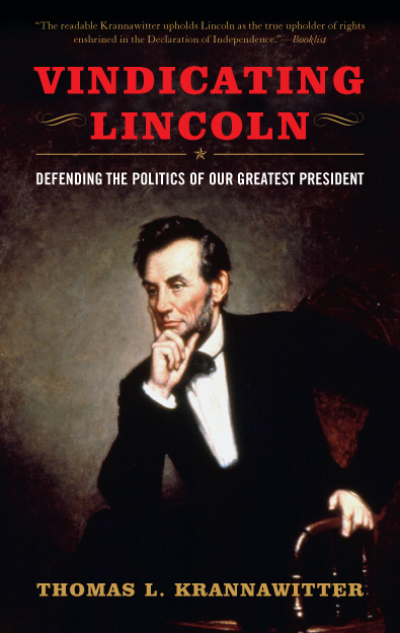
Vindicating Lincoln
Defending the Politics of Our Greatest President
Authors:
Publisher:
2008
Summary
Was Abraham Lincoln a racist, as some critics would have us believe? Was he the father of big government, as some others maintain? Was the sixteenth president a traitor to the cause of free society and constitutional government? Are the political principles that guided him relevant today?
In this provocative and timely book, Thomas L. Krannawitter sets out to defend the man many consider to be our greatest president from critics on both the left and the right. For although public opinion polls tend to rank Lincoln among the country's most venerated presidents, he is also, paradoxically, the president who is least understood. While Lincoln's name is frequently invoked in contemporary American politics, few Americans understand or agree with the moral and political principles for which Lincoln gave his last full measure of devotion.
Many influential authors view Lincoln as an antiquated monument, a man of his age who knew only nineteenth-century prejudices and lacked twenty-first-century enlightenment. Other writers denounce Lincoln as a tyrant who trampled upon the Constitution and states' rights, and thereby inaugurated big government and the kind of politics feared by the Founding Fathers.
Krannawitter argues that both views spring from a misunderstanding of Lincoln. Today, at precisely the moment when America is most in need of his moral and political understanding, we are more removed from Lincoln's thought than ever before.
Vindicating Lincoln reintroduces us to Lincoln the statesman, the man who defended our greatest ideals of freedom and equality at the darkest moment in American history. Krannawitter shows us why it is in our interest not only to learn about Abraham Lincoln, but to learn from him—to understand that Lincoln's guiding principles were true not only for his time, but that they remain true for ours as well.
On the eve of the bicentennial of his birth in 2009, Lincoln can offer moral and political guidance to us all.
Search publication
Bibliographic data
Edition
1/2008
Copyright Year
2008
ISBN-Print
978-0-7425-5972-1
ISBN-Online
978-1-4422-0064-7
Publisher
Rowman & Littlefield, Lanham
Language
English
Pages
360
Product Type
Monograph
Table of contents
ChapterPages
Contents No access
Acknowledgments No access
Introduction No access Pages 1 - 12
Chapter 01. Was Lincoln a Racist? No access Pages 13 - 46
Chapter 02. Was the Kansas-Nebraska Act Pro-Choice or Pro-Slavery? No access Pages 47 - 76
Chapter 03. Who Was Right About the Founding, Lincoln or Taney? No access Pages 77 - 114
Chapter 04. Was Lincoln a "Child of His Age" No access Pages 115 - 144
Chapter 05. Do States Possess a Constitutional Right of Secession? No access Pages 145 - 204
Chapter 06. Was the Civil War Caused by Slavery or Economics? No access Pages 205 - 262
Chapter 07. Was Lincoln's Goal to Preserve the Union or End Slavery? No access Pages 263 - 288
Chapter 08. Wa Lincoln the Father of Big Government? No access Pages 289 - 316
Chapter 09. Was Lincoln a Tyrant? No access Pages 317 - 336