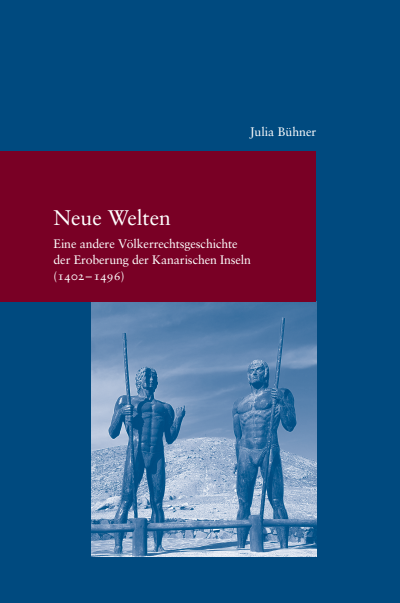
Neue Welten
Eine andere Völkerrechtsgeschichte der Eroberung der Kanarischen Inseln (1402–1496)- Authors:
- Series:
- Studien zur europäischen Rechtsgeschichte, Volume 349
- Publisher:
- 2025
Summary
Europeans were already exploring the waters of New Worlds 200 years before the “discovery” of America by Columbus in 1492 - including those of the Canary Islands, an archipelago off the west coast of Africa that was inhabited by various indigenous peoples. By focusing on the conquest of the Canary Islands, which were in turn subjugated by the French, Portuguese and Spanish in the course of the 15th century, this study adds a new chapter to the history of international law and breaks new ground: it presents the conquest as an encounter between ideas of law and normativity, emphasizes the contribution of the indigenous Canarians to the development of modern international law and opens up a new perspective on the achievements of the Salamanca School of international law.
Keywords
Search publication
Bibliographic data
- Edition
- 1/2025
- Copyright Year
- 2025
- ISBN-Print
- 9783465046646
- ISBN-Online
- 978-3-465-14664-3
- Publisher
- Klostermann, Frankfurt am Main
- Series
- Studien zur europäischen Rechtsgeschichte
- Volume
- 349
- Language
- German
- Pages
- 478
- Product Type
- Monograph
Table of contents
- Inhalt No access
- Vorwort No access
- 1.1.1 Redescubrimiento der Kanarischen Inseln 1291–1402 No access
- 1.1.2 Die conquista señorial 1402–1479 No access
- 1.1.3 Die conquista realenga 1479–1496 No access
- 1.2.1 Die Eroberung der Kanaren – (nur) ein Modell für Amerika? No access
- 1.2.2 Die Gründe für das Forschungsdesiderat in der History of International Law No access
- 1.3.1 Das Verhältnis von Praxis und Theorie in der Völkerrechtsgeschichte No access
- 1.3.2 Überlieferungsmaterial, Entwicklung und Stand der Forschung No access
- 1.3.3 Aufbau der Studie No access
- 1.4.1.1 Die peninsularen Chroniken I: Spanische Historiographen No access
- 1.4.1.2 Die peninsularen Chroniken II: Portugiesische Historiographen No access
- 1.4.1.3 Die insularen Chroniken No access
- 1.4.2.1 Juan de Abreu Galindo No access
- 1.4.2.2 Alonso de Espinosa No access
- 1.4.2.3 Leonardo Torriani No access
- 1.4.3.1 Alonso de Cartagena und Francisco de Vitoria No access
- 1.4.3.2 Antonio Roselli und Antonio Menucci da Pratovecchio No access
- 1.4.3.3 Bartolomé de las Casas No access
- 1.4.4 Schlussfolgerung No access
- 2.1 Methodische Vorbemerkungen No access
- 2.2.1 Allgemeine Eigenschaften No access
- 2.2.2 Regeln und Tabus No access
- 2.2.3 Le Canarien als normativ pragmatische Literatur No access
- 2.3 Zur Unabhängigkeit der Rechtssubjekte auf den Inseln No access
- 2.4.1 Nautische Fähigkeiten No access
- 2.4.2 Interinsulare Beziehungen und Kontakte in Übersee No access
- 2.5 Kanarier und Europäer: Eine Begegnung normativer Ordnungen No access
- 2.6 Schlussfolgerung No access
- 3.1.1 Frontera No access
- 3.1.2 Middle Ground No access
- 3.2.1 Literatur, Quellen und Kontext No access
- 3.2.2.1 Acuerdo, concierto, confederación, pacto und paz No access
- 3.2.2.2 Amigos und enemigos No access
- 3.2.2.3 Bandos de paces und bandos de guerra No access
- 3.2.3 Vertragspartner und andere beteiligte Personen No access
- 3.2.4 Vertragsinhalte No access
- 3.2.5 Verbindlichkeit der Verträge No access
- 3.2.6 Symbolische Akte No access
- 3.3.1 Funktion der Verträge No access
- 3.3.2 Vasallenverträge als Vorläufer des Requerimiento No access
- 3.4 Schlussfolgerung No access
- 4.1.1 Indigene Nebenrollen – ein Panorama No access
- 4.2 Terminologie No access
- 4.3.1 Rekrutierung No access
- 4.3.2 Ausbildung No access
- 4.4.1 Isabel und Alfonso No access
- 4.4.2 Don Fernando Guanarteme No access
- 4.4.3 Tibiabin und Tamonante No access
- 4.5.1 Francisca de Gazmira No access
- 4.6 Schlussfolgerung No access
- 5.1 Methodische Vorbemerkungen No access
- 5.2.1 Paganos oder infieles: Die Kanarier als Heiden No access
- 5.2.2 Bárbaros: Die Wildheit der Kanarier No access
- 5.2.3 Der rusticus: Ein neuer Typus des Barbaren No access
- 5.3 Inferiorität und die Versklavung der Kanarier No access
- 5.4 Schlussfolgerung No access
- 6.1 Terminologische Einführung No access
- 6.2.1 Die Belehnung Luis de la Cerdas No access
- 6.2.2 Der Kreuzzug Béthencourts No access
- 6.3.1 Zur völkerrechtlichen Relevanz von Kartographie und Geographie No access
- 6.3.2 Die Reaktionen auf die Belehnung Luis de la Cerdas und das Argument der vicinitas No access
- 6.3.3 Die historische Betrachtung der vicinitas bei Alonso de Cartagena No access
- 6.4.1 Die Pesquisa des Esteban Pérez de Cabitos No access
- 6.4.2 Cartagena und die Schule von Salamanca No access
- 6.5 Schlussfolgerung No access
- 7.1.1 Rückblick I: Zur Position Innozenz’ IV. No access
- 7.1.2 Rückblick II: Zur Position Paulus Vladimiris beim Konzil von Konstanz No access
- 7.2.1 Antonio Menucci da Pratovecchio und Antonio Roselli No access
- 7.2.2 Alonso de Palencia No access
- 7.3.1 Bartolomé de las Casas No access
- 7.3.2 Alonso de Espinosa No access
- 7.3.3.1 Indigene Kritik No access
- 7.3.3.2 Die Verteidiger indigener Rechte No access
- 7.3.4 Die Eroberung der Kanaren und die Schule von Salamanca No access
- 7.4 Schlussfolgerung No access
- 8.1 Die Eroberung der Kanaren als Kapitel der Völkerrechtsgeschichte No access
- 8.2 Die Eroberung der Kanaren als »alternative history of international law« No access
- 1. Einleitende Bemerkungen No access
- 2. Bibliographie zur Acta de Bufadero No access
- 3. Edition der Acta de Bufadero No access
- Quellen und Literatur No access Pages 433 - 478