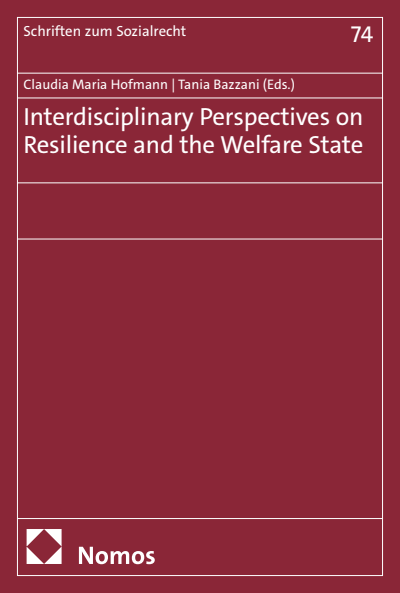
Interdisciplinary Perspectives on Resilience and the Welfare State
- Editors:
- |
- Series:
- Schriften zum Sozialrecht, Volume 74
- Publisher:
- 2025
Summary
In a world where overlapping crises feel less like exceptions and more like the new normal, the question of how to promote resilience becomes central. ‘Interdisciplinary Perspectives on Resilience and the Welfare State’ examines how welfare state policies can be adapted to provide sustainable support in times of 'permacrisis'. With contributions from the fields of law, economics, political science, philosophy and psychology, this book offers both impetus for further research and suggestions for policymakers on how to design welfare state policies.With contributions byDr. Ernest Aigner | Prof. Dr. Edoardo Ales | Dr. Tania Bazzani | Dr. Michele Bertani | Dr. Katharina Bohnenberger | Priv.-Doz. Dr. Katharina Brugger | Dr. Teppo Eskelinen | Dr. Donya Gylan | Prof. Dr. Claudia Maria Hofmann | Prof. Dr. Frank Nullmeier | Prof. Dr. Thomas Rigotti | Dr. Andrea E. Schmidt | Dr. Henrik Thorén | Dr. Felix Würkert | Prof. Dr. Yutaka Sato
Search publication
Bibliographic data
- Edition
- 1/2025
- Copyright Year
- 2025
- ISBN-Print
- 978-3-7560-3044-6
- ISBN-Online
- 978-3-7489-5354-8
- Publisher
- Nomos, Baden-Baden
- Series
- Schriften zum Sozialrecht
- Volume
- 74
- Language
- English
- Pages
- 324
- Product Type
- Edited Book
Table of contents
- Preface No access
- Authors: |
- Conceptualising resilience No access
- New risks and the welfare state No access
- Planetary boundaries and the welfare state No access
- Inclusive resilience No access
- Application of resilience concepts No access
- Participation in society and resilience No access
- The future of the resilient welfare state No access
- The interconnectedness of themes No access
- Looking forward: the resilient welfare state in practice No access
- Authors:
- 1. Introduction No access
- 2. Resilience in ecology and sustainability science No access
- 3. A paradigm shift in ecology No access
- 4. Three resilience concepts No access
- 5. Resilience and sustainability science No access
- 6. Resilience beyond ecology No access
- 7. Dimensions of dissonance No access
- 8. Resilience and the welfare state No access
- 9. Conclusions No access
- Authors:
- 1. Introduction No access
- 2. Welfare states: theory No access
- 3. Dynamic and static images of states No access
- 4. The contested essence of states No access
- 5. Transformational states No access
- 6. Resilience and change No access
- 7. Resilience as learning in crises No access
- 8. The welfare state and civil society No access
- 9. Summary and conclusions No access
- Authors:
- 1.1. Structures No access
- 1.2. Administration & financing No access
- 1.3. The plea No access
- 2. Resilience with(in) a welfare state No access
- 3. Resilience (against) what? No access
- 4. Resilience in what? No access
- 5. Resilience how? No access
- 6. Conclusion: The Grapes of Wrath No access
- Authors:
- 1. Introduction: the need for ecologically informed welfare resilience No access
- 2. Definition: What is an eco-social risk? No access
- 3.1. Causation risks No access
- 3.2. Adaptation risks No access
- 3.3. Transformation risks No access
- 3.4. Cohesion risks No access
- 4.1. Insured risks and level of provisioning No access
- 4.2. Eligibility, pooling and governance No access
- 4.3. Contribution, finance and services No access
- 5. Proposal: European Environmental Risk Insurance Scheme No access
- 6. Conclusions: resilience in a world of anthropogenic environmental crises No access
- Authors:
- 1. Introduction No access
- 2. Sufficientarianism and the focus on the worst-off No access
- 3. Additional focus on the excessively rich: limitarianism No access
- 4. Addressing the entire distributional order No access
- 5. The Reasonable No access
- 6. Defining the Reasonable No access
- 7. Specifying ‘enough’ No access
- 8. Guidelines for a resilient welfare state No access
- Authors: | |
- 1. Introduction No access
- 2. Austrian context No access
- 3. Linking climate resilience, welfare states and health systems No access
- 4.1. How do health systems need to be prepared for and/or adapted to emerging health risks related to climate change? No access
- 4.2. How could the Austrian health system guarantee equal rights and support participation in eco-social transformations within the health sector? No access
- 4.3. Which characteristics of the welfare state need to be adapted? No access
- 4.4. How can the health system enhance well-being for all and in the future within planetary boundaries? No access
- 5. Conclusions No access
- Authors:
- 1. Introduction No access
- 2.1.1. Social model No access
- 2.1.2. Medical model No access
- 2.2. Art. 11 CRPD No access
- 3.1. Ahr Valley flood No access
- 3.2. Covid-19 pandemic No access
- 3.3. Inclusive resilience No access
- 4.1. Disability as an adverse life event No access
- 4.2. Resilience as the need to overcome No access
- 5. Abolitionism: resilience against intervention? No access
- 6. Conclusion No access
- Authors: |
- 1.1. Background and context No access
- 1.2. Definition and scope of resilience in immigration No access
- 1.3. Importance of a resilience strategy No access
- 2.1. Importance of inclusive approaches to migration No access
- 2.2. Reducing social tensions No access
- 3.1. Influence on individual and collective resilience No access
- 3.2. Building trust and cooperation No access
- 4.1. Importance of meeting spaces No access
- 4.2. Encouraging participation No access
- 5.1. Political leadership and policy development No access
- 5.2. Creating commitment through policies No access
- 6.1. Shaping public perceptions and policy responses No access
- 6.2. Need for positive stories and intercultural dialogue No access
- 6.3. Role of political leadership No access
- 6.4. Equitable legal frameworks No access
- 6.5. Civil society participation and cultural exchange No access
- 6.6. Inclusion of migrants in political processes No access
- 6.7. The importance of immigration laws for migrant resilience No access
- 6.8. The role of NGOs and faith-based organisations in supporting migrants’ resilience No access
- 7.1. Summary of key points No access
- 7.2. Future directions No access
- 7.3. Final thoughts No access
- Authors:
- 1. Introduction No access
- 2.1. Micro level: ‘individual’ resilience No access
- 2.2. Meso level: the ‘community’ resilience No access
- 2.3. Macro level: resilience as an ‘institutional pattern’ No access
- 3.1. Frail elderly people, intergenerational solidarity and resilience: results from the REDESIGN project No access
- 3.2. Research project design No access
- 3.3. Results No access
- 4. Conclusion: social welfare policy is a key issue in promoting resilience among older adults No access
- Authors:
- 1. Introduction No access
- 2. Masculinised aspirations and vocational training in the neoliberal economy No access
- 3.1. Saath and vocational training No access
- 3.2. Methods No access
- 4.1. Cultural capital and ‘middle-class’ identities No access
- 4.2. Public-sector versus private-sector jobs: security, resilience and caste discrimination No access
- 5.1. Upendra’s case: neoliberal subjectivity and resilience in escaping poverty No access
- 5.2. Rohan’s case: pursuing a middle-class career and lifestyle No access
- 6. Conclusions No access
- Acknowledgements No access
- Authors:
- 1. A constant state of crisis No access
- 2. Conceptualising resilience No access
- 3. Reactive social protection measures No access
- 4. Introducing salutogenesis No access
- 5. From a reactive to a proactive approach No access
- 6. Way to go No access
- Authors:
- 1. Introduction No access
- 2. Resilient social insurance in the EU No access
- 3. Vulnerable self-employed workers No access
- 4. Developing a resilience test to social insurance for the vulnerable self-employed in case of unemployment No access
- 5.1. Framework No access
- 5.2. Unemployment benefits for the self-employed No access
- 6.1. Framework No access
- 6.2. Unemployment benefits for the self-employed No access
- 7.1. Framework No access
- 7.2. Unemployment Benefits for the Self-Employed No access
- 8. Comparison No access
- 9. Conclusion No access
- List of Authors (alphabetical order) No access Pages 323 - 324