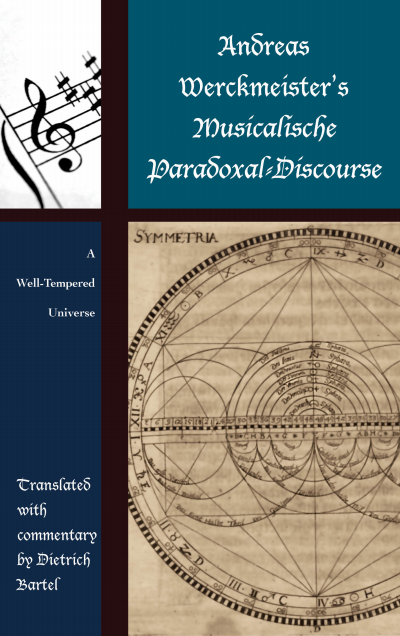
Andreas Werckmeister's Musicalische Paradoxal-Discourse
A Well-Tempered Universe- Editors:
- Publisher:
- 2017
Summary
Andreas Werckmeister (1645 – 1706), a late seventeenth-century German Lutheran organist, composer, and music theorist, is the last great advocate and defender of the Great Tradition in music, with its assumptions that music is a divine gift to humanity, spiritually charged yet rationally accessible, the key being a complex of mathematical proportions which govern and are at the root of the entire universe and all which that embraces. Thus understood, music is the audible manifestation of the order of the universe, allowing glimpses, sound-bites of the very Creator of a well-tempered universe, and of our relationship to each other, our environment, and the divine powers which placed us here. This is the subject matter of the conversation which Werckmeister wishes to have with us, his readers, particularly in his last treatise, the Musicalische Paradoxal-Discourse. But he does not make it easy for today’s readers. He assumes certain proficiencies from his readers, including detailed biblical knowledge, a fluency in Latin, and a familiarity with treatises and publications concerning music, theology, and a number of related disciplines. He writes in a rather archaic German, riddled with obscure references which require a thorough explanation. With its extensive commentary and translation of the treatise, this book seeks to bridge Werckmeister’s world with that of the twenty-first century. Werckmeister wrote for novice and professional musicians alike, an author who wanted to consider with his readers the basic and existential questions and issues regarding the wondrous art of music, questions as relevant then as they are now.
Keywords
Search publication
Bibliographic data
- Edition
- 1/2017
- Copyright Year
- 2017
- ISBN-Print
- 978-1-4985-6634-6
- ISBN-Online
- 978-1-4985-6635-3
- Publisher
- Lexington, Lanham
- Language
- English
- Pages
- 158
- Product Type
- Edited Book
Table of contents
- Contents No access
- Series Editor’s Foreword No access
- Preface No access
- Introduction to the Musicalische Paradoxal-Discourse No access
- Werckmeister Biography No access
- Werckmeister Treatises No access
- Contents and Sources of the Musicalische Paradoxal-Discourse No access
- Musical Paradoxical-Discourse, or uncommon expostulations No access
- Preface No access
- Index and contents of the chapters No access
- CHAPTER ONE. An introduction to this work: the division of the musical proportions No access
- CHAPTER TWO. A testimonial through mathematics and Holy Scriptures themselves, that the course of the heavens are harmonic No access
- CHAPTER THREE. How the mortal body and soul are harmonically created, and furthermore, on the influence of the stars No access
- CHAPTER FOUR. Why humans find such pleasure in music, and whence composers and musicians arise No access
- CHAPTER FIVE. As the image of God, humans are to praise the Creator with music. Buildings and eras in scripture are also harmonic wonders of spiritual music No access
- CHAPTER SIX. On the abuse of music, which the authorities could abolish No access
- CHAPTER SEVEN. How the inclination of a people determines its attitude toward music, and how the heathens were so scattered in their views on music No access
- CHAPTER EIGHT. On the music of the early Christians, and the subsequent changes No access
- CHAPTER NINE. The great difficulties arising out of solmization and the linear staff system No access
- CHAPTER TEN. Proof that the linear staff system is accompanied by great difficulties No access
- CHAPTER ELEVEN. Proof of how everything can be played or sung through the twelve note-names No access
- CHAPTER TWELVE. Further proof that the linear staff system has many more variants than the twelve note-names No access
- CHAPTER THIRTEEN. How the temperaments can be examined, and on German tablature No access
- CHAPTER FOURTEEN. How the chromatic system is to be applied to the tempered keyboard No access
- CHAPTER FIFTEEN. On the disorder of hymn singing No access
- CHAPTER SIXTEEN. On the simplicity of old organs No access
- CHAPTER SEVENTEEN. How the musical modes can be differentiated No access
- CHAPTER EIGHTEEN. On the nature and property of the harmonic numerals No access
- CHAPTER NINETEEN. On the hidden meaning of the numerals No access
- CHAPTER TWENTY. On the properties of the harmonic numerals, when they themselves are subdivided No access
- CHAPTER TWENTY-ONE. On the subdivision of the harmonic numerals No access
- CHAPTER TWENTY-TWO. On the properties of the dissonant musical numerals No access
- CHAPTER TWENTY-THREE. How the harmonic radical numerals are transformed into a tempered tuning, and of their hidden meaning No access
- CHAPTER TWENTY-FOUR. A comparison of incorrect tempered tuning with false Christianity No access
- CHAPTER TWENTY-FIVE. How the temperament can be perfect or imperfect, and how the same can be compared with Christianity No access
- CHAPTER TWENTY-SIX. The Lord’s Prayer in the musical proportional numerals No access
- Bibliography No access Pages 151 - 154
- Index No access Pages 155 - 156
- About the Author No access Pages 157 - 158