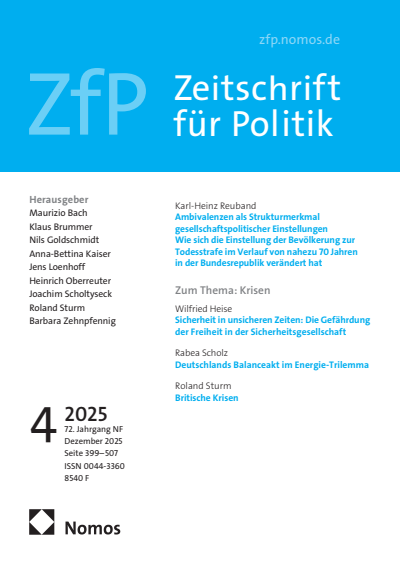
Zeitschrift für Politik sees its main goals in representing political science in its full range; in outlining its development in research and teaching and in serving as a forum for innovative academic discussions. It addresses scholars from various fields of research: political theory and philosophy, comparative political studies and international relations, political sociology, political economy and political law. Website: www.zfp.nomos.de
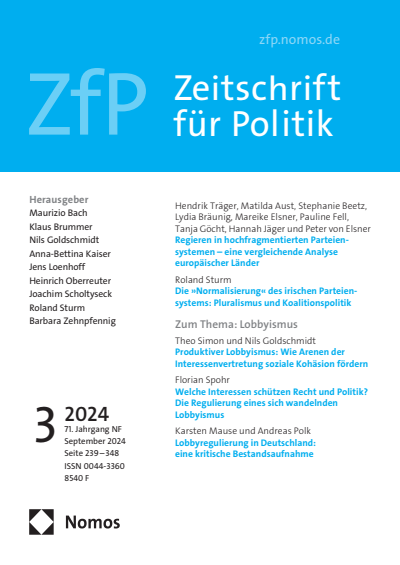
The phenomenon of highly fragmented party systems is becoming increasingly prevalent in Europe, as evidenced by the observed increase in the effective number of parties. The fragmentation of the party system is also increasing in Germany. Against...
The Irish party system was regarded as unique. Characteristica of Irish exceptionalism were a party landscape lacking a left-right axis, without social bases, with pragmatic (non-ideological) coalitions and an absolutely unthinkable government...
In this article we develop the idea of productive lobbying in the Social Market Economy. Lobbying is always productive when it promotes social cohesion and contributes to the pacification of opposing interests. We argue that this perspective expands...
In recent decades, the corporatist German interest mediation has developed towards pluralistic lobbying, which is reflected in the increasing relevance of new actors, such as companies and lobbying service providers, as well as informal practices of...
The article depicts the various lobbying regulations at the federal level in Germany, e.g. the regulations on MPs‘ side jobs, party donations, cooling-off periods for former policymakers, the legislative and executive footprint, and the amended...