, to see if you have full access to this publication.
Edited Book No access
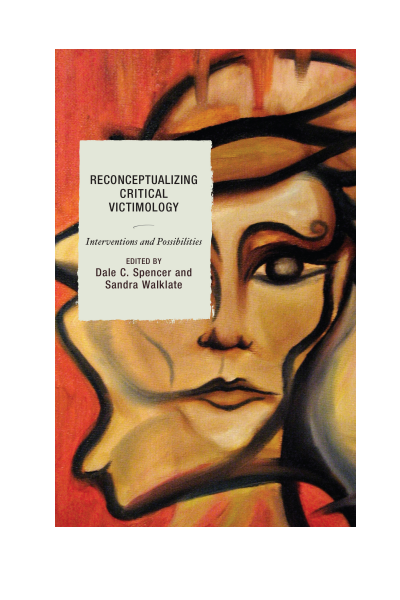
Reconceptualizing Critical Victimology
Interventions and Possibilities
Editors:
|
Publisher:
2016
Summary
Since the 1960s, the field of victimology has developed into a variegated discipline with its own theoretical and methodological traditions. In the early 1990s two texts were published—Towards a Critical Victimology (Fattah, 1992) and Critical Victimology (Mawby and Walklate, 1994)—that concretized critical victimology as a paradigm within victimology. Since then, the field has remained conceptually stale and with few a few exceptions there has not been a considerable lacuna of works from a critical perspective. Reconceptualizing Critical Victimology: Interventions and Possibilities provides a rejoinder to the two aforementioned texts and demonstrate how critical victimology can be reconceptualized, where interventions can be made in this victimological paradigm, and possibilities for future theorizing and research in this provocative field. Reconceptualizing Critical Victimology includes eleven papers on the forms of victimization and issues pertinent to victims written by leading and emerging international scholars in the field of critical victimology. It is interdisciplinary in scope and contains contributions from leading and emergent international scholars on victims and victimization. Reconceptualizing Critical Victimology serves as a crucible to demonstrate the complexities of and the multitude of factors that interact to complicate victim status, the vagaries of victim response, and the phenomenology of violence and victimization.
Keywords
Search publication
Bibliographic data
Edition
1/2016
Copyright Year
2016
ISBN-Print
978-1-4985-1026-4
ISBN-Online
978-1-4985-1027-1
Publisher
Lexington, Lanham
Language
English
Pages
244
Product Type
Edited Book
Table of contents
ChapterPages
Contents No access
Acknowledgments No access
Introduction No access
Chapter One: Sovereign Bodies, Minds, and Victim Culture No access Pages 1 - 14
Chapter Two: Still Worlds Apart? No access Pages 15 - 32
Chapter Three: Boys to Offenders No access Pages 33 - 44
Chapter Four: The Parent as Paradoxical Victim No access Pages 45 - 62
Chapter Five: Victims of Hate No access Pages 63 - 78
Chapter Six: Punishment or Solidarity No access Pages 79 - 94
Chapter Seven: Restorative Justice as a Boundary Object No access Pages 95 - 110
Chapter Eight: Victimhood and Transitional Justice No access Pages 111 - 132
Chapter Nine: A Change for the Better or Same Old Story? No access Pages 133 - 154
Chapter Ten: Hierarchical Victims of Terrorism and War No access Pages 155 - 172
Chapter Eleven: Bereaved Family Activism in Contexts of Organized Mass Violence No access Pages 173 - 190
Conclusion No access Pages 191 - 202
Bibliography No access Pages 203 - 232
Index No access Pages 233 - 240
About the Contributors No access Pages 241 - 244
Similar publications
from the topics "Soziologie allgemein"
Edited Book Full access
Karen Kastenhofer, Marius Albiez, Pauline Riousset, Constanze Scherz, Michael Decker