, to see if you have full access to this publication.
Monograph No access
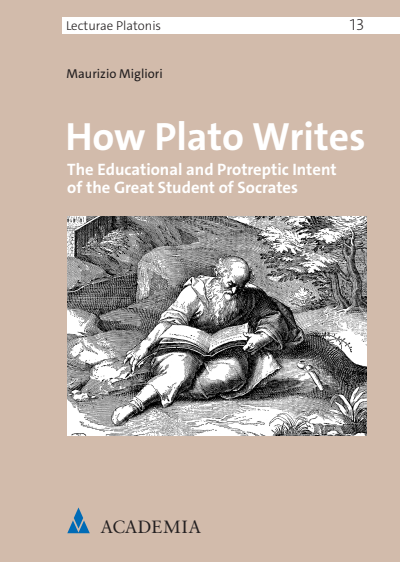
How Plato Writes
The Educational and Protreptic Intent of the Great Student of Socrates- Authors:
- Series:
- Lecturae Platonis, Volume 13
- Publisher:
- 2023
Summary
The difficulties in interpreting Plato depend on a misunderstanding of his writing technique. To overcome them, this study focuses on his technique, based on a laborious game, by which he prompts the reader to take action in response to his provocations and to his use of Socratic maieutics: it produces the sequence of dialogues as a great protreptic. Understanding his use of this technique allows us to grasp his uni-multiple vision of reality. Maurizio Migliori, former professor of History of Philosophy at the University of Macerata (Italy) and member of the International Plato Society, was a specialist on Plato to whom he dedicated numerous books and over 100 articles, in international journals and books.
Keywords
Search publication
Bibliographic data
- Copyright Year
- 2023
- ISBN-Print
- 978-3-98572-145-0
- ISBN-Online
- 978-3-98572-146-7
- Publisher
- Academia, Baden-Baden
- Series
- Lecturae Platonis
- Volume
- 13
- Language
- English
- Pages
- 202
- Product Type
- Monograph
Table of contents
ChapterPages
- Titelei/Inhaltsverzeichnis No access Pages 1 - 8
- 1.1. A Recurring Temptation No access
- The So-called Aporetic Dialogues No access
- The Euthyphro Game: An Early Example of the Omission Technique No access
- Referral Techniques and Other Difficulties No access
- The Double Oddity of Dialectical Dialogues No access
- The Question of Aristotelian Testimony No access
- 1. The problems of a master No access
- 2.1. The Love of “Beautiful” Speech, Written and Oral No access
- The Form No access
- The Soul of the Interlocutor No access
- Writing as an Image (εἴδωλον) No access
- The Dual Value of Writing No access
- 2.4. Further References to the Limits of Writing No access
- The Seventh Letter No access
- Important Games No access
- A Final Summary No access
- Conclusions No access
- 3.2. The Protreptic Function of the Game No access
- The Signs in the Text No access
- The Problem for the Present-day Reader No access
- The Risks in the Concept of Game No access
- Fiction reveals the Author’s Intentions No access
- Irony No access
- 5.1. A Clarification on the Term “Protreptic” No access
- 5.2. A Reflection on the Invention of Socratic Maieutics No access
- 5.3. An Example about Reasoning according to Paradigms No access
- 1.1. The Hiatus No access
- 1.2. Continuity No access
- 1.3. The Unwritten Philosopher No access
- 2.1. A Paradigmatic Example: The Structure of the Symposium No access
- 3.1. Dialogue and Silent Reading No access
- 3.2. Meaningful Changes of the Interlocutor No access
- 3.3. Emphatizations No access
- 4. Games between Different Dialogues No access
- The Analysis of Concepts No access
- Mixture No access
- Who Mixes the Mixture No access
- The Function of the Game No access
- 5.2. The “Minor” Game No access
- 6. An Extreme Example: a Voluntary Mistake No access
- 7.1. The Attitude of the Reader No access
- 7.2 The Magic of a Great Artist No access
- Objective Data No access
- Subjective Data No access
- 1.2 The First Dialogues as “Juvenile” No access
- 2. The Multiplicity of Approaches to a Unified-Multiple Reality No access
- 3.1. A Matter Not Only of Terminology No access
- 3.2. Esotericism No access
- 3.3. The Dialogic Form No access
- 3.4. Dialogue and Refutation No access
- The Early Dialogues No access
- The Problem of “Hypotheses” and the “Middle” Dialogues No access
- Bibliography No access Pages 181 - 192
- Ancient names No access Pages 193 - 194
- Modern names No access Pages 195 - 196
- Index locorum No access Pages 197 - 202