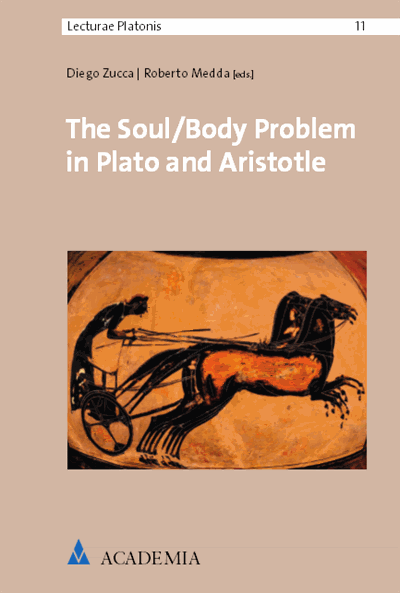
The Soul/Body Problem in Plato and Aristotle
- Editors:
- |
- Series:
- Lecturae Platonis, Volume 11
- Publisher:
- 2018
Summary
This book concerns the soul/body problem in Plato and Aristotle. Established as well as early career scholars actually working on Plato and Aristotle explore - under different points of view as well as through original readings and interpretations - the manifold dimensions involved in the conception of the soul/body relation articulated by the two greatest founders of Western Thought. The book starts with an exploration of the relation between cause and matter in Plato and Aristotle, then some papers on Plato’s theory of soul and body are presented, which involve new advancements in the research about Platonic epistemology, moral and political theory, metaphysics of mind, even about his religious and ‘theological’ view. Some papers on Aristotle’s model follow, which are focused on his so-called “hylomorphism” as an alternative view to Plato’s alleged “dualism”: the ontology of the soul/body relation in Aristotle is explored, as well as the implications of this theoretical framework for his theory of knowledge, his moral theory, his cognitive psychology. Finally, two papers critically assess the philosophical connections between Aristotle’s hylomorphism and its modern and contemporary Wirkungsgeschichte.
Keywords
Search publication
Bibliographic data
- Edition
- 1/2018
- Copyright Year
- 2018
- ISBN-Print
- 978-3-89665-750-3
- ISBN-Online
- 978-3-89665-751-0
- Publisher
- Academia, Baden-Baden
- Series
- Lecturae Platonis
- Volume
- 11
- Language
- English
- Pages
- 200
- Product Type
- Edited Book
Table of contents
- Titelei/Inhaltsverzeichnis No access Pages I - XXII
- Authors:
- I. 1 “Because” as Cause: Plato No accessAuthors:
- I.2 “Because” as Cause: Aristotle No accessAuthors:
- I.3 “Because” as Cause: Sextus Empiricus No accessAuthors:
- II.1 The Stoics and the Material Cause No accessAuthors:
- II. 2 Matter as Condicio sine qua non: Plato No accessAuthors:
- II.3 Matter as Cause or Condicio sine qua non? Aristotle No accessAuthors:
- Conclusions No accessAuthors:
- References No accessAuthors:
- Authors:
- I. Preliminary Remarks No accessAuthors:
- II. Some Introductory Examples of the Multifocal Approach No accessAuthors:
- III. The Soul-Body Relation on the Gnoseological Level No accessAuthors:
- IV. Man’s Attainment of the Truth No accessAuthors:
- V. The True Human Being No accessAuthors:
- VI. The Soul's Complexity No accessAuthors:
- VII. The Immortality of the Soul No accessAuthors:
- VIII. The Multifocal Approach No accessAuthors:
- References No accessAuthors:
- Authors:
- I. No accessAuthors:
- II. No accessAuthors:
- III. No accessAuthors:
- IV. No accessAuthors:
- V. No accessAuthors:
- VI. No accessAuthors:
- VII. No accessAuthors:
- VIII. No accessAuthors:
- IX. No accessAuthors:
- X. No accessAuthors:
- XI. No accessAuthors:
- References No accessAuthors:
- Authors:
- References No accessAuthors:
- I. No access
- II. No access
- III. No access
- IV. No access
- References No access
- Authors:
- I. The Problem No accessAuthors:
- II. A Peculiar “Void” in Critical Literature No accessAuthors:
- III. Looking at 403a25 in the Frame of the Whole De anima No accessAuthors:
- IV. Meaning of “énulos” No accessAuthors:
- V. Meaning of “páthos” No accessAuthors:
- VI. Meaning of “lógos” No accessAuthors:
- VII. Meaning of “lógos énulos” No accessAuthors:
- VIII. Heraclitean Heritages. Heraclitus on Water and Dis-course No accessAuthors:
- IX. The Interpenetration of Matter and Form No accessAuthors:
- X. Conclusions No accessAuthors:
- References No accessAuthors:
- Authors:
- I. No accessAuthors:
- II. No accessAuthors:
- III. No accessAuthors:
- References No accessAuthors:
- Authors:
- Authors:
- I.1 What III 5 Says No accessAuthors:
- I.2 Aristotle’s View of Human Intellect in de An. before III 5 No accessAuthors:
- Authors:
- II.1 The Divine Interpretation (DI) No accessAuthors:
- II.2 The Human Interpretation (HI) No accessAuthors:
- II.3 The “Social” Interpretation (SI) No accessAuthors:
- II.4 Beyond DI, HI and SI: The Content Interpretation (CI) No accessAuthors:
- References No accessAuthors:
- Authors:
- I. Introduction No accessAuthors:
- II. The Debate on the Mind-Body Problem No accessAuthors:
- III. Aristotle’s Psychological Hylomorphism under the Cartesian Lens No accessAuthors:
- IV. Conclusive Remarks No accessAuthors:
- References No accessAuthors:
- Authors:
- References No accessAuthors:
- Bio of the Editors No access Pages 193 - 194
- ANCIENT: No access
- MODERN: No access