, to see if you have full access to this publication.
Edited Book No access
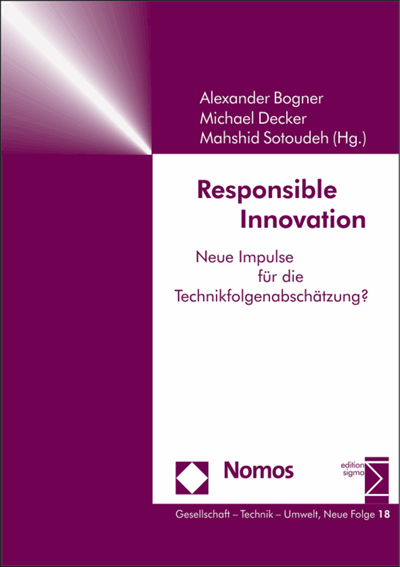
Responsible Innovation
Neue Impulse für die Technikfolgenabschätzung?- Editors:
- | |
- Series:
- Gesellschaft - Technik - Umwelt, Volume 18
- Publisher:
- 2015
Search publication
Bibliographic data
- Edition
- 1/2015
- Copyright Year
- 2015
- ISBN-Print
- 978-3-8487-2882-4
- ISBN-Online
- 978-3-8452-7282-5
- Publisher
- Nomos, Baden-Baden
- Series
- Gesellschaft - Technik - Umwelt
- Volume
- 18
- Language
- German
- Pages
- 396
- Product Type
- Edited Book
Table of contents
ChapterPages
- Titelei/Inhaltsverzeichnis No access Pages 1 - 8
- Vorwort No access Pages 9 - 10
- Technikfolgenabschätzung und „Responsible Innovation“ No access Pages 11 - 28Authors: | |
- Technikfolgenabschätzung – Herausforderungen und Grenzen No access Pages 29 - 46Authors:
- Responsible Innovation No access Pages 47 - 70Authors:
- Inscribing Futures through Responsible Design by Responsible Designers No access Pages 71 - 78Authors:
- Entwicklung eines europäischen Governance-Rahmens für „Responsible Research and Innovation“ No access Pages 81 - 92Authors: | |
- „Public Engagement“ in Forschungs- und Innovationsprozessen No access Pages 91 - 100Authors:
- Demokratiegeleitete Strukturen in Wissenschaften und Forschungspolitik No access Pages 101 - 112Authors: |
- Grand Challenges, Bold Concepts No access Pages 113 - 120Authors:
- „Governance of Discontinuation“ als neue Perspektive der sozialwissenschaftlichen TA No access Pages 121 - 128Authors: | |
- RRI-Governance zwischen linearer Interventionslogik und Sozialinnovation No access Pages 131 - 138Authors:
- Gestaltungsspielräume für „Responsible Research and Innovation“ No access Pages 137 - 146Authors: |
- Verantwortungsvolle Innovationen und ihre Folgen für den konkreten Arbeitsalltag No access Pages 147 - 150Authors: |
- Governance kritischer Informationstechnik in offenen Netzen No access Pages 151 - 164Authors: |
- Klärung des Verhältnisses von „Responsible (Research and) Innovation“ und TA No access Pages 165 - 170Authors: | | | | |
- Orte verantwortlicher Innovation No access Pages 171 - 182Authors:
- Erweiterte Öffentlichkeitsbeteiligung bei der nuklearen Entsorgung No access Pages 185 - 198Authors:
- Über „Frack Off“ und „Frackademia“ No access Pages 197 - 204Authors: |
- Climate Engineering gegen den globalen Klimawandel? No access Pages 205 - 212Authors:
- Gesellschaftliche Probleme automatisierter Videoüberwachung No access Pages 213 - 220Authors:
- „Responsible Innovation“ im Kontext von Interessen- und Wertkonflikten No access Pages 221 - 228Authors:
- „Die Partizipation rettet uns“ No access Pages 231 - 242Authors: |
- Ein Schritt vor der Innovation No access Pages 241 - 250Authors: | | |
- Partizipation der Betroffenen – ein Weg zu verantwortlicher Innovation? No access Pages 251 - 260Authors:
- Attentive Technologien No access Pages 261 - 274Authors: |
- Partizipation? Da könnte ja jeder kommen! No access Pages 275 - 286Authors: | | | |
- Epistemische Verantwortbarkeit No access Pages 287 - 296Authors: |
- „Was bedeutet Industrie 4.0 für unser Unternehmen?“ No access Pages 299 - 308Authors: |
- Ist das patentbasierte pharmakologische Innovationssystem verantwortlich? No access Pages 307 - 316Authors:
- Responsible Research and Innovation in Industry No access Pages 317 - 324Authors:
- Werkzeuge für verantwortungsvolle Forschung? No access Pages 325 - 336Authors: | |
- Stop, Look, Listen and Stay Tuned! No access Pages 337 - 346Authors:
- Spekulative Verantwortung No access Pages 349 - 358Authors: |
- „Responsible Research“ implementieren No access Pages 357 - 368Authors:
- PACITA-Fallstudie „Teleassistenz in einer alternden Gesellschaft“ No access Pages 369 - 378Authors: |
- Fundierung von „Responsible Research and Innovation“ (RRI) und normative Ansprüche prospektiver Technikfolgenabschätzung No access Pages 379 - 390Authors: |
- Autorenverzeichnis No access Pages 391 - 396
Bibliography (654 entries)
No match found. Try another term.
- Abels, G.; Bora, A. (2004): Demokratische Technikbewertung. Bielefeld Open Google Scholar DOI: 10.5771/9783845272825
- Barben, D.; Fisher, E.; Selin, C.; Guston, D.H. (2008): Anticipatory Governance of Nano¬technology: Foresight, Engagement, and Integration. In: Hackett, E.J.; Amsterdamska, O.; Lynch, M.; Wajcman, J. (Hg.): The Handbook of Science and Technology Studies. Cambridge, S. 979-1000 Open Google Scholar DOI: 10.5771/9783845272825
- Beck, U. (1988): Gegengifte – Die organisierte Unverantwortlichkeit. Frankfurt am Main Open Google Scholar DOI: 10.5771/9783845272825
- Bogner, A. (Hg.) (2013): Ethisierung der Technik – Technisierung der Ethik. Der Ethik-Boom im Lichte der Wissenschafts- und Technikforschung. Baden-Baden Open Google Scholar DOI: 10.5771/9783845272825
- Decker, M. (2013): Technikfolgen. In: Grundwald, A. (Hg.): Handbuch Technikethik. Stutt¬gart, S. 33-38 Open Google Scholar DOI: 10.5771/9783845272825
- Dolata, U. (2011): Wandel durch Technik. Eine Theorie soziotechnischer Transformation. Frankfurt am Main/New York Open Google Scholar DOI: 10.5771/9783845272825
- Fisher, E.; Majahan, R.L.; Mitcham, C. (2006): Midstream Modulation of Technology: Gov¬ernance From Within. In: Bulletin of Science, Technology & Society 26, S. 485-496 Open Google Scholar DOI: 10.5771/9783845272825
- Funtowicz, S.; Ravetz, J. (1993): Science for the Post-normal Age. In: Futures 25, S. 739-755 Open Google Scholar DOI: 10.5771/9783845272825
- Grunwald, A. (2012): Responsible Innovation: Neuer Ansatz der Gestaltung von Technik und Innovation oder nur ein Schlagwort? In: Bröchler, S.; Aichholzer, G.; Schaper-Rinkel, P. (Hg.): Theorie und Praxis von Technology Governance. Wien, S. 11-24; http://epub.oeaw.ac.at/ita/ita-manuscript/ita_12_02_Sondernummer.pdf [zuletzt aufge¬sucht am 12.11.2015] Open Google Scholar DOI: 10.5771/9783845272825
- van den Hoven, J. (2013): Value Sensitive Design and Responsible Innovation. In: Owen, R.; Bessant, J.; Heintz, M. (Hg.): Responsible Innovation. Managing the Responsible Emer¬gence of Science and Innovation in Society. Chichester, S. 75-84 Open Google Scholar DOI: 10.5771/9783845272825
- Jonas, H. (1979): Das Prinzip Verantwortung. Versuch einer Ethik für die technologische Zi¬vilisation. Frankfurt am Main Open Google Scholar DOI: 10.5771/9783845272825
- Koch, C.; Senghaas, D. (Hg.) (1970): Texte zur Technokratiediskussion. Frankfurt am Main Open Google Scholar DOI: 10.5771/9783845272825
- Merton, R.K. (1985): Die normative Struktur der Wissenschaft. In: ders. (Hg.): Entwicklung und Wandel von Forschungsinteressen. Aufsätze zur Wissenschaftssoziologie. Frankfurt am Main, S. 86-99 Open Google Scholar DOI: 10.5771/9783845272825
- Owen, R.; Macnaghten, P.; Stilgoe, J. (2012): Responsible Research and Innovation: From Science in Society to Science for Society, with Society. In: Science and Public Policy 39, S. 751-760 Open Google Scholar DOI: 10.5771/9783845272825
- Owen, R.; Stilgoe, J.; Macnaghten, P.; Gorman, M.; Fisher, E.; Guston, D. (2013): A Frame¬work for Responsible Innovation. In: Owen, R.; Bessant, J.; Heintz, M. (Hg.): Responsi¬ble Innovation. Managing the Responsible Emergence of Sceince and Innovation in So¬ciety. Chichester, S. 27-50 Open Google Scholar DOI: 10.5771/9783845272825
- Pielke, R.A. (2007): The Honest Broker. Making Sense of Science in Policy and Politics. Cambridge Open Google Scholar DOI: 10.5771/9783845272825
- Schomberg, R. von (2013): A Vision of Responsible Research and Innovation. In: Owen, R.; Bessant, J.; Heintz, M. (Hg.): Responsible Innovation. Managing the Responsible Emer¬gence of Science and Innovation in Society. Chichester, S. 51-74 Open Google Scholar DOI: 10.5771/9783845272825
- Schot, J.; Rip, A. (1997): The Past and Future of Constructive Technology Assessment. In: Technological Forecasting and Social Change 54, S. 251-268 Open Google Scholar DOI: 10.5771/9783845272825
- Stilgoe, J. (2013): Foreword: Why Responsible Innovation? In: Owen, R.; Bessant, J.; Heintz, M. (Hg.): Responsible Innovation. Managing the Responsible Emergence of Science and Innovation in Society. Chichester, S. xi-xv Open Google Scholar DOI: 10.5771/9783845272825
- Wilsdon, J.; Willis, R. (2004): See-through Science: Why Public Engagement Needs to Move Upstream. London Open Google Scholar DOI: 10.5771/9783845272825
- Literatur Open Google Scholar DOI: 10.5771/9783845272825
- Albach, H.; Schade, D.; Sinn, H. (Hg.) (1991): Technikfolgenforschung und Technikfolgen¬abschätzung. Berlin Open Google Scholar DOI: 10.5771/9783845272825
- Baron, W. (fachl. Bearb. u. Koordination) (1992): Aspekte und Perspektiven der Technikfol¬genforschung: Beiträge und Empfehlungen des Sachverständigenkreises Technikfolgen¬forschung und eines interdisziplinären Expertenteams an den Bundesminister für For¬schung und Technologie. Düsseldorf Open Google Scholar DOI: 10.5771/9783845272825
- Berger, R. (1991): Politik und Technik. Der Beitrag der Gesellschaftstheorien zur Technik¬bewertung. Opladen Open Google Scholar DOI: 10.5771/9783845272825
- Böhret, C.; Franz, P. (1982): Technologiefolgenabschätzung. Institutionelle und verfahrens¬mäßige Lösungsansätze. Frankfurt am Main Open Google Scholar DOI: 10.5771/9783845272825
- Böhret, C.; Franz, P. (1986): Die Technikfolgenabschätzung (technology assessment) als In¬strument der politische Steuerung technischen Wandels? In: Bruder, W. (Hg.): For¬schungs- und Technologiepolitik in der Bundesrepublik Deutschland. Opladen, S. 349-390 Open Google Scholar DOI: 10.5771/9783845272825
- Crew, M.A.; Brennan, T.J. (Hg.) (2014): The Role of the Postal and Delivery Sector in a Digital Age. Cheltenham Open Google Scholar DOI: 10.5771/9783845272825
- Dolata, U.; Schrape, J.F. (2013): Zwischen Individuum und Organisation. Neue kollektive Akteure und Handlungskonstellationen im Internet. SOI Discussion Paper 2013/02, Stuttgart Open Google Scholar DOI: 10.5771/9783845272825
- Ellul, J. (1954): La technique ou l’enjeu du siècle. Paris Open Google Scholar DOI: 10.5771/9783845272825
- FAZ (2013): IG-Metall-Chef fordert Handy-Aus-Regeln. 29.11.2013; http://www.faz.net/ak tuell/beruf-chance/arbeitswelt/staendige-erreichbarkeit-ig-metall-chef-fordert-handy-aus-regeln-12686795.html [zuletzt aufgesucht am 10.11.2015] Open Google Scholar DOI: 10.5771/9783845272825
- Gehlen, A. (2004 [1965]): Anthropologische Ansicht der Technik. In: Rehberg, K.-S. (Hg.): Arnold Gehlen Gesamtausgabe. Die Seele im technischen Zeitalter und andere soziologi¬sche Schriften und Kulturanalysen. Frankfurt am Main, S. 189-203 Open Google Scholar DOI: 10.5771/9783845272825
- Grimmer, K.; Häusler, J.; Kuhlmann, S.; Simonis, G. (Hg.) (1992): Politische Techniksteue¬rung. Opladen Open Google Scholar DOI: 10.5771/9783845272825
- Gzuk, R. (1975): Messung der Effizienz von Entscheidungen. Tübingen Open Google Scholar DOI: 10.5771/9783845272825
- Kruedener, J. von; Schubert, K. von (1981): Technikfolgen und sozialer Wandel. Zur politi¬schen Steuerbarkeit der Technik. Köln Open Google Scholar DOI: 10.5771/9783845272825
- Lutz, B. (1991): Was sind Defizite von TA-Forschung? In: Albach et al. 1991, S. 65-79 Open Google Scholar DOI: 10.5771/9783845272825
- MacKenzie, D. (1992): Economic and Sociological Explanation of Technical Change. In: Coombs, R.; Saviotti, P.; Walsh, V. (Hg.): Technological Change and Company Strate¬gies: Economic and Sociological Perspectives. London, S. 25-48 Open Google Scholar DOI: 10.5771/9783845272825
- Mai, M. (1994): Zur Steuerbarkeit technischer Systeme und zur Steuerungsfähigkeit des Staates. In: Zeitschrift für Soziologie 23(6), 447-459 Open Google Scholar DOI: 10.5771/9783845272825
- Mayntz, R. (1986): Lernprozesse: Probleme der Akzeptanz von TA bei politischen Entschei¬dungsträgern. In: Dierkes, M. (Hg.): Technik und Parlament: Technikfolgen-Abschät¬zung: Konzepte, Erfahrungen, Chancen. Berlin, S. 183-203 Open Google Scholar DOI: 10.5771/9783845272825
- Mayntz, R. (1991): Politische Steuerung und Eigengesetzlichkeiten technischer Entwicklung – zu den Wirkungen von Technikfolgenabschätzung. In: Albach et al. 1991, S. 45-61 Open Google Scholar DOI: 10.5771/9783845272825
- Mayntz, R. (2001a): Die Bestimmung von Forschungsthemen in Max-Planck-Instituten im Spannungsfeld wissenschaftlicher und außerwissenschaftlicher Interessen. Forschungsbe¬richt, MPIfG Discussion Paper 01/08. Köln Open Google Scholar DOI: 10.5771/9783845272825
- Mayntz, R. (2001b): Triebkräfte der Technikentwicklung und die Rolle des Staates. In: Politi¬sche Vierteljahresschrift, Sonderheft 31. Wiesbaden, S. 3-18 Open Google Scholar DOI: 10.5771/9783845272825
- Mayntz, R. (2009): Speaking Truth to Power: Leitlinien für die Regelung wissenschaftlicher Politikberatung. In: dms der moderne staat – Zeitschrift für Public Policy, Recht und Management 1, S. 5-16 Open Google Scholar DOI: 10.5771/9783845272825
- Petermann, T. (2012): Technikfolgenabschätzung als Politikberatung. In: Grunwald, A.; Re¬vermann, C.; Sauter, A. (Hg.): Wissen für das Parlament. Berlin, S. 165-184 Open Google Scholar DOI: 10.5771/9783845272825
- Renn, O. (2014): Mit Sicherheit ins Ungewisse. Möglichkeiten und Grenzen der Technikfol¬genabschätzung. In: Politik und Zeitgeschichte 64, Beilage 6/7 zur Wochenzeitung „Das Parlament“, S. 3-10 Open Google Scholar DOI: 10.5771/9783845272825
- Schneider, I. (2014): Technikfolgenabschätzung und Politikberatung am Beispiel biomedizi¬nischer Felder. In: Politik und Zeitgeschichte 64, Beilage 6/7 zur Wochenzeitung „Das Parlament“, S. 31-39 Open Google Scholar DOI: 10.5771/9783845272825
- Smith, M.R. (1994): Technological Determinism in American Culture. In: Smith, M.R.; Marx, L. (Hg.): Does Technology Drive History? The Dilemma of Technological Deter¬minism. Cambridge, MA, S. 1-35 Open Google Scholar DOI: 10.5771/9783845272825
- Umweltbundesamt (1983): Technologien auf dem Prüfstand. Die Rolle der Technikfolgenab¬schätzung im Entscheidungsprozess. Köln Open Google Scholar DOI: 10.5771/9783845272825
- VDI – Verein Deutscher Ingenieure (1991): Technikbewertung – Begriffe und Grundlagen. Erläuterungen und Hinweise zur VDI-Richtlinie 3780. Berlin Open Google Scholar DOI: 10.5771/9783845272825
- Winner, L. (1977): Autonomous Technology. Technics-out-of-Control as a Theme in Political Thought. Cambridge, MA/London Open Google Scholar DOI: 10.5771/9783845272825
- References Open Google Scholar DOI: 10.5771/9783845272825
- Bedau, M.; Parke, E.C.; Tangen, U.; Hantsche-Tangen, B. (2009): Social and Ethical Check¬points for Bottom-up Synthetic Biology, or Protocells. In: Systems and Synthetic Biol¬ogy 3, pp. 65-75 Open Google Scholar DOI: 10.5771/9783845272825
- den Boer, D.; Rip, A.; Speller, S. (2009): Scripting Possible Futures of Nanotechnologies: A Methodology that Enhances Reflexivity. In: Technology in Society 31(3), pp. 295-304 Open Google Scholar DOI: 10.5771/9783845272825
- Bush, L. (2010): Standards, Law and Governance. In: Journal of Rural Social Sciences 25(3), pp. 56-78 Open Google Scholar DOI: 10.5771/9783845272825
- CEC – Commission of the European Communities (2002): Regulation (EC) no 178/2002 of the European Parliament and of the Council of 28 January 2002 Laying Down the Gen¬eral Principles and Requirements of Food Law, Establishing the European Food Safety Authority and Laying down Procedures in Matters of Food Safety Open Google Scholar DOI: 10.5771/9783845272825
- CEC – Commission of the European Communities (2008): Commission Recommendation of 7 February 2008, on a Code of Conduct for Responsible Nanosciences and Nanotechnol¬ogies Research, 7 February 2008 Open Google Scholar DOI: 10.5771/9783845272825
- CEC – Commission of the European Communities (2009): Communication from the Com¬mission to the Council, the European Parliament and the European Economic and Social Committee. Nanosciences and Nanotechnologies: An Action Plan for Europe 2005-2009. Second Implementation Report 2007-2009, 29.10.2009, COM(2009) 607 final, Brussels Open Google Scholar DOI: 10.5771/9783845272825
- EC – European Commission (2010): Europe 2020 – A European Strategy for Smart, Sustain¬able and Inclusive Growth. 3.3.2010, COM(2010) 2020, Brussels Open Google Scholar DOI: 10.5771/9783845272825
- EC – European Commission (2011): From Challenges to Opportunities: Towards a Common Strategic Framework for EU Research and Innovation Funding. Green Paper, COM(2011)48, Brussels Open Google Scholar DOI: 10.5771/9783845272825
- EEA – European Environmental Agency (ed.) (2002): Late Lessons from Early Warning. The Precautionary Principle 1896-2000. Environmental Issue Report No 22 01, Copenhagen Open Google Scholar DOI: 10.5771/9783845272825
- van Est, R. (2010): From Techno-talk to Social Reflection and Action. Lessons from public participation in converging Technologies. International workshop “Deliberating converging technologies”, IÖW, 25-26 November 2010, Berlin Open Google Scholar DOI: 10.5771/9783845272825
- European Commission (2006): Better Regulation. Simply explained. Office for Official Pub¬lications of the European Communities, Luxembourg Open Google Scholar DOI: 10.5771/9783845272825
- European Union (2010): Consolidated Version of the Treaty on European Union, Official Journal of the European Union 53, C83 of 30 March 2010, Article 3, p. 13 Open Google Scholar DOI: 10.5771/9783845272825
- Fisher, E. (2007): Ethnographic Invention: Probing the Capacity of Laboratory Decisions. In: NanoEthics 1(2), pp. 155-165 Open Google Scholar DOI: 10.5771/9783845272825
- Fisher, E.; Mahajan, R.L.; Mitcham, C. (2006): Midstream Modulation of Technology: Gov¬ernance from Within. Bulletin of Science, Technology & Society 26(6), pp. 485-496 Open Google Scholar DOI: 10.5771/9783845272825
- Forsberg, E.M. (2010): Safe and Socially Robust Development of Nanofood Through ISO Standards? In: Romeo Casabona, C.M.; Escajedo San Epifanio, L.; Emaldi Cirión, A. (eds.): Global Food Security: Ethical and Legal Challenges. Wageningen Open Google Scholar DOI: 10.5771/9783845272825
- Guagnin, D.; Hempel, L.; Ilten, C. (2011): Privacy Practices and the Claim for Accountabil¬ity. In: Schomberg, R. von (ed.): Towards Responsible Research and Innovation in the Information and Communication Technologies and Security Technologies Fields. Lux¬embourg Open Google Scholar DOI: 10.5771/9783845272825
- Karinen, R.; Guston, D.H. (2010): Towards Anticipatory Governance. The Experience with Nanotechnology. In: Kaiser, M. (eds.): Governing Future Technologies. Nanotechnology and the Rise of an Assessment Regime. Dordrecht, pp. 217-232 Open Google Scholar DOI: 10.5771/9783845272825
- Lund Declaration (2009): The Lund Declaration. July 2009 http://www.vinnova.se/upload/ dokument/Verksamhet/UDI/Lund_Declaration.pdf [accessed 04.11.2015] Open Google Scholar DOI: 10.5771/9783845272825
- Mantovani, E. ; Procari, A. (2010): A Governance Platform to Secure the Responsible Deve¬lopment of Nanotechnologies: the FramingNano Project. In: Schomberg, R. von; Davies, S. (eds.): Understanding Public Debate on Nanotechnologies. Options for Public Policy, Luxembourg, pp. 14-30 Open Google Scholar DOI: 10.5771/9783845272825
- Mordini, E. (2011): Policy Brief on Whole Body Image Technology. In: Schomberg, R. von (ed.): Towards Responsible Research and Innovation in the Information and Communi¬cation Technologies and Security Technologies Fields. Luxembourg, pp. 165-210 Open Google Scholar DOI: 10.5771/9783845272825
- National Nanotechnology Initative (2001): NNI Vision, Goals and Objectives. http://nano.gov/about-nni/what/vision-goals [accessed 15 July 2013] Open Google Scholar DOI: 10.5771/9783845272825
- Owen, R.; Goldberg, N. (2010): Responsible Innovation. A Pilot Study with the UK Engi¬neering and Physical Science and Research Council. In: Risk Analysis 30(11), pp. 1699-1707 Open Google Scholar DOI: 10.5771/9783845272825
- Owen, R.; Stillgoe, J.; MacNaughten, P. (2013): A Framework for Responsible Innovation, in: Owen, R.; Heintz, M.; Bessant, J. (eds.): Responsible Innovation. London Open Google Scholar DOI: 10.5771/9783845272825
- Ozolina, Z.; Mitcham, C.; Schroeder, D.; Mordini, E.; McCarthy, P.; Crowley, J. (2012): Ethical and Regulatory Challenges to Science and Research Policy at the Global Level, Luxembourg Open Google Scholar DOI: 10.5771/9783845272825
- Schomberg, R. von (2007): From the Ethics of Technology Towards and Ethics of Knowledge Policy. Working Document of the Service of the European Commission; http://ec.europa.eu/research/science-society/pdf/ethicsofknowledgepolicy_en.pdf [ac¬cessed 18.05.2011]. Open Google Scholar DOI: 10.5771/9783845272825
- Schomberg, R. von (2013): A Vision of Responsible Innovation. In: Owen, R.; Heintz, M.; Bessant, J. (eds.): Responsible Innovation. London Open Google Scholar DOI: 10.5771/9783845272825
- Stahl, B.C. (2011): IT for a Better Future: How to Integrate Ethics, Politics and Innovation. In: Journal of Information, Communication and Ethics in Society 9(3), Special Issue on Emerging Technology and Ethics, pp. 140-156 Open Google Scholar DOI: 10.5771/9783845272825
- References Open Google Scholar DOI: 10.5771/9783845272825
- Axelrod, L.; Fitzpatrick, G.; Burridge, J.; Mawson, S.; Smith, P.; Rodden, T.; Ricketts, I. (2009): The Reality of Homes Fit for Heroes: Design Challenges for Rehabilitation Technology at Home. In: Journal of Assistive Technologies 3(2), pp. 35-43 Open Google Scholar DOI: 10.5771/9783845272825
- Aarhus R.; Ballegaard, S. (2010): Negotiating Boundaries: Managing Disease at Home. In: CHI 2010: Proceedings of the 28th International Conference on Human Factors in Com¬puting Systems. New York, pp. 1223-1232 Open Google Scholar DOI: 10.5771/9783845272825
- Balaam, M.; Rennick Egglestone, S.; Fitzpatrick, G.; Rodden, T.; Hughes, A.M.; Wilkinson, A.; Nind, T.; Axelrod, L.; Harris, E.; Ricketts, I.; Mawson, S.; Burridge, J. (2011): Moti¬vating mobility: designing for lived motivation in stroke rehabilitation. In: CHI 2011: Proceedings of the SIGCHI Conference on Human Factors in Computing Systems. New York, pp. 3073-3082 Open Google Scholar DOI: 10.5771/9783845272825
- Blythe, M.; Monk, A.; Doughty, K. (2005): Socially Dependable Design: The Challenge of Ageing Populations for HCI. In: Interacting with Computers 17(6), pp. 672-689 Open Google Scholar DOI: 10.5771/9783845272825
- Brownsell, S.; Bradley, D.; Blackburn, S.; Cardinaux, F.; Hawley, M. (2011): A Systematic Review of Lifestyle Monitoring Technologies. In: Journal of Telemedicine and Telecare 17(4), pp. 185-189 Open Google Scholar DOI: 10.5771/9783845272825
- Coiera, E. (2009): Building a National Health IT System from the Middle Out. In: Journal of the American Medical Informatics Association 16, pp. 271-273 Open Google Scholar DOI: 10.5771/9783845272825
- Fitzsimmons, D.A.; Thompson, J.; Hawley, M.; Mountain, G.A. (2011): Preventative Tele-health Supported Services for Early Stage Chronic Obstructive Pulmonary Disease: a Protocol for a Pragmatic Randomized Controlled Trial Pilot. In: Trials 12, 6 Open Google Scholar DOI: 10.5771/9783845272825
- Draper, H.; Sorell, T. (2012): Telecare, Remote Monitoring and Care. In: Bioethics 9702, pp. 195-200 Open Google Scholar DOI: 10.5771/9783845272825
- Fitzpatrick, G.; Huldtgren, A.; Malmborg, L.; Harely, D.; Ijsselsteijn, W. (2015): Design for Agency, Adaptivity and Reciprocity: Re-imagining AAL and Telecare Agendas. In: Wulf, V.; Schmidt, K.; Randall, D. (eds.): Designing Socially Embedded Technologies in the Real-World. London, pp. 305-340 Open Google Scholar DOI: 10.5771/9783845272825
- Ganglbauer, E. (2014): From Gardens to Fridges: Technology Design Considerations for Less Food Waste. PhD Thesis, Vienna University of Technology, Vienna Open Google Scholar DOI: 10.5771/9783845272825
- Ganglbauer, E.; Fitzpatrick, G.; Comber, R. (2013): Negotiating Food Waste: Using a Prac¬tice Lens to Inform Design. In: ACM Transactions on Computer-Human Interaction 20(2), Article 11 Open Google Scholar DOI: 10.5771/9783845272825
- Ganglbauer, E.; Fitzpatrick, G.; Subasi, Ö.; Güldenpfennig, F. (2014): Think Globally, Act Locally: a Case Study of a Free Food Sharing Community and Social Networking. In: CSCW 2014: Proceedings of the 17th ACM Conference on Computer Supported Co¬operative Work & Social Computing. New York, pp. 911-921 Open Google Scholar DOI: 10.5771/9783845272825
- Grimpe, G.; Hartswood, M.; Jirotka, M. (2014): Towards a Closer Dialogue Between Policy and Practice: Responsible Design in HCI. In: CHI 2014: Proceedings of the SIGCHI Conference on Human Factors in Computing Systems. New York, pp. 2965-2974 Open Google Scholar DOI: 10.5771/9783845272825
- Gustavsson, J.; Cederberg, C.; Sonesson, U. (2011): Cutting Food Waste to Feed the World Global Food Losses and Food Waste. United Nations Food and Agriculture Organisation, Rome Open Google Scholar DOI: 10.5771/9783845272825
- Henderson, C.; Knapp, M.; Fernández, J.-L.; Beecham, J.; Hirani, S.P.; Cartwright, M.; Rixon, L.; Beynon, M.; Rogers, A.; Bower, P.; Doll, H.; Fitzpatrick, R.; Steventon, A.; Bardsley, M.; Hendy, J.; Newman, S.P. (2013): Cost Effectiveness of Telehealth for Pa¬tients with Long Term Conditions (Whole Systems Demonstrator Telehealth Question¬naire Study): Nested Economic Evaluation in a Pragmatic, Cluster Randomised Con¬trolled Trial. In: BMJ 346, f1035 Open Google Scholar DOI: 10.5771/9783845272825
- Holstein, M.; Minkler, M. (2003): Self, Society and the “New Gerontology”. In: The Geron¬tologist 43(6), pp. 787-796 Open Google Scholar DOI: 10.5771/9783845272825
- Lindley, S.; Harper, R.; Sellen, A. (2008): Designing for Elders: Exploring the Complexity of Relationships in Later Life. In: BCS: Proceedings of the 22nd British HCI Group Annual Conference on People and Computers: Culture, Creativity, Interaction. Vol. 1, Liverpool, pp. 77-86 Open Google Scholar DOI: 10.5771/9783845272825
- Pawson, R.; Tilley, N. (1997): Realistic Evaluation. London Open Google Scholar DOI: 10.5771/9783845272825
- Procter, R.; Greenhalgh, T.; Wherton, J.; Sugarhood, P.; Rouncefield, M.; Hinder, S. (2014): The Day-to-Day Co-Production of Ageing in Place. In: Computer Supported Cooperative Work (CSCW) 23(3), pp. 245-267 Open Google Scholar DOI: 10.5771/9783845272825
- Sanders, C.; Rogers, A.; Bowen, R.; Bower, P.; Hirani, S.P.; Cartwright, M.; Fitzpatrick, R.; Knapp, M.; Barlow, J.; Hendy, J.; Chrysanthaki, T.; Bardsley, M.; Newman, S.P. (2012): Exploring Barriers to Participation and Adoption of Telehealth and Telecare within the Whole System Demonstrator Trial: a Qualitative Study. In: BMC Health Services Re¬search 12, 220 Open Google Scholar DOI: 10.5771/9783845272825
- Sellen, A.; Rogers, Y.; Harper, R.; Rodden, R. (2009): Reflecting Human Values in the Digi¬tal Age. In: Communications of the ACM 52(3), pp. 58-66 Open Google Scholar DOI: 10.5771/9783845272825
- Sharma, U.; Clarke, M. (2014): Nurses’ and Community Support Workers’ Experience of Telehealth: a Longitudinal Case Study. In: BMC Health Services Research 14, 164 Open Google Scholar DOI: 10.5771/9783845272825
- Tornstam, L. (2005): Gerotranscendence. A Developmental Theory of Positive Aging. New York Open Google Scholar DOI: 10.5771/9783845272825
- Literatur Open Google Scholar DOI: 10.5771/9783845272825
- Benz, A. (2006): Governance in Connected Arenas – Political Science Analysis of Coordina¬tion and Control in Complex Control Systems. In: Jansen, D. (Hg.): New Forms of Gov¬ernance in Research Organizations. From Disciplinary Theories towards Interfaces and Integration. Heidelberg, S. 3-22 Open Google Scholar DOI: 10.5771/9783845272825
- Braun, D. (2006): Delegation in the Distributive Policy Arena: The Case of Research Policy. In: Braun, D.; Gilardi, F. (Hg.): Delegation in Contemporary Democracies, London, S. 146-170 Open Google Scholar DOI: 10.5771/9783845272825
- Callon, M.; Lascoumes, P.; Barthe, Y. (2011): Acting in an Uncertain World. An Essay on Technical Democracy. Cambridge, MA Open Google Scholar DOI: 10.5771/9783845272825
- Dorbeck-Jung, B.; Shelley-Egan, C. (2013): Meta-Regulation and Nanotechnologies: The Challenge of Responsibilisation Within the European Commission’s Code of Conduct for Responsible Nanosciences and Nanotechnologies Research. In: Nanoethics 7, S. 55-68 Open Google Scholar DOI: 10.5771/9783845272825
- EC – European Commission (2011): Work Programme 2012. Capacities Part 5: Science in Society. European Commission C(2011)5023 of 19 July 2011, Brüssel Open Google Scholar DOI: 10.5771/9783845272825
- EC – European Commission (2012): Responsible Research and Innovation. Europe’s Ability to Respond to Societal Challenges. Brüssel Open Google Scholar DOI: 10.5771/9783845272825
- Edler, J.; Joly, P.-B.; Kuhlmann, S.; Nedeva, M.; Propp, T.; Rip, A.; Ruhland, S.; Thomas, D. (2006): Understanding “Fora of Strategic Intelligence for Research and Innovation”. The PRIME Forum Research Project, Karlsruhe Open Google Scholar DOI: 10.5771/9783845272825
- Edler, J.; Randles, S.; Gee, S. (2014): Preliminary Lessons from the Case Study Programme. Res-AGorA Interim Report, Deliverable D3.5, May 2014; http://res-agora.eu/assets/ ResAGORA-case-lessons-report-D-3_5-final.pdf [zuletzt aufgesucht am 07.11.2015] Open Google Scholar DOI: 10.5771/9783845272825
- European Union (2013): Regulation (EU) No 1291/2013 of the European Parliament and of the Council of 11 December 2013 establishing Horizon 2020 – the Framework Pro¬gramme for Research and Innovation (2014-2020) and repealing Decision No 1982/2006/EC. Official Journal of the European Union, L 347/104 Open Google Scholar DOI: 10.5771/9783845272825
- Jessop, B. (2002): The Future of the Capitalist State. Oxford Open Google Scholar DOI: 10.5771/9783845272825
- Jessop, B. (2003): Governance and Metagovernance: On Reflexivity, Requisite Variety, and Requisite Irony. In: Bang, H.P. (Hg.): Governance as Social and Poitical Communica¬tion. Manchester, S. 101-116 Open Google Scholar DOI: 10.5771/9783845272825
- Kuhlmann, S. (2001): Future Governance of Innovation Policy in Europe – Three Scenarios. In: Research Policy 30(6), S. 953-976 Open Google Scholar DOI: 10.5771/9783845272825
- Kuhlmann, S. (2003): Evaluation as a Source of „Strategic Intelligence“. In: Shapira, P.; Kuhlmann, S. (Hg.): Learning from Science and Technology Policy Evaluation: Experi¬ences from the United States and Europe. Cheltenham, S. 352-379 Open Google Scholar DOI: 10.5771/9783845272825
- Kuhlmann, S. (2013): Strategische und konstruktive Technikfolgenabschätzung. In: Simonis, G. (Hg.): Konzepte und Verfahren der Technikfolgenabschätzung. Wiesbaden, S. 129-144 Open Google Scholar DOI: 10.5771/9783845272825
- Lindner, R.; Goos, K.; Güth, S.; Schröder, T.; Som, O. (2016): Das Konzept „Responsible Research and Innovation“ und dessen Relevanz für die deutsche Forschungs-, Technolo¬gie- und Innovationspolitik. TA-Studie, Büro für Technikfolgen-Abschätzung beim Deutschen Bundestag. Berlin (in Vorbereitung) Open Google Scholar DOI: 10.5771/9783845272825
- Ornston, D. (2013): Creative Corporatism: The Politics of High-Technology Competition in Nordic Europe. In: Comparative Political Studies 46(6), S. 702-729 Open Google Scholar DOI: 10.5771/9783845272825
- van Oudheusden, M. (2014): Where are the Politics in Responsible Innovation? European Governance, Technology Assessments, and Beyond. In: Journal of Responsible Innova¬tion 1, S. 67-87 Open Google Scholar DOI: 10.5771/9783845272825
- Owen, R.; Stilgoe, J.; Macnaghten, P.; Gorman, M.; Fisher, E.; Guston, D. (2013): A Frame¬work for Responsible Innovation. In: Owen, R.; Bessant, J.; Heintz, M. (Hg.): Responsi¬ble Innovation. Managing the Responsible Emergence of Science and Innovation in So¬ciety. Chicester, S. 27-50 Open Google Scholar DOI: 10.5771/9783845272825
- Randles, S.; Dorbeck-Jung, B.; Lindner, R.; Rip, A. (2014): Where to Next for Responsible Innovation? Report of the Roundtable at S.NET Boston 2013. In: Coenen, C.; Dijkstra, A.; Fautz, C.; Guivant, J.; Konrad, K.; Milburn, C.; van Lente, H. (Hg.): Innovation and Responsibility: Engaging with New and Emerging Technologies. Berlin, S. 19-38 Open Google Scholar DOI: 10.5771/9783845272825
- Randles, S.; Laasch, O. (2015): Theorising the Normative Business Model (NBM). In: Schaltegger, S.; Hansen, E.G.; Lüdeke-Freund, F. (Hg.): Organisation and Environment. Special Issue on „Business Models for Sustainability“, S. 1-21 Open Google Scholar DOI: 10.5771/9783845272825
- Schomberg, René von (2011): Prospects for Technology Assessment in a Framework of Re¬sponsible Research and Innovation. In: Dusseldorp, M.; Beecroft, R. (Hg.): Technikfol¬gen abschätzen lehren. Bildungspotenziale transdisziplinärer Methoden. Wiesbaden, S. 39-61 Open Google Scholar DOI: 10.5771/9783845272825
- Walhout, B.; Kuhlmann, S. (2013): In Search of a Governance Framework for Responsible Research and Innovation. In: 2013 IEEE International Technology Management Confer¬ence & 19th ICE Conference, 24-26 June 2013, Den Haag Open Google Scholar DOI: 10.5771/9783845272825
- Literatur Open Google Scholar DOI: 10.5771/9783845272825
- Bonney, R.; Ballard, H.; Jordan, R.; McCallie, E.; Phillips, T.; Shirk, J.; Wilderman, C.C. (2009): Public Participation in Scientific Research: Defining the Field and Assessing Its Potential for Informal Science Education. A CAISE Inquiry Group Report. Washington, DC Open Google Scholar DOI: 10.5771/9783845272825
- Department of Health (2013): Patient and Public Involvement. http://webarchive.national archives.gov.uk/20131103140330/http:/prp.dh.gov.uk/ppi/ [zuletzt aufgesucht am 03.03.2014] Open Google Scholar DOI: 10.5771/9783845272825
- Dortmund/Brussels Position Paper (2012): Workplace Innovation as Social Innovation. http://ec.europa.eu/enterprise/policies/innovation/files/dortmund-brussels-position-paper-workplace-innovation_en.pdf [zuletzt aufgesucht am 28.01.15] Open Google Scholar DOI: 10.5771/9783845272825
- EC Expert Group (2013): Options for Strengthening Responsible Research and Innovation. Report of the Expert Group on the State of Art in Europe on Responsible Research and Innovation. Brüssel Open Google Scholar DOI: 10.5771/9783845272825
- Evans, R.J.; Plows, A. (2007): Listening Without Prejudice? Re-discovering the Value of the Disinterested Citizen. In: Social Studies of Science 37, S. 827-854 Open Google Scholar DOI: 10.5771/9783845272825
- Fabfoundation (2014): What is a fab lab? http://www.fabfoundation.org/fab-labs/what-is-a-fab-lab/ [zuletzt aufgesucht am 03.03.2014] Open Google Scholar DOI: 10.5771/9783845272825
- Fischer, F. (1999): Technological Deliberation in a Democratic Society: The Case for Partici¬patory Inquiry. In: Science and Public Policy 26, S. 294-302 Open Google Scholar DOI: 10.5771/9783845272825
- Franzoni, C.; Sauermann, H. (2014): Crowd Science: The Organization of Scientific Research in Open Collaborative Projects. In: Research Policy 43, S. 1-20 Open Google Scholar DOI: 10.5771/9783845272825
- Funtowicz, S.O.; Ravetz, J.R. (1992): Three Types of Risk Assessment and the Emergence of Post Normal Science. In: Krimsky, S.; Golding, D. (Hg.): Social Theories of Risk. West¬port, S. 252-274 Open Google Scholar DOI: 10.5771/9783845272825
- Gales, L.; Mansour-Cole, D. (1995): User Involvement in Innovation Projects: Toward an Information Processing Model. In: Journal of Engineering and Technology Management 12, S. 77-109 Open Google Scholar DOI: 10.5771/9783845272825
- Hennen, L. (2012): Why Do We Still Need Participatory Technology Assessment? In: Poiesis & Praxis 9, S. 27-41 Open Google Scholar DOI: 10.5771/9783845272825
- Hennen, L.; Pfersdorf, S. (2014): Public Engagement – Promises, Demands, and Fields of Practice. Deliverable 2.1 of the Engage2020 project. http://engage2020.eu/media/D2.1-Public-Engagement-Promises-demands-and-fields-of-practice.pdf [zuletzt aufgesucht am 28.01.2015] Open Google Scholar DOI: 10.5771/9783845272825
- Hippel, E. von (1988): The Sources of Innovation. New York Open Google Scholar DOI: 10.5771/9783845272825
- Joss, S.; Bellucci, S. (Hg.) (2002): Participatory Technology Assessment – European Per¬spectives. London Open Google Scholar DOI: 10.5771/9783845272825
- Mulder, H.A.J.; Joergensen, M.S.; Pricope, L.; Steinhaus, N.; Valentin, A. (2006): Science Shops as Science-Society Interfaces. In: Guimaraes Pereira, A.; GuedesVaz, S.; Tognetti, S. (Hg.): Interfaces between Science and Society. Joint Research Centre of the European Commission. Sheffield Open Google Scholar DOI: 10.5771/9783845272825
- Mulder, A.J.; De Bok; F.M. (2006): Science Shops as University-Community Interfaces: an Interactive Approach in Science Communication. In: Cheng, D.; Mecalfe, J.; Schiele, B. (Hg.): At the Human Scale – International Practices in Science Communication. Beijing Open Google Scholar DOI: 10.5771/9783845272825
- Ober, S. (2014): Partizipation in der Wissenschaft. Zum Verhältnis von Forschungspolitik und Zivilgesellschaft am Beispiel der High-Tech-Strategie. München Open Google Scholar DOI: 10.5771/9783845272825
- Renn, O.; Webler, Th.; Wiedemann, P. (Hg.) (1995): Fairness and Competence in Citizen Participation. Evaluating New Models for Environmental Discourse. Dordrecht/Boston Open Google Scholar DOI: 10.5771/9783845272825
- Stilgoe, R.; Owen, R.; Macnaghten, P. (2013): Developing a Framework for Responsible In¬novation. In: Research Policy 42, S. 1568-1580 Open Google Scholar DOI: 10.5771/9783845272825
- Sutcliffe, H. (2011): A Report on Responsible Research and Innovation. Prepared for DG Research and Innovation. http://ec.europa.eu/research/science-society/document_library/ pdf_06/rri-report-hilary-sutcliffe_en.pdf [zuletzt aufgesucht am 24.07.2014] Open Google Scholar DOI: 10.5771/9783845272825
- Terry, S.F.; Terry, P.F.; Rauen, K.A.; Uitto, J.; Bercovitch, L.G. (2007): Advocacy Groups as Research Organizations: the PXE International Example. In: Nature Reviews Genetics 8, S. 157-164 Open Google Scholar DOI: 10.5771/9783845272825
- Totterdill, P.; Dhondt, S.; Devons, N. (2013): The Case of Workplace Innovation. http://por tal.ukwon.eu/Case_for_workplace-innovation [zuletzt aufgesucht am 27.10.2015] Open Google Scholar DOI: 10.5771/9783845272825
- Literatur Open Google Scholar DOI: 10.5771/9783845272825
- Albrecht, S. (2006): Freiheit, Kontrolle und Verantwortlichkeit in der Gesellschaft. Moderne Biotechnologie als Lehrstück. Hamburg Open Google Scholar DOI: 10.5771/9783845272825
- Becker, P. (2014): Sustainablity Science. Managing Risk and Resilience for Sustainable Development. Amsterdam/Boston/Waltham Open Google Scholar DOI: 10.5771/9783845272825
- Bongert, E.; Albrecht, S. (2015): Staatliche Forschungsstrukturen, TA & transdisziplinäre Nachhaltigkeitswissenschaften. Auf dem Weg zu einer Symbiose ? In: Decker, M.; Bel¬lucci, S.; Bröchler, S.; D’Anna-Huber, C.; Nentwich, M.; Rey, L.; Sotoudeh, M. (Hg.), Vordenken – mitdenken – nachdenken: Technikfolgenabschätzung im Dienst einer plu¬ralistischen Politik. Berlin, S. 151-162 Open Google Scholar DOI: 10.5771/9783845272825
- Clark, W.; Crutzen, P.; Schellnhuber, J. (2005): Science für Global Sustainability: Toward a New Paradigm. CID Working Paper No. 120, Center for International Development at Harvard University, Cambridge, MA Open Google Scholar DOI: 10.5771/9783845272825
- EEA – European Environment Agency (2013): Late Lessons from Early Warnings: Science, Precaution, Innovation. EEA Report 1/2013, Kopenhagen Open Google Scholar DOI: 10.5771/9783845272825
- Future Earth (2014): Research Agenda 2014. Priorities for a Global Sustainability Research Strategy. Paris Open Google Scholar DOI: 10.5771/9783845272825
- Keane, J. (1988): Democracy and Civil Society. London Open Google Scholar DOI: 10.5771/9783845272825
- Koch, C.; Senghaas, D. (Hg.) (1970): Texte zur Technokratiediskussion (Kritische Studien zur Politikwissenschaft). Frankfurt am Main Open Google Scholar DOI: 10.5771/9783845272825
- Lang, S. (2013): NGOs, Civil Society, and the Public Sphere. Cambridge Open Google Scholar DOI: 10.5771/9783845272825
- Lund Declaration (2009): Europe Must Focus on the Grand Challenges of Our Time. http://era.gv.at/object/document/130 [zuletzt aufgesucht am 08.10.2015] Open Google Scholar DOI: 10.5771/9783845272825
- Norton, B.G. (2005): Sustainability. A Philosophy of Adaptive Ecosystem Management. Chi¬cago Open Google Scholar DOI: 10.5771/9783845272825
- Ostrom, E. (2012): The Future of the Commons. Beyond Market Failure and Government Regulation. London Open Google Scholar DOI: 10.5771/9783845272825
- Poteete, A.R.; Janssen, M.A.; Ostrom, E. (2010): Working Together. Collective Action, the Commons, and Multiple Methods in Practice. Princeton/Oxford Open Google Scholar DOI: 10.5771/9783845272825
- Scholz, R.W. (2011): Environmental Literacy in Science and Society. From Knowledge to Decisions. Cambridge Open Google Scholar DOI: 10.5771/9783845272825
- Schomberg, R. (2013): A Vision of Responsible Innovation. In: Owen, R.; Heintz, M.; Bes¬sant, J. (Hg.): Responsible Innovation. London Open Google Scholar DOI: 10.5771/9783845272825
- Steffek, J.; Kissling, C.; Nanz, P. (Hg.) (2008): Civil Society Participation in European and Global Governance. A Cure for the Democratic Deficit? Basingstoke Open Google Scholar DOI: 10.5771/9783845272825
- de Vries, B.J.M. (2013): Sustainability Science. Cambridge Open Google Scholar DOI: 10.5771/9783845272825
- Literatur Open Google Scholar DOI: 10.5771/9783845272825
- Decker, M.; Ladikas, M. (2004): Bridges between Science, Society and Policy. Technology Assessment – Methods and Impact. Berlin/Heidelberg Open Google Scholar DOI: 10.5771/9783845272825
- Dewald, U.; Truffer, B. (2011): Market Formation in Technological Innovation Systems – Diffusion of Photovoltaic Applications in Germany. In: Industry and Innovation 18(3), S. 285-300 Open Google Scholar DOI: 10.5771/9783845272825
- Dolata, U. (2011): Wandel durch Technik. Eine Theorie soziotechnischer Transition. Frank¬furt am Main/New York Open Google Scholar DOI: 10.5771/9783845272825
- EC – European Commission (2013): Options for Strengthening Responsible Research and Innovation. Brüssel: Directorate-General for Research and Innovation Science in Society, European Commission (EUR25766). http://ec.europa.eu/research/science-society/ document_library/pdf_06/options-for-strengthening_en.pdf [zuletzt aufgesucht am 07.10.2015] Open Google Scholar DOI: 10.5771/9783845272825
- Geels, F. (2004): From Sectoral Systems of Innovation to Socio-technical Systems. Insights about Dynamics and Change from Sociology and Institutional Theory. In: Research Po¬licy 33, S. 897-920 Open Google Scholar DOI: 10.5771/9783845272825
- Grunwald, A. (2012): Responsible Innovation: Neuer Ansatz der Gestaltung von Technik und Innovation oder nur ein Schlagwort? In: Bröchler, S.; Aichholzer, G.; Schaper-Rinkel, P. (Hg.) (2012): Theorie und Praxis von Technology Governance. Wien, S. 11-24 Open Google Scholar DOI: 10.5771/9783845272825
- Kemp, R.; Schot, J.; Hoogma, R. (1998): Regime Shifts to Sustainability through Processes of Niche Formation: The Approach of Strategic Niche Management. In: Technology Analy¬sis and Strategic Management 10(2), S. 175-96 Open Google Scholar DOI: 10.5771/9783845272825
- Owen, R.; Stilgoe, J.; Macnaghten, P.; Gorman, M.; Fisher, E.; Guston, D. (2013): A Frame¬work for Responsible Innovation. In: Owen, R.; Heintz, M.; Bessant, J. (Hg.): Respon¬sible Innovation. Chichester, S. 27-50 Open Google Scholar DOI: 10.5771/9783845272825
- Rohracher, H. (2005): From Passive Consumers to Active Participants. The Diverse Roles of Users in Innovation Processes. In: Rohracher, H. (Hg.): User involvement in innovation processes. Strategies and Limitations from a Socio-technical Perspective. München, S. 9-35 Open Google Scholar DOI: 10.5771/9783845272825
- Schomberg, R. von (2013): A Vision of Responsible Innovation. In: Owen, R.; Heintz, M.; Bessant, J. (Hg.): Responsible Innovation. Chichester, S. 51-74 Open Google Scholar DOI: 10.5771/9783845272825
- Schot, J.; Geels, F. (2008): Strategic Niche Management and Sustainable Innovation Jour¬neys: Theory, Findings, Research Agenda, and Policy. In: Technology Analysis & Stra¬tegic Management 20(5), S. 537-554 Open Google Scholar DOI: 10.5771/9783845272825
- Schot, J.; Rip, A. (1996): The Past and Future of Constructive Technology Assessment. In: Technological Forecasting and Social Change 54, S. 251-268 Open Google Scholar DOI: 10.5771/9783845272825
- Shove, E.; Walker, G. (2007): CAUTION! Transitions Ahead: Politics, Practice, and Sustain¬able Transition Management. In: Environment and Planning A 37, S. 763-770 Open Google Scholar DOI: 10.5771/9783845272825
- Truffer, B.; Coenen, L. (2012): Environmental Innovation and Sustainable Transitions in Re¬gional Studies. Regional Studies 46(1), S. 1-21 Open Google Scholar DOI: 10.5771/9783845272825
- Voß, J-P.; Smith, A.; Grin, J. (2009): Designing Long-term Policy: Rethinking Transition Management. In: Policy Sciences 42(4), S. 275-302 Open Google Scholar DOI: 10.5771/9783845272825
- Literatur Open Google Scholar DOI: 10.5771/9783845272825
- Adelt, F.; Weyer, J.; Fink, R.D. (2014): Governance of Complex Systems: Results of a So¬ciological Simulation Experiment. In: Ergonomics 57(3), S. 434-448 Open Google Scholar DOI: 10.5771/9783845272825
- Bache, I.; Flinders, M. (2004): Multi-level Governance: Conclusions and Implications. In: dies. (Hg.): Multi-level Governance. Oxford, S. 195-206 Open Google Scholar DOI: 10.5771/9783845272825
- Canzler, W. (2010): Mobilitätskonzepte der Zukunft und Elektromobilität. In: Hüttl, R.; Pieschetsrieder, B.; Spah, D. (Hg.): Elektromobilität. Berlin, S. 39-61 Open Google Scholar DOI: 10.5771/9783845272825
- Deters, H. (2012): Arenas and Bargaining Dynamics in EU Efficiency Policy-Making. Paper presented at the 42nd UACES Annual Conference, 5th September 2012, Passau Open Google Scholar DOI: 10.5771/9783845272825
- DfT – Department for Transport (2009): Low Carbon Transport: A Greener Future – A Car¬bon Reduction Strategy for London. London Open Google Scholar DOI: 10.5771/9783845272825
- DfT – Department for Transport (2010): Operational Guidance to Local Authorities: Parking Policy and Enforcement. London Open Google Scholar DOI: 10.5771/9783845272825
- ECMT – European Conference of Ministers of Transport (2001): Implementing Sustainable Urban Travel Policies: National Peer Review: The Netherlands. OECD Publishing, Paris Open Google Scholar DOI: 10.5771/9783845272825
- European Council (2013): Informal Agreement on Car CO2 Emissions Reduction. http://www.consilium.europa.eu/uedocs/cms_data/docs/pressdata/en/envir/139786.pdf [zuletzt aufgesucht am 20.07.2014] Open Google Scholar DOI: 10.5771/9783845272825
- Geels, F. (2012): A Socio-technical Analysis of Low-carbon Transitions: Introducing the Multi-level Perspective into Transport Studies. In: Journal of Transport Geography 24, Open Google Scholar DOI: 10.5771/9783845272825
- S. 471-482 Open Google Scholar DOI: 10.5771/9783845272825
- Loorbach, D.A. (2007): Transition Management: New Mode of Governance for Sustainable Development. Rotterdam Open Google Scholar DOI: 10.5771/9783845272825
- Mayntz, R. (2009): The Changing Governance of Large Technical Infrastructure Systems. In: ders. (Hg.): Über Governance. Frankfurt am Main, S. 121-150 Open Google Scholar DOI: 10.5771/9783845272825
- Moorman, S.A.H.; Kansen, M. (2011): Naar duurzaam wegverkeer in 2050: een verkenning van mogelijke opties. http://www.rijksoverheid.nl/bestanden/documenten-en-publicaties/ rapporten/2011/11/09/naar-duurzaam-wegverkeer-in-2050/naar-duurzaam-wegverkeer-in-2050.pdf [zuletzt aufgesucht am 10.01.2014] Open Google Scholar DOI: 10.5771/9783845272825
- Pinch, T.J.; Bijker, W.E. (1987): The Social Construction of Facts and Artifacts: Or How the Sociology of Science and the Sociology of Technology Might Benefit Each Other. In: Bijker,W.E.; Hughes, T.P.; Pinch, T.J. (Hg.): The Social Construction of Technological Systems: New Directions in the Sociology and History of Technology, Cambridge, MA, S. 17-50 Open Google Scholar DOI: 10.5771/9783845272825
- Stegmaier, P.; Kuhlmann, S.; Visser, V.R. (2012): Governance of the Discontinuation of So¬cio-Technical Systems. Paper presented at the International Workshop of the Copenha¬gen Business School. Kopenhagen Open Google Scholar DOI: 10.5771/9783845272825
- Turnheim, B.; Geels, F. (2012): Regime Destabilisation as the Flipside of Energy Transitions: Lessons from the History of the British Coal Industry (1913-1997). In: Energy Policy 50, S. 35-49 Open Google Scholar DOI: 10.5771/9783845272825
- Urry, J. (2004): The „System“ of Automobility. In: Theory, Culture & Society 21(4/5), S. 25-39 Open Google Scholar DOI: 10.5771/9783845272825
- Wagner, S.M. (2011): The Corporate Political Activities of Multinational Enterprises: The Automotive Industry and Environmental Regulations in the European Union. https://dspace.lboro.ac.uk/2134/8481 [zuletzt aufgesucht am 13.01.2014] Open Google Scholar DOI: 10.5771/9783845272825
- Wells, P.; Nieuwenhuis, P. (2012): Transition Failure: Understanding Continuity in the Au¬tomotive Industry. In: Technological Forecasting and Social Change 79(9), S. 1681-1692 Open Google Scholar DOI: 10.5771/9783845272825
- Weyer, J. (1997): Konturen einer netzwerktheoretischen Techniksoziologie. In: Weyer, J.; Kirchner, U.; Riedl, L. (Hg.): Technik, die Gesellschaft schafft. Soziale Netzwerke als Ort der Technikgenese. Berlin, S. 23-52 Open Google Scholar DOI: 10.5771/9783845272825
- Literatur Open Google Scholar DOI: 10.5771/9783845272825
- Ahrweiler, P.; Pyka, A. (2014): Innovation. In: Saam, N.; Braun, N. (Hg.): Handbuch Modell¬bildung und Simulation in den Sozialwissenschaften. Wiesbaden, S. 855–885 Open Google Scholar DOI: 10.5771/9783845272825
- European Commission (2013): Call for Tenders: N° RTD-B6-PP-00964-2013. https://infoeuropa.eurocid.pt/files/database/000056001-000057000/000056403_2.pdf [zu¬letzt aufgesucht am 17.09.2015] Open Google Scholar DOI: 10.5771/9783845272825
- Owen, R.; Stilgoe, J.; Macnaghten, P.; Gorman, M.; Fisher, E.; Guston, D. (2013): A Frame¬work for Responsible Innovation. London Open Google Scholar DOI: 10.5771/9783845272825
- Literatur Open Google Scholar DOI: 10.5771/9783845272825
- Abromeit, H. (2002): Wozu braucht man Demokratie? Die postnationale Herausforderung der Demokratietheorie. Opladen Open Google Scholar DOI: 10.5771/9783845272825
- BMU – Bundesministerium für Umwelt, Naturschutz und Reaktorsicherheit (2010): Verant¬wortlicher Umgang mit Nanotechnologien. Bericht und Empfehlungen der NanoKom¬mission der deutschen Bundesregierung 2011. Berlin. http://nano.dguv.de/fileadmin/ user_upload/documents/textfiles/Grundlagen/nano_schlussbericht_2011_bf.pdf [zuletzt aufgesucht am 31.10.2015] Open Google Scholar DOI: 10.5771/9783845272825
- EC – European Commission (2008): The Commission Recommendation of 07/02/2008 on a Code of Conduct for Responsible Nanosciences and Nanotechnologies Research. C(2008) 424 final. http://ec.europa.eu/research/science-society/document_library/pdf_ 06/nanocode-apr09_en.pdf [zuletzt aufgesucht am 29.10.2015] Open Google Scholar DOI: 10.5771/9783845272825
- EC – European Commission (2010): Health and Consumers Directorate-General: Explanatory Note: How the Comments Received during the Public Consultation were Taken into Ac¬count for the Final SCENIHR Opinion on the Scientific Basis for the Definition of the Term “Nanomaterial”. SANCO C7. Brüssel Open Google Scholar DOI: 10.5771/9783845272825
- EC – European Commission (2011): Initiative for a Commission Recommendation on „Responsible Research and Innovation“. Brüssel. http://www.ec.europa.eu/governance/ impact/planned_ia/docs/2010_rtd_012_responsible_research_innovation_en.pdf [zuletzt aufgesucht am 31.10.2015] Open Google Scholar DOI: 10.5771/9783845272825
- EC – European Commission (2012): Second Regulatory Review on Nanomaterials. COM(2012) 572 final. http://eur-lex.europa.eu/LexUriServ/LexUriServ.do?uri=COM: 2012:0572:FIN:en:PDF [zuletzt aufgesucht am 31.10.2015] Open Google Scholar DOI: 10.5771/9783845272825
- EC – European Commission (2013): Options for Strengthening Responsible Research and Innovation. Report of the Expert group on the State of the Art in Europe on Responsible Research and Innovation. Brüssel. http://ec.europa.eu/research/science-society/document _library/pdf_06/options-for-strengthening_en.pdf [zuletzt aufgesucht am 31.10.2015] Open Google Scholar DOI: 10.5771/9783845272825
- EU – Europäische Union (2011): Empfehlung der Kommission vom 18. Oktober 2011 zur Definition von Nanomaterialien (2011/696/EU). Amtsblatt der Europäischen Union (2011) L 275/38 vom 20.10.2011. http://eur-lex.europa.eu/LexUriServ/LexUriServ.do? uri=OJ:L:2011:275:0038:0040:de:PDF [zuletzt aufgesucht am 31.10.2015] Open Google Scholar DOI: 10.5771/9783845272825
- Grunwald, A. (2013): The EEE Concept of Responsibility – Ethical, Empirical and Episte¬mological Constituents. Vortrag Workshop GREAT – Governance of Responsible Inno¬vation, Paris 23.04.2012. http://responsibleinnovation.eu/wp-content/uploads/2013/ 12/GREAT-Paris-Workshop-agenda.pdf [zuletzt aufgesucht am 31.10.2015] Open Google Scholar DOI: 10.5771/9783845272825
- Grunwald, A. (2014): Responsible Research and Innovation: an Emerging Issue in Research Policy Rooted in the Debate on Nanotechnology. In: Arnaldi, S.; Magaudda, P.; Ferrari, A. (Hg.) (2014): Responsibility in Nanotechnology Development, The International Library of Ethics and Technology, Bd. 13, Dordrecht Open Google Scholar DOI: 10.5771/9783845272825
- IRGC – International Risk Governance Council (2006): White Paper No. 2 on Nanotechnol¬ogy Risk Governance. Genf Open Google Scholar DOI: 10.5771/9783845272825
- Jahnel, J.; Fleischer, T.; Seitz, S.B. (2013a): Risk Assessment of Nanomaterials and Nano¬products – Adaptation of Traditional Approaches. In: Journal of Physics: Conference Se¬ries 429 (2013) 012063 Open Google Scholar DOI: 10.5771/9783845272825
- Jahnel, J.; Seitz, S.B.; Fleischer, T. (2013b): Regulating Nanomaterials under REACH: Con¬flicting Stakeholder Positions. Posterpräsentation, EuroNanoForum 2013, Dublin Open Google Scholar DOI: 10.5771/9783845272825
- JRC – Joint Research Centre (2011): REACH Implementation Project. Substance Identifica¬tion of Nanomaterials (RIP-oN 1), Advisory Report, Brüssel. http://ec.europa.eu/environ ment/chemicals/nanotech/pdf/report_ripon1.pdf [zuletzt aufgesucht am 29.10.2015] Open Google Scholar DOI: 10.5771/9783845272825
- NRC – National Research Council (1983): Risk Assessment in the Federal Government: Managing the Process. Washington Open Google Scholar DOI: 10.5771/9783845272825
- NRC – National Research Council (2009): Science and Decisions: Advancing Risk Assess¬ment. Washington Open Google Scholar DOI: 10.5771/9783845272825
- Oudheusden, M. (2014): Where are the Politics in Responsible Innovation? European Gov¬ernance, Technology Assessments, and Beyond. In: Journal of Responsible Innovation 1(1), S. 67-86 Open Google Scholar DOI: 10.5771/9783845272825
- Owen, R.; Macnaghten, P.; Stilgoe, J. (2012): Responsible Research and Innovation: From Science in Society to Science for Society, with Society. In: Science and Public Policy 39, S. 751-760 Open Google Scholar DOI: 10.5771/9783845272825
- Rip, A.; Robinson, D.K.R. (2013): Constructive Technology Assessment and the Methodol¬ogy of Insertion. In: Doorn, N.; Schuurbiers, D.; van de Poel, I.; Gorman, M.E. (Hg.) (2013): Early Engagement and New Technologies: Opening Up the Laboratory. Dor¬drecht, S. 101-119 Open Google Scholar DOI: 10.5771/9783845272825
- Roco, M.C.; Harthorn, B.; Guston, D.; Shapira, P. (2011): Innovative and Responsible Gov¬ernance of Nanotechnology for Societal Development. In: Journal of Nanoparticle Research 13, S. 3557-3590 Open Google Scholar DOI: 10.5771/9783845272825
- SCHER – Scientific Committee on Health and Environmental Risks; SCENIHR – Scientific Committee on Emerging and Newly Identified Health Risks, SCCS – Scientific Com¬mittee on Consumer Safety (2013): Opinion on Making Risk Assessment More Relevant for Risk Management. Brüssel. http://www.ec.europa.eu/health/scientific_ commit-tees/consumer_safety/docs/sccs_o_130.pdf [zuletzt aufgesucht am 31.10.2015] Open Google Scholar DOI: 10.5771/9783845272825
- Schomberg, R. von (2013): A Vision of Responsible Innovation. In: Owen, R.; Heintz, M.; Bessant, J. (Hg.): Responsible Innovation: Managing the Responsible Emergence of Sci¬ence and Innovation in Society. Chichester, S. 51-74 Open Google Scholar DOI: 10.5771/9783845272825
- Stilgoe, J.; Owen, R.; Macnaghten, P. (2013): Developing a Framework for Responsible In¬novation. In: Research Policy 42, S. 1568-1580 Open Google Scholar DOI: 10.5771/9783845272825
- Stone, V.; Pozzi-Mucelli, S.; Tran, L.; Aschberger, K.; Sabella, S.; Vogel, U.B.; Poland, C.; Balharry, D.; Fernandes, T.; Gottardo, S.; Hankin, S.; Hartl, M.; Hartmann, N.; Hristo¬zov, D.; Hund-Rinke, K.; Johnston, H.; Marcomini, A.; Panzer, O.; Roncato, D.; Saber, A.T.; Wallin, H.; Scott-Fordsmand, J.J. (2013): Research Prioritization to Deliver an In¬telligent Testing Strategy for Human and Environmental Safety of Nanomaterials. Final Report of the Project ITS-NANO. http://nano.hw.ac.uk/images/ITS%20Nano%20 FINAL%20VERSION%20website.pdf [zuletzt aufgesucht am 13.11.2015] Open Google Scholar DOI: 10.5771/9783845272825
- Literatur Open Google Scholar DOI: 10.5771/9783845272825
- de Haan, P.; Zah, R. (2013): Chancen und Risiken der Elektromobilität in der Schweiz. Zü¬rich Open Google Scholar DOI: 10.5771/9783845272825
- Kahlenborn, W.; Mewes, H.; Knopf, J.; Hauffe, P.; Kampffmeyer, N.; Fichter, K.; Clausen, J.; Weiß, R.; Beucker, S.; Bergset, L. (2013): Treiber und Hemmnisse für die Transforma¬tion der deutschen Wirtschaft zu einer „Green Economy“. Berlin Open Google Scholar DOI: 10.5771/9783845272825
- Nationale Plattform Elektromobilität (2010): Zwischenbericht der nationalen Plattform Elek¬tromobilität. Berlin Open Google Scholar DOI: 10.5771/9783845272825
- Peters, A.; Doll, C.; Kley, F.; Möckel, M.; Plötz, P.; Sauer, A.; Schade, W.; Thielmann, A.; Wietschel, M.; Zanker, C. (2012): Konzepte der Elektromobilität und deren Bedeutung für Wirtschaft, Gesellschaft und Umwelt. Berlin Open Google Scholar DOI: 10.5771/9783845272825
- Peters, A.; Dütschke, E. (2010): Zur Nutzerakzeptanz von Elektromobilität: Analyse aus Ex¬pertensicht. Karlsruhe. Open Google Scholar DOI: 10.5771/9783845272825
- Literatur Open Google Scholar DOI: 10.5771/9783845272825
- Abelson, H.; Anderson, R.; Bellovin, S.M.; Benaloh, J.; Blaze, M.; Diffie, W.; Gilmore, J.; Green, M.; Landau, S.; Neumann, P.G.; Rivest, R.L.; Schiller, J.I.; Schneier, B.; Specter, M.; Weitzner, D.J. (2015): Keys Under Doormats: Mandating Insecurity by Requiring Government Access to All Data and Communications. http://dspace.mit.edu/bitstream/ handle/1721.1/97690/MIT-CSAIL-TR-2015-026.pdf?sequence=6 [zuletzt aufgesucht am 10.11.2015] Open Google Scholar DOI: 10.5771/9783845272825
- Anderson, R. (2001): Why Information Security is Hard. An Economic Perspective. http://www.cl.cam.ac.uk/~rja14/Papers/econ.pdf [zuletzt aufgesucht am 10.11.2015] Open Google Scholar DOI: 10.5771/9783845272825
- Anderson, R.; Böhme, R.; Clayton, R.; Moore, T. (2008): Security Economics and the Inter¬nal Market. http://www.enisa.europa.eu/publications/archive/economics-sec [zuletzt auf¬gesucht am 10.11.2015] Open Google Scholar DOI: 10.5771/9783845272825
- Appelbaum, J.; Horchert, J.; Reißmann, O.; Rosenbach, M.; Schindler, J.; Stöcker, C. (2013): Neue Dokumente: Der geheime Werkzeugkasten der NSA. 30.12.2013. http:// www.spiegel.de/netzwelt/netzpolitik/neue-dokumente-der-geheime-werkzeugkasten-der-nsa-a-941153.html [zuletzt aufgesucht am 10.11.2015] Open Google Scholar DOI: 10.5771/9783845272825
- Bloomberg (2012): Coke Gets Hacked And Doesn’t Tell Anyone. 5.11.2012. http:// www.bloomberg.com/news/2012-11-04/coke-hacked-and-doesn-t-tell.html [zuletzt auf- gesucht am 10.11.2015] Open Google Scholar DOI: 10.5771/9783845272825
- BSI – Bundesamt für Sicherheit in der Informationstechnik (2014): Die Lage der IT-Sicher¬heit in Deutschland 2014. https://www.bsi.bund.de/SharedDocs/Downloads/DE/ BSI/Publikationen/Lageberichte/Lagebericht2014.pdf?__blob=publicationFile [zuletzt aufgesucht am 10.11.2015] Open Google Scholar DOI: 10.5771/9783845272825
- Dalton, C. (2009): A Hypervisor Against Ferrying Away Data. Interview by Franco Furger and Arnd Weber. In: OpenTC Newsletter April 2009. http://www.itas.kit.edu/pub/m/ 2009/webe09b.htm [zuletzt aufgesucht am 10.11.2015] Open Google Scholar DOI: 10.5771/9783845272825
- Falliere, N.; Murchu, L.O; Chien, E. (2010): W32.Stuxnet Dossier. http://www.symantec. com/connect/blogs/w32stuxnet-dossier [zuletzt aufgesucht am 10.11.2015] Open Google Scholar DOI: 10.5771/9783845272825
- Golem (2014): Simko 3. Telekom dementiert Abschaffung des Merkel-Handys. 8.10.2014. http://www.golem.de/news/simko-3-telekom-dementiert-abschaffung-des-merkelphones-1410-109703.html [zuletzt aufgesucht am 10.11.2015] Open Google Scholar DOI: 10.5771/9783845272825
- Greenwald, G. (2014): No place to hide. New York Open Google Scholar DOI: 10.5771/9783845272825
- Guardian (2013): (Snowden documents). http://s3.documentcloud.org/documents/784159/ sigintenabling-clean-1.pdf [zuletzt aufgesucht am 10.11.2015] Open Google Scholar DOI: 10.5771/9783845272825
- Heise online (2014): NSA-Skandal: US-Geheimdienst hat inzwischen 100.000 Computer infi¬ziert. 15.1.2014. http://www.heise.de/newsticker/meldung/NSA-Skandal-US-Geheim dienst-hat-inzwischen-100-000-Computer-infiziert-2085968.html?view=zoom;zoom=1 [zuletzt aufgesucht am 10.11.2015] Open Google Scholar DOI: 10.5771/9783845272825
- Heiser, G. (2013): White Paper: Protecting e-Government Against Attacks. https:// www.itas.kit.edu/downloads/projekt/projekt_webe12_cosiso_heiser_paper.pdf [zuletzt aufgesucht am 10.11.2015] Open Google Scholar DOI: 10.5771/9783845272825
- Intercept (2015): The Great SIM Heist. https://firstlook.org/theintercept/2015/02/19/great-sim-heist/ [zuletzt aufgesucht am 10.11.2015] Open Google Scholar DOI: 10.5771/9783845272825
- Jacobi, A.; Jensen, M.; Kool, L.; Munnichs, G.; Weber, A. (2013): Security of eGovernment Systems. Conference Report. http://www.europarl.europa.eu/stoa/webdav/site/cms/ shared/0_home/STOA%20Sec%20of%20eGovernment%20-%20Conference%20Re port.pdf [zuletzt aufgesucht am 10.11.2015] Open Google Scholar DOI: 10.5771/9783845272825
- Jøsang, A. (2014): Potential Cyber Warfare Capabilities of Major Technology Vendors. Eu¬ropean Conference on Cyber Warfare and Security. Piraeus 2014. http://academic-conferences.org/pdfs/ECCWS_2014-abstract-booklet.pdf [zuletzt aufgesucht am 17.2.2015] Open Google Scholar DOI: 10.5771/9783845272825
- Keller, H. (2014): Gesellschaftliche Relevanz der Informatik als Strukturtechnologie. Forum Technologie & Gesellschaft, Berlin. http://www.forum46.eu/fileadmin/ DOKUMENTE/ Technologie_Gesellschaft/Dokumente/Tagungsbeitrag_H.R.Keller.pdf [zuletzt aufge¬sucht am 10.11.2015] Open Google Scholar DOI: 10.5771/9783845272825
- Klein, G.; Andronick, J.; Elphinstone, K.; Heiser, G.; Cock, D.; Derrin, P.; Elkaduwe, D.; Engelhardt, K.; Kolanski, R.; Norrish, M.; Sewell, T.; Tuch, H.; Winwood, S. (2010): seL4: Formal Verification of an Operating-system Kernel. In: Commun. ACM 53(6), S. 107-115 Open Google Scholar DOI: 10.5771/9783845272825
- Klimburg, A.; Tirmaa-Klaar, H. (2011): Cybersecurity and Cyberpower: Concepts, Con¬ditions and Capabilities for Action within the EU. http://www.europarl.europa.eu/Reg Data/etudes/etudes/join/2011/433828/EXPO-SEDE_ET%282011%29433828_EN.pdf [zuletzt aufgesucht am 10.11.2015] Open Google Scholar DOI: 10.5771/9783845272825
- Kuhlmann, D.; Weber, A. (2009): OpenTC Final Report. The Evolution of the OpenTC Architecture Illustrated via Its Proof-of-Concept-Prototypes. http://www.itas.kit.edu/pub/ m/2009/kuua09a_contents.htm [zuletzt aufgesucht am 10.11.2015] Open Google Scholar DOI: 10.5771/9783845272825
- Leaksource (2013): https://leaksource.files.wordpress.com/2013/12/nsa-tao-supply-chain-interdiction.jpg [zuletzt aufgesucht am 10.11.2015] Open Google Scholar DOI: 10.5771/9783845272825
- Mitra, S.; Wong, H.-S.P.; Wong, S. (2015): Stopping Hardware Trojans in Their Tracks. IEEE Spectrum 20.1.2015. http://spectrum.ieee.org/semiconductors/design/stopping-hardware-trojans-in-their-tracks [zuletzt aufgesucht am 11.11.2015] Open Google Scholar DOI: 10.5771/9783845272825
- Murray, T.; Matichuk, D.; Brassil, M.; Gammie, P.; Bourke, T.; Seefried, S.; Lewis, C.; Gao, X.; Klein, G. (2013): seL4: from General Purpose to a Proof of Information Flow En¬forcement. http://www.ieee-security.org/TC/SP2013/papers/4977a415.pdf [zuletzt aufge¬sucht am 10.11.2015] Open Google Scholar DOI: 10.5771/9783845272825
- Nader, R. (1965): Unsafe at Any Speed. New York Open Google Scholar DOI: 10.5771/9783845272825
- New York Times (2012): U.S. Panel Cites Risks in Chinese Equipment. Oct. 8, 2012. http://www.nytimes.com/2012/10/09/us/us-panel-calls-huawei-and-zte-national-security-threat.html?_r=0 [zuletzt aufgesucht am 21.1.2015] Open Google Scholar DOI: 10.5771/9783845272825
- New York Times (2015): New Rules in China Upset Western Tech Companies. Jan. 28, 2015. http://www.nytimes.com/2015/01/29/technology/in-china-new-cybersecurity-rules-perturb-western-tech-companies.html?ref=business [zuletzt aufgesucht am 1.2.2015] Open Google Scholar DOI: 10.5771/9783845272825
- Peter, M.; Nordholz, J.; Petschick, M.; Danisevskis, J.; Vetter, J.; Seifert, J.-P. (2014): Undermining Isolation through Covert Channels in the Fiasco.OC Microkernel. Cryp¬tology ePrint Archive: Report 2014/984. http://eprint.iacr.org/2014/984 [zuletzt aufge¬sucht am 10.11.2015] Open Google Scholar DOI: 10.5771/9783845272825
- Pfitzmann, A. (2008): Contra Online-Durchsuchung. In: Informatik Spektrum 31(1), S. 65-69 Open Google Scholar DOI: 10.5771/9783845272825
- Pfitzmann, B.; Riordan, J.; Stüble, C.; Waidner, M.; Weber, A. (2001): The PERSEUS Sys¬tem Architecture; IBM Research Report RZ 3335 (#93381) 04/09/01. http://www.semp er.org/sirene/publ/PRSW_01PERSEUS_IBMRep.pdf [zuletzt aufgesucht am 10.11.2015] Open Google Scholar DOI: 10.5771/9783845272825
- Russia Direct (2014): Russia and China to Join Forces as Cyber Superpowers. Oct. 21, 2014. http://www.russia-direct.org/russian-media/russia-and-china-join-forces-cyber-super powers [zuletzt aufgesucht am 10.11.2015] Open Google Scholar DOI: 10.5771/9783845272825
- SBIR Source (2015): Secure Software Components Leveraging the seL4 Microkernel. https://sbirsource.com/sbir/topics/91489-secure-software-components-leveraging-the-sel4-microkernel [zuletzt aufgesucht am 10.11.2015] Open Google Scholar DOI: 10.5771/9783845272825
- Schneier, B. (2007): Did NSA Put a Secret Backdoor in New Encryption Standard? https://www.schneier.com/essays/archives/2007/11/did_nsa_put_a_secret.html [zuletzt aufgesucht am 10.11.2015] Open Google Scholar DOI: 10.5771/9783845272825
- Schneier, B. (2013a): More About the NSA’s Tailored Access Operations Unit. https://www.schneier.com/blog/archives/2013/12/more_about_the.html [zuletzt aufge¬sucht am 10.11.2015] Open Google Scholar DOI: 10.5771/9783845272825
- Schneier, B. (2013b): Want to Evade NSA Spying? Don’t Connect to the Internet. Wired, Oct. 7, 2013. http://www.wired.com/2013/10/149481/ [zuletzt aufgesucht am 10.11.2015] Open Google Scholar DOI: 10.5771/9783845272825
- Schneier, B. (2014a): IRONCHEF: NSA Exploit of the Day. Jan. 3, 2014. https://www.schnei er.com/blog/archives/2014/01/nsa_exploit_of_1.html [zuletzt aufgesucht am 10.11.2015] Open Google Scholar DOI: 10.5771/9783845272825
- Schneier, B. (2014b): QUANTUM Technology Sold by Cyberweapons Arms Manufacturers. Aug. 18, 2014. https://www.schneier.com/blog/archives/2014/08/quantum_technol.html [zuletzt aufgesucht am 10.11.2015] Open Google Scholar DOI: 10.5771/9783845272825
- Schneier, B. (2015): Data and Goliath. The Hidden Battles to Collect Your Data and Control Your World. New York Open Google Scholar DOI: 10.5771/9783845272825
- Schuster, S. (Hg.) (2015): Mass Surveillance. European Parliament (STOA). http://www.euro parl.europa.eu/stoa/ [zuletzt aufgesucht am 10.11.2015] Open Google Scholar DOI: 10.5771/9783845272825
- Stewin, P.; Seifert, J.-P. (2010): In God We Trust All Others We Monitor. https://www.isti.tu-berlin.de/fileadmin/fg214/patrickx/InGodWeTrustAllOthersWeMonitor_poster.pdf [zu¬letzt aufgesucht am 10.11.2015] Open Google Scholar DOI: 10.5771/9783845272825
- Techpowerup (2015): NSA Hides Spying Backdoors into Hard Drive Firmware. Feb. 17, 2015. http://www.techpowerup.com/209925/nsa-hides-spying-backdoors-into-hard-drive- firmware.html [zuletzt aufgesucht am 10.11.2015] Open Google Scholar DOI: 10.5771/9783845272825
- University of Cambridge Computer Laboratory (2014): CTSRD – Rethinking the hardware-software interface for security. https://www.cl.cam.ac.uk/research/security/ctsrd/ [zuletzt aufgesucht am 10.11.2015] Open Google Scholar DOI: 10.5771/9783845272825
- Waidner, M.; Backes, M.; Müller-Quade, J. (2013): Sicherheitstechnik im IT-Bereich. Posi¬tionspapier aus Forschungssicht. Darmstadt. https://www.sit.fraunhofer.de/fileadmin/ dokumente/studien_und_technical_reports/Positionspapier_IT-Sicherheit_Forschung.pdf [zuletzt aufgesucht am 10.11.2015] Open Google Scholar DOI: 10.5771/9783845272825
- Weber, A.; Weber, D.; Lo Presti, S. (2009): Requirements and Design Guidelines for a Trusted Hypervisor User Interface. In: Gawrock, D.; Reimer, H.; Sadeghi, A.-R.; Vishik, C. (Hg.): Future of Trust in Computing. Proceedings of the First International Con¬ference 2008. Wiesbaden, S. 178-189 Open Google Scholar DOI: 10.5771/9783845272825
- Weber, A.; Weber, D. (2011): Isolating Spears. Karlsruhe, July 28, 2011. http://www.open-hypervisor.org/index.php/HPvisor/news/33/ [zuletzt aufgesucht am 10.11.2015] Open Google Scholar DOI: 10.5771/9783845272825
- Weber, A.; Weber, D. (2012): Verifizierte Virtualisierung für mehr Sicherheit und Komfort. In: Datenschutz und Datensicherheit 1, S. 43-47 Open Google Scholar DOI: 10.5771/9783845272825
- Wikipedia (2015a): L4 (Mikrokernel). https://de.wikipedia.org/wiki/L4_(Mikrokernel) [zu¬letzt aufgesucht am 10.11.2015] Open Google Scholar DOI: 10.5771/9783845272825
- Wikipedia (2015b): L4 microkernel family. https://en.wikipedia.org/wiki/L4_microkernel_ family [zuletzt aufgesucht am 10.11.2015] Open Google Scholar DOI: 10.5771/9783845272825
- Literatur Open Google Scholar DOI: 10.5771/9783845272825
- EC – European Commission (2012): The Grand Challenge – The Design and Societal Impact of Horizon 2020. Brüssel Open Google Scholar DOI: 10.5771/9783845272825
- Grunwald, A. (2012): Responsible Innovation: Neuer Ansatz der Gestaltung von Technik und Innovation oder nur ein Schlagwort? In: Bröchler, S.; Aichholzer, G.; Schaper-Rinkel, P. (Hg.) (2012): Theorie und Praxis von Technology Governance. Wien, S. 11-24 Open Google Scholar DOI: 10.5771/9783845272825
- Huxley, J. (1950): Erneuter Besuch in Tennessee: Die Technik demokratischer Planung. In: Huxley, J. (Hg.): Der Mensch in der modernen Welt. Nürnberg, 360-370 Open Google Scholar DOI: 10.5771/9783845272825
- König, H.; Frank, D.; Heil, R.: Science, Technology and the State – Implications for Govern¬ance of Synthetic Biology and Emerging Technologies. In: Michalek, T.; Hebakova, L.; Hennen, L.; Scherz, C.; Nierling, L.; Hahn, J. (Hg.) (2014): Technology Assessment and Policy Areas of Great Transitions. Proceedings from the PACITA 2013 Conference in Prague 13.-15.03.2013. Prag, S. 315-320 Open Google Scholar DOI: 10.5771/9783845272825
- Lenk, H.; Maring, M. (1993): Verantwortung – Normatives Interpretationskonstrukt und em¬pirische Beschreibung. In: Eckensberger, L.H.; Gähde, U. (Hg.) (1993): Ethische Norm und empirische Hypothese. Frankfurt am Main, S. 222-243 Open Google Scholar DOI: 10.5771/9783845272825
- Owen, R.; Stilgoe, J.; Macnaghten, P.; Gorman, M.; Fisher, E.; Guston, D. (2013): A Frame¬work for Responsible Innovation. In: Owen, R.; Heintz, M.; Bessant, J. (Hg.): Responsi¬ble Innovation. Chichester, S. 27-50 Open Google Scholar DOI: 10.5771/9783845272825
- Schomberg, R. von (2013): A Vision of Responsible Innovation. In: Owen, R.; Heintz, M.; Bessant, J. (Hg.): Responsible Innovation. Chichester, S. 51-74 Open Google Scholar DOI: 10.5771/9783845272825
- Star, S.; Griesemer, J. (1989): Institutional Ecology, „Translations“ and Boundary Objects: Amateurs and Professionals in Berkeley’s Museum of Vertebrate Zoology, 1907-39. In: Social Studies of Science 19(4), S. 387-420 Open Google Scholar DOI: 10.5771/9783845272825
- Vogeler, R.-D. (1992): Engagierte Wissenschaftler – Bernal, Huxley und Co.: Über das Pro¬jekt der „Social Relations of Science“-Bewegung. Frankfurt am Main u. a. O. Open Google Scholar DOI: 10.5771/9783845272825
- Literatur Open Google Scholar DOI: 10.5771/9783845272825
- Fisher, E. (2014): Testimony. Transcript of Opening Remarks and Session 6. Presidential Commission for the Study of Bioethical Issues. Sixteenth meeting. February 11, 2014. Washington, DC. http://bioethics.gov/sites/default/files/TRANSCRIPT%20Meeting% 2016%20Opening%20Remarks%20and%20Session%206.pdf [zuletzt aufgesucht am 15.10.2015] Open Google Scholar DOI: 10.5771/9783845272825
- Fisher, E.; Majahan, R.L.; Mitcham, C. (2006): Midstream Modulation of Technology: Gov¬ernance From Within. In: Bulletin of Science, Technology & Society 26(6), S. 485-496 Open Google Scholar DOI: 10.5771/9783845272825
- Frickel, S.; Gross, N. (2005): A General Theory of Scientific/Intellectual Movements. In: American Sociological Review 70, S. 204-232 Open Google Scholar DOI: 10.5771/9783845272825
- Owen, R.; Stilgoe, J.; Macnaghten, P.; Gorman, M.; Fisher, E.; Guston, D. (2013): A Frame¬work for Responsible Innovation. In: Owen, R.; Bessant, J.; Heintz, M. (Hg.): Respon¬sible Innovation: Managing the Responsible Emergence of Science and Innovation in Society. London, S. 27-50 Open Google Scholar DOI: 10.5771/9783845272825
- PCSBI (2010): Presidential Commission for the Study of Bioethical Issues: New Directions. The Ethics of Synthetic Biology and Emerging Technologies. Washington, DC Open Google Scholar DOI: 10.5771/9783845272825
- Star, S.L.; Griesemer, J.R. (1989): Institutional Ecology, „Translations“ and Boundary Ob¬jects: Amateurs and Professionals in Berkeley’s Museum of Vertebrate Zoology, 1907-39. In: Social Studies of Science 19(3), S. 387-420 Open Google Scholar DOI: 10.5771/9783845272825
- Wynne, B. (2011): Lab Work Goes Social, and Vice Versa: Strategising Public Engagement Processes. In: Science and Engineering Ethics 17(4), S. 791-800 Open Google Scholar DOI: 10.5771/9783845272825
- Literatur Open Google Scholar DOI: 10.5771/9783845272825
- Anderson, K. (2013): Cooper Corrosion in Nuclear Waste. In: Bulletin of Science, Technol¬ogy and Society 33(3/4), S. 85-95 Open Google Scholar DOI: 10.5771/9783845272825
- Baltes, B. (Hg.) (2003): Ethische Aspekte der Endlagerung. Bonn Open Google Scholar DOI: 10.5771/9783845272825
- Barth, R.; Brohmann, B.; Kallenbach-Herbert, B.; Schulze, F.; Sering, M. (2007): Anforde¬rungen an die Gestaltung der Öffentlichkeitsbeteiligung im Endlagerauswahlverfahren: Abschlussbericht Teil A. Report SR 2524, Darmstadt Open Google Scholar DOI: 10.5771/9783845272825
- Benz, A.; Dose, N. (Hg.) (2010): Governance – Regieren in komplexen Regelsystemen. Eine Einführung. 2. Auflage, Wiesbaden Open Google Scholar DOI: 10.5771/9783845272825
- Benz, A.; Lütz, S.; Schimank, U.; Simonis, G. (2007): Handbuch Governance. Theoretische Grundlagen und empirische Anwendungsfelder. Wiesbaden Open Google Scholar DOI: 10.5771/9783845272825
- BFE – Bundesamt für Energie (2008): Sachplan geologischer Tiefenlager. Konzeptteil. Bern Open Google Scholar DOI: 10.5771/9783845272825
- BFE – Bundesamt für Energie (2011): Konzept regionale Partizipation: Grundlagen der Um¬setzung in Etappe 1 und 2. Bern Open Google Scholar DOI: 10.5771/9783845272825
- Brunnengräber, A.; Di Nucci, R.; Mez, L.; Schreurs, M.A. (2015): Nuclear Waste Govern¬ance: An International Comparison. Heidelberg/Berlin Open Google Scholar DOI: 10.5771/9783845272825
- DETEC – Federal Department for the Environment, Transport, Energy and Communications (2011): Implementation of the Obligations of the Joint Convention on the Safety Spent Fuel Management on the Safety of Radioactive Waste Management – Fourth National Report of Switzerland. Brugg Open Google Scholar DOI: 10.5771/9783845272825
- FAZ (2014): Atommüll-Endlager frühestens 2050. 22.05.2014; http://www.faz.net/aktuell/ wirtschaft/wirtschaftspolitik/atommuell-endlager-in-deutschland-nicht-vor-2050-12952589.html [zuletzt aufgesucht am 28.10.2015] Open Google Scholar DOI: 10.5771/9783845272825
- Flüeler, T. (2006): Decision Making for Complex Socio-Technical Systems. Robustness from Lessons Learned in Long-term Radioactive Waste Governance. Dordrecht Open Google Scholar DOI: 10.5771/9783845272825
- Gramberger, M. (2001): Citizens as Partners. OECD Handbook on Information, Consultation and Public Participation in Policy-Making. Paris Open Google Scholar DOI: 10.5771/9783845272825
- Grande, E. (2012): Governance-Forschung in der Governance-Falle? Eine kritische Bestands¬aufnahme. In: Politische Vierteljahresschrift 53(4), S. 565-592 Open Google Scholar DOI: 10.5771/9783845272825
- Grunwald, A. (2010): Technikfolgenabschätzung – eine Einführung. 2. Auflage, Berlin Open Google Scholar DOI: 10.5771/9783845272825
- Hocke, P.; Kallenbach-Herbert, B. (2015): Always the Same Old Story or a New Milestone in Working for a Robust Solution? Nuclear Waste Governance in Germany. In: Brunnen¬gräber et al. 2015, S. 177-201 Open Google Scholar DOI: 10.5771/9783845272825
- Hocke, P.; Kuppler, P. (2015): Participation under Tricky Conditions. The New Swiss Nu¬clear Waste Strategy Based on the Sectoral Plan. In: Brunnengräber et al. 2015, S. 157-176 Open Google Scholar DOI: 10.5771/9783845272825
- Hocke, P.; Renn, O. (2011): Concerned Public and the Paralysis of Decision-Making: Nuclear Waste Management Policy in Germany. In: Strandberg, U.; Andrén, M. (Hg.): Nuclear Waste Management in a Globalised World. Abingdon, S. 43-62 Open Google Scholar DOI: 10.5771/9783845272825
- Hoppe, R. (2011): The Governance of Problems: Puzzling, Powering and Participation. Port¬land Open Google Scholar DOI: 10.5771/9783845272825
- Jost, M. (2012): Entsorgung radioaktiver Abfälle: Akteure und Aufgabenteilung in der Schweiz. In: Müller, M. (Hg.): Endlagersuche auf ein Neues? Der Weg zu einem ge¬rechten und durchführbaren Verfahren. Loccum, S. 139-153 Open Google Scholar DOI: 10.5771/9783845272825
- Kallenbach-Herbert, B.; Minhans, A.; Neles, J. (2011): Evaluation des Beteiligungsprozesses im Verfahren zur Stilllegung der Schachtanlage Asse II. Darmstadt Open Google Scholar DOI: 10.5771/9783845272825
- Krütli, P.; Flüeler, T.; Stauffacher, M.; Wiek, A.; Scholz, R.W. (2010a): Technical Safety vs. Public Involvement? A Case Study on the Unrealized Project for the Disposal of Nuclear Waste at Wellenberg. In: Journal of Integrative Environmental Sciences 7, S. 229-244 Open Google Scholar DOI: 10.5771/9783845272825
- Krütli, P.; Stauffacher, M.; Flüeler, T.; Scholz, R.W. (2010b): Functional-Dynamic Public Participation in Technological Decision-Making: Site Selection Processes of Nuclear Waste Repositories. In: Journal of Risk Research 13, S. 861-875 Open Google Scholar DOI: 10.5771/9783845272825
- Jänicke, M. (1986): Staatsversagen. Die Ohnmacht der Politik in der Industriegesellschaft. München/Zürich Open Google Scholar DOI: 10.5771/9783845272825
- Landström, C.; Bergmans, A. (2015): Long-term Repository Governance: A Socio-Technical Challenge. In: Journal of Risk Research 18(3), S. 378-391 Open Google Scholar DOI: 10.5771/9783845272825
- Marschall, S. (2008): Kommunikation und Entscheidungsfindung im Parlament. In: Sarci¬nelli, U.; Tenscher, J. (Hg.): Politikherstellung und Politikdarstellung. Köln, S. 44-62 Open Google Scholar DOI: 10.5771/9783845272825
- Martell, M.; Ferraro, G. (2014): Radioactive Waste Management Stakeholders Map in the European Union. JRC Science and Policy Reports, Luxemburg Open Google Scholar DOI: 10.5771/9783845272825
- Milder, St. (2014): Between Grassroots Activism and Transnational Aspirations: Anti-Nu¬clear Protest from the Rhine Valley to the Bundestag, 1974-1983. In: Historical Social Research 39(1), S. 191-211 Open Google Scholar DOI: 10.5771/9783845272825
- Minhans, A.; Kallenbach-Herbert, B. (2012): Identifying Remaining Socio-Technical Chal¬lenges at the National Level: Switzerland. Insotec Working Paper WP 1 – MS7. https://curie.ornl.gov/system/files/documents/SEA/WP1_MS7_CR_Switzerland_Final.pdf [zuletzt aufgesucht am 29.10.2015] Open Google Scholar DOI: 10.5771/9783845272825
- NAGRA (2014): Planungsstudie Standortareal ML-2-HAA im Planungsperimeter Nördlich Lägern für die Oberflächenanlage eines geologischen Tiefenlagers HAA. Arbeitsbericht NAB 14-04, Wettingen Open Google Scholar DOI: 10.5771/9783845272825
- NZZ – Neue Zürcher Zeitung (2014): CH/Nagra hat alle Planungsstudien für Tiefenlager vor¬gelegt. Newsticker vom 24.5.2014; http://www.nzz.ch/wirtschaft/newsticker/ chnagra-hat-alle-planungsstudien-fuer-tiefenlager-vorgelegt-1.18309034 [zuletzt aufge¬sucht am 28.10.2015] Open Google Scholar DOI: 10.5771/9783845272825
- Ott, K. (2014): Handeln auf Probe für alle Ewigkeit? Die Einlagerung hochradioaktiver ato¬marer Reststoffe als eine Generationenaufgabe. In: Karafylis, N.C. (Hg.): Das Leben füh¬ren? Lebensführung zwischen Technikphilosophie und Lebensphilosophie. Für Günther Ropohl zum 75. Geburtstag. Berlin, S. 239-258 Open Google Scholar DOI: 10.5771/9783845272825
- Radkau, J.; Hahn, L. (2013): Aufstieg und Fall der deutschen Atomwirtschaft. München Open Google Scholar DOI: 10.5771/9783845272825
- Rittmann, G. (2014): Der Umgang mit Komplexität. Soziologische, politische, ökonomische und ingenieurwissenschaftliche Vorgehensweisen in vergleichender systemtheoretischer Analyse. Baden-Baden Open Google Scholar DOI: 10.5771/9783845272825
- Roose, J. (2010): Der endlose Streit um die Atomenergie. Konfliktsoziologische Untersu¬chung einer dauerhaften Auseinandersetzung. In: Feindt, P.; Saretzki, T. (Hg.): Umwelt- und Technikkonflikte. Wiesbaden, S. 79-103 Open Google Scholar DOI: 10.5771/9783845272825
- Rucht, D. (2008): Die Anti-Atomkraftbewegung. In: Roth, R.; Rucht, D. (Hg.): Die sozialen Bewegungen in Deutschland seit 1945. Ein Handbuch. Frankfurt am Main, S. 245-266 Open Google Scholar DOI: 10.5771/9783845272825
- Smeddinck, U. (2014): Elemente des Standortauswahlgesetzes zur Entsorgung radioaktiver Abfälle – Vorgeschichte, Zuschnitt und Regelungskomplexe. In: DVBl 7, S. 408-416 Open Google Scholar DOI: 10.5771/9783845272825
- Solomon, B.D.; Andrén, M.; Strandberg, U. (2010): Three Decades of Social Science Re¬search on High-Level Nuclear Waste. In: Risk, Hazards & Crisis in Public Policy 1, S. 13-47 Open Google Scholar DOI: 10.5771/9783845272825
- Sternstein, W. (2013): „Atomkraft – nein danke!“ Der lange Weg zum Ausstieg. Frankfurt am Main Open Google Scholar DOI: 10.5771/9783845272825
- Streffer, C.; Gethmann, C.F.; Kamp, G.; Kröger, W.; Rehbinder, E.; Renn, O.; Röhlig, K.-J. (2011): Radioactive Waste. Technical and Normative Aspects of its Disposal. Ber¬lin/Heidelberg Open Google Scholar DOI: 10.5771/9783845272825
- World Bank (1992): Governance and Development. Washington, DC Open Google Scholar DOI: 10.5771/9783845272825
- Literatur Open Google Scholar DOI: 10.5771/9783845272825
- acatech – Deutsche Akademie der Technikwissenschaften (2015): Dossier Hydraulic Frac¬turing. http://www.acatech.de/de/aktuelles-presse/dossiers/dossier-hydraulic-fracturing. html [zuletzt aufgesucht am 19.06.2015] Open Google Scholar DOI: 10.5771/9783845272825
- BMUB – Bundesministerium für Umwelt, Naturschutz, Bau und Reaktorsicherheit (2015): Pressemitteilung Nr. 072/15, 01.04.2015, Berlin. http://www.bmub.bund.de/presse/ pressemitteilungen/pm/artikel/kabinett-beschliesst-weit gehende-einschraenkungen-fuer-fracking/?tx_ttnews[backPid]=2564 [zuletzt aufgesucht am 19.06.2015] Open Google Scholar DOI: 10.5771/9783845272825
- Boudet, H.; Clarke, C.; Bugden, D.; Maibach, E.; Roser-Renouf, C.; Leiserowitz, A. (2013): „Fracking“ Controversy and Communication: Using National Survey Data to Understand Public Perceptions of Hydraulic Fracturing. In: Energy Policy 65, S. 57-67 Open Google Scholar DOI: 10.5771/9783845272825
- Grunwald, A. (2011): Responsible Innovation: Bringing Together Technology Assessment, Applied Ethics and STS Research. In: Enterprise and Work Innovation Studies 7, S. 9-31 Open Google Scholar DOI: 10.5771/9783845272825
- Schomberg, R. von (2013): A Vision of Responsible Innovation. In: Owen, R.; Heintz, M.; Bessant, J. (Hg.) (2013): Responsible Innovation. London, S. 51-73 Open Google Scholar DOI: 10.5771/9783845272825
- SRU – Der Rat von Sachverständigen für Umweltfragen (2013): Fracking zur Schiefergasge¬winnung. Ein Beitrag zur energie- und umweltpolitischen Bewertung. Stellungnahme Nr. 18 Open Google Scholar DOI: 10.5771/9783845272825
- Yergin, D.; Wiegert, M. (2014): Mehr Erdgas! In: Die Zeit, Online-Ausgabe. http://www. zeit.de/2014/02/energiewende-erdgas [zuletzt aufgesucht am 19.06.2015] Open Google Scholar DOI: 10.5771/9783845272825
- Literatur Open Google Scholar DOI: 10.5771/9783845272825
- Crutzen, P. (2006): Albedo Enhancement by Stratospheric Sulfur Injections: A Contribution to Resolve a Policy Dilemma? An Editorial Essay. In: Climatic Change 77(3/4), S. 211-220 Open Google Scholar DOI: 10.5771/9783845272825
- Goldenberg, S. (2014): Al Gore says use of geo-engineering to head off climate disaster is insane. In: The Guardian, 15. Januar 2014. http://www.theguardian.com/world/climate-consensus-97-per-cent/2014/jan/15/geo-al-gore-engineering-climate-disaster-instant-solutio [zuletzt aufgesucht am 21.09.2015] Open Google Scholar DOI: 10.5771/9783845272825
- NKGCF – Nationales Komitee für Global Change Forschung; SKO – DFG Senatskommis¬sion für Ozeanographie; SKZAG – DFG Senatskommission Zukunftsaufgaben der Geo¬wissenschaften (2012): Climate Engineering: Forschungsfragen einer gesellschaftlichen Herausforderung. Gemeinsame Stellungnahme für den Senat der Deutschen Forschungs¬gemeinschaft. Bonn. http://www.dfg.de/download/pdf/dfg_im_profil/reden_stellung nahmen/2012/stellungnahme_climate_engineering_120403.pdf [zuletzt aufgesucht am 21.09.2015] Open Google Scholar DOI: 10.5771/9783845272825
- Literatur Open Google Scholar DOI: 10.5771/9783845272825
- Bahner, J. (2008): Übersteigertes Vertrauen in Automation: der Einfluss von Fehlererfah¬rungen auf Complacency und Automation Bias. Diss., Technische Universität Berlin, Berlin Open Google Scholar DOI: 10.5771/9783845272825
- Ball, K. (2012): Surveillancy and Conformity. In: Wright, D.; Čas, J.; Strauß, S. et al.: Deli¬verable D1.1: Surveillance, Fighting Crime and Violence. S. 226-233. http://irisspro ject.eu/wp-content/uploads/2012/02/IRISS_D1_MASTER_DOCUMENT_17Dec 20121.pdf [zuletzt aufgesucht am 02.11.2015] Open Google Scholar DOI: 10.5771/9783845272825
- Cannataci, J. (2010): Squaring the Circle of Smart Surveillance and Privacy. In: ICDS ’10. Fourth International Conference on Digital Society, 2010, St. Maarten, S. 323-328 Open Google Scholar DOI: 10.5771/9783845272825
- Galliker, M.; Wagner, F. (1995): Ein Kategoriensystem zur Wahrnehmung und Kodierung sprachlicher Diskriminierung. In: Journal für Psychologie 3(3), S. 33-43 Open Google Scholar DOI: 10.5771/9783845272825
- Hempel, L.; Töpfer, E. (2004): Videoüberwachung in Europa – Abschlussbericht. In: Urba¬neye Arbeitspapier Nr. 15, Technische Universität Berlin, Berlin Open Google Scholar DOI: 10.5771/9783845272825
- Introna, L.; Wood, D. (2004): Picturing Algorithmic Surveillance: The Politics of Facial Re¬cognition Systems. In: Surveillance & Society 2(2/3), S. 177-198 Open Google Scholar DOI: 10.5771/9783845272825
- Kees, B. (2013): Identifikation gesellschaftlicher Probleme automatisierter Videoüberwa¬chung. Diplomarbeit, Humboldt-Universität zu Berlin Open Google Scholar DOI: 10.5771/9783845272825
- Kees, B. (2015): Algorithmisches Panopticon – Gesellschaftliche Probleme automatisierter Videoüberwachung. MV Wissenschaft, Münster Open Google Scholar DOI: 10.5771/9783845272825
- Kreissl, R. (2012): The Effectiveness of Surveillance in Preventing and Detecting Crime and Terrorism. In: Wright, D.; Čas, J.; Strauß, S. et al.: Deliverable D1.1: Surveillance, Fight¬ing Crime and Violence. S. 159-213. http://irissproject.eu/wp-content/uploads/2012/02/ IRISS_D1_MASTER_DOCUMENT_17Dec20121.pdf [zuletzt aufgesucht am 02.11.2015] Open Google Scholar DOI: 10.5771/9783845272825
- Macnish, K. (2012): Unblinking Eyes: the Ethics of Automating Surveillance. In: Ethics and Information Technology 14(2), S. 151-167 Open Google Scholar DOI: 10.5771/9783845272825
- Rothmann, R. (2012): Zur Evaluation der Sicherheitstechnischen Eignung von Videoüberwa¬chung. Regionale Defizite, internationale Standards, methodische Herausforderungen. In: juridikum, zeitschrift für kritik | recht | gesellschaft 4, S. 481-493 Open Google Scholar DOI: 10.5771/9783845272825
- Welsh, B.; Farrington, D. (2002): Crime Prevention Effects of Closed Circuit Television: A Systematic Review. Home Office Research Studies, Home Office Research, Develop¬ment and Statistics Directorate, London Open Google Scholar DOI: 10.5771/9783845272825
- Literatur Open Google Scholar DOI: 10.5771/9783845272825
- Beck, U. (1986): Risikogesellschaft. Auf dem Weg in eine andere Moderne. Frankfurt am Main Open Google Scholar DOI: 10.5771/9783845272825
- Gethmann, C.F.; Sander T. (1999): Rechtfertigungdiskurse. In: Grunwald, A.; Saupe, S. (Hg.): Ethik in der Technikgestaltung. Berlin/Heidelberg, S. 117-151 Open Google Scholar DOI: 10.5771/9783845272825
- Grunwald, A. (1999): Technikfolgenabschätzung. Konzeptionen und Kritik. In: ders. (Hg.): Rationale Technikfolgenbeurteilung. Konzepte und methodische Grundlagen. Ber¬lin/Heidelberg , S. 11-28 Open Google Scholar DOI: 10.5771/9783845272825
- Grunwald, A. (2000): Technik für die Gesellschaft von Morgen. Möglichkeiten und Grenzen gesellschaftlicher Technikgestaltung. Frankfurt am Main/New York Open Google Scholar DOI: 10.5771/9783845272825
- Hennen, L. (2004): TA, Partizipation und Öffentlichkeit. In: TAB Brief Nr. 26, S. 10-14 Open Google Scholar DOI: 10.5771/9783845272825
- Jonas, H. (1979): Das Prinzip Verantwortung. Versuch einer Ethik für die technologische Zi¬vilisation. Frankfurt am Main Open Google Scholar DOI: 10.5771/9783845272825
- Kiepas, A. (2000): Człowiek wobec dylematów filozofii techniki [Der Mensch angesichts des Dilemmas der Technikphilosophie]. Katowice Open Google Scholar DOI: 10.5771/9783845272825
- Kiepas, A. (2006): TA als prozedurale Konfliktvermeidung im Prozess der Technikentwick¬lung. In: Teorie vedy/Theory of science, Nr. 1, Praha, S. 197-210 Open Google Scholar DOI: 10.5771/9783845272825
- Kiepas, A. ( 2010): Der Mensch. Das vergessene Paradigma der Technikphilosophie. Münster Open Google Scholar DOI: 10.5771/9783845272825
- Ministerstwo Gospodarki [Wirtschaftsministerium] (2009): Polityka energetyczna Polski do 2030 roku. http://www.mg.gov.pl/files/upload/8134/Polityka%20energetyczna%20ost. pdf [zuletzt aufgesucht am 08.11.2015] Open Google Scholar DOI: 10.5771/9783845272825
- Stankiewicz, P. (2014): Zbudujemy wam elektrownię atomową. Praktyka oceny technologii przy rozwoju energetyki jądrowej w Polsce [Wir werden für euch Atomkraftwerke bauen. Praxis der Technikfolgenabschätzung bei der Entwicklung der Kernenergie in Polen]. In: Studia Socjologiczne 1, S. 77-107 Open Google Scholar DOI: 10.5771/9783845272825
- Literatur Open Google Scholar DOI: 10.5771/9783845272825
- Abels, G. (2007): Citizen Involvement in Public Policy-Making: Does it Improve Democratic Legitimacy and Accountability? The Case of pTA. In: Interdisciplinary Information Sci¬ences 13(1), S. 103-116 Open Google Scholar DOI: 10.5771/9783845272825
- Bogner, A. (2010): Participation as a Laboratory Experiment. Paradoxes of Deliberation on Technology Issues by Lay People. In: Zeitschrift für Soziologie 39(2), S. 87-105 Open Google Scholar DOI: 10.5771/9783845272825
- Decker, M.; Fleischer, T. (2014): Bürgerdialoge: „Die Notwendigkeit für solche Formate ist auf jeden Fall gegeben“. Inteview mit Christoph Braß über die Bürgerdialoge „Zu¬kunftstechnologien und Zukunftsthemen“ des BMBF. Technikfolgenabschätzung – The¬orie & Praxis 23(2), S. 56-62 Open Google Scholar DOI: 10.5771/9783845272825
- Grunwald, A. (2011): Responsible Innovation: Bringing Together Technology Assessment, Applied Ethics, and STS Research. In: Enterprise and Work Innovation Studies 7, S. 9-31 Open Google Scholar DOI: 10.5771/9783845272825
- Hahn, J.; Seitz, S.B.; Weinberger, N.; Decker, M.; Fleischer, T. (in Vorbereitung): The Dis¬connect of Participation and Small Steps in a New Policy Scene – The German Citizens’ Dialogues on Future Topics in the Context of Democratic Decision-Making. In: Policy Research Open Google Scholar DOI: 10.5771/9783845272825
- Hahn, J.; Seitz, S.B.; Weinberger, N. (2014): What Can TA Learn from „the People“? A Case Study of the German Citizens’ Dialogues on Future Technologies. In: Michalek, T.C.; Hebakova, L.; Hennen, L.; Scherz, C.; Nierling, L.; Hahn, J. (Hg.) (2014): Technology Assessment and Policy Areas of Great Transitions. Prag, S. 165-170 Open Google Scholar DOI: 10.5771/9783845272825
- Jasanoff, S. (2003): Technologies of Humility: Citizen Participation in Governing Science. In: Minerva 41, S. 223-244 Open Google Scholar DOI: 10.5771/9783845272825
- Koalitionsvertrag (2009): Wachstum. Bildung. Zusammenhalt. Koalitionsvertrag zwischen CDU, CSU und FDP, 17. Legislaturperiode. https://www.bmi.bund.de/SharedDocs/ Downloads/DE/Ministerium/koalitionsvertrag.pdf?__blob=publicationFile [zuletzt auf¬gesucht am 26.10.2015] Open Google Scholar DOI: 10.5771/9783845272825
- Merkel, W. (2014): Ist die Krise der Demokratie eine Erfindung? In: Reder, M.; Cojocaru, M.-D. (Hg.): Zukunft der Demokratie: Ende einer Illusion oder Aufbruch zu neuen For¬men? Stuttgart, S. 25-46 Open Google Scholar DOI: 10.5771/9783845272825
- Owen, R.; Macnaghten, P.; Stilgoe, J. (2012): Responsible Research and Innovation: From Science in Society to Science for Society, with Society. In: Science and Public Policy 39(6), S. 751-760 Open Google Scholar DOI: 10.5771/9783845272825
- Schavan, A. (2010): Die Weisheit der vielen. In: Welt am Sonntag vom 26.12.10; http://www.welt.de/print/wams/vermischtes/article11828128/Die-Weisheit-der-vielen.html [zuletzt aufgesucht am 26.10.2015] Open Google Scholar DOI: 10.5771/9783845272825
- Stilgoe, J.; Owen, R.; Macnaghten, P. (2013): Developing a Framework for Responsible In¬novation. In: Research Policy 42(9), S. 1568-1580 Open Google Scholar DOI: 10.5771/9783845272825
- Stirling, A. (2008): „Opening Up” and „Closing Down“: Power, Participation, and Pluralism in the Social Appraisal of Technology. In: Science, Technology & Human Values 33, S. 262-294 Open Google Scholar DOI: 10.5771/9783845272825
- Walk, H. (2013): Herausforderungen für eine integrative Perspektive in der sozialwissen¬schaftlichen Klimaforschung. In: Knierim, A.; Baasch, S.; Gottschick, M. (Hg.) (2013): Partizipation und Klimawandel – Ansprüche, Konzepte und Umsetzung. München, S. 21-35 Open Google Scholar DOI: 10.5771/9783845272825
- Literatur Open Google Scholar DOI: 10.5771/9783845272825
- EC – European Commission (2012): Responsible Research and Innovation – Europe’s ability to respond to societal challenges. http://ec.europa.eu/research/science-society/document_ library/pdf_06/responsible-research-and-innovation-leaflet_en.pdf [zuletzt aufgesucht am 21.10.2015] Open Google Scholar DOI: 10.5771/9783845272825
- Gudowsky, N.; Peissl, W.; Sotoudeh, M.; Bechtold, U. (2012): Forward-looking Activities: Incorporating Citizens’ Visions – A Critical Analysis of the CIVISTI Method. In: Poiesis & Praxis 9(1), S. 101-123 Open Google Scholar DOI: 10.5771/9783845272825
- Gudowsky, N.; Sotoudeh, M.; Capari, L. (2014): Leben2050 – Bürgerbeteiligung in einer vorausschauenden Studie zu selbstbestimmtem Leben im Alter in Wien. In: Schrenk, M.; Popovich, V.; Zeile, P.; Elisei, P. (Hg.): Proceedings REAL CORP 2014. Wien, S. 349-356; http://programm.corp.at/cdrom2014/papers2014/CORP2014_152.pdf [zuletzt aufge¬sucht am 21.10.2015] Open Google Scholar DOI: 10.5771/9783845272825
- Owen, R. (2012): Responsible Research and Innovation: Options for Research and Innovation Policy in the EU. http://ec.europa.eu/research/innovation-union/pdf/expert-groups/ Responsible_Research_and_Innovation.pdf [zuletzt aufgesucht am 21.10.2015] Open Google Scholar DOI: 10.5771/9783845272825
- Owen, R.; Macnaghten, P.; Stilgoe, J. (2012): Responsible Research and Innovation: from Science in Society to Science for Society, with Society. In: Science and Public Policy 39(6), S. 751-760 Open Google Scholar DOI: 10.5771/9783845272825
- Schomberg, R. von (2013): A Vision of Responsible Innovation. In: Owen, R.; Heintz, M.; Bessant, J. (Hg.): Responsible Innovation. London, S. 51-74 Open Google Scholar DOI: 10.5771/9783845272825
- Literatur Open Google Scholar DOI: 10.5771/9783845272825
- Austin American Statesman (2011): Family Starts Foundation, Raises Money to Fight Batten Disease (Interview mit C. Benson), 8.5.2011; https://beyondbatten.org/news/media-coverage/family-starts-foundation-raises-money-to-fight-batten-disease/ [zuletzt aufge¬sucht am 27.11.2014] Open Google Scholar DOI: 10.5771/9783845272825
- BBDF – Beyond Batten Disease Foundation (2014a): Our Mission. https://beyondbatten.org/ about/our-mission/ [zuletzt aufgesucht am 27.11.2014] Open Google Scholar DOI: 10.5771/9783845272825
- BBDF – Beyond Batten Disease Foundation (2014b): Prevention and Diagnosis Strategy. https://beyondbatten.org/our-role-and-impact/prevention-and-diagnosis-strategy/ [zuletzt aufgesucht am 27.11.2014] Open Google Scholar DOI: 10.5771/9783845272825
- Deutscher Ethikrat (2013): Die Zukunft der genetischen Diagnostik. Von der Forschung in die klinische Anwendung. Stellungnahme. Berlin Open Google Scholar DOI: 10.5771/9783845272825
- Grob, R. (2011): A House on Fire: Newborn Screening, Parents’ Advocacy, and the Dis¬course of Urgency. In: Hoffman, B.; Tomes, N.; Schlesinger, M.; Grob, R. (Hg.): Pa¬tients as Policy Actors. New Brunswick, NJ, S. 231-256 Open Google Scholar DOI: 10.5771/9783845272825
- Kingsmore, S. (2012): Comprehensive Carrier Screening and Molecular Diagnostic Testing for Recessive Childhood Diseases. PLOS Currents, Evidence on Genomic Tests, 2012 May 2. Edition 1. doi: 10.1371/4f9877ab8ffa9 Open Google Scholar DOI: 10.5771/9783845272825
- NPR – National Public Radio (2011): New Genetic Test Screens Would-Be Parents. https://beyondbatten.org/news/media-coverage/new-genetic-test-screens-would-be-parents/ [zuletzt aufgesucht am 02.12.2014] Open Google Scholar DOI: 10.5771/9783845272825
- Owen, R.; Bessant, J.; Heintz, M. (Hg.) (2013): Responsible Innovation: Managing the Re¬sponsible Emergence of Science and Innovation in Society. Chichester Open Google Scholar DOI: 10.5771/9783845272825
- Schicktanz, S. (2014): Ethische und soziale Aspekte der präkonzeptionellen genetischen Di¬agnostik. In: Propping, P.; Schott, H. (Hg.): Auf dem Wege zur perfekten Rationalisie¬rung der Fortpflanzung? Perspektiven der neuesten genetischen Diagnostik. Berlin, S. 140-147 Open Google Scholar DOI: 10.5771/9783845272825
- Wehling, P. (2014): Kinderwunsch als genetisches Risiko? Gesellschaftliche Implikationen erweiterter präkonzeptioneller Anlageträger-Screenings. In: medizinische genetik 26(4), S. 411-416 Open Google Scholar DOI: 10.5771/9783845272825
- Wehling, P. (2015): Fighting a Losing Battle? The Right Not to Know and the Dynamics of Biomedical Knowledge Production. In: Gross, M.; McGoey, L. (Hg.): Routledge Inter¬national Handbook of Ignorance Studies. New York/London, S. 206-214 Open Google Scholar DOI: 10.5771/9783845272825
- Wehling, P.; Viehöver, W. (2013): „Uneingeladene“ Partizipation der Zivilgesellschaft – ein kreatives Element der Governance von Wissenschaft. In: Grande, E.; Jansen, D.; Jarren, O.; Rip, A.; Schimank, U.; Weingart, P. (Hg.): Neue Governance der Wissenschaft. Re¬organisation – externe Anforderungen – Medialisierung. Bielefeld, S. 213-234 Open Google Scholar DOI: 10.5771/9783845272825
- Wehling, P.; Viehöver, W. (2015): The Virtues (and Some Perils) of Activist Participation: the Political and Epistemic Legitimacy of Patient Activism. In: Wehling, P.; Viehöver, W.; Koenen, S. (Hg.): The Public Shaping of Medical Research. Patient Associations, Health Movements and Biomedicine. New York/London, S. 226-245 Open Google Scholar DOI: 10.5771/9783845272825
- Wehling, P.; Viehöver, W.; Koenen, S. (Hg.) (2015): The Public Shaping of Medical Re¬search. Patient Associations, Health Movements and Biomedicine. New York/London Open Google Scholar DOI: 10.5771/9783845272825
- Wynne, B. (2007): Public Participation in Science and Technology: Performing and Obscur¬ing a Political-Conceptual Category Mistake. In: East Asian Science, Technology and Society: an International Journal 1(1), S. 99-110 Open Google Scholar DOI: 10.5771/9783845272825
- Literatur Open Google Scholar DOI: 10.5771/9783845272825
- acatech – Deutsche Akademie der Technikwissenschaften (2009): Intelligente Objekte – Klein, Vernetzt, Sensitiv. Acatech bezieht Position 5. http://www.acatech.de/fileadmin/ user_upload/Baumstruktur_nach_Website/Acatech/root/de/Publikationen/Stellungnahmen/acatech_bezieht_Position_intelligente_Objekte_web.pdf [zuletzt aufgesucht am 20.10.2015] Open Google Scholar DOI: 10.5771/9783845272825
- Becker, H.; Scheermesser, M.; Früh, M.; Treusch, Y.; Holger, A.; Hüppi, R.A.; Meier, F. (2013): Robotik in Betreuung und Gesundheitsversorgung. Zürich Open Google Scholar DOI: 10.5771/9783845272825
- Beer, J.M.; Smarr, C.-A.; Chen, T.L.; Prakash, A.; Mitzner, T.L.; Kemp, C.C.; Rogers, W.A. (2012): The Domesticated Robot: Design Guidelines for Assisting Older Adults to Age in Place. Vortrag bei HRI '12, Boston, MA Open Google Scholar DOI: 10.5771/9783845272825
- Bloch, E. (1973): Das Prinzip Hoffnung. Bd. 2, Frankfurt am Main Open Google Scholar DOI: 10.5771/9783845272825
- BMBF – Bundesministerium für Bildung und Forschung (2013): Die Verankerung des The¬mas „Verantwortungsvolle Forschung und Innovation“ in der Europäischen Forschungs¬politik und -förderung. Bonn Open Google Scholar DOI: 10.5771/9783845272825
- Broadbent, E.; Tamagawa, R.; Patience, A.; Knock, B.; Kerse, N.; Day, K.; MacDonald, B.A. (2012): Attitudes towards Health-care Robots in a Retirement Village. Australasian Jour¬nal on Ageing 31(2), S. 115-120 Open Google Scholar DOI: 10.5771/9783845272825
- Broekens, J.; Heerink, M.; Rosendal, H. (2009): Assistive Social Robots in Elderly Care: A Review. Gerontechnology 8(2), S. 94-103 Open Google Scholar DOI: 10.5771/9783845272825
- Bugmann, G.; Copleston, S.N. (2011): What Can a Personal Robot Do for You? In: Groß, R.; Alboul, L.; Melhuish, C.; Witkowski, M.; Prescott, T.J.; Penders, J. (Hg.): Towards Au¬tonomous Robotic Systems. Berlin/Heidelberg, S. 360-371 Open Google Scholar DOI: 10.5771/9783845272825
- Christaller, T. (Hg.) (2001): Robotik – Perspektiven für menschliches Handeln in der zukünf¬tigen Gesellschaft. Bd. 14, Berlin Open Google Scholar DOI: 10.5771/9783845272825
- Coy, W.; Bonsiepen, L. (1989): Erfahrung und Berechnung: Kritik der Expertensystemtech¬nik. Berlin u. a. O. Open Google Scholar DOI: 10.5771/9783845272825
- Demeester, E.; Hüntemann, A.; Vanhooydonck, D.; Vanacker, G.; Van Brussel, H.; Nuttin, M. (2008): User-adapted Plan Recognition and User-adapted Shared Control: A Bayesian Approach to Semi-autonomous Wheelchair Driving. In: Autonomous Robots 24(2), S. 193-211 Open Google Scholar DOI: 10.5771/9783845272825
- Dörpinghaus, A. (2009): Bildung: Plädoyer wider die Verdummung. Forschung und Lehre 9, Supplement Open Google Scholar DOI: 10.5771/9783845272825
- EU – European Union (2012): Responsible Research and Innovation: Europe’s Ability to Respond to Societal Challenges. https://ec.europa.eu/research/swafs/pdf/pub_public_ en¬gagement/responsible-research-and-innovation-leaflet_en.pdf [zuletzt aufgesucht am 20.10.2015] Open Google Scholar DOI: 10.5771/9783845272825
- Euler, P. (1999): Technologisierung und Urteilskraft – Zur Neufassung des Bildungsbegriffs. Weinheim Open Google Scholar DOI: 10.5771/9783845272825
- Ezer, N.; Fisk, A.D.; Rogers, W.A. (2009): More than a Servant: Self-Reported Willingness of Younger and Older Adults to Having a Robot Perform Interactive and Critical Tasks in the Home. In: Proceedings of the Human Factors and Ergonomics Society. Annual Meeting Human Factors and Ergonomics Society. Annual Meeting 53(2), S. 136-140 Open Google Scholar DOI: 10.5771/9783845272825
- Forlizzi, J.; DiSalvo, C.; Gemperle, F. (2004): Assistive Robotics and an Ecology of Elders Living Independently in Their Homes. In: Human-Computer Interaction 19, S. 25-59 Open Google Scholar DOI: 10.5771/9783845272825
- Frennert, S.; Eftring, H.; Östlund, B. (2013): What Older People Expect of Robots: A Mixed Methods Approach. In: Herrmann, G.; Pearson, M.J.; Lenz, A.; Bremner, P.; Spiers, A.; Leonards, U. (Hg.): Social Robotics: 5th International Conference, ICSR 2013, Bristol, UK, October 27-29, 2013, Proceedings. Cham, S. 19-29 Open Google Scholar DOI: 10.5771/9783845272825
- Gleich, A. v. (1988): Werkzeugcharakter, Eingriffstiefe und Mitproduktivität als zentrale Kriterien der Technikbewertung und Technikwahl. In: Rauner, F. (Hg.): „Gestalten“ – eine neue gesellschaftliche Praxis. Bd. 21, Bonn, S. 115-147 Open Google Scholar DOI: 10.5771/9783845272825
- Graf, B.; Heyer, T.; Klein, B.; Wallhoff, F. (2013): Servicerobotik für den demografischen Wandel. In: Bundesgesundheitsblatt – Gesundheitsforschung – Gesundheitsschutz 56(8), S. 1145-1152 Open Google Scholar DOI: 10.5771/9783845272825
- HEP – Berufsverband Heilerziehungspflege (o. J.): Berufsbild des Berufsverbandes Heilerzie¬hungspflege. http://www.berufsverband-hep.de/index.php/berufsbild-531.html [zuletzt aufgesucht am 29.07.2014] Open Google Scholar DOI: 10.5771/9783845272825
- Herzog, O.; Schildhauer, T. (Hg.). (2009): Intelligente Objekte: Technische Gestaltung – Wirtschaftliche Verwertung – Gesellschaftliche Wirkung. http://www.acatech.de/filead min/user_upload/Baumstruktur_nach_Website/Acatech/root/de/Publikationen/acatech_diskutiert/acatech_diskutiert_Intelligente_Objekte_web.pdf [zuletzt aufgesucht am 20.10.2015] Open Google Scholar DOI: 10.5771/9783845272825
- Heydorn, H.-J. (1970): Über den Widerspruch zwischen Bildung und Herrschaft. Frankfurt am Main Open Google Scholar DOI: 10.5771/9783845272825
- Hoeniger, T. (1998): Dynamically Shared Control in Human-Robot Teams through Physical Interactions. In: Proceedings of the 1998 IEEE/RSJ International Conference on Intelli¬gent Robots and Systems. Bd. 2, Victoria, BC, S. 744-749 Open Google Scholar DOI: 10.5771/9783845272825
- Humboldt, W. von (1986 [1790]): Theorie der Bildung des Menschen. Bruchstück. In: Ten¬orth, H.-E. (Hg.): Allgemeine Bildung. Analysen zu ihrer Wirklichkeit, Versuche über ihre Zukunft. Weinheim/München, S. 32-38 Open Google Scholar DOI: 10.5771/9783845272825
- IPTS – Institute for Prospective Technological Studies (2006): User Needs in ICT Research for Independent Living, with a Focus on Health Aspects. Seville Open Google Scholar DOI: 10.5771/9783845272825
- Kachouie, R.; Sedighadeli, S.; Khosla, R.; Chu, M.-T. (2014): Socially Assistive Robots in Elderly Care: A Mixed-Method Systematic Literature Review. In: International Journal of Human-Computer Interaction 30(5), S. 369-393 Open Google Scholar DOI: 10.5771/9783845272825
- Kerschensteiner, G. (1926): Theorie der Bildung. Leipzig/Berlin Open Google Scholar DOI: 10.5771/9783845272825
- McCreadie, C.; Tinker, A. (2005): The Acceptability of Assistive Technology to Older Peo¬ple. In: Ageing & Society 25(1), S. 91-110 Open Google Scholar DOI: 10.5771/9783845272825
- Meyer, S. (2011): Mein Freund der Roboter. Servicerobotik für ältere Menschen – eine Ant¬wort auf den demographischen Wandel? Berlin Open Google Scholar DOI: 10.5771/9783845272825
- Mumford, L. (1974): Mythos der Maschine: Kultur, Technik und Macht. Wien Open Google Scholar DOI: 10.5771/9783845272825
- Powers, A.; Kiesler, S.; Goetz, J. (2003): Matching Robot Appearance and Behavior to Tasks to Improve Human-Robot Cooperation. http://repository.cmu.edu/cgi/viewcontent.cgi? article=1104&context=hcii [zuletzt aufgesucht am 20.10.2015] Open Google Scholar DOI: 10.5771/9783845272825
- Prenzel, O.; Martens, C.; Cyriacks, M.; Wang, C.; Gräser, A. (2007): System-controlled User Interaction within the Service Robotic Control Architecture MASSiVE. In: Robotica 25(2), S. 237-244 Open Google Scholar DOI: 10.5771/9783845272825
- Qureshi, H.; Henwood, M. (2000): Older People’s Definitions of Quality Services. York Open Google Scholar DOI: 10.5771/9783845272825
- Ropohl, G. (1999): Allgemeine Technologie: eine Systemtheorie der Technik. München Open Google Scholar DOI: 10.5771/9783845272825
- Sharkey, A.; Sharkey, N. (2012): Granny and the Robots: Ethical Issues in Robot Care for the Elderly. In: Ethics and Information Technology 14(1), S. 27-40 Open Google Scholar DOI: 10.5771/9783845272825
- Smarr, C.A.; Fisk, A.D.; Rogers, W.A. (2013): Towards a Qualitative Framework of Ac¬ceptance of Personal Robots. HFA-TR-1304. Atlanta, GA Open Google Scholar DOI: 10.5771/9783845272825
- Smarr, C.A.; Prakash, A.; Beer, J.M.; Mitzner, T.L.; Kemp, C.C.; Rogers, W.A. (2012): Older Adults’ Preferences for and Acceptance of Robot Assistance for Everyday Living Tasks. In: Proceedings of the Human Factors and Ergonomics Society Annual Meeting 56(1), S. 153-157 Open Google Scholar DOI: 10.5771/9783845272825
- Stocker, T. (1988): Die Kreativität und das Schöpferische: Leitbegriffe zweier pädagogischer Reformperioden. Bd. 16, Frankfurt am Main Open Google Scholar DOI: 10.5771/9783845272825
- Wu, Y.-H.; Fassert, C.; Rigaud, A.-S. (2012): Designing Robots for the Elderly: Appearance Issue and Beyond. In: Archives of Gerontology and Geriatrics 54(1), S. 121-126 Open Google Scholar DOI: 10.5771/9783845272825
- Literatur Open Google Scholar DOI: 10.5771/9783845272825
- Abels, G.; Bora, A. (2004): Demokratische Technikbewertung. 1. Auflage, Bielefeld Open Google Scholar DOI: 10.5771/9783845272825
- Bechmann, G. (1994): Frühwarnung – Die Achillesferse der Technikfolgenabschätzung (TA)? In: Grunwald, A.; Sax, H. (Hg.): Technikbeurteilung in der Raumfahrt. Anforde¬rungen, Methoden, Wirkungen. Berlin, S. 88-104 Open Google Scholar DOI: 10.5771/9783845272825
- Carson, R.L. (1970 [1962]): Der Stumme Frühling. 1. Auflage, München Open Google Scholar DOI: 10.5771/9783845272825
- Chilvers, J. (2008): Deliberating Competence. Theoretical and Practitioner Perspectives on Effective Participatory Appraisal Practice. In: Science, Technology, & Human 33(3), S. 421-451 Open Google Scholar DOI: 10.5771/9783845272825
- Decker, M.; Fleischer, T. (2012): Participation in „Big Style“: First Observations at the Ger¬man Citizens’ Dialogue on Future Technologies. In: Poiesis & Praxis 9, S. 81-88 Open Google Scholar DOI: 10.5771/9783845272825
- Eijndhoven, J. van; Est, R. van (2002): The Choice of Participatory Technology Assessment Methods. In: Joss/Bellucci 2002, S. 209-234 Open Google Scholar DOI: 10.5771/9783845272825
- Finke, P. (2014): Citizen Science. Das unterschätzte Wissen der Laien. München Open Google Scholar DOI: 10.5771/9783845272825
- Feindt, P.H. (2001): Regierung durch Diskussion? Diskurs- und Verhandlungsverfahren im Kontext von Demokratietheorie und Steuerungsdiskussion. Frankfurt am Main Open Google Scholar DOI: 10.5771/9783845272825
- Feld, L.P.; Kirchgässner, G. (2000): Direct Democracy, Political Culture, and the Outcome of Economic Policy: A Report on the Swiss Experince. In: European Journal of Political Economy 16, S. 287-306 Open Google Scholar DOI: 10.5771/9783845272825
- Felt, U.; Fochler, M.; Müller, A. (2003): Sozial robuste Wissenspolitik. Analyse des Wandels von dialogisch orientierten Interaktionen zwischen Wissenschaft, Politik und Öffentlich¬keit. Gutachten des Instituts für Wissenschaftstheorie und Wissenschaftsforschung. Wien Open Google Scholar DOI: 10.5771/9783845272825
- Fung, A. (2006): Varieties of Participation in Complex Governance. In: Public Administration Review 66, Special Issue, S. 66-75 Open Google Scholar DOI: 10.5771/9783845272825
- Giesecke, S. (2003): Von der Technik- zur Nutzerorientierung. Neue Ansätze in der Innova¬tionsforschung. In: Dies. (Hg.): Technikakzeptanz durch Nutzerintegration? Beiträge zur Innovations- und Technikanalyse. Teltow, S. 9-17 Open Google Scholar DOI: 10.5771/9783845272825
- Gill, B. (1994): Folgenerkenntnis. Science Assessment als Selbstreflexion der Wissenschaft. In: Soziale Welt 45, S. 430-453 Open Google Scholar DOI: 10.5771/9783845272825
- Grunwald, A. (2002): Technikfolgenabschätzung. Eine Einführung. Berlin Open Google Scholar DOI: 10.5771/9783845272825
- Grunwald, A. (2003): Eine Stellungnahme aus Sicht der klassischen Technikfolgenabschät¬zung. In: Giesecke 2003, S. 113-126 Open Google Scholar DOI: 10.5771/9783845272825
- Hennen, L. (1999): Partizipation und Technikfolgenabschätzung. In: Bröchler, S.; Simonis, G.; Sundermann, K. (Hg.): Handbuch Technikfolgenabschätzung. Band 2, Berlin, S. 563-571 Open Google Scholar DOI: 10.5771/9783845272825
- Hennen, L. (2003): Experten und Laien. Bürgerbeteiligung und Technikfolgenabschätzung in Deutschland. In: Schicktanz, S.; Naumann, J. (Hg.): Bürgerkonferenz. Streitfall Gen¬diagnostik. Ein Modellprojekt der Bürgerbeteiligung am bioethischen Diskurs, S. 37-47 Open Google Scholar DOI: 10.5771/9783845272825
- Hennen, L. (2012): Why Do We Still Need Participatory Technology Assessment? In: Poiesis & Praxis 9(1-2), S. 27-41 Open Google Scholar DOI: 10.5771/9783845272825
- Japp, K.P. (1997): Die Beobachtung von Nichtwissen. In: Soziale Systeme 3, S. 289-312 Open Google Scholar DOI: 10.5771/9783845272825
- Joly, P.B.; Assouline, G. (2001): Assessing Public Debate and Participation in Technology Assessment in Europe (ADAPTA). Final Report. Grenoble Open Google Scholar DOI: 10.5771/9783845272825
- Joss, S.; Bellucci, S. (2002): Participatory Technology Assessment in Europe: Introducing the EUROpTA Research Project. In: Dies. (Hg.): Participatory Technology Assessment. Eu¬ropean Perspectives. London, S. 3-11 Open Google Scholar DOI: 10.5771/9783845272825
- Kriesi, H. (2002): Individual Opinion Formation in a Direct-democratic Campaign. In: British Journal of Political Science 32, S. 171-191 Open Google Scholar DOI: 10.5771/9783845272825
- Liebert, W. (2003): Aspekte der Technik- und Wissenschaftsgestaltung. Ein Rückblick auf die Beiträge. In: Mensch/Schmidt 2003, S. 213-222 Open Google Scholar DOI: 10.5771/9783845272825
- Mensch, K.; Schmidt, J.C. (Hg.) (2003): Technik und Demokratie. Zwischen Expertokratie, Parlament und Bürgerbeteiligung. Opladen Open Google Scholar DOI: 10.5771/9783845272825
- Merkel, W. (2014): Direkte Demokratie. Referenden aus demokratietheoretischer und sozial¬demokratischer Sicht. Internationale Politikanalyse. Friedrich-Ebert-Stiftung. Berlin Open Google Scholar DOI: 10.5771/9783845272825
- nexus Institut für Kooperationsmanagement und interdisziplinäre Forschung (2013): Partizi¬pation Tempelhofer Freiheit. http://partizipation-thf.nexusinstitut.de [zuletzt aufgesucht am 21.07.2014] Open Google Scholar DOI: 10.5771/9783845272825
- Nowotny, H.; Scott. P.; Gibbons, M. (2001): Re-Thinking Science. Knowledge and the Public in an Age of Uncertainty. Cambridge Open Google Scholar DOI: 10.5771/9783845272825
- Ornetzeder, M.; Kastenhofer, K. (Hg.) (2012): Special Issues Focus: Participatory Technol¬ogy Assessment. Poiesis & Praxis, 9(1/2) Open Google Scholar DOI: 10.5771/9783845272825
- Paschen, H.; Petermann, T. (1992): Technikfolgenabschätzung. Ein strategisches Rahmen¬konzept für die Analyse und Bewertung von Technikfolgen. In: Petermann 1992, S. 19-42 Open Google Scholar DOI: 10.5771/9783845272825
- Petermann, T. (Hg.) (1992): Technikfolgen-Abschätzung als Technikforschung und Politikbe¬ratung. Frankfurt am Main Open Google Scholar DOI: 10.5771/9783845272825
- Rip, A.; Misa, T.J.; Schot, J. (Hg.) (1995): Managing Technology in Society. London Open Google Scholar DOI: 10.5771/9783845272825
- Römmele, A.; Schober, H. (2010): Warum die Primarschule in Hamburg gescheitert ist. Poli¬tikblog. http://blog.zeit.de/zweitstimme/2010/07/19/warum-die-primarschule-in-ham burg-gescheitert-ist/ [zuletzt aufgesucht am 22.07.2014] Open Google Scholar DOI: 10.5771/9783845272825
- Saretzki, T. (2012): Legitimation Problems of Participatory Processes in Technology Assess¬ment and Technology Policy. In: Poiesis & Praxis 9(1-2), S. 7-26 Open Google Scholar DOI: 10.5771/9783845272825
- Schachtner, C.; Roth-Ebner, C. (2009): Konstruktivistisch-partizipative Technikentwicklung. In: kommunikation@gesellschaft 10, Beitrag 1. http://nbn-resolving.de/urn:nbn:de:0228-200910010 [zuletzt aufgesucht am 12.10.2015] Open Google Scholar DOI: 10.5771/9783845272825
- Statista (2014): Wahlbeteiligung bei den Abgeordnetenhauswahlen in Berlin von 1946 bis 2011. http://de.statista.com/statistik/daten/studie/3169/umfrage/wahlbeteiligung-bei-den-abgeordnetenhauswahlen-in-berlin-seit-1946/ [zuletzt aufgesucht am 16.07.2014] Open Google Scholar DOI: 10.5771/9783845272825
- statistik Berlin Brandenburg (2014): Bericht der Landesabstimmungsleiterin zugleich Statisti¬scher Bericht B VII 4 – 1. Volksentscheid über den Erhalt des Tempelhofer Feldes am 25. Mai 2014. https://www.wahlen-berlin.de/abstimmungen/VE2014_TFeld/ebe_ ve14_www.pdf [zuletzt aufgesucht am 16.07.2014] Open Google Scholar DOI: 10.5771/9783845272825
- Tempelhofer Freiheit (2014): Die Parklandschaft. http://www.tempelhoferfreiheit.de/tempel hofer-feld/parklandschaft/ [zuletzt aufgesucht am 21.07.2014] Open Google Scholar DOI: 10.5771/9783845272825
- Wehling, P. (2012): From Invited to Uninvited Participation (and Back?). Rethinking Civil Society Engagement in Technology Assessment and Development. In: Poiesis & Praxis 9(1-2), S. 43-60 Open Google Scholar DOI: 10.5771/9783845272825
- Weingart, P. (2001): Die Stunde der Wahrheit? Zum Verhältnis der Wissenschaft zu Politik. Wirtschaft und Medien in der Wissensgesellschaft. Weilerswist Open Google Scholar DOI: 10.5771/9783845272825
- Willke, H. (1992): Ironie des Staates. Grundlinien einer Staatstheorie polyzentrischer Gesell¬schaft. Frankfurt am Main Open Google Scholar DOI: 10.5771/9783845272825
- Zeit Online (2010): Schwarz-Grün verliert den Schul-Volksentscheid. http://www.zeit.de/ge sellschaft/schule/2010-07/hamburg-schulreform-volksentscheid [zuletzt aufgesucht am 22.07.2014] Open Google Scholar DOI: 10.5771/9783845272825
- Literatur Open Google Scholar DOI: 10.5771/9783845272825
- Böschen, S.; Pfersdorf, S. (2014): Model of CSO Participation in Research Governance. De¬liverable D3.3 des Forschungsprojekts CONSIDER. Karlsruhe (Ms. 76 S.) Open Google Scholar DOI: 10.5771/9783845272825
- Delisle, H.; Roberts, J.H.; Munro, M.; Jones, L.; Gyorkos, T.W. (2005): The Role of NGOs in Global Health Research for Development. In: Health Research Policy and Systems 3, S. 3 (open access) Open Google Scholar DOI: 10.5771/9783845272825
- Epstein, S. (1996): Impure Science. AIDS, Activism, and the Politics of Knowledge. Ber¬keley, CA Open Google Scholar DOI: 10.5771/9783845272825
- Hippel, E. von (2005): Democratizing Innovation. Cambridge, MA Open Google Scholar DOI: 10.5771/9783845272825
- Pfersdorf, S.; Revel, M.; Stahl, B.; Wakunuma, K. (2014): Civil Society Organisations in Re¬search Governance. In: Michalek, T.; Hebáková, L.; Hennen, L.; Scherz, C.; Nierling, L.; Hahn, J. (Hg.) (2014): Technology Assessment and Policy Areas of Great Transitions. Prague, S. 133-142 Open Google Scholar DOI: 10.5771/9783845272825
- Schomberg, R. von (2013): A Vision of Responsible Innovation. In: Owen, R.; Bessant, J.; Heintz, M. (Hg.) (2013): Responsible Innovation. London, S. 51-74 Open Google Scholar DOI: 10.5771/9783845272825
- Wehling, P.; Viehöver, W. (2013): „Uneingeladene“ Partizipation der Zivilgesellschaft – ein kreatives Element der Governance von Wissenschaft. In: Grande, E.; Jansen, D.; Jarren, O.; Rip, A.; Schimank, U.; Weingart, P. (Hg.) (2013): Neue Governance der Wissen¬schaft: Reorganisation – externe Anforderungen – Medialisierung. Bielefeld, S. 213-234 Open Google Scholar DOI: 10.5771/9783845272825
- Literatur Open Google Scholar DOI: 10.5771/9783845272825
- Brödner, P.; Kötter, W. (Hg.) (1999): Frischer Wind in der Fabrik. Spielregeln und Leitbilder von Veränderungsprozessen. Berlin/Heidelberg Open Google Scholar DOI: 10.5771/9783845272825
- Kagermann, H.; Wahlster, W.; Helbig, J. (Hg.) (2013): Umsetzungsempfehlungen für das Zukunftsprojekt Industrie 4.0. Abschlussbericht des Arbeitskreises Industrie 4.0. http:// www.bmbf.de/pubRD/Umsetzungsempfehlungen_Industrie4_0.pdf [zuletzt aufgesucht am 14.04.2014] Open Google Scholar DOI: 10.5771/9783845272825
- Schomberg, R. von (2011): Introduction: Towards Responsible Research and Innovation in the Information and Communication Technologies and Security Technology Fields. In: Ders. (Hg.): Towards Responsible Research and Innovation in the Information and Communication Technologies and Security Technology Fields. Luxembourg, S. 7-15 Open Google Scholar DOI: 10.5771/9783845272825
- Weltz, F. (2011): Nachhaltige Innovation. Ein industriesoziologischer Ansatz zum Wandel in Unternehmen. Berlin Open Google Scholar DOI: 10.5771/9783845272825
- Literatur Open Google Scholar DOI: 10.5771/9783845272825
- Ärzte ohne Grenzen (2008): Forschungszwerg Deutschland. http://www.aerzte-ohne-grenzen. de/sites/germany/files/attachments/2008-report-forschungszwerg-deutschland.pdf [zuletzt aufgesucht am 19.10.2015] Open Google Scholar DOI: 10.5771/9783845272825
- BMBF – Bundesministerium für Bildung und Forschung (2011): Förderkonzept Vernachläs¬sigte und armutsassoziierte Krankheiten. Berlin Open Google Scholar DOI: 10.5771/9783845272825
- Bundesregierung (2014): Bundesbericht Forschung und Innovation 2014. Bundestags-Druck¬sache 18/1510 Open Google Scholar DOI: 10.5771/9783845272825
- Cullet, P. (2003): Patents and Medicines: the Relationship between TRIPS and the Human Right to Health. In: International Affairs 79(1), S. 139-160 Open Google Scholar DOI: 10.5771/9783845272825
- EFI – Expertenkommission Forschung und Innovation (2013): Gutachten zu Forschung, In¬novation und technologischer Leistungsfähigkeit Deutschlands 2013. Bundestags-Druck¬sache 17/12611 Open Google Scholar DOI: 10.5771/9783845272825
- Gerlinger, K. (2013): Neues TA-Projekt: Arzneimittelentwicklung für Entwicklungsländer. In: TAB-Brief Nr. 42, S. 19-26 Open Google Scholar DOI: 10.5771/9783845272825
- Hoen, E. ‘t; Berger, J.; Calmy, A.; Moon, S. (2011): Driving a Decade of Change: HIV/AIDS, Patents and Access to Medicines for All. In: Journal of the International AIDS Society 14, S. 15 Open Google Scholar DOI: 10.5771/9783845272825
- Hoen, E. ‘t; Passarelli, C.A. (2013): The Role of Intellectual Property Rights in Treatment Access. In: Current Opinion in HIV and AIDS 8(1), S. 70-74 Open Google Scholar DOI: 10.5771/9783845272825
- Light, D.W.; Warburton, R. (2011): Demythologizing the High Costs of Pharmaceutical Re¬search. In: BioSocieties 6(1), S. 34-50 Open Google Scholar DOI: 10.5771/9783845272825
- MSF – Médecins Sans Frontières (2013): Untangling the Web of Antiretroviral Price Reduc¬tions. http://www.msfaccess.org/content/untangling-web-antiretroviral-price-reductions [zuletzt aufgesucht am 23.06.2014] Open Google Scholar DOI: 10.5771/9783845272825
- Policy Cures (2008): The G-Finder Report 2008. Neglected Disease Research and Develop¬ment: How Much are We Really Spending? policycures.org/downloads/G-FINDER_ survey_of_global_R&D_funding_for_Neglected_diseases_2008.pdf [zuletzt aufgesucht am 23.06.2014] Open Google Scholar DOI: 10.5771/9783845272825
- Sauter, A.; Gerlinger, K. (2012): Der pharmakologisch verbesserte Mensch. Leistungsstei¬gernde Mittel als gesellschaftliche Herausforderung. Studien des Büros für Technikfol¬gen-Abschätzung beim Deutschen Bundestag 34. Berlin Open Google Scholar DOI: 10.5771/9783845272825
- vfa – Verband der forschenden Pharma-Unternehmen (2013): Forschung für das Leben. Ent¬wicklungsprojekte für innovative Arzneimittel. http://www.vfa.de/de/download-manager/ _forschung-fuer-das-leben-2015.pdf [zuletzt aufgesucht am 23.06.2014] Open Google Scholar DOI: 10.5771/9783845272825
- References Open Google Scholar DOI: 10.5771/9783845272825
- European Commission (2012): Responsible Research and Innovation – Europe’s Ability to Respond to Societal Challenges. Brussels. http://ec.europa.eu/research/science-society/ document_library/pdf_06/responsible-research-and-innovation-leaflet_en.pdf [last acces¬sed 24.09.2015] Open Google Scholar DOI: 10.5771/9783845272825
- European Commission (2013): Options for Strengthening Responsible Research and Innova¬tion. Report of the Expert Group on the State of Art in Europe on Responsible Research and Innovation. Luxembourg. http://ec.europa.eu/research/science-society/document_ library/pdf_06/options-for-strengthening_en.pdf [last accessed 24.09.2015] Open Google Scholar DOI: 10.5771/9783845272825
- Owen, R.; Stilgoe, J.; Macnaghten, P.; Gorman, M.; Fisher, E.; Guston, D. (2013): A Frame¬work for Responsible Innovation. In: Owen, R.; Heintz, M.; Bessant, J. (eds.): Responsi¬ble Innovation. Chichester, UK, pp. 27-50 Open Google Scholar DOI: 10.5771/9783845272825
- Schomberg, R. von (ed.) (2011): Towards Responsible Research and Innovation in the Infor¬mation and Communication Technologies and Security Technologies Fields. Luxem¬bourg. http://ec.europa.eu/research/science-society/document_library/pdf_06/mep-rapport-2011_en.pdf [last accessed 24.09.2015] Open Google Scholar DOI: 10.5771/9783845272825
- Schomberg, R. von (2013): A Vision of Responsible Research and Innovation. In: Owen, R.; Heintz, M.; Bessant, J. (eds.): Responsible Innovation. Chichester, UK, pp. 51-74 Open Google Scholar DOI: 10.5771/9783845272825
- Stahl, B.C. (2004): Responsible Management of Information Systems. Hershey, PA Open Google Scholar DOI: 10.5771/9783845272825
- Stahl, B.C. (2013): Responsible Research and Innovation: The Role of Privacy in an Emerg¬ing Framework. In: Science and Public Policy 40(6), pp. 708-716 Open Google Scholar DOI: 10.5771/9783845272825
- Stahl, B.C.; Eden, G.; Jirotka, M.; Coeckelbergh, M. (2014): From Computer Ethics to Re¬sponsible Research and Innovation in ICT: The Transition of Reference Discourses In¬forming Ethics-related Research in Information Systems. In: Information & Management 51(6), pp. 810-818 Open Google Scholar DOI: 10.5771/9783845272825
- Stilgoe, J.; Owen, R.; Macnaghten, P. (2013): Developing a Framework for Responsible In¬novation. In: Research Policy, 42(9), pp. 1568-1580 Open Google Scholar DOI: 10.5771/9783845272825
- technopolis; Fraunhofer ISI (2012): Interim Evaluation & Assessment of Future Options for Science in Society Actions. Executive Summary. Final Report. Brighton, UK http:// ec.europa.eu/research/science-society/document_library/pdf_06/executive-summary-122012_en.pdf [last accessed 24.09.2015] Open Google Scholar DOI: 10.5771/9783845272825
- Literatur Open Google Scholar DOI: 10.5771/9783845272825
- European Union (Hg.) (2012): Responsible Research and Innovation – Europe’s Ability to Respond to Societal Challenges. https://ec.europa.eu/research/swafs/pdf/pub_public_ engagement/responsible-research-and-innovation-leaflet_en.pdf [zuletzt aufgesucht am 03.11.2015] Open Google Scholar DOI: 10.5771/9783845272825
- European Commission (2013): Options for Strengthening Responsible Research and Innova¬tion. Brüssel; https://ec.europa.eu/research/science-society/document_library/pdf_06/ options-for-strengthening_en.pdf [zuletzt aufgesucht am 03.11.2015] Open Google Scholar DOI: 10.5771/9783845272825
- Klaassen, P.; Kupper, F.; Rijnen, M.; Vermeulen, S.; Broerse, J. (2014): Polcy Brief on the State of the Art on RRI and a Working Definition of RRI (Deliverable No. D1.1). Am¬sterdam. http://www.rri-tools.eu/documents/10182/18424/RRITools_D1.1-RRIPolicy Brief.pdf/e89f61f1-582e-40e3-8e49-7a5344c04473?version=1.2 [zuletzt aufgesucht am 15.11.2015] Open Google Scholar DOI: 10.5771/9783845272825
- Kupper, F.; Rijnen, M.; Vermeulen, S.; Broerse, J. (2014): Methodology for the Collection and Classification of RRI Practices. RRI Tools Project Deliverable No. D 1.2., Amster¬dam Open Google Scholar DOI: 10.5771/9783845272825
- Marschalek, I.; Handler, K.; Hofer, M.; Voigt, C. (2014): Report on „Coverage of RRI As¬pects in STI (Science, Technology, Innovation) Evaluations“. RRI Tools Project Deliver¬able No. D 5.1., Wien Open Google Scholar DOI: 10.5771/9783845272825
- Owen, R.; Macnaghten, P.; Stilgoe, J. (2012): Responsible Research and Innovation: From Science in Society to Science for Society, with Society. In: Science and Public Policy 39, S. 751-760 Open Google Scholar DOI: 10.5771/9783845272825
- Owen, R.; Stilgoe, J.; Macnaghten, P.; Gorman, M.; Fisher, E.; Guston, D. (2013): A Frame¬work for Responsible Innovation. In: Owen, R.; Bessant, J.; Heintz, M. (Hg.): Responsi¬ble Innovation. Chichester, S. 27-50 Open Google Scholar DOI: 10.5771/9783845272825
- Schomberg, R. von (2011): Towards Responsible Research and Innovation in the Information and Communication Technologies and Security Technologies Fields. Luxemburg Open Google Scholar DOI: 10.5771/9783845272825
- Stilgoe, J.; Owen, R.; Macnaghten, P. (2013): Developing a Framework for Responsible In¬novation. In: Research Policy 42(9), S. 1568-1580 Open Google Scholar DOI: 10.5771/9783845272825
- Timmermans, J.; Stahl, B.C. (2014): D6.4 Annual Report on the Main Trends of SIS, in Par¬ticular the Trends Related to RRI (GREAT Project). http://www.great-project.eu/deli verables_files/deliverables05 [zuletzt aufgesucht am 03.11.2015] Open Google Scholar DOI: 10.5771/9783845272825
- Literatur Open Google Scholar DOI: 10.5771/9783845272825
- Banse, G.; Reher, E.-O. (Hg.) (2008): Allgemeine Technologie – verallgemeinertes Fachwis¬sen und konkretisiertes Orientierungswissen zur Technologie. 3. Symposium der Leib¬niz-Sozietät der Wissenschaften und des Instituts für Technikfolgenabschätzung und Systemanalyse des Forschungszentrums Karlsruhe Technik und Umwelt. Berlin Open Google Scholar DOI: 10.5771/9783845272825
- Bogner, A. (2012): The Paradox of Participation Experiments. In: Science, Technology & Human Values 37(4), S. 506-527 Open Google Scholar DOI: 10.5771/9783845272825
- Bora, A. (2007): Die disziplinären Grundlagen der Wissenschaft. ita manu:script ITA-07-08; http://www.uni-bielefeld.de/soz/personen/bora/pdf/ITA_07_08%5B2%5D.pdf [zuletzt aufgesucht am 23.07.2014] Open Google Scholar DOI: 10.5771/9783845272825
- Da Costa, O.; Warnke, P.; Cagnin, C.; Scapolo, F. (2008): The Impact of Foresight on Policy-making: Insights from the FORLEARN Mutual Learning Process. In: Technology Ana¬lysis & Strategic Management 20(3), S. 369-387 Open Google Scholar DOI: 10.5771/9783845272825
- Fietkau, H.-J. (1996): Kommunikationsmuster und Kommunikationserwartungen in Media¬tionsverfahren. In: van den Daele, W.; Neidhardt, F. (Hg.) (1996): Kommunikation und Entscheidung. Politische Funktionen öffentlicher Meinungsbildung und diskursiver Ver¬fahren. WZB-Jahrbuch 1996. Berlin, S. 275-296 Open Google Scholar DOI: 10.5771/9783845272825
- Hennen, L. (1999): Partizipation und Technikfolgenabschätzung. In: Bröchler, S.; Simonis, G.; Sundermann, K. (Hg.) (1999): Handbuch Technikfolgenabschätzung, Bd. 2. Berlin, S. 565-571 Open Google Scholar DOI: 10.5771/9783845272825
- Mölders, M. (2013): Irritation Expertise. Recipient Design as Instrument for Strategic Rea¬soning. In: European Journal of Futures Research 2(1), S. 32 Open Google Scholar DOI: 10.5771/9783845272825
- Mölders, M. (2015): Das Janusgesicht der Aufklärung und der Lenkung. Irritationsgestaltung: Der Fall ProPublica. In: Medien & Kommunikationswissenschaft 63(1), S. 3-17 Open Google Scholar DOI: 10.5771/9783845272825
- Teubner, G. (2011): Verfassungen ohne Staat? Zur Konstitutionalisierung transnationaler Re¬gimes. In: Kadelbach, S.; Günther, K. (Hg.) (2011): Recht ohne Staat? Zur Normativität nichtstaatlicher Rechtsetzung. Frankfurt am Main/New York, S. 49-100 Open Google Scholar DOI: 10.5771/9783845272825
- Literatur Open Google Scholar DOI: 10.5771/9783845272825
- Bensaude-Vincent, B. (2014): The Politics of Buzzwords at the Interface of Technoscience, Market and Society: The Case of „Public Engagement in Science“. In: Public Under¬standing of Science 23(3), S. 238-253 Open Google Scholar DOI: 10.5771/9783845272825
- Böl, G.-F.; Epp, A.; Hertel, R. (Hg.) (2010): Wahrnehmung der Nanotechnologie in internet¬gestützten Diskussionen. Ergebnisse einer Onlinediskursanalyse zu Risiken und Chancen von Nanotechnologie und Nanoprodukten. Berlin Open Google Scholar DOI: 10.5771/9783845272825
- Coenen, C.; Simakova E. (Hg.) (2013): Governance of Visionary Technosciences Science. Technology & Innovation Studies 9(2), Sonderband. http://www.sti-studies.de/ojs/ index.php/sti/article/view/159/115 [zuletzt aufgesucht am 02.11.2015] Open Google Scholar DOI: 10.5771/9783845272825
- Douglas, C.M.W.; Stemerding, D. (2013): Governing Synthetic Biology for Global Health through Responsible Research and Innovation. In: Systems and Synthetic Biology 7(3), S. 139-150 Open Google Scholar DOI: 10.5771/9783845272825
- Douglas, C.M.W.; Stemerding, D. (2014): Challenges for the European Governance of Syn¬thetic Bbiology for Human Health. In: Life Sciences, Society and Policy 10(6), S. 1-18 Open Google Scholar DOI: 10.5771/9783845272825
- Grin, J.; Grunwald, A. (Hg.) (2000): Vision Assessment: Shaping Technology in 21st Century Society. Towards a Repertoire for Technology Assessment. Berlin/Heidelberg/New York Open Google Scholar DOI: 10.5771/9783845272825
- van den Hoeven, J.; Jacob, K.; Nielsen, L.; Roure, F.; Rudze, L.; Stilgoe, J.; Blind, K.; Guske, A.-L.; Riera, C.M. (2013): Options for Strengthening Responsible Research and Innova¬tion. Report of the Expert Group on the State of Art in Europe on Responsible Research and Innovation. Luxemburg Open Google Scholar DOI: 10.5771/9783845272825
- Kastenhofer, K. (2010): Do We Need a Specific Kind of Technoscience Assessment? Taking the Convergence of Science and Technology Seriously. In: Poiesis & Praxis 7(1/2), S. 37-54 Open Google Scholar DOI: 10.5771/9783845272825
- Nordmann, A. (2007): If and Then: A Critique of Speculative. In: NanoEthics 1(1), S. 31-46 Open Google Scholar DOI: 10.5771/9783845272825
- Rip, A.; Voß, J.-P. (2013): Umbrella Terms as Mediators in the Governance of Emerging Sci¬ence and Technology. In: Science, Technology & Innovation Studies 9(2), S. 39-59 Open Google Scholar DOI: 10.5771/9783845272825
- Sauter, A.; Gerlinger, K. (2011): Pharmakologische Interventionen zur Leistungssteigerung als gesellschaftliche Herausforderung. TAB Arbeitsbericht 143. Berlin Open Google Scholar DOI: 10.5771/9783845272825
- Torgersen, H. (2012): Sie haben Anschluss auf Gleis 21 – Zum Wandel der Funktionen von TA in Zeiten verstärkten Öffentlichkeitsbezugs. Vortrag am 30.10.2012, NTA 5 – 5. Jah¬restagung des Netzwerks TA und Jubiläumsfeier 20 Jahre TA-SWISS. Bern Open Google Scholar DOI: 10.5771/9783845272825
- Literatur Open Google Scholar DOI: 10.5771/9783845272825
- Balmer, A.; Martin, P. (2008): Synthetic Biology. Social and Ethical Challenges. Nottingham Open Google Scholar DOI: 10.5771/9783845272825
- Bhattachary, D.; Calitz, J.P.; Hunter, A. (2010): Synthetic Biology Dialogue. o. O. Open Google Scholar DOI: 10.5771/9783845272825
- Boholm, A.; Corvellec, H.; Karlsson, M. (2012): The Practice of Risk Governance: Lessons From the Field. In: Journal of Risk Research 15(1), S. 1-20 Open Google Scholar DOI: 10.5771/9783845272825
- Broerse, J.E.W.; van der Ham, L.; Tielemans, B.M.; Mazzonetto, M. (2014): Voices for Re¬sponsible Research and Innovation: Engaging Citizens to Shape EU Research Policy on Urban Waste. Brüssel Open Google Scholar DOI: 10.5771/9783845272825
- COGEM – The Netherlands Commission on Genetic Modification (2008): Biological Machines? Anticipating Developments in Synthetic Biology. COGEM Report CGM/080925-01, Bilthoven Open Google Scholar DOI: 10.5771/9783845272825
- Collingridge, D. (1980): The Social Control of Technology. London Open Google Scholar DOI: 10.5771/9783845272825
- DFG – Deutsche Forschungsgemeinschaft; Acatech; Deutsche Akademie der Naturforscher Leopoldina (2009): Synthetische Biologie. Stellungnahme. Weinheim Open Google Scholar DOI: 10.5771/9783845272825
- Deutscher Ethikrat (2013): Werkstatt Leben. Bedeutung der Synthetischen Biologie für Wis¬senschaft und Gesellschaft. Tagungsdokumentation. Berlin Open Google Scholar DOI: 10.5771/9783845272825
- van Doren, D.; Heyen, N.B. (2014): Synthetic Biology: Too Early for Assessments? A Re¬view of Synthetic Biology Assessments in Germany. In: Science and Public Policy 41, S. 272-282 Open Google Scholar DOI: 10.5771/9783845272825
- EASAC – European Academies Science Advisory Council (2010): Realising European Po¬tential in Synthetic Biology: Scientific Opportunities and Good Governance. Halle Open Google Scholar DOI: 10.5771/9783845272825
- EGE – European Group on Ethics in Science and New Technologies (2009): Ethics of Syn¬thetic Biology. Recommendations. o.O. Open Google Scholar DOI: 10.5771/9783845272825
- EPTA – European Parliamentary Technology Assessment (2011): Briefing Note No. 1: Syn¬thetic Biology. o. O. Open Google Scholar DOI: 10.5771/9783845272825
- van Est, R.; de Vriend, H.; Walhout, B. (2007): Constructing Life. The World of Synthetic Biology. Den Haag Open Google Scholar DOI: 10.5771/9783845272825
- etc Group (2007): Extreme Genetic Engineering. An Introduction to Synthetic Biology. o. O. Open Google Scholar DOI: 10.5771/9783845272825
- Europäische Kommission (2011a): Mobilisation and Mutual Learning (MML) Action Plans on Societal Challenges. Call for Proposals – Science in Society Work Programme 2012. Luxemburg Open Google Scholar DOI: 10.5771/9783845272825
- Europäische Kommission (2011b): Work Programme 2012. Capacities. Part 5: Science in Society. C(2011)5023, Brüssel Open Google Scholar DOI: 10.5771/9783845272825
- Feldman, M.S.; Orlikowski, W.J. (2011): Theorizing Practice and Practicing Theory. In: Or¬ganization Science 22(5), S. 1240-1253 Open Google Scholar DOI: 10.5771/9783845272825
- Garfinkel, M.S.; Endy, D.; Epstein, G.L.; Friedman, R.M. (2007): Synthetic Genomics. Op¬tions for Governance. Rockville, MD Open Google Scholar DOI: 10.5771/9783845272825
- Gaskell, G.; Stares, S.; Allansdottir, A.; Allum, N.; Castro, P.; Esmer, Y.; Fischler, C.; Jack¬son, J.; Kronberger, N.; Hampel, J.; Mejlgaard, N.; Quintanilha, A.; Rammer, A.; Re¬vuelta, G.; Stoneman, P.; Torgersen, H.; Wagner, W. (2010): Europeans and Biotechnol¬ogy in 2010 – Winds of Change? Brüssel Open Google Scholar DOI: 10.5771/9783845272825
- Gerritsen, A.L.; Stuiver, M.; Termeer, C.J.A.M. (2013): Knowledge Governance: An Explo¬ration of Principles, Impact, and Barriers. In: Science and Public Policy 40, S. 604-615 Open Google Scholar DOI: 10.5771/9783845272825
- Grunwald, A. (2012): Synthetische Biologie als Naturwissenschaft mit technischer Ausrich¬tung. Plädoyer für eine „Hermeneutische Technikfolgenabschätzung“. In: Technikfol¬genabschätzung – Theorie und Praxis 21(2), S. 10-15 Open Google Scholar DOI: 10.5771/9783845272825
- Grunwald, A. (2013): Techno-visionary Sciences. Challenges to Policy-advice. In: Science, Technology and Innovation Studies 9, S. 21-38 Open Google Scholar DOI: 10.5771/9783845272825
- König, H.; Frank, D.; Heil, R.; Coenen, C. (2013): Synthetic Genomics and Synthetic Biology Applications Between Hopes and Concerns. In: Current Genomics 14(1), S. 11-24 Open Google Scholar DOI: 10.5771/9783845272825
- Lave, J. (1996): Teaching, as Learning, in Practice. In: Mind, Culture & Activity 3(3), S. 149-164 Open Google Scholar DOI: 10.5771/9783845272825
- Lave, J.; Wenger, E. (1991): Situated Learning. Legitimate Peripheral Participation. Cam¬bridge, MA Open Google Scholar DOI: 10.5771/9783845272825
- Lehmkuhl, M. (2011): Die Repräsentation der synthetischen Biologie in der deutschen Presse. Abschlussbericht einer Inhaltsanalyse von 23 deutschen Pressetiteln. Berlin Open Google Scholar DOI: 10.5771/9783845272825
- Liebert, W.; Schmidt, J.C. (2010): Towards a Prospective Technology Assessment: Challen¬ges and Requirements for Technology Assessment in the Age of Technoscience. In: Poi¬esis & Praxis 7, S. 99-116 Open Google Scholar DOI: 10.5771/9783845272825
- Miller, S.; Selgelid, M.J. (2007): Ethical and Philosophical Consideration of the Dual-use Dilemma in the Biological Sciences. In: Science and Engineering Ethics 13(4), S. 523-580 Open Google Scholar DOI: 10.5771/9783845272825
- OECD – Organisation for Economic Cooperation and Development (2014): Emerging Policy Issues in Synthetic Biology. Paris Open Google Scholar DOI: 10.5771/9783845272825
- Oldenhuizing, J.; de Kraker, J.; Valkering, P. (2013): Design of a Quality-of-Life Monitor to Promote Learning in a Multi-actor Network for Sustainable Urban Development. In: Journal of Cleaner Production 49, S. 74-84 Open Google Scholar DOI: 10.5771/9783845272825
- Oldham, P.; Hall, S.; Burton, G. (2012): Synthetic Biology: Mapping the Scientific Land¬scape. In: PLOS one 7(4), e34368 Open Google Scholar DOI: 10.5771/9783845272825
- Oudheusden, M. (2014): Where are the Politics in Responsible Innovation? European Gov¬ernance, Technology Assessments, and Beyond. In: Journal of Responsible Innovation 1, S. 67-86 Open Google Scholar DOI: 10.5771/9783845272825
- Owen, R.; Macnaghten, P.; Stilgoe, J. (2012): Responsible Research and Innovation: From Science in Society to Science for Society, with Society. In: Science and Public Policy 39, S. 751-760 Open Google Scholar DOI: 10.5771/9783845272825
- PCSBI – Presidential Commission for the Study of Bioethical Issues (2010): New Directions. The Ethics of Synthetic Biology and Emerging Technologies. Washington, DC Open Google Scholar DOI: 10.5771/9783845272825
- RAEng – The Royal Academy of Engineering (2009): Synthetic Biology: Public Dialogue on Synthetic Biology. London Open Google Scholar DOI: 10.5771/9783845272825
- Rerimassie, V.; Stemerding, D. (2014): SynBio Politics. Bringing Synthetic Biology into De¬bate. Den Haag Open Google Scholar DOI: 10.5771/9783845272825
- Rip, A. (2014): The Past and Future of RRI. In: Life Sciences, Society and Policy 10, S. 17 Open Google Scholar DOI: 10.5771/9783845272825
- Sauter, A. (2011): Synthetische Biologie: Finale Technisierung des Lebens oder Etiketten¬schwindel? In: TAB-Brief Nr. 39, S. 23-30 Open Google Scholar DOI: 10.5771/9783845272825
- Schomberg, R. von (2012): Prospects for Technology Assessment in a Framework of Respon¬sible Research and Innovation. In: Dusseldorp, M.; Beecroft, R. (Hg.) (2012): Technik¬folgen abschätzen lehren. Wiesbaden, S. 39-61 Open Google Scholar DOI: 10.5771/9783845272825
- Schugurensky, D. (2000): The Forms of Informal Learning: Towards a Conceptualization of the Field. NALL Working Paper 19/2000. http://nall.oise.utoronto.ca/res/19forms ofinformal.htm [zuletzt aufgesucht am 21.11.2014] Open Google Scholar DOI: 10.5771/9783845272825
- SYBHEL – Synthetic Biology for Human Health: The Ethical and Legal Issues (2012): Final Report and Policy Recommendations. o. O. Open Google Scholar DOI: 10.5771/9783845272825
- Torgersen, H.; Schmidt, M. (2013): Frames and Comparators: How Might a Debate on Syn¬thetic Biology Evolve? In: Futures 48, S. 44-54 Open Google Scholar DOI: 10.5771/9783845272825
- de Vriend, H. (2006): Constructing Life: Early Social Reflections on the Emerging Field of Synthetic Biology. Den Haag Open Google Scholar DOI: 10.5771/9783845272825
- Walsh, E.M.; Tsurusaki, B.K. (2014): Social Controversy Belongs in the Climate Science Classroom. In: Nature Climate Change 4, S. 259-263 Open Google Scholar DOI: 10.5771/9783845272825
- Wärnbäck, A.; Soneryd, L.; Hilding-Rydevik, T. (2013): Shared Practice and Converging Views in Nuclear Waste Management: Long-term Relations Between Implementer and Regulator in Sweden. In: Environment and Planning A 45, S. 2212-2226 Open Google Scholar DOI: 10.5771/9783845272825
- Wenger, E. (1998): Communities of Practice. Cambridge Open Google Scholar DOI: 10.5771/9783845272825
- Wenger, E.; McDermott, R.; Snyder, W.M. (2002): Cultivating Communities of Practice: A Guide to Managing Knowledge. Boston, MA Open Google Scholar DOI: 10.5771/9783845272825
- Wickson, F.; Carew, A.L. (2014): Quality Criteria and Indicators for Responsible Research and Innovation: Learning from Transdisciplinarity. In: Journal of Responsible Innovation 1, S. 254-273 Open Google Scholar DOI: 10.5771/9783845272825
- Willets, D. (2013): Eight Great Technologies. London. http://www.policyexchange.org.uk/ images/publications/eight%20great%20technologies.pdf [zuletzt aufgesucht am 05.09.2014] Open Google Scholar DOI: 10.5771/9783845272825
- World Bank Institute (2013): The Art of Knowledge Exchange. A Primer for Government Officials and Development Practitioners. o. O. Open Google Scholar DOI: 10.5771/9783845272825
- Literatur Open Google Scholar DOI: 10.5771/9783845272825
- Andriof, J.; Waddock, S. (2002): Unfolding Stakeholder Engagement In: Andriof, J.; Wad¬dock, S.; Hustod, B.; Sutherland Rahman, S. (Hg.) (2002): Unfolding Stakeholder Thinking. Sheffield, S. 19-42 Open Google Scholar DOI: 10.5771/9783845272825
- Bryson, J. M.; Crosby, B.C.; Stone, M.M. (2006): The Design and Implementation of Cross-sector Collaborations: Propositions from the Literature. In: Public Administration Re¬view 66, S. 44-55 Open Google Scholar DOI: 10.5771/9783845272825
- Grunwald, A. (2012): Technikzukünfte als Medium von Zukunftsdebatten und Technikge¬staltung. Karlsruher Studien Technik und Kultur, Bd. 6, Karlsruhe. http://www.itas. kit.edu/pub/v/2012/grun12b.pdf [zuletzt aufgesucht am 07.08.2014] Open Google Scholar DOI: 10.5771/9783845272825
- EC – European Commission (2014): Horizon 2020 – Work Programme 2014-2015: 16. Sci¬ence with and Science for Society (Revised). http://ec.europa.eu/research/participants/ data/ref/h2020/wp/2014_2015/main/h2020-wp1415-swfs_en.pdf [zuletzt aufgesucht am 07.08.2014] Open Google Scholar DOI: 10.5771/9783845272825
- Kosow, H.; Gaßner, R. (2008): Methoden der Zukunfts- und Szenarioanalyse – Überblick, Bewertung und Auswahlkriterien. Werkstattbericht Nr. 103 des Instituts für Zukunftsstu¬dien und Technikbewertung (IZT) Berlin. https://www.izt.de/fileadmin/downloads/ pdf/IZT_WB103.pdf [zuletzt aufgesucht am 07.08.2014] Open Google Scholar DOI: 10.5771/9783845272825
- Owen, R.; Stilgoe, J.; Macnaghten, P.; Gorman, M.; Fisher, E.; Guston, D. (2013): A Frame¬work for Responsible Innovation. In: Owens, R.; Bessant, J.; Heintz M. (Hg.) (2013): Responsible Innovation: Managing the Responsible Emergence of Science and Innova¬tion in Society. London, S. 27-50 Open Google Scholar DOI: 10.5771/9783845272825
- Schomberg, R. von (2013): A Vision of Responsible Innovation. In: Owens, R.; Bessant, J.; Heintz, M. (Hg.) (2013): Responsible Innovation: Managing the Responsible Emergence of Science and Innovation in Society. London, S. 51-74 Open Google Scholar DOI: 10.5771/9783845272825
- Stilgoe, J.; Owen, R.; Macnaghten, P. (2013): Developing a Framework for Responsible In¬novation. In: Research Policy 42(9), S. 1568-1580 Open Google Scholar DOI: 10.5771/9783845272825
- Svedin, U. (2009): New Worlds – New Solutions. Research and Innovation as a Basis for De¬veloping Europe in a Global Context. Final Report, Lund Open Google Scholar DOI: 10.5771/9783845272825
- Literatur Open Google Scholar DOI: 10.5771/9783845272825
- Bloch, E. (1959): Prinzip Hoffnung. Frankfurt am Main Open Google Scholar DOI: 10.5771/9783845272825
- EC – European Commission (2012): Responsible Research and Innovation. Europe’s ability to respond to societal challenges. http://ec.europa.eu/research/science-society/document_ library/pdf_06/responsible-research-and-innovation-leaflet_en.pdf [zuletzt aufgesucht am 20.08.2014]. Open Google Scholar DOI: 10.5771/9783845272825
- Grunwald, A. (1999): Technology Assessment or Ethics of Technology? In: Ethical Perspec¬tives 6(2), S. 170-182 Open Google Scholar DOI: 10.5771/9783845272825
- Grunwald, A. (2000): Handeln und Planen. München Open Google Scholar DOI: 10.5771/9783845272825
- Habermas, J. (1991): Erläuterungen zur Diskursethik. In: ders.: Erläuterungen zur Diskurs¬ethik. Frankfurt am Main, S. 119-226 Open Google Scholar DOI: 10.5771/9783845272825
- Habermas, J. (1999): Eine genealogische Betrachtung zum kognitiven Gehalt der Moral. In: ders.: Die Einbeziehung des anderen. Frankfurt am Main, S. 11-64 Open Google Scholar DOI: 10.5771/9783845272825
- Habermas, J. (2002): Die Zukunft der menschlichen Natur. Auf dem Weg zu einer liberalen Eugenik? Frankfurt am Main Open Google Scholar DOI: 10.5771/9783845272825
- Höffe, O. (Hg.) (2013): Einführung in die utilitaristische Ethik. Tübingen/Basel Open Google Scholar DOI: 10.5771/9783845272825
- Hubig, C.; Luckner, A. (2013): Klugheitsethik/Provisorische Moral. In: Grunwald, A. (Hg.): Handbuch Technikethik. Stuttgart/Weimar, S. 148-153 Open Google Scholar DOI: 10.5771/9783845272825
- Jonas, H. (1979): Das Prinzip Verantwortung. Versuch einer Ethik für die technologische Zi¬vilisation. Frankfurt am Main Open Google Scholar DOI: 10.5771/9783845272825
- Lepenies, W. (1997): Benimm und Erkenntnis. Frankfurt am Main Open Google Scholar DOI: 10.5771/9783845272825
- Liebert, W. (2003): Wertfreiheit oder Wertbindung der Wissenschaft. Kritische Anmerkungen zum Wertfreiheitspostulat der Wissenschaft. In: Bender, W.; Schmidt, J.C. (Hg.): Zu¬kunftsorientierte Wissenschaft. Prospektive Wissenschafts- und Technikbewertung. Münster, S. 39-61 Open Google Scholar DOI: 10.5771/9783845272825
- Liebert, W.; Schmidt, J.C.; Bender, W. (2005): Prospektive Gestaltung von Wissenschaft und Technik – Zum Umgang mit Fragilität und Ambivalenz. In: Bora, A.; Decker, M.; Grun¬wald, A.; Renn, O. (Hg.): Technik in einer fragilen Welt. Die Rolle der Technikfolgenab¬schätzung. Berlin, S. 353-362 Open Google Scholar DOI: 10.5771/9783845272825
- Liebert, W.; Schmidt, J.C. (2010a): Governance von Technoscience durch antizipierende Ge¬staltung – Zugänge durch ProTA. In: Aichholzer, G.; Bora, A.; Bröchler, S.; Decker, M.; Latzer, M. (Hg.): Technology Governance – Der Beitrag der Technikfolgenabschätzung. Berlin, S. 145-154 Open Google Scholar DOI: 10.5771/9783845272825
- Liebert, W.; Schmidt, J.C. (2010b): Towards a Prospective Technology Assessment: Chal¬lenges and Requirements for Technology Assessment in the Age of Technoscience. In: Poesis & Praxis 7, S. 99-116 Open Google Scholar DOI: 10.5771/9783845272825
- Schmidt, J.C. (2013): Prinzip Verantwortung; In: Grunwald, A. (Hg.): Handbuch Technik¬ethik. Stuttgart/Weimar, S. 143-148 Open Google Scholar DOI: 10.5771/9783845272825
- Schmidt, J.C. (2014): Verantwortung für die wissenschaftlich-technologische Zivilisation. Ein Plädoyer für Hans Jonas’ Zugangs-Zukunfts-Ethik. In: Leiner, M. Boomgaarden, J. (Hg..), (2014): Kein Mensch, der der Verantwortung entgehen könnte. Verantwortungs¬ethik in theologischer, philosophischer und religionswissenschaftlicher Perspektive. Freiburg, S. 167-193 Open Google Scholar DOI: 10.5771/9783845272825
- Schomberg, R. von (2012): Prospects for Technology Assessment in a Framework of Respon¬sible Research and Innovation. In: Dusseldorp, M.; Beecroft, R. (Hg.): Technikfolgen ab¬schätzen lehren. Wiesbaden, S. 39-61 Open Google Scholar DOI: 10.5771/9783845272825
- Tugendhat, E. (1993): Vorlesungen über Ethik. Frankfurt am Main Open Google Scholar DOI: 10.5771/9783845272825