, to see if you have full access to this publication.
Edited Book No access
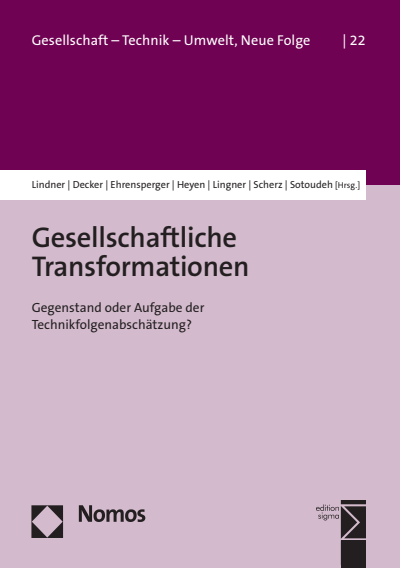
Gesellschaftliche Transformationen
Gegenstand oder Aufgabe der Technikfolgenabschätzung?- Editors:
- | | | | | |
- Series:
- Gesellschaft - Technik - Umwelt, Volume 22
- Publisher:
- 2021
Search publication
Bibliographic data
- Edition
- 1/2021
- Copyright Year
- 2021
- ISBN-Print
- 978-3-8487-6035-0
- ISBN-Online
- 978-3-7489-0155-6
- Publisher
- Nomos, Baden-Baden
- Series
- Gesellschaft - Technik - Umwelt
- Volume
- 22
- Language
- German
- Pages
- 428
- Product Type
- Edited Book
Table of contents
ChapterPages
- Titelei/Inhaltsverzeichnis No access Pages 1 - 10
- Authors: | | | | | |
- Zur 8. NTA-Konferenz No accessAuthors: | | | | | |
- Danksagung No accessAuthors: | | | | | |
- Literatur No accessAuthors: | | | | | |
- Authors:
- 1 Einleitung No accessAuthors:
- 2 Zum Begriff der Transformation – erste Anknüpfungspunkte an TA No accessAuthors:
- 3 Verhältnisbestimmung von TA und Transformation: Zwei Thesen No accessAuthors:
- 4 Die Große Transformation als Möglichkeitsraum No accessAuthors:
- Authors:
- 5.1 Grenzerfahrung I – Die Große Transformation als menschheitsgeschichtlicher Umbruch No accessAuthors:
- 5.2 Grenzerfahrung II – Transformative TA No accessAuthors:
- 5.3 Grenzerfahrung III – TA als technisches Unterfangen No accessAuthors:
- Literatur No accessAuthors:
- Authors:
- 1 TA and Democracy No accessAuthors:
- 2 TA as Object and Observer of Ambivalence No accessAuthors:
- 3 A Problem of Representation No accessAuthors:
- 4 Roles of Science in Democracy No accessAuthors:
- 5 An Example of TA as Honest Broker No accessAuthors:
- 6 Conclusion No accessAuthors:
- References No accessAuthors:
- Authors: |
- 1 Gesellschaftliche Transformation als Projekt No accessAuthors: |
- 2 TA als Projekt der Optionensteigerung No accessAuthors: |
- 3 TA als Projekt der Inklusionssteigerung No accessAuthors: |
- 4 TA als Projekt der Innovationssteigerung No accessAuthors: |
- 5 TA als Reflexions- und Transformationsagentin No accessAuthors: |
- Literatur No accessAuthors: |
- Authors:
- 1 Zur Fragestellung No accessAuthors:
- 2 TA zwischen Intervention und Neutralität No accessAuthors:
- 3 Zum TA-Verständnis No accessAuthors:
- 4 TA als transformativ wirkender Honest Broker No accessAuthors:
- 5 TA als Issue Advocate für Demokratie No accessAuthors:
- 6 Schlussbemerkung No accessAuthors:
- Literatur No accessAuthors:
- Authors: |
- Einleitung No accessAuthors: |
- 1 Verkürzungen des Konzepts Transformativer Wissenschaften No accessAuthors: |
- 2 Ausweitung auf sozio-technowissenschaftliche Transformationen: Prospektive Technikfolgenabschätzung No accessAuthors: |
- 3 Zwei Fallbeispiele: Dünnschicht-Photovoltaik und Gene Drives gegen Malaria No accessAuthors: |
- 4 Fazit: ProTA als notwendiger Teil transformativer Wissenschaft No accessAuthors: |
- Literatur No accessAuthors: |
- Authors:
- 1 Einleitung No accessAuthors:
- 2 Computer und Computernetze jenseits des Eisernen Vorhangs No accessAuthors:
- 3 Fazit No accessAuthors:
- 4 Anmerkung No accessAuthors:
- Literatur No accessAuthors:
- Authors:
- 1 Einleitung: Transformationen als soziale Innovationen No accessAuthors:
- 2 Transformationsprozesse feldtheoretisch aufschlüsseln? No accessAuthors:
- 3 Zwei Transformationsarenen: Energiewende und Klimapolitik No accessAuthors:
- 4 Transformationsarenen und Problemlösung No accessAuthors:
- Literatur No accessAuthors:
- Authors:
- 1 TA – von der Wachhund- zur Spürhund-Funktion No accessAuthors:
- 2 „Embedded Humanism“ – soziotechnische Integration durch Interaktion No accessAuthors:
- 3 Chancen und Risiken von STIR No accessAuthors:
- Literatur No accessAuthors:
- Authors: |
- 1 Vision Assessment als Analyse von Visionen soziotechnischer Zukünfte No accessAuthors: |
- 2 Visionen als Teil von Transformationspraktiken – Ausgangslage/Perspektive No accessAuthors: |
- 3 Rolle und Begrenztheit des bisherigen Vision Assessments No accessAuthors: |
- 4 Vorschläge für eine Erweiterung des Vision Assessments für Transformationen No accessAuthors: |
- 5 Konsequenzen der Erweiterung für Technikfolgenabschätzung und Vision Assessment – in der Diskussion No accessAuthors: |
- Literatur No accessAuthors: |
- Authors:
- 1 Die Beobachtungstechnik des operativen Konstruktivismus No accessAuthors:
- 2 Die Technikbeobachtung der modernen Gesellschaft No accessAuthors:
- 3 Technikfolgenabschätzung und Technikambivalenz No accessAuthors:
- 4 Auf dem Weg zu einem konstruktivistischen Forschungsprogramm No accessAuthors:
- Literatur No accessAuthors:
- Authors:
- 1 Einleitung No accessAuthors:
- 2 Schumpeter’sche Politische Ökonomie No accessAuthors:
- 3 Technikdeterminismus im Historischen Institutionalismus No accessAuthors:
- 4 Dependenztheorie No accessAuthors:
- 5 Kernpunkte einer politischen Wissenstheorie technischen Wandels No accessAuthors:
- 6 Fazit No accessAuthors:
- Literatur No accessAuthors:
- Authors: |
- 1 Offene Werkstätten als Singularitäten – ein Gegenstand für die TA No accessAuthors: |
- 2 Bestandsaufnahme von Offenen Werkstätten in Deutschland No accessAuthors: |
- Authors: |
- 3.1 Typologisierung No accessAuthors: |
- 3.2 Fallbeispiele No accessAuthors: |
- 3.3 Skalierung der Wirkungen No accessAuthors: |
- 3.4 Desiderata für eine neue TA-Agenda über singuläre Phänomene No accessAuthors: |
- Literatur No accessAuthors: |
- Authors: | |
- 1 Einleitung No accessAuthors: | |
- Authors: | |
- 2.1 Unterschiedliche Positionen aber mehrheitlich einheitliche Praxis No accessAuthors: | |
- 2.2 Eine Nachhaltigkeitspolitik die ihre Ziele verfehlt No accessAuthors: | |
- 2.3 Das Verschließen von Alternativen: Institutionalisierung und Hegemonie No accessAuthors: | |
- 3 Das Öffnen von Alternativen: Schlussfolgerungen für die nachhaltigkeitsorientierte Technikfolgenabschätzung No accessAuthors: | |
- Literatur No accessAuthors: | |
- Authors: | | | | | |
- 1 Einführung No accessAuthors: | | | | | |
- 2 Akteure und Partizipation im Reallabor No accessAuthors: | | | | | |
- Authors: | | | | | |
- 3.1 Frage 1: Wer sind die Akteure, die an transdisziplinärer bzw. an transformativer Forschung zu beteiligen sind? No accessAuthors: | | | | | |
- 3.2 Frage 2: Wie hängen Legitimität und Partizipation zusammen? No accessAuthors: | | | | | |
- 4 Das experimentelle Moment in Reallaboren: epistemischer Normalfall – partizipativer Grenzfall No accessAuthors: | | | | | |
- 5 Visuelles Schlusswort – Graphic Recording der Inhalte No accessAuthors: | | | | | |
- Literatur No accessAuthors: | | | | | |
- Authors: | |
- 1 Anforderungen an Öffentlichkeitsbeteiligung im Rahmen von RRI No accessAuthors: | |
- Authors: | |
- 2.1 Die Mobilisierung der Öffentlichkeit für Fragen der synthetischen Biologie No accessAuthors: | |
- 2.2 Deliberation als Antwort auf Protest No accessAuthors: | |
- Authors: | |
- 3.1 Akteure: Rollenkonflikte und organisationale Mission No accessAuthors: | |
- 3.2 Timing: Zum Problem der Frühzeitigkeit von Beteiligung No accessAuthors: | |
- 3.3 Framing: Was wird (nicht) verhandelt? No accessAuthors: | |
- 3.4 Modi und Intensität: Rationalisierungsansprüche durch eingeladene Beteiligung No accessAuthors: | |
- 3.5 Zweck und Wirkung von Dialogen: je konkreter, desto besser? No accessAuthors: | |
- 4 Fazit: Welche Bedingungen fördern zivilgesellschaftliche Beteiligung? No accessAuthors: | |
- Hinweis zur Projektförderung No accessAuthors: | |
- Literatur No accessAuthors: | |
- Authors: |
- 1 Responsible Research and Innovation und Mainstreaming von Beteiligung No accessAuthors: |
- Authors: |
- Authors: |
- 2.1.1 Design der Bürger*innenpanels No accessAuthors: |
- 2.1.2 Design der europäischen Multi-Akteurs-Konferenz No accessAuthors: |
- 2.2 Zentrale Ergebnisse No accessAuthors: |
- Authors: |
- Szenario A: Beteiligung als Feigenblatt No accessAuthors: |
- Szenario B: Beteiligung als willkommener Input No accessAuthors: |
- Szenario C: Demokratisierte Forschung No accessAuthors: |
- Anmerkungen No accessAuthors: |
- Literatur No accessAuthors: |
- Authors: | |
- 1 Einführung No accessAuthors: | |
- 2 Governance als Konzept für politische Steuerung No accessAuthors: | |
- Authors: | |
- 3.1 Ausgestaltung der Kooperation und Koordination netzwerkförmiger Governance No accessAuthors: | |
- 3.2 Institutionalisierung von Partizipation und die Ausgestaltung der Schnittstellen No accessAuthors: | |
- 3.3 Umgang mit Wissen und Ungewissheiten in Planungs- und Entscheidungsprozessen No accessAuthors: | |
- 4 Ausblick No accessAuthors: | |
- Literatur No accessAuthors: | |
- Authors: |
- 1 Inspiration oder Information No accessAuthors: |
- 2 Ansprüche an Informations- und Inspirationsmaterial No accessAuthors: |
- 3 Zielkonflikte und Spannungsfelder No accessAuthors: |
- 4 Fazit No accessAuthors: |
- Literatur No accessAuthors: |
- Authors: | | |
- 1 Einleitung No accessAuthors: | | |
- Authors: | | |
- 2.1 Von Einzelmaßnahmen zum Policy Packaging No accessAuthors: | | |
- 2.2 Policy Packaging in der Anwendung No accessAuthors: | | |
- Authors: | | |
- 3.1 Hintergrund und Problemstellung No accessAuthors: | | |
- 3.2 Methodisches Vorgehen und transdisziplinäre Einbettung No accessAuthors: | | |
- Authors: | | |
- 3.3.1 Policy Package „Stärkung der Multi- und Intermodalität in urbanen Räumen durch (kostengünstigen) ÖPNV und integriertes Flächenmanagement“ No accessAuthors: | | |
- 3.3.2 Policy Package „CO2-Flottengrenzwerte & CO2-Preiskomponente“ No accessAuthors: | | |
- 4 Diskussion No accessAuthors: | | |
- 5 Zusammenfassung und Ausblick No accessAuthors: | | |
- Literatur No accessAuthors: | | |
- Anhang No accessAuthors: | | |
- Authors: | | | |
- 1 Introduction No accessAuthors: | | | |
- 2 Lithium-ion batteries and the rush competition for a resilient market No accessAuthors: | | | |
- 3 Conceptual framework and the assessment procedures for strategic relevance of lithium No accessAuthors: | | | |
- 4 Identifying the risk level of lithium as a critical material for Germany No accessAuthors: | | | |
- 5 Conclusions – perspective for core policy measures as strategic recommendations No accessAuthors: | | | |
- References No accessAuthors: | | | |
- Authors: | | | |
- 1 Einleitung No accessAuthors: | | | |
- 2 Agentenbasierte Modellierung und Simulation als Methode der TA No accessAuthors: | | | |
- Authors: | | | |
- 3.1 Gebäude- und Stromnetzsimulator No accessAuthors: | | | |
- 3.2 Endkunden-Simulator No accessAuthors: | | | |
- 3.3 Steuerungssimulator No accessAuthors: | | | |
- Authors: | | | |
- 4.1 Szenario-Beschreibung und Experimentaufbau No accessAuthors: | | | |
- 4.2 Ergebnisse No accessAuthors: | | | |
- 5 Fazit No accessAuthors: | | | |
- Danksagung No accessAuthors: | | | |
- Literatur No accessAuthors: | | | |
- Authors:
- Hintergrund und Zielsetzung No accessAuthors:
- 1 Fallbeispiel Kältetechnik No accessAuthors:
- 2 Technikambivalenzen No accessAuthors:
- Authors:
- 3.1 Ambivalenz des Erfolgs No accessAuthors:
- 3.2 Ambivalenzen der Versprechungen und der Rhetorik No accessAuthors:
- 3.3 Ambivalenz der Wirkungen No accessAuthors:
- 4 Schlussfolgerungen No accessAuthors:
- Literatur No accessAuthors:
- Authors: |
- 1 Einleitung No accessAuthors: |
- 2 Vorläufer der Bioökonomie No accessAuthors: |
- 3 Etablierung des Konzepts Bioökonomie und erste integrierte Bioökonomie-Strategien No accessAuthors: |
- 4 Verbreitung und Differenzierung der Bioökonomie-Konzepte No accessAuthors: |
- 5 Neuere Entwicklungen No accessAuthors: |
- 6 Fazit No accessAuthors: |
- Literatur No accessAuthors: |
- Authors: | |
- 1 Bioeconomy controversies and the need for orientational knowledge No accessAuthors: | |
- 2 TA tools for connecting ethical aspects with political processes No accessAuthors: | |
- 3 Rationale and methodology for integrated case studies of ethical arguments, policy push, and policy pull No accessAuthors: | |
- 4 Outlook No accessAuthors: | |
- References No accessAuthors: | |
- Authors:
- 1 Einleitung No accessAuthors:
- 2 Drei Ordnungsversprechen des smarten abstrakten Raumes No accessAuthors:
- 3 Abstrahierter Stadtraum No accessAuthors:
- 4 Gelebter Stadtraum No accessAuthors:
- 5 Interaktionen von abstrahierten und gelebten Räumen No accessAuthors:
- 6 Tendenziell fortschreitende Ökonomisierung in der Smart City No accessAuthors:
- 7 Forschungsplädoyer als Fazit No accessAuthors:
- Literatur No accessAuthors:
- Authors: | |
- 1 Handwerksorientierte Spezialisierung des Repair und Do-it-yourself Urbanism in Neubau No accessAuthors: | |
- 2 Gentrifizierung in Ottakring und vorhandene Entwicklungspotentiale des Repair und Do-it-yourself Urbanism No accessAuthors: | |
- 3 Schlussfolgerungen No accessAuthors: | |
- Literatur No accessAuthors: | |
- Authors: | |
- 1 Introduction No accessAuthors: | |
- Authors: | |
- 2.1 Methods No accessAuthors: | |
- 2.2 Accessibility No accessAuthors: | |
- 2.3 Technology design and development No accessAuthors: | |
- Authors: | |
- 2.4.1 Independent living No accessAuthors: | |
- 2.4.2 Education No accessAuthors: | |
- 2.4.3 Employment No accessAuthors: | |
- Authors: | |
- 3.1 Scenario one: Mid-tech solutions in an inclusive society No accessAuthors: | |
- 3.2 Scenario two: Technological fixes in a prejudiced society No accessAuthors: | |
- 3.3 Scenario three: Intensive high-tech reliance in an individualistic society No accessAuthors: | |
- 3.4 Scenario four: Privileged use of technology in a divided society No accessAuthors: | |
- 4 Socio-technical strategies for an inclusive society No accessAuthors: | |
- Literature No accessAuthors: | |
- Authors: |
- 1 Einleitung No accessAuthors: |
- Authors: |
- Zwischenfazit No accessAuthors: |
- Authors: |
- 3.1 Reflexivität No accessAuthors: |
- 3.2 Risiko-Analyse No accessAuthors: |
- Zwischenfazit No accessAuthors: |
- Authors: |
- 4.1 Unterstützung der Führungsebene No accessAuthors: |
- 4.2 Aufwand und Disruption No accessAuthors: |
- 4.3 Allgemeinverständlichkeit des DSFA-Verfahrens No accessAuthors: |
- Zwischenfazit No accessAuthors: |
- 5 Fazit No accessAuthors: |
- Literatur No accessAuthors: |
- Authors: | | |
- Authors: | | |
- 1.1 Welcher gesellschaftliche Transformationsprozess ist für Sie zentral, und was ist nötig, um diesen Wandel voranzubringen? No accessAuthors: | | |
- 1.2 Was erwarten politische Entscheidungsträger von Seiten der Wissenschaft? Und umgekehrt: Mit welchen Erwartungen sehen sich Wissenschaftler/TA-ler von Seiten der Politik konfrontiert? No accessAuthors: | | |
- 1.3 Geht es eher um Expertise bzgl. bestimmter Technikfelder (KI, IKT, Mobilität etc.) oder auch um Expertise bzgl. der Gestaltung der eigentlichen Transformationsprozesse? No accessAuthors: | | |
- 1.4 Verschiebt sich da womöglich was, braucht TA mehr Prozessgestaltungs-Expertise? Oder finden politische Entscheidungsträger, dass bei ihnen die Expertise bzgl. der Gestaltung von Transformationspro... No accessAuthors: | | |
- 1.5 Wieviel Normativität steht der TA gut zu Gesicht, wieviel Neutralität? Ist Neutralität schon gewahrt, wenn keine Eigeninteressen der TA-Akteure im Spiel sind, oder sollte es um auch um „Wertneutra... No accessAuthors: | | |
- 1.6 Welchen Transformationsprozessen ist die TA-/Wissenschafts-Szene selbst aktuell unterworfen? Wie soll sie darauf reagieren? Welche Transformationsziele soll sie sich womöglich selbst setzen? Welch... No accessAuthors: | | |
- Authors: | | |
- 2.1 Was erwarten politische Entscheidungsträger von Seiten der Wissenschaft? Und umgekehrt: mit welchen Erwartungen sehen sich Wissenschaftler/TA-ler von Seiten der Politik konfrontiert? Geht es eher ... No accessAuthors: | | |
- 2.2 Wieviel Normativität steht der TA gut zu Gesicht, wieviel Neutralität? Ist Neutralität schon gewahrt, wenn keine Eigeninteressen der TA-Akteure im Spiel sind, oder sollte es um auch um „Wertneutra... No accessAuthors: | | |
- 2.3 Welchen Transformationsprozessen ist die TA-/Wissenschafts-Szene selbst aktuell unterworfen? Wie soll sie darauf reagieren? Welche Transformationsziele soll sie sich womöglich selbst setzen? Welch... No accessAuthors: | | |
- 2.4 Wie müsste eine kohärente und gut aufgestellte Transformationspolitik aussehen? Was fehlt einer missionsorientierten FuI-Politik, um eine Transformationspolitik zu sein? Welche Rollen kommen hier ... No accessAuthors: | | |
- Authors: | | |
- 3.1 Transformative Herausforderungen in Wirtschaft und Gesellschaft … No accessAuthors: | | |
- 3.2 … und ihre Auswirkungen auf die gesellschaftliche Rolle von Wissenschaft No accessAuthors: | | |
- 3.3 Neue Anforderung an TA für die Unterstützung gesellschaftlicher Transformationsprozesse No accessAuthors: | | |
- 3.4 Die Komplexitätsfalle transformativer Politik No accessAuthors: | | |
- 3.5 TA im Rahmen transformativer Politik No accessAuthors: | | |
- Literatur No accessAuthors: | | |