KNOWLEDGE ORGANIZATION is a forum for all those interested in the organization of knowledge on a universal or a domain-specific scale, using concept-analytical or concept-synthetical approaches, as well as quantitative and qualitative methodologies. KNOWLEDGE ORGANIZATION also addresses the intellectual and automatic compilation and use of classification systems and thesauri in all fields of knowledge, with special attention being given to the problems of terminology.KNOWLEDGE ORGANIZATION publishes original articles, reports on conferences and similar communications, as well as book reviews, letters to the editor, and an extensive annotated bibliography of recent classification and indexing literature.KNOWLEDGE ORGANIZATION should therefore be available at every university and research library of every country, at every information center, at colleges and schools of library and information science, in the hands of everybody interested in the fields mentioned above and thus also at every office for updating information on any topic related to the problems of order in our information-flooded times.
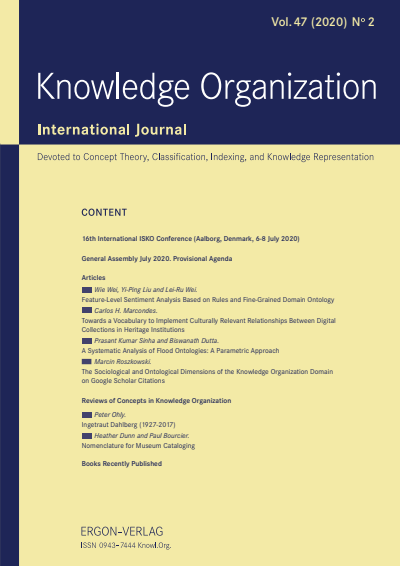
Mining product reviews and sentiment analysis are of great significance, whether for academic research purposes or optimizing business strategies. We propose a feature-level sentiment analysis framework based on rules parsing and fine-grained domain...
Cultural heritage institutions are publishing their digital collections over the web as LOD. This is is a new step in the patrimonialization and curatorial processes developed by such institutions. Many of these collections are thematically...
The article identifies the core literature available on flood ontologies and presents a review on these ontologies from various perspectives like its purpose, type, design methodologies, ontologies (re)used, and also their focus on specific flood...
This study aims to identify the profiles of researchers in the knowledge organization domain on Google Scholar Citations (GSC) and investigate its sociological and ontological dimensions. The sociological dimension is related to GSC users who...
Dr. Ingetraut Dahlberg essentially introduced and shaped the term “knowledge organization.” She also was the main engine in the founding of the scientific associations Society for Classification and International Society for Knowledge...
We present an overview of Nomenclature’s history, characteristics, structure, use, management, development process, limitations, and future. Nomenclature for Museum Cataloging is a bilingual (English/French) structured and controlled list of...