, to see if you have full access to this publication.
Monograph No access
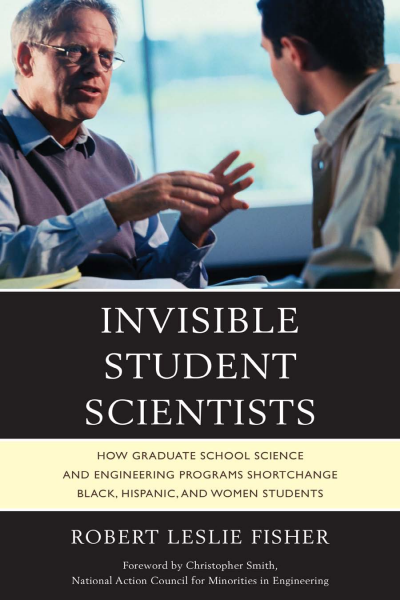
Invisible Student Scientists
How Graduate School Science and Engineering Programs Shortchange Black, Hispanic, and Women Students
Authors:
Publisher:
2013
Summary
In this book, Robert Leslie Fisher contends that thanks to misguided university and government policies, we have created a science elite that does not represent the demographics of the nation. We need to recruit more native-born women and under-represented minorities into graduate programs in order to maintain our nation’s prosperity and military strength. Fisher draws on sample data from 1300 male and female respondents from White, Black, Hispanic, and Asian students. He shows how the student culture of graduate schools in science and engineering sees women, Black, and Hispanic students as outsiders and deprives these budding scientists and research engineers of the collaborators they need to succeed in their careers. Fisher argues that we must inspire female, Black, and Hispanic graduate students to believe they can succeed in their careers by (1) changing the student culture in graduate schools’ science and engineering programs to be more inclusive, (2) removing burdensome undergraduate educational duties from graduate students so that they can concentrate on mastering the difficult subject matter of their disciplines, and (3) hiring more women and under-represented minorities as faculty to serve as role models.
Keywords
Search publication
Bibliographic data
Edition
1/2013
Copyright Year
2013
ISBN-Print
978-0-7618-6258-1
ISBN-Online
978-0-7618-6262-8
Publisher
Hamilton Books, Lanham
Language
English
Pages
134
Product Type
Monograph
Table of contents
ChapterPages
Table of Contents No access
List of Tables No access
Foreword No access
Preface No access
Acknowledgements No access
Introduction No access
Chapter One: Theoretical Orientation and Study Plan No access Pages 1 - 22
Chapter Two: Cosseted White Males Revisited No access Pages 23 - 58
Chapter Three: Women Graduate Students: Some Are More Equal Than Others No access Pages 59 - 72
Chapter Four: Are (White) Men Better Professors and Scientists? No access Pages 73 - 116
Chapter Five: Conclusions and Policy Implications No access Pages 117 - 122