, to see if you have full access to this publication.
Monograph No access
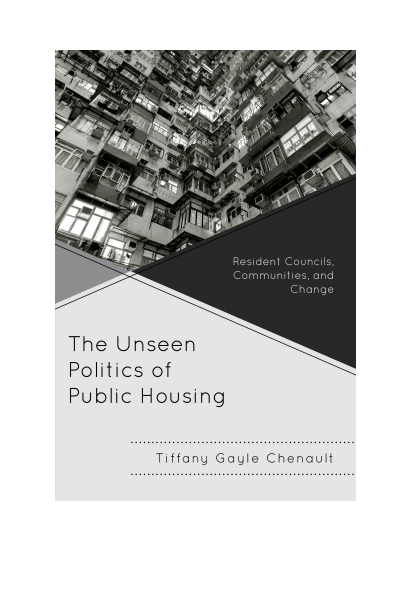
The Unseen Politics of Public Housing
Resident Councils, Communities, and Change
Authors:
Publisher:
2015
Summary
The Department of Housing and Urban Development (HUD) emphasizes the word “community” for building economic development, citizen participations, and revitalization of facilities and services in urban and rural areas. Resident Councils are one way to develop and build community among residents of public housing. Despite HUD stressing community building in public housing and investing money and policies around it, there are some resident councils that are not fulfilling the expectations of HUD.
This book is my attempt to describe and explain HUD’s expectations for the resident council as an active agent for community building and the actual practices of the resident council. I argue that policies and regulations of resident councils which exist to support the effectiveness of the resident council in creating and implementing community-building, self-sufficiency, and empowerment activities and goals in a public housing community may do more harm than good.
The Department of Housing and Urban Development invests and spends billions on Public Housing Programs (6.6 billion in 2013). The majority of the 1.2 million people who live in public housing do not live in large urban areas with thousands of people confined to a certain space. The majority of public housing units (90%) have fewer than 500 units. These smaller units and the people that live in them tend to go unnoticed.
This ethnographic case study focuses on explaining and understanding the factors and constraints that exist between HUD's expectations for the resident council as an active agent for community building and the actual practices of the resident council. To explain the disjunction—in fact, to determine if such disjunctions identified by Rivertown council members are real. Using the tenets of Critical Race Theory allows us to understand what forces—either real or imagined, structural or cultural—prevent the resident council from being an effective agent for change in the public housing community.
Keywords
Search publication
Bibliographic data
Edition
1/2015
Copyright Year
2015
ISBN-Print
978-0-7391-6506-5
ISBN-Online
978-0-7391-6508-9
Publisher
Lexington, Lanham
Language
English
Pages
131
Product Type
Monograph
Table of contents
ChapterPages
Contents No access
Start of the Journey No access
1 Welcome to Rivertown No access Pages 1 - 12
2 Code for Community Engagement No access Pages 13 - 24
3 Who’s Leading the Council? No access Pages 25 - 42
4 Rules for Organizing a Council No access Pages 43 - 56
5 Not Fitting the Public Housing Image: Location and Communication No access Pages 57 - 72
6 Meetings and Manager Dynamics No access Pages 73 - 88
7 Policy Recommendations No access Pages 89 - 100
Appendix A No access Pages 101 - 104
Appendix B No access Pages 105 - 110
Bibliography No access Pages 111 - 126
Index No access Pages 127 - 130
About the Author No access Pages 131 - 131
Similar publications
from the topics "Soziologie allgemein"
Edited Book Full access
Karen Kastenhofer, Marius Albiez, Pauline Riousset, Constanze Scherz, Michael Decker