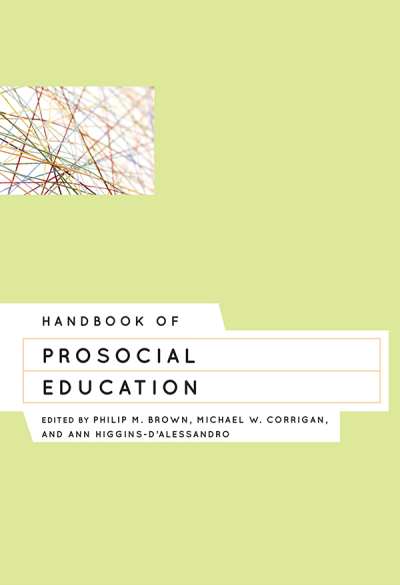
Handbook of Prosocial Education
- Editors:
- | |
- Publisher:
- 2012
Summary
Handbook of Prosocial Education is the definitive theoretical, practical, and policy guide to the prosocial side of education, the necessary second side of the educational coin. Academic teaching and learning are the first side of education; however, academic success depends upon the structures and support of prosocial educational efforts from promoting positive school climate to fostering student and teacher development to civic literacy and responsible and critical citizenship participation. The Handbook of Prosocial Education chapters, written by highly-respected researchers and outstanding educators, represent the wide range of research-based prosocial interventions from pre-school through high school. The chapters explore and explain how prosocial education helps teachers create effective classroom learning environments to support the development of the whole student, principals encourage positive school climate, and superintendents work to improve the health and well-being of their systems. As readers will learn, when done well, prosocial education develops the capacities and competencies of students, teachers, and school administrators that lead to a more autonomous, positive self-concept, greater sense of purpose, more socially responsible behaviors, and increased connections between families, schools, and communities.
This book pulls together in one place for the first time the various threads that create the prosocial education tapestry, making a compelling case for the necessity of changing national educational policy that continues to be ever-more oriented to only the academic side of the educational coin, thus jeopardizing the foundational and historic purpose of educating our children for their full human development and participation in our democracy.
Search publication
Bibliographic data
- Edition
- 1/2012
- Copyright Year
- 2012
- ISBN-Print
- 978-1-4422-1119-3
- ISBN-Online
- 978-1-4422-1121-6
- Publisher
- Rowman & Littlefield, Lanham
- Language
- English
- Pages
- 838
- Product Type
- Edited Book
Table of contents
- Contents No access
- Foreword No access
- Foreword. The Case for Prosocial Education: Developing Caring, Capable Citizens No access
- Preface No access
- CHAPTER 1. The Second Side of Education: Prosocial Development No access
- CHAPTER 2. The History of Prosocial Education No access
- CHAPTER 3. The History and Direction of Research on Prosocial Education No access
- CHAPTER 4. The Practice of Prosocial Education No access
- CHAPTER 5. Prosocial Education: A Coherent Approach to Putting Applied Theory into Action No access
- CHAPTER 6. Character Education: A Primer on History, Research, and Effective Practices No access
- Case Study 6A. Francis Howell Middle School, Missouri No access
- Case Study 6B. The Jefferson Way No access
- CHAPTER 7. Civic Education and Prosocial Behavior No access
- Case Study 7A. Project Citizen No access
- Case Study 7B. Civic Environmentalism: Social Responsibility for Public Resources No access
- CHAPTER 8. Moral Education No access
- Case Study 8A. Philosophy as Prosocial Education No access
- Case Study 8B. Reading for Life No access
- Case Study 8C. The “A”-School: Democracy and Learning No access
- CHAPTER 9. School Climate and Culture Improvement: A Prosocial Strategy That Recognizes,Educates, and Supports the Whole Child and the Whole School Community No access
- Case Study 9A. School Climate: The Road Map to Student Achievement No access
- Case Study 9B. School Climate Reform at Upper Merion Area Middle School No access
- CHAPTER 10. The Case for Prosocial Education: Service Learning as Community Building No access
- Case Study 10A. Service Learning Success in Philadelphia No access
- Case Study 10B. Service Learning in Mineola High School No access
- Case Study 10C. Service Learning in Practice: Lake Riviera Middle School No access
- CHAPTER 11. Social and Emotional Learning and Prosocial Education: Theory, Research, and Programs No access
- Case Study 11A. Implementing the PATHS Program in Birmingham, UK No access
- Case Study 11B. Roots of Empathy No access
- Case Study 11C. “The Missing Piece in Schooling”: Social and Emotional Learning No access
- CHAPTER 12. Supporting Educational Goals through Cultivating Mindfulness: Approaches for Teachers and Students No access
- Case Study 12A. Learning to BREATHE No access
- Case Study 12B. Implementing the Cultivating Awareness and Resilience in Education (CARE) Program No access
- CHAPTER 13. Positive Youth Development No access
- Case Study 13A. Integrating Six Developmental Pathwaysin the Classroom: The Synergy between Teacher and Students No access
- Case Study 13B. Children First: It Starts with You No access
- Case Study 13C. Positive Youth Development: Positive Action at Farmdale Elementary School No access
- CHAPTER 14. Prevention of Harassment, Intimidation, and Bullying No access
- Case Study 14A. Lynch Elementary School Bullying Prevention Program No access
- Case Study 14B. Team LEAD—Leadership, Empathy, Accountability, and Discussion: Addressing Social Aggression through Bystander Leadership Groups No access
- Case Study 14C. Building a Bullying Prevention Program from the Ground Up: Students as the Key No access
- CHAPTER 15. Establishing the Foundations: Prosocial Education in Early Childhood Development No access
- Case Study 15A. The Early Learning Campus No access
- Case Study 15B. Implementing an Evidence-Based Preschool Program: A Superintendent’s Perspective on Tools of the Mind No access
- CHAPTER 16. After School as a Context for Prosocial Development No access
- Case Study 16A. The Core Five Essentials: A Prosocial Application in After-School Settings No access
- Case Study 16B. The Committee for Hispanic Children and Families After-School Program at PS/MS 279 No access
- CHAPTER 17. Building a Prosocial Mind-Set in Teacher and Administrator Preparation Programs No access
- Case Study 17A. Developing Emotionally Intelligent School Counselors for the Prosocial Classroom No access
- Case Study 17B. Leading in the Middle: A Tale of Prosocial Education Reform in Two Principals and Two Middle Schools No access
- Case Study 17C. Prospective Teachers’ Work with Homeless Youth: Articulating the Value of Service Learning in Teacher Education No access
- CHAPTER 18. Multicultural Education Is/as/in Prosocial Education No access
- Case Study 18A. Facing History and Ourselves No access
- Case Study 18B. Educating American Indian Students: Creating a Prosocial Context No access
- CHAPTER 19. The District Superintendent’s Role in Supporting Prosocial Education No access
- CHAPTER 20. The School Principal’s Role in Planning and Organizing Prosocial Education No access
- CHAPTER 21. The School Specialist’s Role as a Champion of Prosocial Education No access
- CHAPTER 22. The Teacher’s Role in Implementing Prosocial Education No access
- CHAPTER 23. The Body of Evidence Supporting the Call for Prosocial Education No access
- CHAPTER 24. Prosocial Education: Weaving a Tapestry to Support Policy and Practice No access
- Index No access Pages 801 - 820
- About the Contributors No access Pages 821 - 838