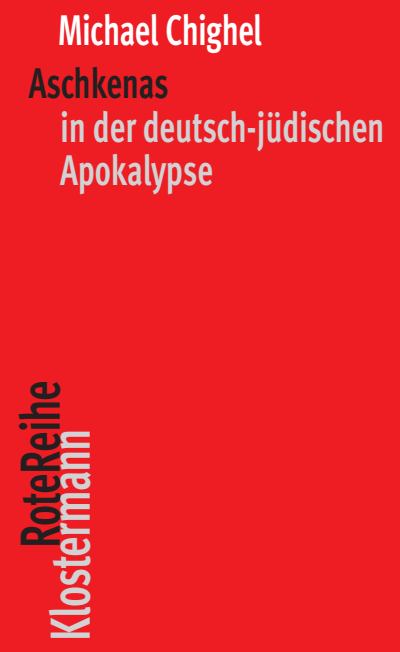
In his new book, Michael Chighel, the director of the Budapest Ashkenazium, turns his attention to the inner dynamics of German-Jewish history over the last half millennium. What he finds is a ‘theory of Ashkenaz’, the observation of a Judaism and a Germanness that have mutually influenced each other in their encounter. The key figure in this encounter is Martin Luther, whose work had an effect in both good and evil ways. Based on Hermann Cohen's important essay "Deutschtum und Judentum" (Germanness and Judaism), Chighel advances to an understanding of the Ashkenazim that emphasises their messianic character, especially for the present, while touching on all the catastrophes that the German-Jewish relationship experienced in the 20th century. This bold attempt is thus dedicated to a resumption of Cohen's project, which could only have been perceived as naïve had it been undertaken immediately after the Shoah. It is also a contribution to the question of the spiritual situation of Judaism today, and thus also to the question of the spiritual situation of a Western civilisation whose Christian roots reach right down to the soil of the Hebrew Bible.
Keywords
Search publication
Bibliographic data
Edition
1/2025
Copyright Year
2025
ISBN-Print
9783465046493
ISBN-Online
978-3-465-14649-0
Publisher
Klostermann, Frankfurt am Main
Series
Klostermann Rote Reihe
Volume
160
Language
German
Pages
296
Product Type
Monograph
Table of contents
ChapterPages
Titelei/Inhaltsverzeichnis No access Pages 1 - 14
I. Die Aschkenas-Frage No access Pages 15 - 60
II. Die Saphir-Theorie No access Pages 61 - 132
III. Die Auschwitz-Analyse No access Pages 133 - 286