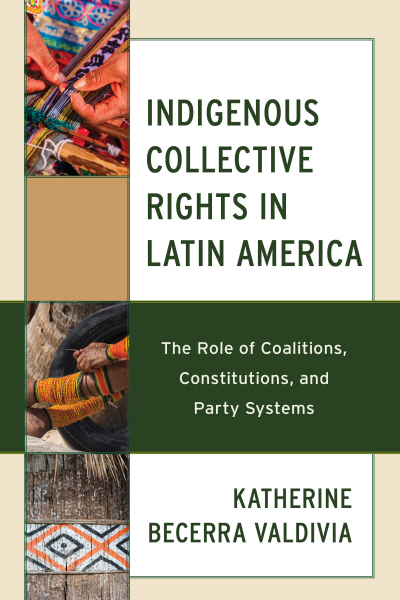
Indigenous Collective Rights in Latin America
The Role of Coalitions, Constitutions, and Party Systems- Authors:
- Publisher:
- 2022
Summary
Latin America is a region with high levels of recognition for Indigenous collective rights. Still, legal protections differ considerably among countries. Why do some countries in Latin America have a strong recognition of collective rights for Indigenous people while others do not? What are the factors that help enhance the presence of collective rights? The author argues that while Indigenous social movements are crucial to the protection of Indigenous rights, they are not enough. The recognition of these rights is influenced by organizational factors (such as coalitions between Indigenous peoples and non-Indigenous allies) as well as institutional conditions (including constitutional replacement and party systems). By employing qualitative comparative analysis (QCA) and case studies from Bolivia, Chile, Colombia, Ecuador, Guatemala, Mexico, and Peru, this book explores the ways various elements combine to create conditions for a variety of collective rights.
Keywords
Search publication
Bibliographic data
- Edition
- 1/2022
- Copyright Year
- 2022
- ISBN-Print
- 978-1-6669-0910-4
- ISBN-Online
- 978-1-6669-0911-1
- Publisher
- Lexington, Lanham
- Language
- English
- Pages
- 180
- Product Type
- Monograph
Table of contents
- Dedication No access
- Contents No access
- Figures No access
- Tables No access
- Acknowledgments No access
- Indigenous Collective Rights Is about Going Further than Social Movements No access
- The Argument of This Book: Strong, Moderate, and Weak Collective Rights No access
- Cases and Analysis No access
- Plan of the Book No access
- Collective Rights: Conceptualization and Importance in Latin America No access
- Anti-Neoliberal Mass Mobilizations in Latin America: Effectiveness of Indigenous Social Movement for Protecting Collective Rights No access
- Notes No access
- Indigenous Social Movements: Are Indigenous Mobilizations Successful, If So Then When? No access
- The Institutional Conditions to Tell the Story: Party System and Constitutional Change No access
- The Equifinality Theory: Organizations and Institutions Creating More Collective Rights No access
- Notes No access
- Countries under Study and Methodology, Using QCA and Case Study No access
- The Conditions Influencing More Indigenous Collective Rights No access
- Conditions and Outcomes: Constructing a Truth Table No access
- Summary of the QCA Analysis No access
- Countries and Their Trajectories: Moving Forward and Stagnation No access
- Notes No access
- Colombian Context: Political Crisis and Violence No access
- Recognizing Collective Rights: The Role of Weak Party System and Personalistic Leaders No access
- Recognizing Collective Rights: The Role of National Organizations of Indigenous Peoples and Their Influence in Politics No access
- A Moment of Profound Change: More Coalitions and a New Constitution No access
- The Afterwards of the 1991 Constitution: More Collective Rights for Indigenous Peoples No access
- Colombia in Current Times: New Coalitions and New Challenges No access
- Notes No access
- Peru: A Context of Political Instability No access
- Weak Party System: Weak Collective Rights for Indigenous “Communities” No access
- The Status Quo Persists: New Constitution and Maintaining the Weak Collective Rights No access
- Political Instability and a New Constitution: The Institutional Conditions No access
- Organizations and Some Level of Coalitions for Indigenous Peoples for Recognizing Indigenous Collective Rights No access
- Peru in Current Times: Challenges for “Indigenous Peoples” No access
- Notes No access
- Context of Chile: A Stable Country No access
- An Institutionalized Party System: The Role of a High Level of Party Organization for Weak Indigenous Collective Rights No access
- Pinochet and Indigenous Peoples: Juridical Ethnocide and 1980 Constitution No access
- The New Agreements and the 1993 Indigenous Act: A Great Effort without Substantial Consequences No access
- The Never-Ending Story: The Failed Process of Constitutional Amendments No access
- A New Hope: ILO’s Convention No. 169 and the Right to Prior Consultation No access
- The Organization Condition: High Level of Indigenous Social Movements but Lack of Indigenous Organizations and Coalitions No access
- Chile in Currents Time: A New Constitution and the Role of Indigenous Peoples No access
- Notes No access
- Strong Coalitions and Unstable Institutions for Increasing the Level of Protection of Indigenous Collective Rights No access
- Indigenous Social Movements Need Coalitions to Be Successful No access
- Summary and Findings No access
- Future Research Agenda Regarding Collective Rights No access
- Appendix No access Pages 143 - 154
- References No access Pages 155 - 174
- Index No access Pages 175 - 178
- About the Author No access Pages 179 - 180