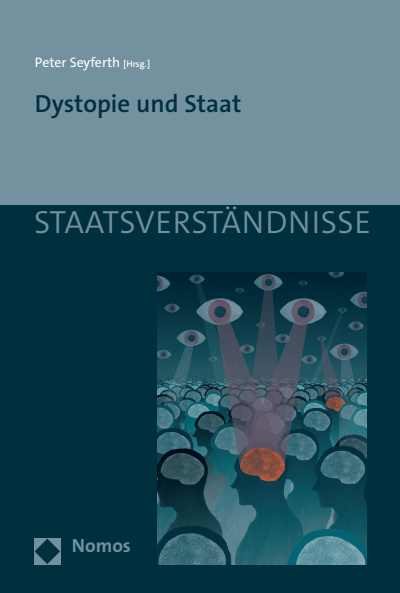
The state can be understood through the artistic expressions with which it is critically legitimised or delegitimised. Therefore, it is fruitful in political science to analyse dystopias in all their manifestations: in literature, film, comics, computer games, cartoons and music. Dystopias are the opposite of utopias, i.e. they represent not the ideal but the abominable state. Accordingly, they warn against bad state tendencies: totalitarianism and (eco-)dictatorships, surveillance and intrusion, state security and the health regime, capitalism and neo-feudalism—as well as resistance to them. This volume analyses dystopias from all phases of their development: from their precursors to their classic and latest forms. With contributions byAlexander Amberger | Andreas Brocza | Stefan Brocza | Felicia Englmann | Luis Glaser | Andreas Heyer | Anastasiya Kasko | Alexander Neupert-Doppler | Benedikt Neuroth | Sandra Maria Pfister | Patrizia Piredda | Thomas Schölderle | Maurice Schuhmann | Peter Seyferth | Tobias Weiß.
Keywords
Search publication
Bibliographic data
Copyright Year
2023
ISBN-Print
978-3-8487-7765-5
ISBN-Online
978-3-7489-2172-1
Publisher
Nomos, Baden-Baden
Series
Staatsverständnisse
Volume
168
Language
German
Pages
322
Product Type
Edited Book
Table of contents
ChapterPages
Titelei/Inhaltsverzeichnis No access Pages 1 - 8
Vom Horrorstaat erzählen. Über Dystopien als Warnliteratur, die nicht ignoriert werden sollte. Und über die Beiträge dieses Sammelbandes No access Pages 9 - 52
Authors:
Methode Hexenjagd. Juli Zehs klassische Dystopie Corpus Delicti No access Pages 55 - 76
Authors:
Vom Château Silling nach Butua. Staatsdystopien im Werk des Marquis de Sade No access Pages 77 - 94
Authors:
Paradigmen der Utopien und Dystopien in der Avengers-Saga aus den Marvel-Studios No access Pages 97 - 120
Authors:
The day the music died: Staatliche Repräsentation durch Musik und Klang in literarischen und filmischen Dystopien No access Pages 121 - 144
Authors:
Ikonographie der Privatsphäre. Über den dystopischen Gehalt in US-amerikanischen Karikaturen aus den 1960er und 1970er Jahren No access Pages 145 - 170
Authors:
Wenn der Staat abgedankt hat. Neofeudale Herrschaftssysteme transnationaler Familienkonzerne im Comic Lazarus No access Pages 171 - 194
Authors: |
Staatsverständnisse in dystopischen Videospielen. Wie die Spiele BioShock und Papers, Please den dystopischen Staat erlebbar machen No access Pages 195 - 220
Authors: |
Ökodiktatur als Dystopie. Entwürfe, Romane, Verschwörungsideologien No access Pages 223 - 244
Authors:
Dystopien in der DDR? Die Gesellschaftskritiker Robert Havemann, Gert Prokop und Wolfgang Harich No access Pages 245 - 266
Authors: |
Dystopie und Natalität. Über die Möglichkeit des politischen Handelns in einer dystopischen Gesellschaft No access Pages 267 - 286
Authors:
Die Vorwegnahme der (nächsten) Katastrophe. Zu einer grundlegenden Ambivalenz am Herzen des staatlichen Sicherheitsversprechens No access Pages 287 - 314
Authors:
Die Autorinnen und Autoren No access Pages 315 - 322