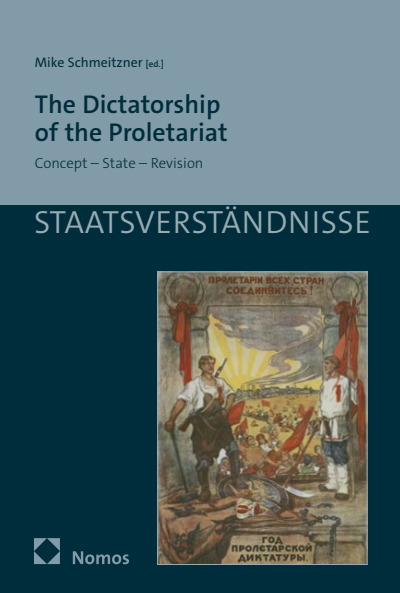
The Dictatorship of the Proletariat
Concept – State – Revision- Editors:
- Series:
- Staatsverständnisse, Volume 195
- Publisher:
- 2026
Summary
The term ‘dictatorship of the proletariat’ is one of the most enigmatic and powerful concepts of the 20th century. The authors assembled in this volume therefore not only trace the different interpretations of the term, but also the fascination of certain patterns of interpretation and their functionalization in the political sphere. Individual important pioneers and thinkers are introduced, the early statehood of the ‘dictatorship of the proletariat’ is discussed using case studies, and conceptual shifts and revisions are analysed. Long before 1989, the term ‘dictatorship of the proletariat’ had congealed into a legitimizing concept of Marxism-Leninism, and today it is itself only part of history.
With contributions by Helmut Altrichter | Bernward Anton | Jan Claas Behrends | Béla Bodo | Marie-Janine Calic | Nikolas Dörr | Mario Keßler | Wilfried Nippel | Mike Schmeitzner | Uli Schöler | Tom Thieme | Stefan Weise
Search publication
Bibliographic data
- Edition
- 1/2026
- Copyright Year
- 2026
- ISBN-Print
- 978-3-7560-3444-4
- ISBN-Online
- 978-3-7489-6372-1
- Publisher
- Nomos, Baden-Baden
- Series
- Staatsverständnisse
- Volume
- 195
- Language
- English
- Pages
- 289
- Product Type
- Edited Book
Table of contents
- Editorial No access
- Editorial – Understanding the State No access
- Introduction No access Pages 9 - 16Authors:
- Authors:
- 1. The Roman archetype No access
- 2. End of clarity: French Revolution No access
- 3. Dictatorship to establish a new social order No access
- 4. Boom in dictatorship debates: the revolutions of 1848/49 No access
- 5. Dictatorship and class struggle No access
- 6. Unclear authorship: communists, Blanquists and others No access
- 7. Dictators within the party No access
- 8. Lessons from the Paris Commune No access
- 9. After the Socialist Law: Engels' last words No access
- 10. Outlook No access
- Authors:
- 1. The starting point No access
- 2. Influential forces and interconnections: conceptual developments before 1918 No access
- 3. The struggle for interpretation, 1918–1921 No access
- 4. Effects and insights No access
- 5. Conclusion No access
- Authors:
- 1. The Menshevik concept of the transitional period No access
- 2. Julius Martow: Dictatorship of the proletariat as a dictatorship of the popular majority No access
- 3. Martov's criticism of Lenin No access
- 4.1 Max Adler: Political or social democracy No access
- 4.2. Hans Kelsen: Compatibility of the dictatorship of the proletariat and parliamentarianism No access
- 4.3 Otto Bauer: Soviet dictatorship or democracy? No access
- 4.4 Dictatorship of the proletariat only as the dictatorship of democracy (Bauer) No access
- 5. Final remark No access
- Authors:
- 1. Preliminary remarks No access
- 2. From “bourgeois” to “socialist” revolution No access
- 3. The proclamation of the “Soviet State” No access
- 4. The “social [socialist] revolution” No access
- 5. The end of an illusion: the Soviet State in civil war No access
- 6. Control and violence No access
- 7. On the road to state capitalism No access
- 8. The party's directive power No access
- Conclusion No access
- Authors:
- 1. “Dictatorship out of desperation” No access
- 2. The nature of the new regime No access
- 3. Emancipation or new slavery? No access
- 4. Conclusion No access
- Authors:
- 1. Introduction No access
- 2. Bavarian social democracy until the end of the First World War No access
- 3. The revolutionary phase until early April 1919 No access
- 4. The First Soviet Republic No access
- 5. The Second Soviet Republic No access
- 6. Socialisation policy No access
- 7. Press policy No access
- 8. Outlook No access
- Authors:
- 1. The workers' government according to Marx and Engels No access
- 2. The discussion about the workers' government in the wake of the Kapp-Lüttwitz Putsch in 1920 No access
- 3. The workers' government and the united front No access
- 4. The workers' government as a political concept No access
- 5. The workers' governments of October 1923 No access
- Authors:
- 1. Stalin, the concept of dictatorship and the “revolution from above” (1917–1934) No access
- 2. Sham constitutionalism and the “Great Terror” (1935–1941) No access
- 3. Pan-Slavism and the “Great Patriotic War” (1939–1945) No access
- 4. The return of ideology in High Stalinism (1946–1953) No access
- 5. Outlook No access
- Authors:
- 1. The dictatorship of the proletariat and the GDR No access
- 2. Wolfgang Harich: From democratic to dictatorial communism No access
- 3. Robert Havemann: From dictatorial to democratic communism No access
- 4. Rudolf Bahro: From Enlightenment to Esotericism No access
- 5. Fritz Behrens: Heresies confined to the filing cabinet No access
- 6. Conclusion No access
- Authors:
- 1. The CPY in the struggle for the dictatorship of the proletariat No access
- 2. Dismantling of the party dictatorship and the invention of workers' self-management No access
- 3. Criticism of the dictatorship of the proletariat No access
- 4. Relapse into monism No access
- 5. Proletarian dictatorship – or what? No access
- 6. Conclusion No access
- Authors:
- Eurocommunism and the “dictatorship of the proletariat” No access
- The challenge of the “dictatorship of the proletariat” for the Eurocommunists No access
- Partito Comunista Italiano No access
- Parti Communiste Français No access
- Real existing socialism and the Eurocommunist rejection of the “dictatorship of the proletariat” No access
- Partido Comunista de España No access
- Conclusion No access
- Authors:
- 1. Introduction No access
- 2. Organisational change No access
- 3. Personnel changes No access
- 4. Ideological change No access
- 5. Conclusion – What remains of communism? What remains of the dictatorship of the proletariat? No access
- List of authors No access Pages 287 - 288