, to see if you have full access to this publication.
Monograph No access
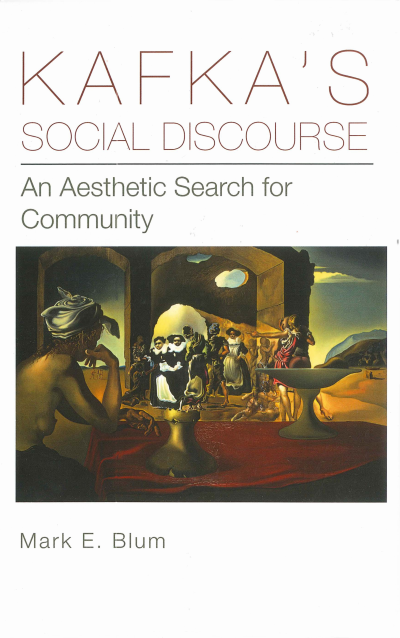
Kafka's Social Discourse
An Aesthetic Search for Community
Authors:
Publisher:
2011
Summary
Franz Kafka is among the most significant 20th century voices to examine the absurdity and terror posed for the individual by what his contemporary Max Weber termed 'the iron cage' of society. Ferdinand Tsnnies had defined the problem of finding community within society for Kafka and his peers in his 1887 book Gemeinschaft und Gesellschaft. Kafka took up this issue by focusing upon the 'social discourse' of human relationships. In this book, Mark E. Blum examines Kafka's three novels, Amerika, The Trial, and The Castle in their exploration of how community is formed or eroded in the interpersonal relations of its protagonists. Critical literature has recognized Kafka's ability to narrate the gestural moment of alienation or communion. This 'social discourse' was augmented, however, by a dimension virtually no commentator has recognized-Kafka's conversation with past and present authors. Kafka encoded authors and their texts representing every century of the evolution of modernism and its societal problems, from Bunyan and DeFoe, through Pope and Lessing, to Fontane and Thomas Mann. The inter-textual conversation Kafka conducted can enable us to appreciate the profound human problem of realizing community within society. Cultural historians as well as literary critics will be enriched by the evidence of these encoded cultural conversations. Kafka's 'Imperial Messenger' may finally be heard in the full history of his emanations. Kafka encoded not only past authors, but painters as well. Kafka had been known as a graphic artist in his youth, and was informed by expressionism and cubism as he matured. Kafka's encodings of literature as well as fine art are not solely of the work to which he refers, but the community of authors or painters and their success or failure of community. Kafka's encodings were meant as an extra-textual readings for astute readers, but also as a lesson to his fellow authors whom he held accountable in his correspondence as cultural messengers. Encoding had been a Germanic literary norm since the sixteenth century. Many of Kafka's encodings are of Austrian satirists since the eighteenth century, among them Franz Christoph von Scheyb and Gottlieb Wilhelm Rabener, Josef Schreyvogel, as well as the genial irony of Franz Grillparzer. Austrian literature is prominent, but Kafka's encodings are drawn from all Western literature from Plato through his own present. In The Castle the figure of Momus becomes a major index in the history of Western literature, extended from Plato through Lucian, to Nicolaus Gerbel through Goethe. Momus, the arch-critic of manners, morals, and judge of human character, enables a Kafka reader to use this thread to comprehend the errors of commission and omission in the social discourse of his protagonists throughout his opus.