, to see if you have full access to this publication.
Edited Book No access
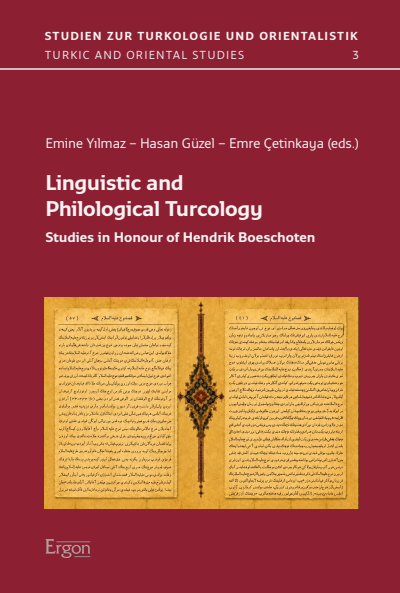
Linguistic and Philological Turcology
Studies in Honour of Hendrik Boeschoten- Editors:
- | |
- Series:
- Studien zur Turkologie und Orientalistik | Turkic and Oriental Studies, Volume 3
- Publisher:
- 2026
Summary
The volume contains eighteen contributions on a wide range of topics in Turkic philology and linguistics, including pre-modern languages such as Old Uyghur, Ottoman Turkish, and Middle Kipchak, and modern varieties such as Turkish, Uyghur, and Turkic languages of Iran. Also included are contributions on the history of Turkic Studies and on lexicography. The authors are colleagues, students, and friends of the Dutch Turcologist Hendrik Boeschoten, who passed away in 2024. The editors are Turcologists at Hacettepe University in Ankara. Emine Yılmaz is an expert in Altaic Studies, Chuvash, and Old Turkic. Hasan Güzel is a sociolinguist focusing on Turkic languages in Iran. Emre Çetinkaya investigates information structure in Turkic languages.
Search publication
Bibliographic data
- Edition
- 1/2026
- Copyright Year
- 2026
- ISBN-Print
- 978-3-98740-309-5
- ISBN-Online
- 978-3-98740-310-1
- Publisher
- Ergon, Baden-Baden
- Series
- Studien zur Turkologie und Orientalistik | Turkic and Oriental Studies
- Volume
- 3
- Language
- English
- Pages
- 353
- Product Type
- Edited Book
Table of contents
ChapterPages
- Preface No access
- Authors:
- Introduction No access
- On the author and the work No access
- Prof. Dr. Hendrik Boeschoten and the study of Evliyā Çelebī No access
- Conclusion No access
- References No access
- Authors:
- Introduction No access
- Actional recategorization No access
- Polysemy as an actional recategorization process No access
- More examples No access
- Conclusion No access
- References No access
- Authors:
- Introduction No access
- Analytic vs periphrastic No access
- Auxiliary (aux) vs light verb (lv) No access
- Cross-linguistic perspectives on auxiliary and light verb constructions (lvc) No access
- V-(x)p + Vlight /auxiliary? No access
- Reinterpretation of θ-roles and reconfiguration of macroroles No access
- Macro-role realignment and split intransitivity: from unergative to unaccusative No access
- Stative cognitive & processual cognitive No access
- Semelfactives & spontaneity No access
- Perception & emission No access
- The function of blocking passive interpretation No access
- The grammaticalization perspective No access
- A schematic overview of the functions identified in the present study No access
- Theoretical and methodological implications No access
- References No access
- Authors:
- Introduction No access
- Henry Hofman, Karl Jahn and other predecessors No access
- New possibilities No access
- Rik Boeschoten and his peers at Utrecht No access
- Language contact and Irano-Turcica No access
- Evliya Çelebi’s Seyahatname and Rabghuzi’s Qisas al-Anbiya No access
- Further institutionalisation of Turkish studies and embedding in the Faculty of Humanities No access
- Further flourishing: the 1990s No access
- Decline No access
- References No access
- Authors:
- Introduction No access
- The distribution of the polar question marker -mu in Uyghur No access
- Non-obligatoriness of the polar question marker -mu No access
- Focus sensitivity and presuppositional effects No access
- Conclusion No access
- References No access
- Authors:
- Introduction No access
- Evliya Çelebi’s Seyāhatnāme No access
- Khwarezmian Turkic: Qiṣaṣ al-Anbiyā’ No access
- Dede Korkut Oğuznameleri No access
- Alexander Stories No access
- Conclusion No access
- References No access
- Appendix: Publication List to Hendrik Boeshoten No access
- Authors:
- Introduction No access
- Çağatay No access
- Çağatay original No access
- Ottoman original (excerpt) No access
- Dutch translation No access
- Late Ottoman (Meşrutiyet) No access
- Ottoman original (excerpt) No access
- Translation No access
- Öztürkçe original No access
- Translation No access
- Çağatay No access
- High Ottoman No access
- Late Ottoman No access
- Öztürkçe No access
- Conclusion No access
- References No access
- Authors:
- Historical background No access
- Two pioneer reformers in the East: Mirza Fathali Akhundov and Malkum Khan No access
- The Iran of the Shahs No access
- Why the Latin Alphabet? No access
- Why the Perso-Arabic Alphabet? No access
- Current situation No access
- Conclusion No access
- References No access
- Authors:
- Introduction No access
- Theoretical approach: The concept of object within grammatical relations No access
- Studies on the DKO No access
- Object marking in Old Turkic and Old Anatolian Turkish No access
- Marking personal pronouns No access
- Marking proper names No access
- Marking of human common nouns No access
- Marking of animate nouns No access
- Marking of inanimate nouns No access
- Conclusion No access
- References No access
- Authors: | |
- Introduction No access
- Seeing language in public space No access
- Iran as a linguistically regulated space No access
- Approaches in Iranian linguistic landscape research No access
- A comparative project: Linguistic landscapes of Ardabil and Tehran No access
- Theoretical framework and new analytical directions No access
- Data collection No access
- Preliminary findings No access
- Final words No access
- References No access
- Authors: |
- Rik’s views on the language of the Alexander stories No access
- Middle Turkic literary languages No access
- The “mixed” language of the Alexander stories No access
- The copying nature of the Alexander stories No access
- Spoken Turkic vernaculars in Iran: lingua turcica agemica No access
- A comparison of the morphological and syntactic features of the Alexander stories and the lingua turcica agemica of the transcription texts No access
- Case marking No access
- Possessive suffixes No access
- Other suffixes No access
- Reflexive pronouns No access
- Personal pronouns No access
- Interrogative pronouns No access
- Postposition ‘with’ No access
- Person markers. Copula No access
- Tense and aspect No access
- Modal forms No access
- Non-finite forms No access
- Further remarks No access
- Relative clauses No access
- Complement clauses No access
- Temporal clauses No access
- Adverbial clauses No access
- The use of the optative in subordinated clauses No access
- Coordinating kim No access
- Conclusion No access
- References No access
- Authors:
- References No access
- Authors:
- The Chain of accidents No access
- First impressions No access
- The Second accident: Meeting Uğur Derman No access
- Living tradition and commercial afterlife No access
- Restitution, not nostalgia No access
- Coda No access
- References No access
- Authors:
- Prologue No access
- Introduction No access
- Necessity No access
- Possibility No access
- Volitive modality No access
- MOD-2: The Optative in -GAy No access
- Epistemicity No access
- Summary No access
- Abbreviations No access
- References No access
- Authors:
- Introduction No access
- Aim, scope and method No access
- Assimilation of the /g/ and /k/ in common Turkic No access
- Graphic appearance of the phonemes /g/, /k/, /ʁ/, and /χ/ in the Armenian alphabet No access
- Letter ‹կ› (ken) No access
- Letters ‹գ› (kim) and ‹ք› / ‹x› (ke) No access
- Letter ‹ղ› (gad) No access
- Letter ‹խ› (khe) No access
- Special status of the Töre Bitiki “The code of law” No access
- Use of the letter ‹կ› (ken) at the suffix-onset position No access
- Use of letters ‹գ› (kim) and ‹ք/ք› (ke) at the suffix-onset position No access
- Use of the letter ‹ղ› (gad) at the suffix-onset position No access
- Use of the letter ‹խ› (khe) at the suffix-onset position No access
- Overview of the formative and syntactic inflectional according to the letters examined No access
- The Case in early and modern Western Kipchak No access
- Assumptions No access
- Abbreviations No access
- References No access
- Internet Resources No access
- Authors:
- How this came about No access
- Background of Boeschoten’s dictionary No access
- My project: A parallel version of the dictionary No access
- Some examples of easily recognizable modern Turkish words in Boeschoten’s dictionary No access
- How certain characters in Boeschoten’s dictionary have to be converted to arrive at the correct spelling in contemporary Turkish No access
- Brain teasers No access
- Solutions to brain teasers No access
- Two sample pages from my alternative version No access
- Some critical remarks No access
- Afterword No access
- Authors:
- Introduction No access
- Formal features No access
- Transcription, transliteration and translation No access
- Commentary No access
- The Tibetan parallel passage No access
- The Sanskrit parallel passage No access
- The Chinese parallel passage No access
- Final words No access
- References No access
- Authors:
- Introduction No access
- Budapest manuscript No access
- Hamidiye manuscript No access
- Istanbul: Hamidiye and Fatih manuscripts No access
- Evaluations on the vocabulary of FBŞ No access
- Transcription No access
- Vowel length No access
- Closed ė No access
- Inconsistency in the use of footnotes No access
- Incorrect readings arising from copyists’ mistakes No access
- Errors arising from Hazai and Tietze’s readings No access
- Abbreviations No access
- References No access