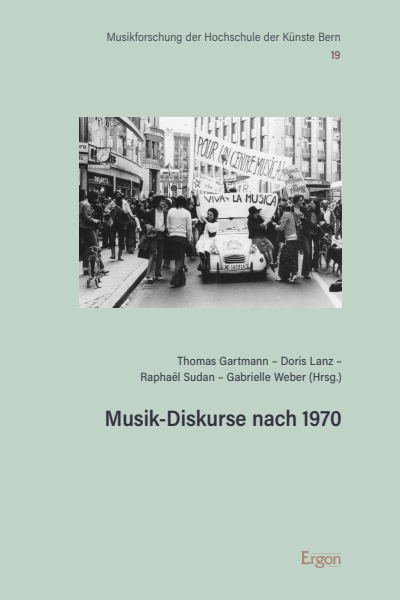
Musik-Diskurse nach 1970
- Editors:
- | | |
- Series:
- Musikforschung der Hochschule der Künste Bern, Volume 19
- Publisher:
- 2025
Summary
What developments characterised music discourses after the emergence around 1970? Case studies are examined from different national perspectives as well as from a practical, institutional and theoretical point of view. Common narratives and ideological labelling are questioned, from the dualism between tradition and avant-garde to only progress-oriented musical thinking. The discrepancy between artistic niche and mass medium in new music on television is discussed in a new way, as well as composition and improvisation as supposed opposing poles, which were in fact mutually stimulating and produced fluid transitions. The panorama is concluded with a discussion of a new historiography of music that is appropriate to the different phenomena.
With contributions by Michael Baumgartner | Carl Bergstrøm-Nielsen | Jessie Cox | Anna Dalos | Pascal Decroupet | Leo Dick | Tatiana Eichenberger | Thomas Gartmann | Roddy Hawkins | Jörn-Peter Hiekel | Jelena Janković-Beguš | Mathias Knauer | Peter Kraut | Michael Kunkel | Doris Lanz | Joachim Lucchesi | Ivana Medić Medic | Thomas Meyer | Nina Polaschegg | Stefan Sandmeier | Maria Sappho | Philip Sarasin | Alain Savouret | Rūta Stanevičiūtė | Roman Stolyar | Raphaël Sudan | Gabrielle Weber
Keywords
Search publication
Bibliographic data
- Edition
- 1/2025
- Copyright Year
- 2025
- ISBN-Print
- 978-3-98740-227-2
- ISBN-Online
- 978-3-98740-228-9
- Publisher
- Ergon, Baden-Baden
- Series
- Musikforschung der Hochschule der Künste Bern
- Volume
- 19
- Language
- German
- Pages
- 502
- Product Type
- Edited Book
Table of contents
- Inhalt
- Introduction
- Musik-Diskurse nach 1970
- Ausgangspunkt Schweiz
- Ästhetische Diskurse
- Neue Musik und die audio-visuellen Medien
- Improvisation als Katalysator?
- Dank
- Literatur
- Authors:Download chapter (PDF)
- “The Future’s Uncertain”. The 1970s as a Threshold to a New Epoch
- Pop als Seismograf
- Der technologische Wandel
- Die Reise zu sich selbst
- Fazit
- Literatur
- Authors:Download chapter (PDF)
- The Multi-Perspective Nature of New Music. György Ligeti’s Position in Modernism as a Point of Crystallisation
- Prägungen des Diskurses in einer geistigen Gemengelage
- Adornos Resonanzen
- Kristallisationspunkte der Korrespondenz von Ligeti und Adorno
- Die Aufhebung des Ideologischen
- Literatur
- Authors:Download chapter (PDF)
- “Don’t Forget Going Forwards”. Musical Discourses in the GDR Between Political Aspirations and Practical Stubbornness
- Literatur
- Authors:Download chapter (PDF)
- Reflecting on Sound as a Focal Point of the Aesthetic Confrontationsin Paris in the 1970s and 1980s
- Auswirkungen der digitalen Revolution auf das Verständnis von Klang
- Akustische und elektroakustische Metaphern bei Grisey und Murail
- Zwischenbilanz und Perspektiven am IRCAM um 1985
- Historiographischer Ausblick über den Tellerrand hinaus
- Literatur
- Authors:Download chapter (PDF)
- Challenged Traditions. The ‘Avant-Garde’ and the Swiss Musicians’ Association in Around 1970
- Lugano 1970
- Bern 1972
- Nachlese
- Literatur
- Authors:Download chapter (PDF)
- After the mixed avant-garde: positioning Contact and the New Complexity in the British context
- Keith Potter, Michael Finnissy, Suoraan and the emergence of the grouping New Complexity in Britain
- Dispatches from Darmstadt (and elsewhere)
- (For and) Against intellectual complexity in music
- Conclusion
- Bibliography
- Authors:Download chapter (PDF)
- Soviet music exports: between ideology and commerce
- How to sell music? Music festivals in Soviet Lithuania
- Propaganda and the international reception of Lithuanian music
- Conclusion: The impact of the Soviet Lithuanian music festivals
- Bibliography
- Authors:Download chapter (PDF)
- Introduction
- Realism in music, and the influence of Boris Asafyev’s ‘theory of intonations’
- ‘Socialist realism’, ‘socialist aestheticism’ and ‘socialist modernism’
- Hercigonja’s relationship to music folklore
- Hercigonja’s oeuvre and Serbian television
- Conclusion
- Bibliography
- Authors:Download chapter (PDF)
- Introduction
- Finding a platform for artistic research
- Choosing a direction
- The science of “Quantum Music”
- “Beyond Quantum Music”
- Concluding remarks
- Bibliography
- Authors:Download chapter (PDF)
- Colourblindness
- New Questions
- “You know, there really are Black composers in the future”
- Bibliography
- Authors:Download chapter (PDF)
- New Music and Television in Switzerland
- Stagiaire an der Kreuzstraße
- Musik und Fernsehen – Dominanz des Visuellen
- Das Fernsehen und unser Musikleben
- Zur Ära Armin Brunner
- Unser Film El pueblo nunca muere
- Komponist und Autor: Gestalter oder Diener?
- Perspektiven?
- ›Konvergenz‹ und Kulturabbau bei der SRG
- Literatur
- Authors:Download chapter (PDF)
- Hoketus of the Knife Stabs. Mauricio Kagel and Swiss Television 1978 – 1987
- Das Playback in der Aera Marthaler
- Literatur
- Authors:Download chapter (PDF)
- The Diversity of Switzerland in Contemporary Music. Ten Television Portraits for Swiss Television in 2001
- Die Rahmenbedingungen
- Wie kam es zu dieser Kooperation?
- Was für ein Bild des Schweizer zeitgenössischen Musikschaffens wurde gezeigt?
- Wie verorten sich die Porträts innerhalb der Strategien von SRG und STV?
- Wie wird zeitgenössisches Musikschaffen 2001 filmisch dargestellt?
- Dramaturgie durch übergreifende Fragen
- Wie unterscheidet sich die Narration 2001 von den Porträts der siebziger Jahre?
- Inwiefern wurde die Präsenz am Massenmedium Fernsehen für eine Öffnung und Vermittlung der zeitgenössischen Musik an ein breites Publikum genutzt?
- Fazit
- Literatur
- Authors:Download chapter (PDF)
- The Total Work of Art of Reified Relationships. Forward-Looking Aspects of the TV Opera Die schwarze Spinne (1983/84) by Armin Brunner, Werner Düggelin, Hansjörg Schneider and Rudolf Kelterborn
- Herausforderungen für die Klangbühne
- Anpassung des Stoffs an den Zeitgeist der 1980er-Jahre in der Schweiz
- Remake und Making off: Ingredienzien für ein multimodales Musiktheater avant la lettre
- Radio-Oper, TV-Oper => Social-Media-Oper?
- Fazit
- Literatur
- Authors: |Download chapter (PDF)
- The SRG and the STV. From Quiet Cooperation to Shrill Discord
- Teil I: Beziehungsgeflecht auf vielen Ebenen
- Streit um das Radio-Orchester Beromünster
- Teil II: Medien- und kulturpolitische Diskussionen der 1980er- und 90er-Jahre
- STV-Resolution zur Medienpolitik: Für die Einhaltung des Kulturauftrags
- Mäzenatentum für Minoritätenbedürfnisse vs. Verpflichtung zur kulturellen Vielfalt
- Die SRG und ihre Orchester – eine komplizierte Beziehung
- Sorgen um die Kultur am Radio: Roy Oppenheim an der STV-Generalversammlung 1987
- »SOS SRG – Rettet die Kultur am Radio«
- Fazit
- Literatur
- Authors:Download chapter (PDF)
- Philip Glass’s machine music in Godfrey Reggio’s Koyaanisqatsi
- Posthuman Music in Beryl Korot and Steve Reich’s Three Tales
- Conclusion
- Bibliography
- Authors:Download chapter (PDF)
- Was Free Improvisation a Discursive Discipline? A Paleomusicological Reading of the Music Journal Dissonanz/Dissonance (DILEM-41)
- –1
- 1
- 2
- 3
- 4
- 5
- Literatur
- Authors:Download chapter (PDF)
- Introduction
- a) conceptualising and contextualising
- b) The FIG
- c) Irène Schweizer and Switzerland
- a) The Daniel Fueter years
- b) Improvisers as committee members
- c) The STV: A woman-friendly environment?
- d) Collège i
- a) Women in free improvisation today
- b) Intentions and quotas
- Conclusion: have we already entered an era that makes this kind of reflection obsolete?
- Bibliography
- Authors:Download chapter (PDF)
- A brief history of human-machine relationships
- eXtra-musicality
- Creating a Global Improvising Orchestra
- Creating a relationship with a new machine member
- The Concerto for Virtualities and Orchestra
- Virtualities: The virtues of expanded spaces
- Conclusions
- Bibliography
- Authors:Download chapter (PDF)
- The Interplay Between Improvisation and Composition in Austria after 1970
- Wiener Musik Galerie
- Mediale Einflüsse
- Musik nach 2000
- Kompositionen von Improvisierenden
- Komponierende schreiben für Improvisierende
- Inspiration durch Improvisation, aber streng notierte Partituren
- Re-Konfiguration
- Ensembles – neuer Interpretentypus
- Begegnungen und Wechselwirkungen im Konzertbetrieb?
- Fazit
- Literatur
- Authors:Download chapter (PDF)
- Bibliography
- Authors:Download chapter (PDF)
- A Singular Experiment or the Beginning of a Paradigm Shift? The Tonkünstlerfest 1982 in Search of “Points of Contact Between Serious and Popular Music”
- Genese des Programms
- Berührungspunkte zwischen ›E‹ und ›U‹?
- Pressereaktionen
- ›Debriefing‹
- Literatur
- Anhang
- Authors:Download chapter (PDF)
- Concerts as Discourse and Politics – the Bernese Organisers “Taktlos” and “tonart”, 1980 – 2007
- 1Programm
- 2Diskursräume
- 3Diskurs und Zeitgeist
- 4Diskursverschiebungen
- Literatur
- Authors:Download chapter (PDF)
- The Phonocultural Revolution of the Twentieth Century
- Hypothèse de la triple écoute
- La naissance des ‹ graphonages ›
- Du son au phone : la révolution de l’apparition du haut-parleur
- Bibliographie
- Authors:Download chapter (PDF)
- Bibliography
- Authors:Download chapter (PDF)
- Open Composition – A Focal Point of Current Change Processes
- Einführung
- Terminologie
- Warum Komposition?
- Warum Improvisation?
- Aufführungspraxis I – die heutigen Zerrissenheiten
- Aufführungspraxis II – Texttreue versus Werktreue
- Erstes Beispiel: Karlheinz Stockhausen: Zugvogel
- Zweites Beispiel: Max Eugen Keller: Psychogramm
- Drittes Beispiel: Karlheinz Stockhausen: Nachtmusik
- Zusammenfassung und Diskussion der Resultate
- Ausblick
- Literatur
- Authors:Download chapter (PDF)
- Mission Accomplished? The End of the Swiss Musicians’ Association
- Rückschau
- Gewerkschafts-Denken?
- Auf dem Weg zur Fusion
- Improvisation zwischen Integration und Autonomie
- Elitediskurs
- Verschwinden in Trägerschaften?
- Ende des Vereins: Mission vollendet oder historisch-gesellschaftliche Notwendigkeit?
- Literatur
- Challenges of Music Historiography
- Literatur
- Personen-, Werk- und OrtsregisterPages 479 - 498 Download chapter (PDF)
- Reihe »Musikforschung der Hochschule der Künste Bern«Pages 499 - 502 Download chapter (PDF)