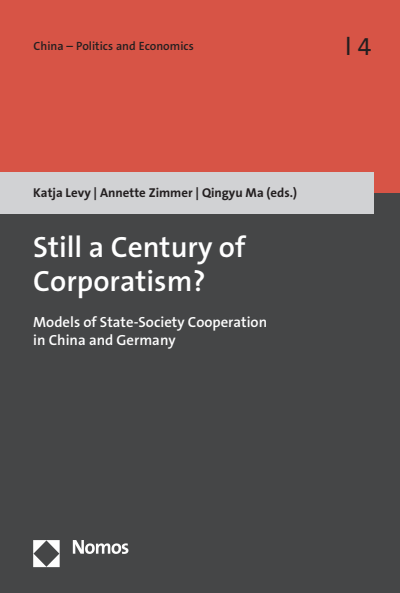
Still a Century of Corporatism?
Models of State-Society Cooperation in China and Germany- Editors:
- | |
- Series:
- China - Politics and Economics, Volume 4
- Publisher:
- 2021
Summary
Dieses Buch untersucht aus politikwissenschaftlicher Perspektive, wie lokale Regierungen und gesellschaftliche Organisationen in Deutschland und China zusammenarbeiten, um akute soziale Probleme zu lösen. Vor dem Hintergrund der Migrationsbewegung nach Europa in den Jahren 2015/16 und der längeren Geschichte der Migration vom Land in die Städte in China untersuchen die AutorInnen, vor welchen Herausforderungen lokale Kommunalverwaltungen angesichts von Migration und Integration stehen. Trotz der grundlegenden Unterschiede zwischen Deutschland und China hinsichtlich ihrer politischen Systeme fanden sie eine Vielzahl von Gemeinsamkeiten, was die Herausforderungen und Lösungsansätze angeht. Sowohl in Deutschland als auch in China spielt "collaborativegovernance", also die Zusammenarbeit von Kommunen und Nonprofit-Organisationen eine zunehmend wichtige Rolle.
Search publication
Bibliographic data
- Edition
- 1/2021
- Copyright Year
- 2021
- ISBN-Print
- 978-3-8487-6602-4
- ISBN-Online
- 978-3-7489-0740-4
- Publisher
- Nomos, Baden-Baden
- Series
- China - Politics and Economics
- Volume
- 4
- Language
- English
- Pages
- 185
- Product Type
- Edited Book
Table of contents
- Titelei/Inhaltsverzeichnis No access Pages 1 - 6
- Authors: | |
- Authors: | |
- The Challenges of Migration No accessAuthors: | |
- The Role of Local Governments and Non-profit Organisations in Dealing With the Challenges of Migration No accessAuthors: | |
- State–NPO Relationships in Transition—Corporatism and Neoliberalism No accessAuthors: | |
- Methodology of the Research Project and a Typology of State–NPO Relations No accessAuthors: | |
- The Contributions in this Volume No accessAuthors: | |
- Authors:
- 1. Introduction No accessAuthors:
- Authors:
- 2.1 Distinctive Models of Government–Non-profit Relationships No accessAuthors:
- 2.2 Current Changes in German Non-profit–Government Relationships No accessAuthors:
- Authors:
- Authors:
- Registered Association/Eingetragener Verein No accessAuthors:
- Cooperative/Genossenschaft No accessAuthors:
- Private Law Foundation/Stiftung des Privatrechts No accessAuthors:
- Private Limited Company/Gemeinschaft mit beschränkter Haftung No accessAuthors:
- 3.2 Tax Laws and Tax Incentives No accessAuthors:
- 4. The Success Story of Germany’s Non-profit Sector from Growth to its Limits? No accessAuthors:
- 5. In Need of Change! No accessAuthors:
- Authors: |
- 1 Introduction No accessAuthors: |
- Authors: |
- 2.1 The Bureaucracy Model No accessAuthors: |
- 2.2 The New Public Management Model No accessAuthors: |
- 2.3 The New Public Governance Model No accessAuthors: |
- Authors: |
- 3.1 Tradition and Reality of Local Self-Government No accessAuthors: |
- 3.2 The Dual System of Local Social Service Provision No accessAuthors: |
- 3.3 Subsidiarity as a Variant of Neo-Corporatism No accessAuthors: |
- 4 Social Service Provision Today No accessAuthors: |
- 5 Summary No accessAuthors: |
- Authors: |
- 1 Introduction No accessAuthors: |
- Authors: |
- 2.1 Cooperation and Public Administration No accessAuthors: |
- 2.2 Third-Party Government and Network Governance No accessAuthors: |
- 2.3 Coston’s Model of Government–NPO Relationships No accessAuthors: |
- Authors: |
- 3.1 Methods No accessAuthors: |
- 3.2 Summary of Cases No accessAuthors: |
- Authors: |
- Authors: |
- 4.1.1 Organisation Description No accessAuthors: |
- 4.1.2 Interest in Cooperation No accessAuthors: |
- 4.1.3 Project Cooperation—Third-Party Government No accessAuthors: |
- Authors: |
- 4.2.1 Organisation Description No accessAuthors: |
- 4.2.2 Interest in Cooperation No accessAuthors: |
- 4.2.3 Project Cooperation—Network Governance No accessAuthors: |
- 5 Conclusion No accessAuthors: |
- Authors: |
- 1 Introduction No accessAuthors: |
- 2 State of the Art: State–NPO Cooperation Structures in China and Germany No accessAuthors: |
- 3 Data and Methodology No accessAuthors: |
- Authors: |
- 4.1 Third-Party Government No accessAuthors: |
- 4.2 Network Governance No accessAuthors: |
- Authors: |
- Authors: |
- Authors: |
- 1. Existence of Formalised Cooperation No accessAuthors: |
- 2. Transfer of Administrative Responsibilities No accessAuthors: |
- 3. Complementary Cooperative Relationship No accessAuthors: |
- 4. Congruence of Goals No accessAuthors: |
- 5. Favourable Power Relations No accessAuthors: |
- Authors: |
- 1. Support Public Service Provision No accessAuthors: |
- 2. Fulfil Guidelines Set by Higher Administrative Levels No accessAuthors: |
- 3. Derive Support from NPO Expertise No accessAuthors: |
- 4. Maintain Control and Social Stability No accessAuthors: |
- Authors: |
- 5.2.1 Existence of Networks No accessAuthors: |
- Authors: |
- Authors: |
- (1) Improving NPO Visibility No accessAuthors: |
- (2) Ensuring NPO Access to Information Vital for their Work No accessAuthors: |
- (3) Making Use of For-Profit Entities for their Non-profit Work No accessAuthors: |
- (4) Ensuring Access to Expert Knowledge for the Provision of Services No accessAuthors: |
- (5) Functioning as an Information Platform in their Field of Expertise (the Internet, Social Media, etc.) No accessAuthors: |
- 2. Exchange Condition: Funding Uncertainty No accessAuthors: |
- Authors: |
- (1) High Numbers of People and Parties Involved No accessAuthors: |
- (2) The Problems to be Solved are Complex and Demand Complex Solutions No accessAuthors: |
- (3) The Resources for Solving the Problems are Scattered No accessAuthors: |
- 6 Conclusion No accessAuthors: |
- Appendix No accessAuthors: |
- Authors: |
- 1 Introduction No accessAuthors: |
- 2 Typologies of Government–NGO Relationships No accessAuthors: |
- 3 The Cases of Local Government–SO Cooperation in Germany and China in the LoGoSO Project No accessAuthors: |
- 4 Analysis of the LoGoSO Cases No accessAuthors: |
- 5 Categorising models of cooperation between local governments and social organisations in Germany and China No accessAuthors: |
- 6 Conclusion No accessAuthors: |
- Authors: | |
- 1 Introduction No accessAuthors: | |
- 2 The Degree of Development and Function of NPOs in China and Germany No accessAuthors: | |
- Authors: | |
- 3.1 Types of Corporatism in the Two Countries under Different Rationalities No accessAuthors: | |
- 3.2 Relationship Characteristics in Legal Form No accessAuthors: | |
- 3.3 Relationship Characteristics in Registration Conditions No accessAuthors: | |
- 3.4 Relationship Characteristics in Administration No accessAuthors: | |
- 3.5 Relationship Characteristics in Tax Policies No accessAuthors: | |
- 3.6 Relationship Characteristics in Service Cooperation No accessAuthors: | |
- 3.7 Relationship Characteristics in NPO Governance No accessAuthors: | |
- 4 The Rationality behind the Relationship between Government and Social Organisations No accessAuthors: | |
- 5 Conclusion No accessAuthors: | |
- Authors: |
- State–Society Relations in Transformation: from Corporatism towards Neoliberalism No accessAuthors: |
- Challenges Posed by Migration: Local Government Responses No accessAuthors: |
- Challenges Posed by Migration: The Role of NPOs No accessAuthors: |
- Local Government–NPO Cooperation: Models of Cooperation No accessAuthors: |
- Local Government–NPO Cooperation: Factors that Influence the Cooperation No accessAuthors: |
- Authors: |
- State–Society Relations in Transformation: from Corporatism towards Neoliberalism No accessAuthors: |
- Challenges Posed by Migration: Local Government Responses No accessAuthors: |
- Challenges Posed by Migration: the Role of NPOs No accessAuthors: |
- Local Government–NPO Cooperation: Models of Cooperation No accessAuthors: |
- Local Government–NPO Cooperation: Factors that Influence Cooperation No accessAuthors: |
- Index No access Pages 183 - 185