, to see if you have full access to this publication.
Monograph No access
Teaching Students to Work Harder and Enjoy It
Practice Makes Permanent
Authors:
Publisher:
2012
Summary
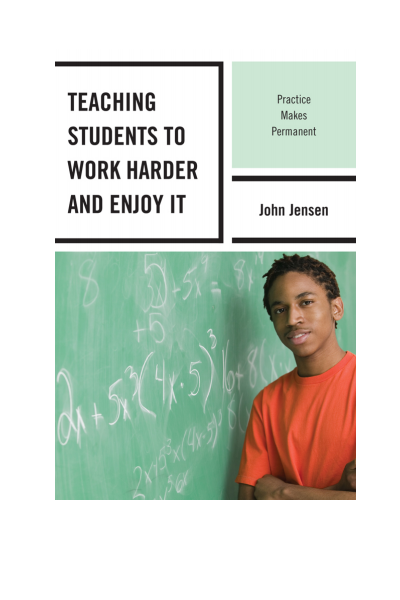
Teaching Students to Work Harder and Enjoy It: Practice Makes Permanent points out a single, fundamental, and easily-corrected flaw that has held back American education for nearly a century—the design of instruction to achieve familiarization instead of mastery. This book explains the psychological dynamics and methods involved in mastery, and how to apply them easily in K-12 learning. A basic insight is that once students have a correct answer to any question, a straight road to its mastery is entirely comprised of practice. Practice continues to “make perfect” in all skill areas including the accumulation of a body of knowledge. Outlined here are the forms of it that enable students to master academic learning perfectly and permanently, as well as become competent with social/emotional skills and alter their behavior. A combination of methods especially valuable for students falling behind can turn classrooms around quickly.
Search publication
Bibliographic data
Edition
1/2012
Copyright Year
2012
ISBN-Print
978-1-61048-732-0
ISBN-Online
978-1-61048-734-4
Publisher
Rowman & Littlefield, Lanham
Language
English
Pages
155
Product Type
Monograph
Table of contents
ChapterPages
Contents No access
Preface No access
Chapter One: First, Practice: The Nature and Importance of Practice No access Pages 1 - 4
Chapter Two: Accumulate Knowledge: U.S. Education Subverts Mastered Knowledge No access Pages 5 - 14
Chapter Three: Practice Requires Effort: The Essential Place of Focused Effort No access Pages 15 - 26
Chapter Four: Effort in the Inner Venue: Connect Learning to Effort inside the Mind No access Pages 27 - 32
Chapter Five: Practice by Explaining: The Central Role of Explaining Learning No access Pages 33 - 42
Chapter Six: Developing a Mental Field: What Comprehension Looks Like Inside No access Pages 43 - 50
Chapter Seven: Practice Saves Prior Learning: The Cycle of Deepening Mastery No access Pages 51 - 56
Chapter Eight: Practice Behavioral Knowledge: Knowing as the First Step to Doing No access Pages 57 - 70
Chapter Nine: Students Talk Meaning: How to Help Students Express What’s Important No access Pages 71 - 78
Chapter Ten: Practice on Substantial Topics: Weigh Fundamental Issues No access Pages 79 - 94
Chapter Eleven: Score Results Objectively: How Scoring Can Energize Learning No access Pages 95 - 102
Chapter Twelve: More Ways to Use Scoring: Tracking Progress on Many Fronts No access Pages 103 - 116
Chapter Thirteen: Practice by Performance: The Motivational Spur from Performing No access Pages 117 - 124
Chapter Fourteen: The High School Vise: Working around Limitations No access Pages 125 - 134
Chapter Fifteen: Seven Steps to Turn a Class Around: Key Levers for a Distracted Class No access Pages 135 - 142
Notes No access Pages 143 - 148
Index No access Pages 149 - 154
Note to the Reader No access Pages 155 - 155
Similar publications
from the topics "Bildung allgemein"
Edited Book Full access
Christoph T. Burmeister, Thorsten Hertel, Sophia Richter