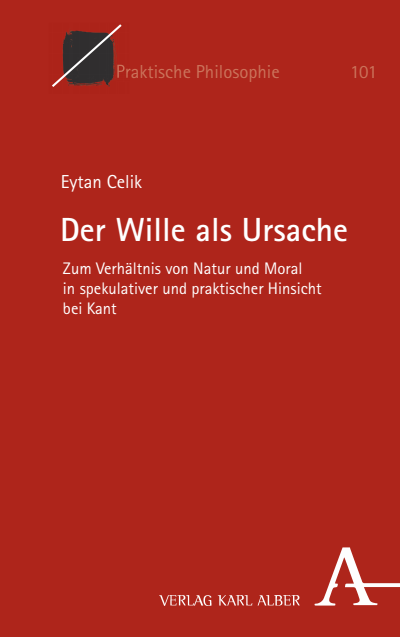
Der Wille als Ursache
Zum Verhältnis von Natur und Moral in spekulativer und praktischer Hinsicht bei Kant- Authors:
- Series:
- Praktische Philosophie, Volume 101
- Publisher:
- 2024
Summary
According to Kant, the proof of free will forms the "Schlussstein" of a coherent system of theoretical and practical philosophy. Still, in the current debate it is controversial whether he has succeeded in proving this. This thesis argues for a coherent reading of Kant's philosophy and, with the concept of cause, has identified a connecting element that builds a bridge between Kant's theoretical and practical philosophy. To this end, the first part of the thesis traces the "deduction" of the concept of cause in theoretical terms, and the second part justifies its practical extension to the will, in order to derive an argument for freedom of the will. In this context, topics such as self-deception and the meaning of authenticity, as well as Hume's influence on Kant and the concept of transcendental freedom are also elaborated in detail.
Keywords
Search publication
Bibliographic data
- Copyright Year
- 2024
- ISBN-Print
- 978-3-495-99324-8
- ISBN-Online
- 978-3-495-99325-5
- Publisher
- Karl Alber, Baden-Baden
- Series
- Praktische Philosophie
- Volume
- 101
- Language
- German
- Pages
- 285
- Product Type
- Monograph
Table of contents
- Titelei/Inhaltsverzeichnis No access Pages 1 - 10
- Vorbemerkungen No access Pages 11 - 14
- Einleitung No access Pages 15 - 24
- 1.1.1 Die Humesche Gabel No access
- 1.1.2 »Schranken« zu »Grenzen« der Erkenntnis erweitern No access
- § 1.2 Kausalität und die Bedingung der Möglichkeit von Erfahrung No access
- § 2. Notwendigkeit in der Ursache No access
- § 3. Exkurs: Kants Erwachen und Humes »Funkenschlag« No access
- i. Ergebnis des ersten Kapitels No access
- § 4.1 »Überschreitung von Schranken« No access
- 4.2.1 Der Beweis der Thesis No access
- 4.2.2 Der Beweis der Antithesis No access
- 4.2.3 Der Gegenstand der Auseinandersetzung No access
- § 5.1 Unterscheidung in dynamische und mathematische Antinomien No access
- § 5.2 Die zwei Charaktere der Ursache No access
- § 5.3 Ursachenbestimmung und Handlungsbegründung No access
- § 6. Exkurs: Praktische und transzendentale Freiheit im »Kanon« No access
- ii. Ergebnis des zweiten Kapitels No access
- 7.1.1 Hume zur Unabhängigkeit von Vernunft und Wille No access
- 7.1.2 Der Wille als praktische Vernunft No access
- 7.2.1 Autonomie des Willens No access
- 7.2.2 Notwendige Annahme eines freien Willens No access
- 7.3.1 Freiheit und Gesetz als »Wechselbegriffe« No access
- 7.3.2 Das Sollen des reinen Willens No access
- § 8.1 Die praktische Erweiterung des Ursachenbegriffs No access
- § 8.2 Das »Faktum« der praktischen Notwendigkeit No access
- iii. Ergebnis des dritten Kapitels No access
- § 9.1 Zur moralischen Verantwortung bei Hume No access
- § 9.2 Der moralische Wert einer Handlung bei Kant No access
- § 10.1 Kontrafaktische Selbstreflexion No access
- § 10.2 Möglichkeit der Selbsttäuschung No access
- § 10.3 Zurechnung böser Handlungen und das Reinhold-Problem No access
- iv. Ergebnis des vierten Kapitels No access
- § 11. Was soll ich tun? No access
- § 12. Wer will ich sein? No access
- Literatur No access Pages 275 - 285
Bibliography (163 entries)
No match found. Try another term.
- ADICKES, ERICH [1889]: Immanuel Kants Kritik der reinen Vernunft. Mit einer Einleitung und Anmerkungen. Berlin: Mayer und Müller. Open Google Scholar DOI: 10.5771/9783495993255
- AL-AZM, SADIK J. [1972]: The origins of Kant’s arguments in the Antinomies. Oxford: Oxford University Press. Open Google Scholar DOI: 10.5771/9783495993255
- ALLISON, HENRY E. [1986]: Morality and Freedom: Kant’s Reciprocity Thesis. In: The Philosophical Review, 95 (3), S. 393–425. Open Google Scholar DOI: 10.5771/9783495993255
- ALLISON, HENRY E. [1990]: Kant’s Theory of Freedom. Cambridge: Cambridge University Press. Open Google Scholar DOI: 10.5771/9783495993255
- ALLISON, HENRY E. [1994]: Causality and Causal Laws in Kant: A Critique of Michael Friedman. In: Kant and Contemporary Epistemology ed. Paolo Parrini. Dordrecht: Kluwer Academic Publishers, S. 291–308. Open Google Scholar DOI: 10.5771/9783495993255
- ALLISON, HENRY E. [2004]: Kant’s Transcendental Idealism. An Interpretation and Defense; Revised and Enlarged Edition. New Haven und London: Yale University Press. Open Google Scholar DOI: 10.5771/9783495993255
- ALLISON, HENRY E. [2011]: Kant’s Groundwork for the Metaphysics of Morals: A commentary. Oxford: Oxford University Press. Open Google Scholar DOI: 10.5771/9783495993255
- AMERIKS, KARL [2011]: »Pure Reason of Itself Alone Suffices to Determine the Will« (42–57). In: Kritik der praktischen Vernunft ed. Otfried Höffe. Berlin: Akademie Verlag, S. 87–100. Open Google Scholar DOI: 10.5771/9783495993255
- ANNEN, MARTIN [1997]: Das Problem der Wahrhaftigkeit in der Philosophie der deutschen Aufklärung. Ein Beitrag zur Ethik und zum Naturrecht des 18. Jahrhunderts. Würzburg: Königshausen & Neumann. Open Google Scholar DOI: 10.5771/9783495993255
- ARNDT, HANS WERNER [1976]: Einleitung. In: Christian Wolff. Gesammelte Werke. 1. Abt. Deutsche Schriften, Bd. 4. Vernünftige Gedancken von der Menschen Thun und Lassen (Deutsche Ethik) ed. Jean École. Hildesheim: Georg Olms Verlag, S. I–XXVIII. Open Google Scholar DOI: 10.5771/9783495993255
- BAILLIE, JAMES [2000]: Hume on Morality. London [u.a.]: Routledge. Open Google Scholar DOI: 10.5771/9783495993255
- BAUM, MANFRED [2015]: Kants »Möglichkeit der Erfahrung«. In: Kants Theorie der Erfahrung ed. Rainer Enskat. Berlin [u.a.]: de Gruyter, S. 151–68. Open Google Scholar DOI: 10.5771/9783495993255
- BECK, LEWIS WHITE [1963]: A Commentary on Kant’s Critique of Practical Reason. Chicago: University of Chicago Press. Open Google Scholar DOI: 10.5771/9783495993255
- BECK, LEWIS WHITE [1978]: The Prussian Hume and Scottish Kant. In: Essays on Kant and Hume ed. Ders. New Haven: Yale University Press, S. 111–29. Open Google Scholar DOI: 10.5771/9783495993255
- BECK, LEWIS WHITE [1981]: Über die Regelmässigkeit der Natur bei Kant. In: Dialectica, 35 (1), S. 43–56. Open Google Scholar DOI: 10.5771/9783495993255
- BEEBEE, HELEN [2011]: ›Hume’s Two Definitions: The Procedural Interpretation‹. In: Hume Studies, 37, S. 243–74. Open Google Scholar DOI: 10.5771/9783495993255
- BEIER, KATHI [2010]: Selbsttäuschung. Berlin [u.a.]: de Gruyter. Open Google Scholar DOI: 10.5771/9783495993255
- BEIER, KATHI [2014]: Selbsttäuschung, Selbstbestimmung und Authentizität bei Sartre. In: Existenzphilosophie und Ethik ed. Hans Feger und Manuela Hackel. Berlin [u.a.]: de Gruyter, S. 421–34. Open Google Scholar DOI: 10.5771/9783495993255
- BENNETT, JONATHAN [2016]: Kant’s Dialectic. Cambridge: Cambridge University Press. Open Google Scholar DOI: 10.5771/9783495993255
- BERGER, LARISSA [2015]: Der »Zirkel« im dritten Abschnitt der Grundlegung – Eine neue Interpretation und ein Literaturbericht. In: Kants Begründung von Freiheit und Moral in Grundlegung III. Neue Interpretationen ed. Dieter Schönecker. Münster: Mentis, S. 9–82. Open Google Scholar DOI: 10.5771/9783495993255
- BERNECKER, SVEN [2006]: Kant zur moralischen Selbsterkenntnis. In: Kant-Studien, 97. Jahrg., S. 163–83. Open Google Scholar DOI: 10.5771/9783495993255
- BIERI, PETER [2001]: Das Handwerk der Freiheit. München: Fischer Taschenbuch Verlag. Open Google Scholar DOI: 10.5771/9783495993255
- BITTNER, RÜDIGER [1974]: Maximen. In: Akten des 4. Internationalen Kant-Kongresses, Teil II.2, S. 485–98. Open Google Scholar DOI: 10.5771/9783495993255
- BITTNER, RÜDIGER [1980]: Hypothetische Imperative. In: Zeitschrift für philosophische Forschung, 34 (2), S. 210–26. Open Google Scholar DOI: 10.5771/9783495993255
- BITTNER, RÜDIGER [2009]: Achtung und ihre moralische Bedeutung. In: Analyse & Kritik, 31 (2), S. 339–50. Open Google Scholar DOI: 10.5771/9783495993255
- BLÖSER, CLAUDIA [2014]: Zurechnung bei Kant. Zum Zusammenhang von Person und Handlung in Kants praktischer Philosophie. Berlin [u.a.]: de Gruyter. Open Google Scholar DOI: 10.5771/9783495993255
- BÖHME, HARTMUT AND GERNOT BÖHME [1983]: Das Andere der Vernunft. Frankfurt am Main: Suhrkamp. Open Google Scholar DOI: 10.5771/9783495993255
- BOJANOWSKI, JOCHEN [2006]: Kants Theorie der Freiheit. Rekonstruktion und Rehabilitierung. Berlin [u.a.]: de Gruyter. Open Google Scholar DOI: 10.5771/9783495993255
- BOJANOWSKI, JOCHEN [2007]: Kant und das Problem der Zurechenbarkeit. In: Zeitschrift für philosophische Forschung, 61 (2), S. 207–28. Open Google Scholar DOI: 10.5771/9783495993255
- BOJANOWSKI, JOCHEN [2012]: Ist Kant ein Kompatibilist? In: Sind wir Bürger zweier Welten?: Freiheit und moralische Verantwortung im transzendentalen Idealismus ed. Mario Brandhorst. Hamburg: Meiner, S. 59–76. Open Google Scholar DOI: 10.5771/9783495993255
- BOJANOWSKI, JOCHEN [2015]: Die Deduktion des Kategorischen Imperativs. In: Kants Begründung von Freiheit und Moral in Grundlegung III ed. Dieter Schönecker. Münster: mentis Verlag, S. 83–108. Open Google Scholar DOI: 10.5771/9783495993255
- BOTTERILL, GEORGE [2002]: Hume on Liberty and Necessity. In: Reading Hume on Human Understanding ed. Peter Millican. Oxford: Clarendon Press, S. 277–300. Open Google Scholar DOI: 10.5771/9783495993255
- BRANDT, REINHARD [1989]: Einführung. In: David Hume in Deutschland. Literatur zur Hume-Rezeption in Marburger Bibliotheken ed. Reinhard Brandt/ Heiner Klemme. Marburg: Universitätsbibliothek Marburg, S. 5–18. Open Google Scholar DOI: 10.5771/9783495993255
- BRANDT, REINHARD [1992]: Lothar Kreimendahl: Kant – Der Durchbruch von 1769 (Book Review). In: Kant-Studien, 83 (1), S. 100–11. Open Google Scholar DOI: 10.5771/9783495993255
- BRANDT, REINHARD [2007]: Die Bestimmung des Menschen als Zentrum der Kantischen Philosophie. In: Kant in der Gegenwart ed. Jürgen Stolzenberg. Berlin [u.a.]: de Gruyter, S. 17–52. Open Google Scholar DOI: 10.5771/9783495993255
- BUCHDAHL, GERD [1969]: Metaphysics and the Philosophy of Science: The classical Origins Descartes to Kant. Oxford: Basil Blackwell. Open Google Scholar DOI: 10.5771/9783495993255
- CAIMI, MARIO [2015]: Der Schematismus der reinen Verstandesbegriffe. In: Kants Theorie der Erfahrung ed. Rainer Enskat. Berlin [u.a.]: de Gruyter, S. 201–38. Open Google Scholar DOI: 10.5771/9783495993255
- CARL, WOLFGANG [1989]: Der schweigende Kant. Ruprecht GmbH & Co. Open Google Scholar DOI: 10.5771/9783495993255
- COHEN, HERMANN [1885]: Kants Theorie der Erfahrung. Zweite neubearbeitete Auflage. Berlin: Dümmler. Open Google Scholar DOI: 10.5771/9783495993255
- COHEN, HERMANN [1982]: Humes Verhältnis zu Kant. In: Hume und Kant. Interpretation und Diskussion ed. Wolfgang Farr. Freiburg/ München: Verlag Karl Alber, S. 73–76. Open Google Scholar DOI: 10.5771/9783495993255
- CRAIG, EDWARD [1979]: David Hume: Eine Einführung in seine Philosophie. Vittorio Klostermann. Open Google Scholar DOI: 10.5771/9783495993255
- CRAMER, KONRAD Hypothetische Imperative? In: Rehabilitierung der praktischen Philosophie ed. Manfred Riedel., S. 159–212. Open Google Scholar DOI: 10.5771/9783495993255
- DAVIDSON, DONALD [1973]: Freedom to Act. In: Essays on Freedom of Action ed. Ted Honderich. London/Boston: Routledge & Kegan Paul, S. 137–56. Open Google Scholar DOI: 10.5771/9783495993255
- DAVIDSON, DONALD [1980]: Essays on actions and events. Oxford: Clarendon Press. Open Google Scholar DOI: 10.5771/9783495993255
- DE BOER, KARIN [2019]: Kant’s Response to Hume’s Critique of Pure Reason. In: Archiv für Geschichte der Philosophie, 101 (3), S. 376–406. Open Google Scholar DOI: 10.5771/9783495993255
- DIMPKER, HENNING, BERND KRAFT, AND DIETER SCHÖNECKER [1996]: Torsionen der dritten Antinomie. Zum Widerstreit ihrer Beweise und Anmerkungen. In: Kant Analysen- Probleme- Kritik, Band II ed. Gerhard Seel Hariolf Oberer. Würzburg: Königshausen & Neumann, S. 175–237. Open Google Scholar DOI: 10.5771/9783495993255
- DREIER, JAMES [1997]: Humean Doubts about the Practical Justification of Morality. In: Ethics and Practical Reason ed. Garrett Cullity and Berys Gaut. Oxford: Clarendon Press, S. 81–99. Open Google Scholar DOI: 10.5771/9783495993255
- DUNCAN, ALISTAIR R. [1957]: Practical Reason and Morality. A Study of Immanuel Kant’s Foundations for the Metaphysics of Morals. London. Open Google Scholar DOI: 10.5771/9783495993255
- EIDAM, HEINZ [2005]: ›Das einzige Faktum der reinen Vernunft‹: Zum Verhältnis von Freiheit und Sittengesetz in Kants praktischer Philosophie. In: Revista Portuguesa de Filosofia, 61 (2), S. 501–32. Open Google Scholar DOI: 10.5771/9783495993255
- ERTL, WOLFGANG [1998]: Kants Auflösung der »dritten Antinomie«. Open Google Scholar DOI: 10.5771/9783495993255
- ESTEVES, JULIO C. R. [2004]: Mußte Kant Thesis und Antithesis der dritten Antinomie der Kritik der reinen Vernunft vereinbaren? In: Kant-Studien, 95 (2), S. 146–170. Open Google Scholar DOI: 10.5771/9783495993255
- FÖRSTER, ECKART [1992]: »Was darf ich hoffen?« Zum Problem der Vereinbarkeit von theoretischer und praktischer Vernunft bei Immanuel Kant. In: Zeitschrift für philosophische Forschung, 46 (2), S. 168–85. Open Google Scholar DOI: 10.5771/9783495993255
- FÖRSTER, ECKART [1998]: Die Vorreden. In: Immanuel Kant, Kritik der reinen Vernunft ed. Georg Mohr und Marcus Willaschek. Berlin: Akademie Verlag GmbH, S. 37–56. Open Google Scholar DOI: 10.5771/9783495993255
- FÖRSTER, ECKART [2002]: Die Dialektik der reinen praktischen Vernunft (107–121). ed. Otfried Höffe. Berlin: Akademie Verlag GmbH, S. 173–86. Open Google Scholar DOI: 10.5771/9783495993255
- FRIEDMAN, MICHAEL [2006]: Causal Laws and the Foundations of natural science. In: The Cambridge Companion to Kant ed. Paul Guyer. Cambridge: Cambridge University Press, S. 161–99. Open Google Scholar DOI: 10.5771/9783495993255
- GARRETT, DON [1993]: The Representation of Causation and Hume’s Two Definitions of ›Cause‹. In: Noûs, 27 (2), S. 167–90. Open Google Scholar DOI: 10.5771/9783495993255
- GARRETT, DON [1997]: Cognition and Commitment in Hume’s Philosophy. New York: Oxford University Press. Open Google Scholar DOI: 10.5771/9783495993255
- GAWLICK, GUNTER AND LOTHAR KREIMENDAHL [1987]: Hume in der deutschen Aufklärung. Stuttgart: Frommann-Holzboog. Open Google Scholar DOI: 10.5771/9783495993255
- GEISMANN, GEORG [2007]: Kant über Freiheit in spekulativer und in praktischer Hinsicht. In: Kant-Studien, 98 (3), S. 283–305. Open Google Scholar DOI: 10.5771/9783495993255
- GEISMANN, GEORG [2020]: Zur Rolle der Freiheit in Kants (Moral-) Philosophie. In: Kant-Studien, 111 (3), S. 386–422. Open Google Scholar DOI: 10.5771/9783495993255
- GERHARDT, VOLKER [1986]: Handlung als Verhältnis von Ursache und Wirkung. Zur Erkenntnis des Handlungsbegriffs bei Kant. In: Handlungstheorie und Transzendentalphilosophie ed. Gerold Prauss. Frankfurt/M.:, S. 98–131. Open Google Scholar DOI: 10.5771/9783495993255
- GOY, INA [2007]: Immanuel Kant über das moralische Gefühl der Achtung. In: Zeitschrift für philosophische Forschung, 61 (3), S. 337–60. Open Google Scholar DOI: 10.5771/9783495993255
- GROOS, KARL [1901]: Hat Kant Hume’s Treatise gelesen? In: Kant-Studien, 5 (Issue 1–3), S. 177–81. Open Google Scholar DOI: 10.5771/9783495993255
- GUYER, PAUL [2003]: Kant’s Answer to Hume? In: Philosophical Topics, SPRING AND FALL 2003, 31 (1/2), S. 127–64. Open Google Scholar DOI: 10.5771/9783495993255
- GUYER, PAUL [2007]: Kant’s Groundwork for the Metaphysics of Morals: A Reader’s Guide. London: Continuum. Open Google Scholar DOI: 10.5771/9783495993255
- GUYER, PAUL [2009]: Knowledge, Reason, and Taste. Princeton: Princeton University Press. Open Google Scholar DOI: 10.5771/9783495993255
- HARRIS, JAMES [2005]: Of Liberty and Necessity. Oxford: Clarendon Press. Open Google Scholar DOI: 10.5771/9783495993255
- HEIMSOETH, HEINZ [1967]: Vierfache Vernunftantinomie, Natur und Freiheit, intelligibler und empirischer Charakter. Berlin [u.a.]: de Gruyter. Open Google Scholar DOI: 10.5771/9783495993255
- HENRICH, DIETER [1969]: The Proof-Structure of Kant’s Transcendental Deduction. In: The Review of Metaphysics, 22 (4), S. 640–59. Open Google Scholar DOI: 10.5771/9783495993255
- HENRICH, DIETER [1975]: Die Deduktion des Sittengesetzes. In: Denken im Schatten des Nihilismus ed. Alexander Schwan., S. 55–112. Open Google Scholar DOI: 10.5771/9783495993255
- HENRICH, DIETER [1989]: Kant’s Notion of a Deduction and the Methodological Background of the First Critique. In: Kant’s Transcendental Deductions. The Three Critques and the Opus postumum ed. Eckart Förster. California: Stanford University Press, S. S. 29–46. Open Google Scholar DOI: 10.5771/9783495993255
- HERMAN, BARBARA [1981]: On the Value of Acting from the Motive of Duty. In: The Philosophical Review, 90 (3), S. 359–82. Open Google Scholar DOI: 10.5771/9783495993255
- HÖFFE, OTFRIED [1977]: Kants kategorischer Imperativ als Kriterium des Sittlichen. 31 (3), S. 354–84. Open Google Scholar DOI: 10.5771/9783495993255
- HÖFFE, OTFRIED [2003]: Kants Kritik der reinen Vernunft: die Grundlegung der modernen Philosophie. München: C.H. Beck. Open Google Scholar DOI: 10.5771/9783495993255
- HOPPE, HANSGEORG [1971]: Kants Antwort auf Hume. In: Kant-Studien, 62 (3), S. 335–51. Open Google Scholar DOI: 10.5771/9783495993255
- HORN, CHRISTOPH, MIETH, CORINNA, SCARANO, NICO [2007]: Immanuel Kant. Grundlegung zur Metaphysik der Sitten. Kommentar. Frankfurt a. M.: Suhrkamp. Open Google Scholar DOI: 10.5771/9783495993255
- KANE, ROBERT [2005]: A Contemporary Introduction to Free Will. New York: Oxford University Press. Open Google Scholar DOI: 10.5771/9783495993255
- KAULBACH, FRIEDRICH [1988]: Immanuel Kants »Grundlegung zur Metaphysik der Sitten«. Interpretation und Kommentar. Darmstadt: Wissenschaftliche Buchgesellschaft. Open Google Scholar DOI: 10.5771/9783495993255
- KAWAMURA, KATSUTOSHI [1996]: Spontaneität und Willkür. Der Freiheitsbegriff in Kants Antinomielehre und seine historischen Wurzeln. Stuttgart- Bad Cannstatt: Frommann-Holzboog. Open Google Scholar DOI: 10.5771/9783495993255
- KEIL, GEERT [2001]: Wo hat Kant das Prinzip vom nomologischen Charakter der Kausalität begründet? In: Kant und die Berliner Aufklärung. Akten des IX. Internationalen Kant-Kongresses ed. Volker Gerhardt und Ralph Schumacher Rolf-Peter Horstmann. Berlin [u.a.]: de Gruyter, S. 562–71. Open Google Scholar DOI: 10.5771/9783495993255
- KEIL, GEERT [2007]: Willensfreiheit. Berlin [u.a.]: de Gruyter. Open Google Scholar DOI: 10.5771/9783495993255
- KEMP SMITH, NORMAN [1941]: The Philosophy of David Hume. London: Macmillan. Open Google Scholar DOI: 10.5771/9783495993255
- KEMP SMITH, NORMAN [2003]: A Commentary to Kant’s ›Critique of Pure Reason‹. London: Macmillan. Open Google Scholar DOI: 10.5771/9783495993255
- KIENZLER, WOLFGANG [2012]: Kants Erwachen aus dem dogmatischen Schlummer. In: Jenaer Zeitschrift für kritisches Denken, 44, S. 23–38. Open Google Scholar DOI: 10.5771/9783495993255
- KLEMME, HEINER [1996]: Kants Philosophie des Subjekts. Systematische und entwicklungsgeschichtliche Untersuchung zum Verhältnis von Selbstbewusstsein und Selbsterkenntnis. Hamburg: Felix Meiner Verlag. Open Google Scholar DOI: 10.5771/9783495993255
- KLEMME, HEINER [2008]: Moralisches Sollen, Autonomie und Achtung. Kants Konzeption der »libertas indifferentiae« zwischen Wolff und Crusius. In: Recht und Frieden in der Philosophie Kants, Akten des X. Internationalen Kant-Kongresses 5 ed. Ricardo R. Terra Valerio Rohden, Guido A. de Almeida, Margit Ruffing. Berlin [u.a.]: de Gruyter, S. 215–28. Open Google Scholar DOI: 10.5771/9783495993255
- KLEMME, HEINER [2012]: Spontaneität und Selbsterkenntnis. Kant über die ursprüngliche Einheit von Natur und Freiheit im Aktus des ›Ich denke‹ (1785–1787). In: Sind wir Bürger zweier Welten? Freiheit und moralische Verantwortung im transzendentalen Idealismus ed. Andree Hahmann Mario Brandhorst, Bernd Ludwig. Hamburg: Felix Meiner Verlag, S. 195–222. Open Google Scholar DOI: 10.5771/9783495993255
- KLEMME, HEINER [2014]: Gehören hypothetische Imperative zur praktischen Philosophie? Wille und praktische Vernunft in Kants Grundlegung zur Metaphysik der Sitten und in der »Ersten Einleitung« in die Kritik der Urteilskraft. In: Il Cannocchiale, 34, S. 209–31. Open Google Scholar DOI: 10.5771/9783495993255
- KORSGAARD, CHRISTINE M. Skepticism about Practical Reason. In: The Journal of Philosophy, 83 (1), S. 5–25. Open Google Scholar DOI: 10.5771/9783495993255
- KORSGAARD, CHRISTINE M. [1996]: The Sources of Normativity. Cambridge: Cambridge University Press. Open Google Scholar DOI: 10.5771/9783495993255
- KORSGAARD, CHRISTINE M. [1997]: The Normativity of Instrumental Reason. In: Ethics and Practical Reason ed. Garrett Cullity and Berys Gaut. Oxford: Clarendon, S. 215–54. Open Google Scholar DOI: 10.5771/9783495993255
- KORSGAARD, CHRISTINE M. [2009]: Self-Constitution. Agency, Identity, and Integrity. Oxford: Oxford University Press. Open Google Scholar DOI: 10.5771/9783495993255
- KREIMENDAHL, LOTHAR [1990]: Kant – Der Durchbruch von 1769. Köln: Dinter. Open Google Scholar DOI: 10.5771/9783495993255
- KREIMENDAHL, LOTHAR [2015]: Eine neue Hypothese zu Kants früher philosophischer Entwicklung? Erwiderung auf Wolfgang Kienzler. In: Zeitschrift für philosophische Forschung, 69 (1), S. 43–60. Open Google Scholar DOI: 10.5771/9783495993255
- KRIJNEN, CHRISTIAN [2016]: Kants Kategorien der Freiheit und das Problem der Einheit der Vernunft. In: Die »Kategorien der Freiheit« in Kants praktischer Philosophie. Historisch-systematische Beiträge ed. Stephan Zimmermann. Berlin [u.a.]: de Gruyter, S. 309–32. Open Google Scholar DOI: 10.5771/9783495993255
- LA ROCCA, CLAUDIO [1989]: Schematismus und Anwendung. In: Kant-Studien, 80 (1–4), S. 129–54. Open Google Scholar DOI: 10.5771/9783495993255
- LUDWIG, BERND [2008]: Was wird in Kants ›Grundlegung‹ eigentlich deduziert? Über einen Grund der vermeintlichen Dunkelheit des ›Dritten Abschnitts‹. In: Jahrbuch für Recht und Ethik, 16, S. 431–63. Open Google Scholar DOI: 10.5771/9783495993255
- LUDWIG, BERND [2015]: ›Die Kritik der reinen Vernunft hat die Wirklichkeit der Freiheit nicht bewiesen, ja nicht einmal deren Möglichkeit.‹: Über die folgenreiche Fehlinterpretation eines Absatzes in der Kritik der reinen Vernunft. In: Kant-Studien, 106 (3), S. 398–417. Open Google Scholar DOI: 10.5771/9783495993255
- LUDWIG, BERND [2020]: Aufklärung über die Sittlichkeit. Zu Kants Grundlegung einer Metaphysik der Sitten. Frankfurt am Main: Vittorio Klostermann GmbH. Open Google Scholar DOI: 10.5771/9783495993255
- LUDWIG, BERND [2023] Sollte die Kritik der reinen Vernunft die Vollständigkeit der Urteilstafel tatsächlich (nur) »vor Augen stellen«? Allgemeine reine Logik und Transzendentalphilosophie in Kants Deduktion der reinen Verstandesbegriffe. In: Kant-Studien 114 (3), 463–492. Open Google Scholar DOI: 10.5771/9783495993255
- MAGRI, TITO [1996]: Natural Obligation and Normative Motivation in Hume’s Treatise. In: Hume Studies, 12 (2), S. 231–54. Open Google Scholar DOI: 10.5771/9783495993255
- MALZKORN, WOLFGANG [1999]: Kants Kosmologie-Kritik. Eine formale Analyse der Antinomielehre. Berlin [u.a.]: de Gruyter. Open Google Scholar DOI: 10.5771/9783495993255
- MILLICAN, PETER [2010]: Hume’s Determinism. In: Canadian Journal of Philosophy, 40 (4), S. 611–42. Open Google Scholar DOI: 10.5771/9783495993255
- MILLIGRAM, ELIJAH [1995]: Was Hume a Humean? In: Hume Studies, XXI (1), S. 75–93. Open Google Scholar DOI: 10.5771/9783495993255
- NOLLER, JÖRG [2020]: Vernünfteln. Kant über die Rationalität des Bösen. In: Deutsche Zeitschrift für Philosophie, 68 (1), S. 28–50. Open Google Scholar DOI: 10.5771/9783495993255
- ORTWEIN, BIRGER [1983]: Kants problematische Freiheitslehre. Bonn: Bouvier. Open Google Scholar DOI: 10.5771/9783495993255
- PAPISH, LAURA [2018]: Kant on Evil, Self-Deception, and Moral Reform. New York: Oxford University Press. Open Google Scholar DOI: 10.5771/9783495993255
- PATON, H. J. [1936]: Kant’s Metaphysics of Experience. A Commentary on the First Half of the Kritik der reinen Vernunft. Band 1. London: George Allen & Unwin LTD. Open Google Scholar DOI: 10.5771/9783495993255
- PATON, H. J. [1964]: Groundwork of the Metaphysics of Morals. Annotated translation and analysis. New York [u.a.]: Harper & Row. Open Google Scholar DOI: 10.5771/9783495993255
- PATON, H. J. [1971]: The Categorical Imperative: A Study in Kant’s Moral Philosophy. London: Hutchinson’s University Library. Open Google Scholar DOI: 10.5771/9783495993255
- PAUER-STUDER, HERLINDE [2007]: Kommentar zu David Hume: Über Moral. Frankfurt am Main: Suhrkamp. Open Google Scholar DOI: 10.5771/9783495993255
- PAULSEN, FRIEDRICH [1875]: Versuch einer Entwicklungsgeschichte der Kantischen Erkenntnistheorie. Leipzig. Open Google Scholar DOI: 10.5771/9783495993255
- PINHEIRO WALLA, ALICE [2022]: Happiness in Kant's Practical Philosophy. Morality, Indirect Duties and Welfare Rights. Contemporary Studies in Idealism Series, Lexington Books, Rowman & Littlefield. Open Google Scholar DOI: 10.5771/9783495993255
- PORCHEDDU, ROCCO [2016]: Wie argumentiert Kant in den Sektionen 2 und 3 des Deduktionskapitels der Grundlegung? In: CON-TEXTOS KANTIANOS. International Journal of Philosophy, 3, S. 231–52. Open Google Scholar DOI: 10.5771/9783495993255
- PRAUSS, GEROLD [2017]: Kant über Freiheit als Autonomie. Frankfurt am Main: Vittorio Klostermann. Open Google Scholar DOI: 10.5771/9783495993255
- PULS, HEIKO [2011]: Freiheit als Unabhängigkeit von bloß subjektiv bestimmenden Ursachen —: Kants Auflösung des Zirkelverdachts im dritten Abschnitt der Grundlegung zur Metaphysik der Sitten. In: Zeitschrift für philosophische Forschung, 65 (4), S. 534–62. Open Google Scholar DOI: 10.5771/9783495993255
- PULS, HEIKO [2016]: Sittliches Bewusstsein und kategorischer Imperativ in Kants ›Grundlegung‹. Ein Kommentar zum dritten Abschnitt. Berlin [u.a.]: de Gruyter. Open Google Scholar DOI: 10.5771/9783495993255
- QUARFOOD, MARCEL [2006]: The circle and Two Standpoints (GMS III, 3). In: Groundwork of the Metaphysics of Morals ed. Christoph Horn, Dieter Schönecker, and Corinna Mieth. Berlin [u.a.]: de Gruyter, S. 285–300. Open Google Scholar DOI: 10.5771/9783495993255
- RANG, BERNHARD [1990]: Naturnotwendigkeit und Freiheit. Zu Kants Theorie der Kausalität als Antwort auf Hume. In: Kant-Studien, 81 (1), S. 24–56. Open Google Scholar DOI: 10.5771/9783495993255
- REINHOLD, KARL LEONARD [1975]: Erörterung des Begriffs von der Freiheit des Willens. Gekürzte Neuauflage des 8. Briefes aus dem zweiten Band der ›Briefe über die Kantische Philosophie‹. In: Materialien zu Kants Kritik der praktischen Vernunft ed. Rüdiger Bittner and Konrad Cramer. Frankfurt am Main: Suhrkamp, S. 252–74. Open Google Scholar DOI: 10.5771/9783495993255
- RICHTER, PHILIPP [2013]: Kants ›Grundlegung zur Metaphysik der Sitten‹. Ein systematischer Kommentar. Darmstadt: Wissenschaftliche Buchgesellschaft. Open Google Scholar DOI: 10.5771/9783495993255
- ROSEFELDT, TOBIAS [2019]: Kant über das Sollen als Wollen. In: Natur und Freiheit: Akten des XII. Internationalen Kant-Kongresses ed. Violetta L. Waibel, Margit Ruffing, and David Wagner. Berlin [u.a.]: de Gruyter, S. 265–88. Open Google Scholar DOI: 10.5771/9783495993255
- RÖTTGES, HEINZ [1974]: Kants Auflösung der Freiheitsantinomie. In: Kant-Studien, 65 (1–4), S. 33–49. Open Google Scholar DOI: 10.5771/9783495993255
- RUSSELL, PAUL [1990]: Hume on Responsibility and Punishment. In: Canadian Journal of Philosophy, 20 (4), S. 539–63. Open Google Scholar DOI: 10.5771/9783495993255
- RUSSELL, PAUL [1995]: Freedom and Moral Sentiment: Hume’s Way of Naturalising Responsibility. New York: Oxford University Press. Open Google Scholar DOI: 10.5771/9783495993255
- SARTRE, JEAN-PAUL [2007]: Das Sein und das Nichts. Versuch einer phänomenologischen Ontologie. Hamburg: Rowohlt Taschenbuch Verlag. Open Google Scholar DOI: 10.5771/9783495993255
- SCHADOW, STEFFI [2013]: Achtung für das Gesetz. Moral und Motivation bei Kant. Berlin [u.a.]: de Gruyter. Open Google Scholar DOI: 10.5771/9783495993255
- SCHADOW, STEFFI [2015]: Art. Achtung. In: Kant-Lexikon ed. Marcus Willaschek. Berlin [u.a.]:, S. 18–20. Open Google Scholar DOI: 10.5771/9783495993255
- SCHILLER, FRIEDRICH [1958]: Sämtliche Werke, Bd. I. eds. Gerhard Fricke and Herbert Göpfert. München: Hanser. Open Google Scholar DOI: 10.5771/9783495993255
- SCHMUCKER, JOSEF [1990]: Das Weltproblem in Kants Kritik der reinen Vernunft. Bonn: Bouvier. Open Google Scholar DOI: 10.5771/9783495993255
- SCHÖNECKER, DIETER [1997]: Die ›Art von Zirkel‹ im dritten Abschnitt von Kants Grundlegung zur Metaphysik der Sitten. In: Allgemeine Zeitschrift für Philosophie, 22, S. 189–202. Open Google Scholar DOI: 10.5771/9783495993255
- SCHÖNECKER, DIETER [1999]: Kant: Grundlegung III – Die Deduktion des kategorischen Imperativs. Freiburg/München: Alber. Open Google Scholar DOI: 10.5771/9783495993255
- SCHÖNECKER, DIETER AND ALLEN W. WOOD [2002]: Immanuel Kant »Grundlegung zur Metaphysik der Sitten«. Paderborn [u.a.]: Schöningh. Open Google Scholar DOI: 10.5771/9783495993255
- SCHÖNECKER, DIETER [2005]: Kants Begriff transzendentaler und praktischer Freiheit: Eine entwicklungsgeschichtliche Studie. Berlin [u.a.]: de Gruyter. Open Google Scholar DOI: 10.5771/9783495993255
- SCHÖNECKER, DIETER [2013]: Das gefühlte Faktum der Vernunft. Skizze einer Interpretation und Verteidigung. In: Deutsche Zeitschrift für Philosophie, 61 (1), S. 91–107. Open Google Scholar DOI: 10.5771/9783495993255
- SCHOPENHAUER, ARTHUR [2015]: Die Welt als Wille und Vorstellung. Frankfurt am Main: Suhrkamp. Open Google Scholar DOI: 10.5771/9783495993255
- SCHULZ, JOHANN HEINRICH [1783]: Versuch einer Anleitung zur Sittenlehre für alle Menschen, ohne Unterschied der Religionen, nebst einem Anhange von den Todesstrafen. Erster Teil. Berlin: Stahlbaum. Open Google Scholar DOI: 10.5771/9783495993255
- SEDGWICK, SALLY [2008]: Kant’s Groundwork of the Metaphysics of Morals. Cambridge [u.a.]: Cambridge University Press. Open Google Scholar DOI: 10.5771/9783495993255
- SENSEN, OLIVER [2015]: Die Begründung des Kategorischen Imperativs. In: Kants Begründung von Freiheit und Moral in Grundlegung III. Neue Interpretationen ed. Dieter Schönecker. Münster: Mentis, S. 231–56. Open Google Scholar DOI: 10.5771/9783495993255
- STEIGLEDER, KLAUS [2002]: Kants Moralphilosophie. Die Selbstbezüglichkeit reiner praktischer Vernunft. Stuttgart/Weimar: Verlag J.B. Metzler. Open Google Scholar DOI: 10.5771/9783495993255
- STICKER, MARTIN [2017]: When the Reflective Watch-Dog Barks: Conscience and Self-Deception in Kant. In: Journal of Value Inquiry, 51, S. 85–104. Open Google Scholar DOI: 10.5771/9783495993255
- STICKER, MARTIN [2022]: Rationalizing (Vernünfteln). (Elements in Philosophy of Immanuel Kant). Cambridge: Cambridge University Press. Open Google Scholar DOI: 10.5771/9783495993255
- STRAWSON, GALEN [2003]: Free Will. In: Routledge Encyclopedia of Philosophy ed. Edward Craig. London/New York: Routledge, S. 293–94. Open Google Scholar DOI: 10.5771/9783495993255
- STRAWSON, GALEN [2014]: The Secret Connexion. Causation, Realism, and David Hume. Oxford: Oxford University Press. Open Google Scholar DOI: 10.5771/9783495993255
- STRAWSON, PETER [2018]: The Bounds of Sense. London/New York: Routledge. Open Google Scholar DOI: 10.5771/9783495993255
- TIMMERMANN, JENS [2000]: Kant’s Puzzling Ethics of Maxims. In: The Harvard Review of Philosophy, 8, S. 39–52. Open Google Scholar DOI: 10.5771/9783495993255
- TIMMERMANN, JENS [2003]: Sittengesetz und Freiheit. Untersuchungen zu Immanuel Kants Theorie des freien Willens. Berlin [u.a.]: de Gruyter. Open Google Scholar DOI: 10.5771/9783495993255
- TIMMERMANN, JENS [2007]: Kant’s Groundwork of the Metaphysics of Morals. A Commentary. Cambridge [u.a.]: Cambridge University Press. Open Google Scholar DOI: 10.5771/9783495993255
- TIMMERMANN, JENS [2007]: Das Creditiv des moralischen Gesetzes. In: Studi Kantiani, 20, S. 111–15. Open Google Scholar DOI: 10.5771/9783495993255
- TIMMERMANN, JENS [2018]: Emerging Autonomy: Dealing with the Inadequacies of the »Canon« of the Critique of Pure Reason (1781). In: The Emergence of Autonomy in Kant’s Moral Philosophy ed. Stefano Bacin and Oliver Sensen. Cambridge: Cambridge University Press, S. 102–21. Open Google Scholar DOI: 10.5771/9783495993255
- TONELLI, GEORGIO [1966]: Die Anfänge von Kants Kritik der Kausalbeziehungen und ihre Voraussetzungen im 18. Jahrhundert. In: Kant-Studien, 57, S. 417–60. Open Google Scholar DOI: 10.5771/9783495993255
- VIGO, ALEJANDRO G. [2015]: Kategoriale Synthesis und Einheit des Bewusstseins. Zu Kants Lehre vom Verhältnis zwischen Wahrnehmung und Erfahrung. In: Kants Theorie der Erfahrung ed. Rainer Enskat. Berlin [u.a.]: de Gruyter, S. 169–99. Open Google Scholar DOI: 10.5771/9783495993255
- VON DER LÜHE, ASTRID [2013]: Wie ist eine empirische Wissenschaft vom Menschen möglich? Humes skeptische Zweifel und ihre skeptische Lösung (Abschnitt II und III). In: David Hume: Eine Untersuchung über den menschlichen Verstand ed. Jens Kulenkampff. Berlin: Akademie-Verlag, S. 53–71. Open Google Scholar DOI: 10.5771/9783495993255
- WATKINS, ERIC [2005]: Kant and the Metaphysics of Causality. Cambridge: Cambridge University Press. Open Google Scholar DOI: 10.5771/9783495993255
- WEBER, MICHAEL [2003]: The Motive of Duty and the Nature of Emotions: Kantian Reflection on Moral Worth. In: Canadian Journal of the Philosophy, 33 (2), S. 183–202. Open Google Scholar DOI: 10.5771/9783495993255
- WHITE BECK, LEWIS [1961]: Das Faktum der Vernunft: Zur Rechfertigungsproblematik in der Ethik. In: Kant-Studien, 52 (1–4), S. 271–82. Open Google Scholar DOI: 10.5771/9783495993255
- WILLASCHEK, MARCUS [1992]: Praktische Vernunft. Stuttgart/Weimar: J. B. Metzler. Open Google Scholar DOI: 10.5771/9783495993255
- WILLIAMS, BERNARD [1981]: Internal and external reasons. In: Moral Luck Cambridge: Cambridge University Press, S. 101–13. Open Google Scholar DOI: 10.5771/9783495993255
- WOLFF, ROBERT PAUL [1973]: The Autonomy of Reason. A Commentary on Kant’s Groundwork of the Morals. New York [u.a.]: Harper & Row. Open Google Scholar DOI: 10.5771/9783495993255
- WOOD, ALLEN W. [1984]: Kant’s Compatibilism. In: Self and Nature in Kant’s Philosophy ed. Allen W. Wood. Ithaca [u.a.]: Cornell University Press, S. 73–101. Open Google Scholar DOI: 10.5771/9783495993255
- WOOD, ALLEN W. [2007]: Kantian Ethics. Cambridge: Cambridge University Press. Open Google Scholar DOI: 10.5771/9783495993255
- XIE, SIMON SHENGJIAN [2009]: What Is Kant: A Compatibilist Or An Incompatibilist? A new interpretation of Kant’s solution to the free will problem. In: Kant-Studien, 100 (1), S. 53–76. Open Google Scholar DOI: 10.5771/9783495993255
- ZOGLAUER, THOMAS [2003]: Die Vernunft: Ein Sklave der Affekte? Zur Kritik am moralischen Subjektivismus. In: Grundlagen der Ethik: Normativität und Objektivität ed. Peter Schaber and Rafael Hüntelmann. Berlin [u.a.]: de Gruyter, S. 145–62. Open Google Scholar DOI: 10.5771/9783495993255