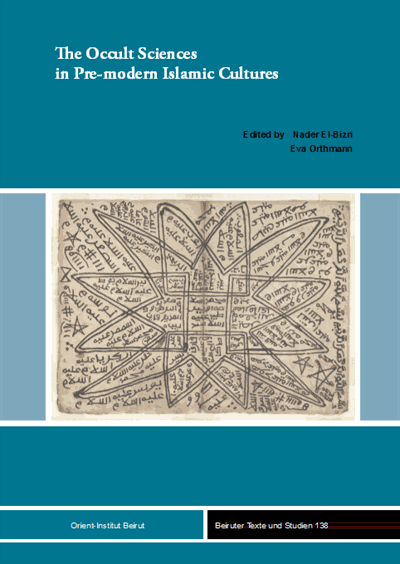
The Occult Sciences in Pre-modern Islamic Cultures
- Editors:
- |
- Series:
- Beiruter Texte und Studien (BTS), Volume 138
- Publisher:
- 2018
Summary
The present edited volume is based in part on papers that were delivered at an international conference, which was held at the American University of Beirut (AUB) on 5–6 December 2013 and was organized by the Orient-Institut Beirut (OIB) in association with the Center for Arab and Middle Eastern Studies (CAMES) at the American University of Beirut (AUB). The conference carried the title that has been retained for this present volume as: The Occult Sciences in Premodern Islamic Cultures. Not all the chapters that constitute the present volume were presented at the conference, and some of the papers that were delivered at the conference have not been included in this volume. It is therefore more prudent to think of this book as a collection of studies rather than as a strict proceedings volume. It is also evident that some of the chapters are expanded and adapted versions of the papers delivered at the conference. In pre-modern Islamic cultures, a number of arts and practices that are associated with the occult sciences were seen as epistemic expansions of the field of scientific knowledge in its various branches. The sciences of the occult dealt with what was taken to be of the order of non-observable realities that were studied by pre-modern natural scientists. This included all phenomena that could not be explained on the basis of the four classical elements. The sciences of the occult were situated between natural philosophy and metaphysics, and at times blended with these in more direct forms — as was the case with astronomia (ʿilm al-nujūm), which combined mathematical astronomy with astrology, or the bent on arithmology and numerology that accompanied the sciences of arithmetic and number theory. An examination of these pre-modern forms of knowledge can itself further enrich our modern understanding of what constitutes the limits of science and its epistemological bearings in the deliberations of philosophy of science.
Keywords
Search publication
Bibliographic data
- Copyright year
- 2018
- ISBN-Print
- 978-3-95650-291-0
- ISBN-Online
- 978-3-95650-375-7
- Publisher
- Ergon, Baden-Baden
- Series
- Beiruter Texte und Studien (BTS)
- Volume
- 138
- Language
- English
- Pages
- 263
- Product type
- Edited Book
Table of contents
- Titelei/InhaltsverzeichnisPages 1 - 6 Download chapter (PDF)
- Introduction No access Pages 7 - 12
- Notes on Contributors No access Pages 13 - 16
- The Occult in Numbers: The Arithmology and Arithmetic of the Ikhwān al-Ṣafāʾ No access Pages 17 - 40 Nader El-Bizri
- Between Medicine and Natural Philosophy. Avicenna on Properties (khawāṣṣ) and Qualities (kayfiyyāt) No access Pages 41 - 66 Emma Gannagé
- Is Physiognomy a Science? Reflections on the Kitāb al-Firāsa of Fakhr al-Dīn al-Rāzī No access Pages 67 - 82 Muhammad Ali Khalidi, Tarif Khalidi
- A Science for Kings and Masters. Firāsa at the Crossroad between Natural Sciences and Power Relationships in Arabic Sources No access Pages 83 - 104 Antonella Ghersetti
- Cometary Theory and Prognostications in the Islamic World and Their Relationship to Renaissance Europe No access Pages 105 - 134 George Saliba
- Predictions of ‘Natural’ Disasters in the Astro-meteorological Malḥamah Handbooks No access Pages 135 - 150 Kristine Chalyan-Daffner
- Persianate Geomancy from Ṭūsī to the Millennium. A Preliminary Survey No access Pages 151 - 200 Matthew Melvin-Koushki
- The Occult Sciences in Ḥurūfī Discourse. Science of Letters, Alchemy and Astrology in the Works of Faḍlallāh Astarābādī No access Pages 201 - 222 Orkhan Mir-Kasimov
- Lettrism and Magic in an Early Mughal Text. Muḥammad Ghawth’s Kitāb al-Jawāhir al-Khams No access Pages 223 - 248 Eva Orthmann
- Going Egyptian in Medieval Arabic Culture. The Long-Desired Fulfilled Knowledge of Occult Alphabets by Pseudo-Ibn Waḥshiyya No access Pages 249 - 263 Isabel Toral-Niehoff, Annette Sundermeyer