, to see if you have full access to this publication.
Monograph No access
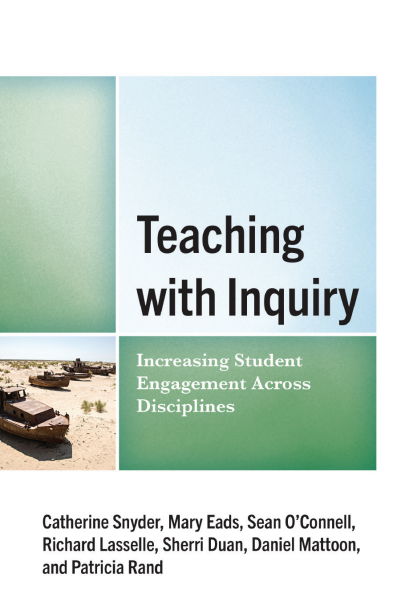
Teaching with Inquiry
Increasing Student Engagement across Disciplines
Authors:
| | | | | |
Publisher:
2023
Summary
Inquiry Learning is an innovative, hands-on, and collaborative approach to student learning. The Inquiry Learning Model shifts the heavy cognitive lifting from the teacher to the student. Documents and artifacts are used to provoke deep analysis and hone critical-thinking skills as students work in teams to interpret and connect clues to solve a mystery. A detailed step-by-step methodology is provided as well as six multidisciplinary lessons. Lessons are suitable for collaborative teaching or stand alone in discipline specific classes. For example, Exploitation and Immortality: The Story of Henrietta Lacks, is a lesson that can be used in the science, social studies, English or math classroom, or a combination of any of these disciplines. In addition to the methodology and lessons, Teaching with Inquiry includes differentiation strategies to adapt lessons to all learners, suggestions for lesson use in multiple disciplines, and a variety of graphic organizers to help students organize, process, and summarize the information throughout the lesson.
Keywords
Search publication
Bibliographic data
Edition
1/2023
Copyright Year
2023
ISBN-Print
978-1-4758-7171-5
ISBN-Online
978-1-4758-7173-9
Publisher
Rowman & Littlefield, Lanham
Language
English
Pages
116
Product Type
Monograph
Table of contents
ChapterPages
Contents No access
Using Inquiry as a Tool for Learning No access
Teaching Students to Question Their Ideas No access
Leading Students to Discovery with the ILM No access
ILM for All No access
Lesson 1: The Disappearing Aral Sea (History/Earth Science) No access
Lesson 2: Let’s Travel to an English-Speaking City (World Languages/TESOL) No access
Lesson 3: Cyclical Modeling No access
Lesson 4: Constructing Chinese Characters (Chinese/History) No access
Lesson 5: Exploitation and Immortality No access
Lesson 6: China’s Maritime Might (Economics/History) No access
References No access Pages 111 - 114
About the Authors No access Pages 115 - 116
Similar publications
from the topics "Bildung allgemein"
Edited Book Full access
Christoph T. Burmeister, Thorsten Hertel, Sophia Richter