, to see if you have full access to this publication.
Monograph No access
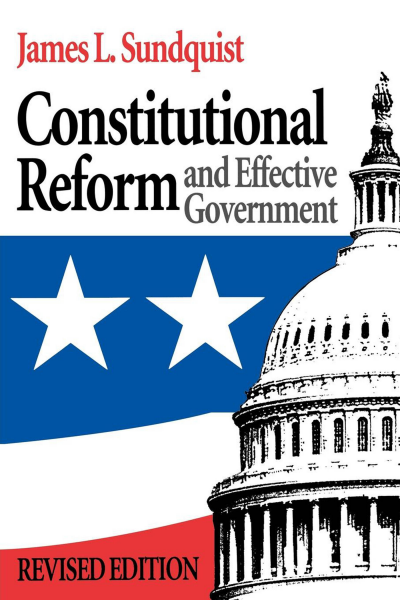
Constitutional Reform and Effective Government
Authors:
Publisher:
2011
Summary
For years the public has become increasingly disillusioned and cynical about its governmental institutions. In the face of alarming problems-most notably the $400 billion budget deficit-the government seems deadlocked, reduced to partisan posturing and bickering, with the president and Congress blaming each other for failure. And neither party can be held accountable. The public tendency is to blame individual leaders- or politicians as a class-but an insistent and growing number of experienced statesmen and political scientists believe that much of the difficulty can be traced to the governmental structure itself, designed in the eighteenth century and essentially unchanged since then. Is that inherited constitutional system adequate to meet the challenges of the twenty-first century, or has the time come for fundamental change? Should we adopt an electoral system that encourages unified control of the presidency, the Senate and the House? Lengthen terms of office? Limit congressional terms? Abolish or modify the electoral college? Introduce a mechanism for calling special elections? Permit legislators to hold executive offices? Redistribute the balance of powers within the governmental system? In this revised edition of his highly acclaimed 1986 volume, James Sundquist reviews the origins and rationale of the constitutional structure and the current debate about whether reform is needed, then raises practical questions about what changes might work best if a consensus should emerge that the national government is too prone to stalemate to meet its responsibilities. Analyzing the main proposals advanced to adapt the Constitution to current conditions, he attempts to separate the workable ideas from the unworkable, the effective from the ineffective, the possibly feasible from the wholly infeasible, and finally arrives at a set of recommendations of his own.
Search publication
Bibliographic data
Edition
1/2011
Copyright Year
2011
ISBN-Print
978-0-8157-8230-8
ISBN-Online
978-0-8157-1430-9
Publisher
Rowman & Littlefield, Lanham
Language
English
Pages
344
Product Type
Monograph
Table of contents
ChapterPages
Contents No access
The Current Constitutional Debate No access
The Barriers to Constitutional Reform No access
The Parliamentary Model—and Incrementalism No access
What Changes Might Work? No access
Checks on the Congress No access
Checks on the President No access
The Process of Amendment No access
Presidential Tenure No access
Presidential Selection No access
Linking Cabinet and Congress No access
Direct Election of Senators No access
The Amendment Process No access
Approval of Treaties No access
Congressional Tenure No access
Removing a Failed President No access
The War Power No access
Efficiency, Leadership, and Accountability No access
The Accepted Theory of Party Government No access
The New Era of Divided Government No access
Evaluations of Divided Government No access
The Origins of Divided Government No access
Designing a Solution No access
The Presidential-Congressional Team Ticket No access
Two Simpler Approaches No access
Bonus Seats in Congress No access
Effectiveness versus Feasibility No access
Windows and Honeymoons No access
The Four-Eight-Four Plan No access
The Six-Six-Three Plan No access
Repeal of the Twenty-second Amendment No access
Limiting Congressional Terms No access
Electing the President No access
Special Elections as the Remedy No access
Designing the Special Election Mechanism No access
The Need for a Safety Valve No access
Modifying the Separation of Powers No access
Strengthening Political Parties No access
The Promise of Improved Collaboration No access
The Item Veto No access
The Legislative Veto No access
The War Power No access
Approval of Treaties No access
Breaking Deadlocks by Referenda No access
Preserving the Executive-Legislative Balance No access
The Difficulty of Doing Anything No access
Variations in the Amendment Process No access
The Problem of Gainers and Losers No access
A No access
B No access
C No access
D No access
E No access
F No access
G No access
H No access
I No access
J No access
K No access
L No access
M No access
N No access
O No access
P No access
Q No access
R No access
S No access
T No access
U No access
V No access
W No access
Y No access
Z No access
Similar publications
from the topics "Recht allgemein, Übergreifende Werke und Sammlungen"