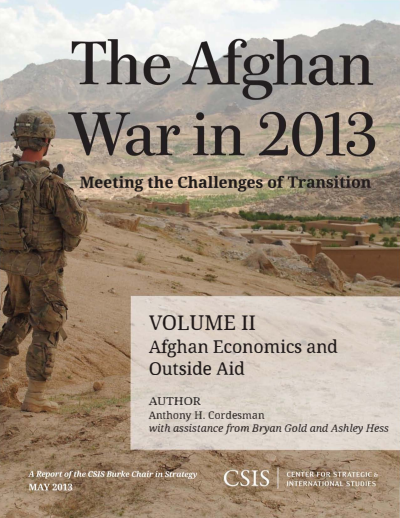
The Afghan War in 2013: Meeting the Challenges of Transition
Afghan Economics and Outside Aid- Authors:
- | |
- Publisher:
- 2013
Summary
After more than a decade of fighting in Afghanistan, the United States and its allies are set to transfer security responsibilities to Afghan forces in 2014. This transition poses many challenges, and much will depend on the future of Afghan politics, governance, corruption, development, security, and economics. How the United States manages the transition is vital for any hopes of creating a secure Afghanistan, as well as preventing the reemergence of the Taliban and other terrorist groups. The Afghan War in 2013 honestly assesses the benefits, costs, and risks involved in transition. It is essential reading for an in-depth understanding of the complex forces and intricacies of the United States’ role in Afghanistan and the difficulties involved in creating a stable Afghanistan in 2014 and beyond. Afghanistan is still at war and will probably be at war long after 2014. At the same time, the coming cuts in the International Security Assistance Force (ISAF) and cuts in military and civil aid, along with the country’s fractious politics and insecurity, will interact with a wide range of additional factors that threaten to derail the transition. These factors, examined in this three-volume study, highlight the need to make the internal political, governmental, economic, and security dimensions of the transition as effective as possible. This will require a new degree of realism about what the Afghans can and cannot accomplish, about the best approaches to shaping the Afghan National Security Forces (ANSF), and the need for better planned and managed outside aid.
Keywords
Search publication
Bibliographic data
- Copyright Year
- 2013
- ISBN-Print
- 978-1-4422-2499-5
- ISBN-Online
- 978-1-4422-2500-8
- Publisher
- Rowman & Littlefield, Lanham
- Language
- English
- Pages
- 162
- Product Type
- Monograph
Table of contents
- Table of Contents No access
- Continued Aid and Economic Stability as Key Threats to a Successful Transition No access
- The Need to Focus on the Afghan War Fatigue No access
- The Need for Credible Economic and Aid Plans, Credible Resources, and Transparency No access
- Time Is Another Key Threat No access
- Restructure Economic Aid to Reflect the Fact Afghans Will Need Aid for Economic Stability During Transition More Than for Development No access
- Create an Effective and Coordinated International Effort No access
- Shift Governance Aid to Deal with the Realities of a Flawed Afghan Political System But Hold the Afghan Government Accountable Where This Is Critical to Transition No access
- Accept the Reality That the “New Silk Road” and Regional Development May Benefit Afghanistan After 2020, But Offer No Practical Basis of Support for Transition No access
- Prepare to Shift Economic Aid from Development to Stability No access
- Real World vs. “Mythical-macro” Economics: There Are No Reliable Macroeconomic Data on Afghanistan No access
- No Reliable GDP or GDP Per Capita Data No access
- The Uncertain Forces Driving the Afghan GDP No access
- Per Capita Income Data Provide Only the Roughest Warnings No access
- How Many Afghans and Where? No One Knows No access
- Making Up More Detailed Numbers by Model and Guesstimate No access
- Taking a Guess at Some Key Population Trends Affecting Every Element of Development and Transition No access
- Without Credible Baseline Data, More Sophisticated Breakouts Become Impossible No access
- Past Spending, Current Spending Rates, and Spending as a Percent of Total Aid Funds Are Not a Measure of Merit, and Never Will Be No access
- Unreliable, Missing, and Self-Contradictory Country-by-Country Data That Do Not Provide Any Indication of How Much Money Was Actually Spent in, and Stayed in, Afghanistan No access
- The Totals for All International Aid Are Equally Unreliable and Fail to Provide Any Meaningful Measure of Progress No access
- The US as a Case Study and a Warning No access
- The Unknown Impact of Coming US Cuts in Spending No access
- Look at the Trends in US Aid vs. Total Spending No access
- The Lack of Meaningful Transition Data on the Sources of Afghan Government Domestic Revenues No access
- Afghan Investment and Future Sources of Revenue No access
- A New “Great Game”? No access
- The Problem of Sustaining Aid Levels No access
- Unaffordable “Needs” and the Rush for the Exits No access
- Building on a Weak Foundation No access
- World Bank Estimates of Dependence on Outside Spending No access
- Department of Defense Comments on Dependence No access
- General Accountability Office Estimate of Aid Dependence No access
- The Risks in Cutting Outside Spending No access
- The Afghan Response: Requesting More Than Will Ever Come No access
- Concepts Not Plans No access
- Promises of Reform from a Decade-Long Non-Reformer No access
- The Oliver Twist Approach to Transition: “More. Please.” No access
- World Bank, CRS, and SIGAR Warnings No access
- An Impossible Financing Gap in Aid? No access
- A Long History of Unmet Pledges and Real-World Abandonment No access
- Hope and Uncertainty No access
- The Operational Realities No access
- No Basis for Meaningful Planning No access
- If Reality Intervenes No access
- Afghan Problems versus Outside “Pledges” No access
- Trying to Make Aid Work as PRTs Are Eliminated and with Inadequate US, European, Donor, and UN Structures No access
- The Death of the Afghan Compact and Development Plan No access
- The US, ISAF, and Afghanistan Cannot Rely on Mines and the “New Silk Road” for Transition No access
- A Mining Option for the Future, Not for Transition No access
- The “New Silk Road” Is a Poor Cover, Even for an Exit Strategy No access
- Agriculture No access
- The Service Sector No access
- Mining and Narcotics No access
- Security Problems and Regional Impacts No access
- Demographics and Economic Stability No access
- Employment No access
- Poverty, Food Issues, and the UN World Food Program No access
- Refugees, Displaced Persons, and Poverty No access
- Rising Area under Cultivation Even in Helmand and Other Areas in the South and Rebirth of Taliban Influence No access
- Reality vs. Anti-Narcotics Claims of Progress No access
- Narcotics, Criminal Networks, Leadership Flight, and the ANSF No access
- Narco-Corruption as a Critical Part of Afghan Economic and Transition No access
- Dodging the Worst Case, But the Bad Case Is Bad Enough No access
- The Need to Focus on the Afghan War Fatigue No access
- The Need for Credible Economic and Aid Plans, Credible Resources, and Transparency No access
- Time Is Another Key Threat No access
- Restructure Economic Aid to Reflect the Fact Afghans Will Need Aid for Economic Stability During Transition More Than for Development No access
- Create an Effective and Coordinated International Effort No access
- Shift Governance Aid to Deal with the Realities of a Flawed Afghan Political System But Hold the Afghan Government Accountable Where This Is Critical to Transition No access
- Accept the Reality That the “New Silk Road” and Regional Development May Benefit Afghanistan After 2020, But Offer No Practical Basis of Support for Transition No access
- Prepare to Shift Economic Aid from Development to Stability No access