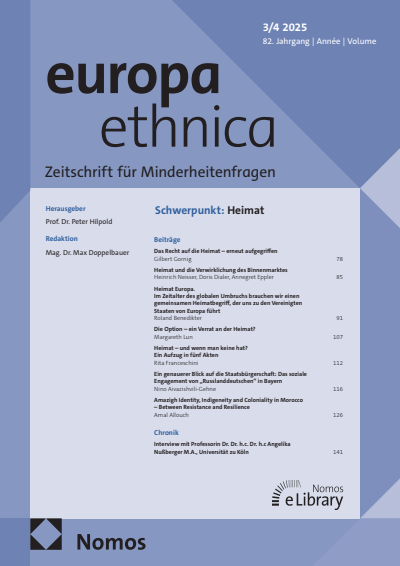
The idea of a right to one's homeland developed when millions of people were expelled from their homes during and after the Second World War. Although there was already a ban on expulsion, there was no individual right not to be expelled. Since...
This article explores the question of how a European sense of community could be established against the backdrop of a “civil religion.” A typological comparison of approaches to revitalizing historical and intellectual ideals rooted in the...
This article draws on ethnographic research with “Russian Germans” in Bavaria who engage in full-time or voluntary work as administrative counsellors for Ukrainian refugees, unravelling perceptions of citizenship and integration in the context...
Amazigh identity stretches far back into North African history, much further than most people realise. It is not only a legacy of deep-rooted history, but also an expression of a vibrant present. Shaped by centuries of cultural continuity, the...
Dyck, Noel, ed. 1985. Indigenous Peoples and the Nation-State: Fourth World Politics in Canada, Australia and Norway, Social and Economic Papers No. 14. St. John’s: Institute of Social and Economic Research, Memorial University of Newfoundland. Open Google Scholar doi.org/10.5771/0014-2492-2025-3-4-126
Doppelbauer, Max. 2016. Melilla/Tamlilt, ¿la codiciada? Realidades sociolingüísticas de una ciudad en la intersección de dos mundos. In Cichon, Peter, Doppelbauer, Max, and Gamez, Sonia, eds. Melilla-Vienna. An unprecedented axis of social research. Transcultural perspectives on the perception of Europe's southern border. Melilla: Instituto de las Culturas, 29–44. Open Google Scholar doi.org/10.5771/0014-2492-2025-3-4-126
Wagner, Theresa. and Schwenken, Helen. (2023). Engagement für ukrainische Geflüchtete. Eine ‘Zweitklassen-Solidarität’. Movements. Journal for Critical Migration and Border Regime Studies 7 (2): 43–64. Open Google Scholar doi.org/10.5771/0014-2492-2025-3-4-116
Kratochwil, Gabriele. 2002. ‘The Berber Movement in Morocco. On the History of the Construction of an Ethnic Identity (1912–1997). In Winkelhane, Gerd: Islamic Studies, vol. 247. Berlin: Reimer. Open Google Scholar doi.org/10.5771/0014-2492-2025-3-4-126
Eckert, Julia. (2020). The Office. Ethos and Ethics in Migration Bureaucracies. In The Bureaucratic Production of Difference, edited by Julia Eckert: 7- 26. Bielefeld: Transcript Verlag. Open Google Scholar doi.org/10.5771/0014-2492-2025-3-4-116
Gupta, Akhil. (2006). Blurred Boundaries: The Discourse of Corruption, the Culture of Politics, and the Imagined State. In The Anthropology of the State, edited by Aradhana Sharma and Akhil Gupta. Malden: Blackwell Publishing: 211–242. Open Google Scholar doi.org/10.5771/0014-2492-2025-3-4-116
Fleischmann, Larissa and Steinhilper, Elias. (2017). Thy Myth of Apolitical Volunteering for Refugees: German Welcome Culture and New Dispositif of Helping. Social Inclusion 5 (3): 17–27. Open Google Scholar doi.org/10.5771/0014-2492-2025-3-4-116
Darieva, Tsypylma. (2006). Russlanddeutsche, Nationalstaat und Familie in transnationaler Zeit. In Zuhause fremd – Russlanddeutsche zwischen Russland und Deutschland, edited by Sabine Ipsen-Peitzmeier and Markus Kaiser, Bielefeld: transcript Verlag: 349–364. Open Google Scholar doi.org/10.5771/0014-2492-2025-3-4-116
Brković, Čarna. (2022). Postsocialist Mediterranean. Scalar Gaze, Moral Self, and Relational Labor of Favors in Eastern Europe. Focaal-Journal of Global and Historical Anthropology 92: 82–97. Open Google Scholar doi.org/10.5771/0014-2492-2025-3-4-116
Petersen, Hans Christian. (2023). Russlanddeutsch(e). In Inventar der Migrationsbegriffe, herausgegeben von Inken Bartels; Isabela Löhr; Christiane Reinecke, Philip Schäfer, Laura Stielike, 1.6.2023. Online: http://www.migrationsbegriffe.de/russlanddeutsch, DOI: https://doi.org/10.48693/337. Open Google Scholar doi.org/10.5771/0014-2492-2025-3-4-116
Thelen, Tatjana; Thiemann, André and Roth, Duška. (2018). State Kinning and Kinning the State in Serbian Elder Care Programs. In Stategraphy: Toward a Relational Anthropology of the State, edited by Tatjana Thelen, Larissa Vetters and Keebet von Benda-Beckmann: 107–123. New York; Oxford: Berghahn. Open Google Scholar doi.org/10.5771/0014-2492-2025-3-4-116
Strobl, Rainer. (2006). Chancen und Probleme der Integration junger Aussiedler aus der früheren Sowjetunion. In Zuhause fremd – Russlanddeutsche zwischen Russland und Deutschland, herausgegeben von Sabine Ipsen-Peitzmeier and Markus Kaiser: 87–107. Bielefeld: Transcript Verlag. Open Google Scholar doi.org/10.5771/0014-2492-2025-3-4-116
Stan, Sabina. (2012). Neither commodities nor gifts: post-socialist informal exchanges in the Romanian healthcare system. Journal of the Royal Anthropological Institute (N.S.) 18: 65–82. Open Google Scholar doi.org/10.5771/0014-2492-2025-3-4-116
Rivkin-Fisch, Michele R. (2005). Bribes, Gifts, and Unofficial Payments: Rethinking Corruption in Post-Soviet Russian Healthcare. In Corruption: Anthropological Perspectives, edited by Dieter Haller and Cris Shore. Bloomington: Indiana University Press: 47–64. Open Google Scholar doi.org/10.5771/0014-2492-2025-3-4-116
Polese, Abel. (2008). ‘If I receive it. It is a gift; if I demand it, then it is a bribe’: On the Local Meaning of Economic Transactions in Post-Soviet Ukraine. Anthropology of Action 15 (3): 47–60 Open Google Scholar doi.org/10.5771/0014-2492-2025-3-4-116
Panagiotidis, Jannis. (2020): ‘Wir Strebermigranten’? Migration und Erfolg bei (Spät-) Aussiedlern. In Handbuch Migration und Erfolg. Psychologische und sozialwissenschaftliche Aspekte, herausgegeben von Petia Genkova and Andrea Riecken. Wiesbaden: Springer: 107–120. Open Google Scholar doi.org/10.5771/0014-2492-2025-3-4-116