, um zu prüfen, ob Sie einen Vollzugriff auf diese Publikation haben.
Ausgabe Kein Zugriff

Jahrgang 82 (2025), Heft 3-4

europa ethnica
Autor:innen:
Zeitschrift:
europa ethnica
Verlag:
 2025

Über die Zeitschrift

europa ethnica ist eine interdisziplinär ausgerichtete Fachzeitschrift und bietet zwei Mal jährlich aktuelle und grundlegende Beiträge zur rechtlichen, politischen und sprachlichen Situation europäischer Minderheiten, Berichte über aktuelle Ereignisse und Tagungen sowie Rezensionen. International namhafte WissenschafterInnen aus Politik, Recht und Sprache setzen sich mit Fragen des multikulturellen Zusammenlebens, mit einzelnen Wanderungsbewegungen und neuen Minderheiten auseinander. Diskutiert werden weiters Gesetzesentwürfe unter Einbeziehung des internationalen humanitären Rechts.

Publikation durchsuchen


Bibliographische Angaben

ISSN-Print
0014-2492
ISSN-Online
2664-5459
Verlag
Nomos, Baden-Baden
Sprache
Deutsch
Produkttyp
Ausgabe

Artikel

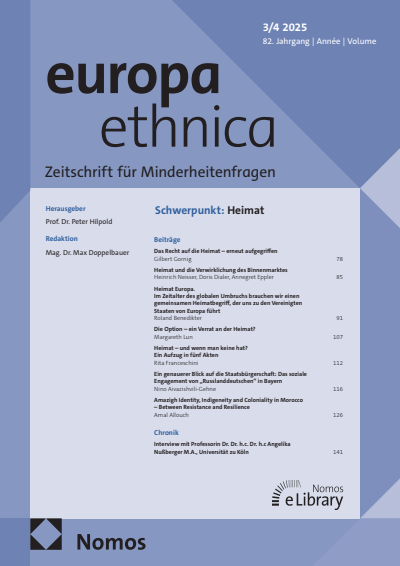
Cover der Ausgabe: europa ethnica Jahrgang 82 (2025), Heft 3-4
Artikel
Kein Zugriff

Seite I - II
Nomos Verlagsgesellschaft mbH & Co. KG, Baden-Baden 2025

Cover der Ausgabe: europa ethnica Jahrgang 82 (2025), Heft 3-4
Artikel
Kein Zugriff

Seite 75 - 75
Nomos Verlagsgesellschaft mbH & Co. KG, Baden-Baden 2025

Cover der Ausgabe: europa ethnica Jahrgang 82 (2025), Heft 3-4
Artikel
Kein Zugriff

Seite 76 - 76
Nomos Verlagsgesellschaft mbH & Co. KG, Baden-Baden 2025
Autor:innen:

Cover der Ausgabe: europa ethnica Jahrgang 82 (2025), Heft 3-4
Artikel
Kein Zugriff

Seite 77 - 77
Nomos Verlagsgesellschaft mbH & Co. KG, Baden-Baden 2025
Autor:innen:

Cover der Ausgabe: europa ethnica Jahrgang 82 (2025), Heft 3-4
Artikel
Kein Zugriff

Seite 78 - 84
Nomos Verlagsgesellschaft mbH & Co. KG, Baden-Baden 2025
Autor:innen:

Cover der Ausgabe: europa ethnica Jahrgang 82 (2025), Heft 3-4
Artikel
Kein Zugriff

Seite 85 - 90
Nomos Verlagsgesellschaft mbH & Co. KG, Baden-Baden 2025
Autor:innen:

Cover der Ausgabe: europa ethnica Jahrgang 82 (2025), Heft 3-4
Artikel
Kein Zugriff

Seite 91 - 106
Dieser Beitrag geht der Frage nach, wie ein europäisches Zusammengehörigkeitsgefühl vor dem Hintergrund einer „Zivilreligion“ zu begründen wäre. Aus dem typologischen Vergleich verschiedener Ansätze zu einer Verlebendigung...
Nomos Verlagsgesellschaft mbH & Co. KG, Baden-Baden 2025
Autor:innen:

Cover der Ausgabe: europa ethnica Jahrgang 82 (2025), Heft 3-4
Artikel
Kein Zugriff

Seite 107 - 111
Nomos Verlagsgesellschaft mbH & Co. KG, Baden-Baden 2025
Autor:innen:

Cover der Ausgabe: europa ethnica Jahrgang 82 (2025), Heft 3-4
Artikel
Kein Zugriff

Seite 112 - 115
Nomos Verlagsgesellschaft mbH & Co. KG, Baden-Baden 2025
Autor:innen:

Cover der Ausgabe: europa ethnica Jahrgang 82 (2025), Heft 3-4
Artikel
Kein Zugriff

Seite 116 - 125
Nomos Verlagsgesellschaft mbH & Co. KG, Baden-Baden 2025
Autor:innen:

Cover der Ausgabe: europa ethnica Jahrgang 82 (2025), Heft 3-4
Artikel
Kein Zugriff

Seite 126 - 140
Nomos Verlagsgesellschaft mbH & Co. KG, Baden-Baden 2025
Autor:innen:

Cover der Ausgabe: europa ethnica Jahrgang 82 (2025), Heft 3-4
Artikel
Kein Zugriff

Seite 141 - 142
Nomos Verlagsgesellschaft mbH & Co. KG, Baden-Baden 2025

Cover der Ausgabe: europa ethnica Jahrgang 82 (2025), Heft 3-4
Artikel
Kein Zugriff

Seite 143 - 147
Nomos Verlagsgesellschaft mbH & Co. KG, Baden-Baden 2025

Cover der Ausgabe: europa ethnica Jahrgang 82 (2025), Heft 3-4
Artikel
Kein Zugriff

Seite 148 - 148
Nomos Verlagsgesellschaft mbH & Co. KG, Baden-Baden 2025

Literaturverzeichnis (79 Einträge)

  1. Federal Agency for Civic Education. 2019. UN Day of Indigenous Peoples. Google Scholar öffnen doi.org/10.5771/0014-2492-2025-3-4-126
  2. El-Asrouti, Fouzia. 2007. The Rif War 1921–1926. A critical examination of the social transformation process under Muḥammad Ibn ʿAbd al-Karīm al-Khaṭṭābī. Berlin: Klaus Schwarz Verlag. Google Scholar öffnen doi.org/10.5771/0014-2492-2025-3-4-126
  3. Dyck, Noel, ed. 1985. Indigenous Peoples and the Nation-State: Fourth World Politics in Canada, Australia and Norway, Social and Economic Papers No. 14. St. John’s: Institute of Social and Economic Research, Memorial University of Newfoundland. Google Scholar öffnen doi.org/10.5771/0014-2492-2025-3-4-126
  4. Doppelbauer, Max. 2018. Metropolises, languages, identities. In: Quo Vadis, Romania?, 51/52, 77–101. Google Scholar öffnen doi.org/10.5771/0014-2492-2025-3-4-126
  5. Doppelbauer, Max. 2016. Melilla/Tamlilt, ¿la codiciada? Realidades sociolingüísticas de una ciudad en la intersección de dos mundos. In Cichon, Peter, Doppelbauer, Max, and Gamez, Sonia, eds. Melilla-Vienna. An unprecedented axis of social research. Transcultural perspectives on the perception of Europe's southern border. Melilla: Instituto de las Culturas, 29–44. Google Scholar öffnen doi.org/10.5771/0014-2492-2025-3-4-126
  6. Cornwell, Graham H., and Mona Atia. 2012. ‘Imaginative Geographies of Amazigh Activism in Morocco’. Social & Cultural Geography, 13 (3): 255–274. Google Scholar öffnen doi.org/10.5771/0014-2492-2025-3-4-126
  7. Chtatou, Mohamed. 2024. Personal interview. Conducted in Rabat, Morocco, May 2024. Google Scholar öffnen doi.org/10.5771/0014-2492-2025-3-4-126
  8. Catlos, Brian A. 2019. Al-Andalus: History of Islamic Spain. Munich: C.H. Beck. Google Scholar öffnen doi.org/10.5771/0014-2492-2025-3-4-126
  9. Castells, Manuel. 2017. The Power of Identity. In Rössel, J., Schiman, U., and Vobruba, G. (eds.). New Library of Social Sciences, Vol. 2. Wiesbaden: Springer Fachmedien. Google Scholar öffnen doi.org/10.5771/0014-2492-2025-3-4-126
  10. BMZ (Federal Ministry for Economic Cooperation and Development). 2022. Rights of Indigenous Peoples. Google Scholar öffnen doi.org/10.5771/0014-2492-2025-3-4-126
  11. Ennaji, Moha. 2014. ‘Recognising the Berber Language in Morocco: A Step for Democratisation’. Georgetown Journal of International Affairs, Summer/Fall, 15 (2): 93–99. Google Scholar öffnen doi.org/10.5771/0014-2492-2025-3-4-126
  12. Becker, Cynthia J. 2006. ‘Amazigh Arts in Morocco: Women Shaping Berber Identity’. University of Texas Press. Google Scholar öffnen doi.org/10.5771/0014-2492-2025-3-4-126
  13. Ashcroft, Bill, Gareth Griffiths, und Helen Tiffin, Hrsg. 1989. The Empire Writes Back: Theory and Practice in Post-Colonial Literatures. London: Routledge. Google Scholar öffnen doi.org/10.5771/0014-2492-2025-3-4-126
  14. Abd el-Krim. Memoirs. 1927. My War Against Spain and France. Edited by J. Roger-Mathieu. Translated by Artur Rosenberg. Google Scholar öffnen doi.org/10.5771/0014-2492-2025-3-4-126
  15. Wanner, Catherine. 2006. Money, Morality and New Forms of Exchange in Postsocialist Ukraine. Ethnos 70 (4): 515–537. Google Scholar öffnen doi.org/10.5771/0014-2492-2025-3-4-116
  16. Wagner, Theresa. and Schwenken, Helen. (2023). Engagement für ukrainische Geflüchtete. Eine ‘Zweitklassen-Solidarität’. Movements. Journal for Critical Migration and Border Regime Studies 7 (2): 43–64. Google Scholar öffnen doi.org/10.5771/0014-2492-2025-3-4-116
  17. Walzer, Michael. (1998). The Civil Society Argument. In The Citizenship Debates, edited by Gershon Shafir. Minneapolis; London: University of Minnesota Press: 291–308. Google Scholar öffnen doi.org/10.5771/0014-2492-2025-3-4-116
  18. Walther, Eva-Maria. (2021). Brokers in Straitjackets: The Moral Quandaries of Refugee Support Organizations in Slovakia. Cultural Dynamics 33 (4): 316–330. Google Scholar öffnen doi.org/10.5771/0014-2492-2025-3-4-116
  19. Vertovec, Steven. (2020). Considering the Work of Integration. MMG Working Paper 04. https://www.mmg.mpg.de/565490/WP_20-04_Vertovec_Integration.pdf. Google Scholar öffnen doi.org/10.5771/0014-2492-2025-3-4-116
  20. Yurchak, Alexei. (2005). Everything Was Forever, Until It Was No More. The Last Soviet Generation. Princeton and Oxford: Princeton University Press. Google Scholar öffnen doi.org/10.5771/0014-2492-2025-3-4-116
  21. Lefèvre, Raphaël. 2016. North Africa’s ‘Berber Question’. The Journal of North African Studies, 21, no. 4. Google Scholar öffnen doi.org/10.5771/0014-2492-2025-3-4-126
  22. Weaver, Jace. 2005. ‘Indigenousness and Indigeneity’. In Schwarz, Henry, und Sangeeta Ray, Hrsg. A Companion to Postcolonial Studies. Blackwell Publishers. Google Scholar öffnen doi.org/10.5771/0014-2492-2025-3-4-126
  23. Sadiqi, Fatima. 2024. Personal interview. Conducted in May 2024. Google Scholar öffnen doi.org/10.5771/0014-2492-2025-3-4-126
  24. Raha, Rashid. 2024. Personal interview. Conducted in Agadir, Morocco, July 2024. Google Scholar öffnen doi.org/10.5771/0014-2492-2025-3-4-126
  25. Pfeifer, Kristin. 2015. "We are not Arabs!" Amazigh identity construction in Morocco. 1st ed. transcript Verlag. Google Scholar öffnen doi.org/10.5771/0014-2492-2025-3-4-126
  26. Pelican, Michaela. 2009. ‘Complexities of Indigeneity and Autochthony: An African Example’. American Ethnologist, 36 (1): 52–65. Google Scholar öffnen doi.org/10.5771/0014-2492-2025-3-4-126
  27. Parti de l'Istiqlal. 1944. Manifeste de l'Indépendance. Rabat: Imprimerie Arrisala. Google Scholar öffnen doi.org/10.5771/0014-2492-2025-3-4-126
  28. Morocco News: 10 April 1947 – Mohammed V in Tangier to deliver his historic speech. 2024. Google Scholar öffnen doi.org/10.5771/0014-2492-2025-3-4-126
  29. Morocco News. 2021. Morocco Celebrates 77th Anniversary of Independence Manifesto, Google Scholar öffnen doi.org/10.5771/0014-2492-2025-3-4-126
  30. Maddy-Weitzmann, B. 2011. The Berber Identity Movement and the Challenge to North African States. University of Texas Press. Google Scholar öffnen doi.org/10.5771/0014-2492-2025-3-4-126
  31. Turner, Bryan S. (1997). Citizenship Studies: A General Theory. Citizenship Studies 1 (1): 5–18. Google Scholar öffnen doi.org/10.5771/0014-2492-2025-3-4-116
  32. Lamlili, Nadia. 2017. Tensions in El Hoceima: Social inequality figures explain Moroccan discontent. Jeune Afrique. Google Scholar öffnen doi.org/10.5771/0014-2492-2025-3-4-126
  33. Lahdifi, Sahar. 2019. The struggle for ethnic identities in Morocco and Algeria: A colonial legacy of inequalities. Google Scholar öffnen doi.org/10.5771/0014-2492-2025-3-4-126
  34. Lafi, Nora. 2016. ‘Historical perspectives on the Maghreb’. Journal of Politics and Contemporary History, vol. 33–34: 4–10. Google Scholar öffnen doi.org/10.5771/0014-2492-2025-3-4-126
  35. Kratochwil, Gabriele. 2002. ‘The Berber Movement in Morocco. On the History of the Construction of an Ethnic Identity (1912–1997). In Winkelhane, Gerd: Islamic Studies, vol. 247. Berlin: Reimer. Google Scholar öffnen doi.org/10.5771/0014-2492-2025-3-4-126
  36. Jaspert, Nikolas. 2019. The Reconquista: Christians and Muslims on the Iberian Peninsula. Google Scholar öffnen doi.org/10.5771/0014-2492-2025-3-4-126
  37. INA (Institut national de l’audiovisuel). Le discours de Tanger, 1947. Google Scholar öffnen doi.org/10.5771/0014-2492-2025-3-4-126
  38. Hall, Bruce. 2011. A History of Race in Muslim West Africa 1600–1960. Cambridge: Cambridge University Press. Google Scholar öffnen doi.org/10.5771/0014-2492-2025-3-4-126
  39. Gagliardi, Silvia. 2018. ‘When the “minority” Speaks: Voices of Amazigh Women in Morocco’. NUI Galway. Google Scholar öffnen doi.org/10.5771/0014-2492-2025-3-4-126
  40. Field notes. March 2024. Rabat. Nador, Morocco. Google Scholar öffnen doi.org/10.5771/0014-2492-2025-3-4-126
  41. Eckert, Julia. (2020). The Office. Ethos and Ethics in Migration Bureaucracies. In The Bureaucratic Production of Difference, edited by Julia Eckert: 7- 26. Bielefeld: Transcript Verlag. Google Scholar öffnen doi.org/10.5771/0014-2492-2025-3-4-116
  42. Favell, Adrian. (2019). Integration: Twelve Propositions after Schinkel. CMS 7 (21) https://doi.org/10.1186/s40878-019-0125-7 Google Scholar öffnen doi.org/10.5771/0014-2492-2025-3-4-116
  43. Humphrey, Caroline. (2012). Favors and ‘Normal Heroes.’ The Case of Postsocialist Higher Education. Journal of Ethnographic Theory 2 (2): 22–41. Google Scholar öffnen doi.org/10.5771/0014-2492-2025-3-4-116
  44. Humphrey, Caroline. (2002). The Unmaking of Soviet Life: Everyday Economies after Socialism. Ithaca, NY: Cornell University Press. Google Scholar öffnen doi.org/10.5771/0014-2492-2025-3-4-116
  45. Heckmann, Friedrich. (2015) Integration von Migranten. Einwanderung und neue Nationenbildung. Wiesbaden: Springer VS. Google Scholar öffnen doi.org/10.5771/0014-2492-2025-3-4-116
  46. Haraway, Donna. (1988). Situated Knowledges: The Science Question in Feminism and the Privilege of Partial Perspective. Feminist Studies 14 (3): 575–599. Google Scholar öffnen doi.org/10.5771/0014-2492-2025-3-4-116
  47. Gupta, Akhil. (2006). Blurred Boundaries: The Discourse of Corruption, the Culture of Politics, and the Imagined State. In The Anthropology of the State, edited by Aradhana Sharma and Akhil Gupta. Malden: Blackwell Publishing: 211–242. Google Scholar öffnen doi.org/10.5771/0014-2492-2025-3-4-116
  48. Fleischmann, Larissa and Steinhilper, Elias. (2017). Thy Myth of Apolitical Volunteering for Refugees: German Welcome Culture and New Dispositif of Helping. Social Inclusion 5 (3): 17–27. Google Scholar öffnen doi.org/10.5771/0014-2492-2025-3-4-116
  49. Fleischmann. Larissa. (2019). Making Volunteering with Refugees Governable: The Contested Role of ‘Civil Society’ in the German Welcome Culture. Social Inclusion 7 (2): 64–73. Google Scholar öffnen doi.org/10.5771/0014-2492-2025-3-4-116
  50. Fassin, Didier, ed. (2015). At the Heart of the State. The Moral World of Institutions. London: Pluto. Google Scholar öffnen doi.org/10.5771/0014-2492-2025-3-4-116
  51. Favell, Adrian. (2001). Philosophies of Integration. Immigration and the Idea of Citizenship in France and Britain. Second Edition. Hampshire and New York: Palgrave. Google Scholar öffnen doi.org/10.5771/0014-2492-2025-3-4-116
  52. Dunn, Elizabeth C. (2004). Privatizing Poland: Baby Food, Big Business, and the Remaking of Labor. Ithaca, NY: Cornel University Press. Google Scholar öffnen doi.org/10.5771/0014-2492-2025-3-4-116
  53. Darieva, Tsypylma. (2006). Russlanddeutsche, Nationalstaat und Familie in transnationaler Zeit. In Zuhause fremd – Russlanddeutsche zwischen Russland und Deutschland, edited by Sabine Ipsen-Peitzmeier and Markus Kaiser, Bielefeld: transcript Verlag: 349–364. Google Scholar öffnen doi.org/10.5771/0014-2492-2025-3-4-116
  54. Clasmann, Anne Beatrice. (2024 19 April). Putins Spione in Bayern [Putin’s spies in Bavaria]. Mittelbayerische Zeitung: 2. Google Scholar öffnen doi.org/10.5771/0014-2492-2025-3-4-116
  55. Brković, Čarna. (2022). Postsocialist Mediterranean. Scalar Gaze, Moral Self, and Relational Labor of Favors in Eastern Europe. Focaal-Journal of Global and Historical Anthropology 92: 82–97. Google Scholar öffnen doi.org/10.5771/0014-2492-2025-3-4-116
  56. Brković, Čarna. (2017). Managing Ambiguity. How Clientelism, Citizenship, and Power Shape Personhood in Bosnia and Herzegovina. New-York and Oxford: Berghahn books. Google Scholar öffnen doi.org/10.5771/0014-2492-2025-3-4-116
  57. Brković, Čarna. (2016). Depoliticization ‘from Below’: Everyday Humanitarianism in Bosnia and Herzegovina. Narodna umjetnost: Special Issue on the 12th SIEF Congress 53 (1): 97–115. Google Scholar öffnen doi.org/10.5771/0014-2492-2025-3-4-116
  58. Brown, Wendy. (2006). Finding the Man in the State. In The Anthropology of the State, edited by Aradhana Sharma and Akhil Gupta: 187–210. Malden: Blackwell Publishing. Google Scholar öffnen doi.org/10.5771/0014-2492-2025-3-4-116
  59. Anderson, Bridget. (2013). Us and Them? The Dangerous Politics of Immigration Control. Oxford: Oxford University Press. Google Scholar öffnen doi.org/10.5771/0014-2492-2025-3-4-116
  60. Aivazishvili-Gehne, Nino. (2024). Auf der Suche nach dem guten Leben. Postsowjetische Gemeinschaften in Osnabrück. Bielefeld: transcript. Google Scholar öffnen doi.org/10.5771/0014-2492-2025-3-4-116
  61. Petersen, Hans Christian. (2023). Russlanddeutsch(e). In Inventar der Migrationsbegriffe, herausgegeben von Inken Bartels; Isabela Löhr; Christiane Reinecke, Philip Schäfer, Laura Stielike, 1.6.2023. Online: http://www.migrationsbegriffe.de/russlanddeutsch, DOI: https://doi.org/10.48693/337. Google Scholar öffnen doi.org/10.5771/0014-2492-2025-3-4-116
  62. Thiemann, André. (2024). The Politics of Relations. How Self-Government, Infrastructures, and Care Transform the State in Serbia. New York; Oxford: Berghahn. Google Scholar öffnen doi.org/10.5771/0014-2492-2025-3-4-116
  63. Thelen, Tatjana; Thiemann, André and Roth, Duška. (2018). State Kinning and Kinning the State in Serbian Elder Care Programs. In Stategraphy: Toward a Relational Anthropology of the State, edited by Tatjana Thelen, Larissa Vetters and Keebet von Benda-Beckmann: 107–123. New York; Oxford: Berghahn. Google Scholar öffnen doi.org/10.5771/0014-2492-2025-3-4-116
  64. Strobl, Rainer. (2006). Chancen und Probleme der Integration junger Aussiedler aus der früheren Sowjetunion. In Zuhause fremd – Russlanddeutsche zwischen Russland und Deutschland, herausgegeben von Sabine Ipsen-Peitzmeier and Markus Kaiser: 87–107. Bielefeld: Transcript Verlag. Google Scholar öffnen doi.org/10.5771/0014-2492-2025-3-4-116
  65. Stan, Sabina. (2012). Neither commodities nor gifts: post-socialist informal exchanges in the Romanian healthcare system. Journal of the Royal Anthropological Institute (N.S.) 18: 65–82. Google Scholar öffnen doi.org/10.5771/0014-2492-2025-3-4-116
  66. Scott, James. (1999). Seeing Like a State: How Certain Schemes to Improve the Human Condition Have Failed. New Haven and London: Yale University Press. Google Scholar öffnen doi.org/10.5771/0014-2492-2025-3-4-116
  67. Rytter, Mikkel. (2019). Writing against Integration: Danish Imaginaries of Culture, Race and Belonging. Ethnos 84 (4): 678–697. Google Scholar öffnen doi.org/10.5771/0014-2492-2025-3-4-116
  68. Rivkin-Fisch, Michele R. (2005). Bribes, Gifts, and Unofficial Payments: Rethinking Corruption in Post-Soviet Russian Healthcare. In Corruption: Anthropological Perspectives, edited by Dieter Haller and Cris Shore. Bloomington: Indiana University Press: 47–64. Google Scholar öffnen doi.org/10.5771/0014-2492-2025-3-4-116
  69. Rawls, John. (1998). Justice as Fairness in the Liberal Polity. In The Citizenship Debates, edited by Gershon Shafir. Minneapolis; London: University of Minnesota Press: 53–72. Google Scholar öffnen doi.org/10.5771/0014-2492-2025-3-4-116
  70. Polese, Abel. (2008). ‘If I receive it. It is a gift; if I demand it, then it is a bribe’: On the Local Meaning of Economic Transactions in Post-Soviet Ukraine. Anthropology of Action 15 (3): 47–60 Google Scholar öffnen doi.org/10.5771/0014-2492-2025-3-4-116
  71. Aivazishvili-Gehne, Nino. (2023). Staatsbürgerschaft an der Grenze. Die georgischsprachigen Ingiloer in Aserbaidschan. Wiesbaden: Reichert. Google Scholar öffnen doi.org/10.5771/0014-2492-2025-3-4-116
  72. Patico, Jennifer. (2002). Chocolate and Cognac. Gifts and Recognition of Social Worlds in Post-Soviet Russia. Ethnos 67 (3): 345–368. Google Scholar öffnen doi.org/10.5771/0014-2492-2025-3-4-116
  73. Panagiotidis, Jannis und Petersen, Hans-Christian (2024). Antiosteuropäischer Rassismus in Deutschland. Geschichte und Gegenwahrt. Weinheim: Beltz Juventa Verlag. Google Scholar öffnen doi.org/10.5771/0014-2492-2025-3-4-116
  74. Panagiotidis, Jannis. (2021). Postsowjetische Migration in Deutschland. Eine Einführung. Weinheim Basel: Beltz Juventa. Google Scholar öffnen doi.org/10.5771/0014-2492-2025-3-4-116
  75. Panagiotidis, Jannis. (2020): ‘Wir Strebermigranten’? Migration und Erfolg bei (Spät-) Aussiedlern. In Handbuch Migration und Erfolg. Psychologische und sozialwissenschaftliche Aspekte, herausgegeben von Petia Genkova and Andrea Riecken. Wiesbaden: Springer: 107–120. Google Scholar öffnen doi.org/10.5771/0014-2492-2025-3-4-116
  76. Muehlebach, Andrea. (2012). The Moral Neoliberal. Welfare and Citizenship in Italy. Chicago and London: University of Chicago Press. Google Scholar öffnen doi.org/10.5771/0014-2492-2025-3-4-116
  77. Marshall, Thomas H. (1998). Citizenship and Social Class. In The Citizenship Debates, edited by Gershon Shafir. Minneapolis; London: University of Minnesota Press: 93–111. Google Scholar öffnen doi.org/10.5771/0014-2492-2025-3-4-116
  78. Ledeneva, Alena V. (1998). Russia’s Economy of Favours: Blat, Networking, and Informal Exchange. Cambridge: Cambridge University Press. Google Scholar öffnen doi.org/10.5771/0014-2492-2025-3-4-116
  79. Ipsen-Peitzmeier, Sabine and Kaiser, Markus, eds. (2006). Zuhause fremd – Russland deutsche zwischen Russland und Deutschland. Bielefeld: transcript. Google Scholar öffnen doi.org/10.5771/0014-2492-2025-3-4-116

Neuesten Ausgaben

europa ethnica
Alle Ausgaben anzeigen
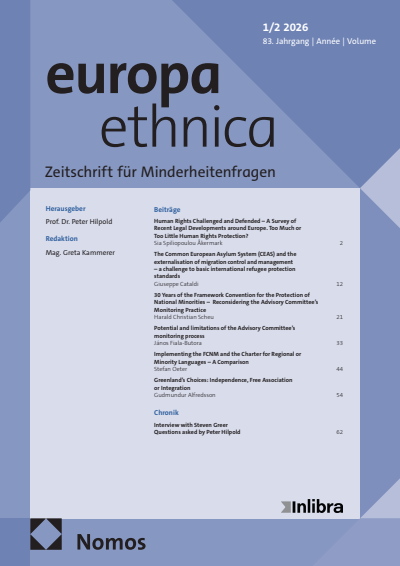
Cover der Ausgabe: europa ethnica Jahrgang 82 (2025), Heft 3-4
Ausgabe Kein Zugriff
Zeitschrift für Minderheitenfragen
Jahrgang 82 (2025), Heft 3-4
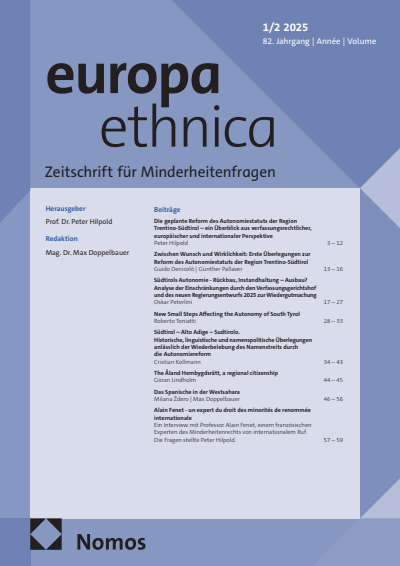
Cover der Ausgabe: europa ethnica Jahrgang 82 (2025), Heft 1-2
Ausgabe Kein Zugriff
Zeitschrift für Minderheitenfragen
Jahrgang 82 (2025), Heft 1-2
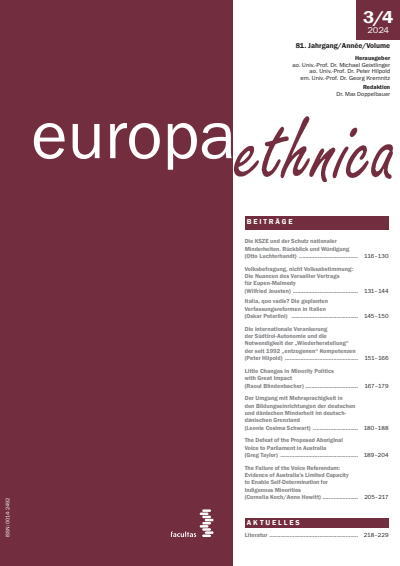
Cover der Ausgabe: europa ethnica Jahrgang 81 (2024), Heft 3-4
Ausgabe Kein Zugriff
Zeitschrift für Minderheitenfragen
Jahrgang 81 (2024), Heft 3-4
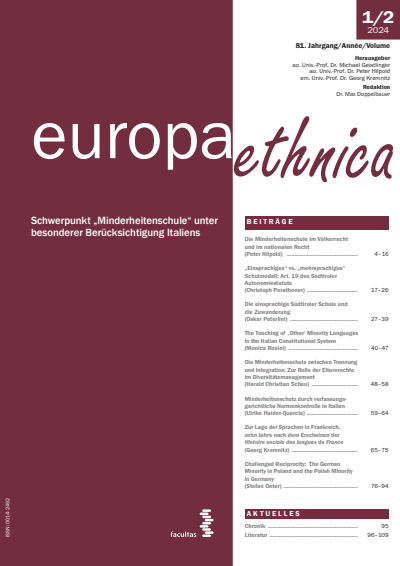
Cover der Ausgabe: europa ethnica Jahrgang 81 (2024), Heft 1-2
Ausgabe Kein Zugriff
Zeitschrift für Minderheitenfragen
Jahrgang 81 (2024), Heft 1-2
Cover der Ausgabe: europa ethnica Jahrgang 80 (2023), Heft 3-4
Ausgabe Kein Zugriff
Zeitschrift für Minderheitenfragen
Jahrgang 80 (2023), Heft 3-4