, to see if you have full access to this publication.
Edited Book No access
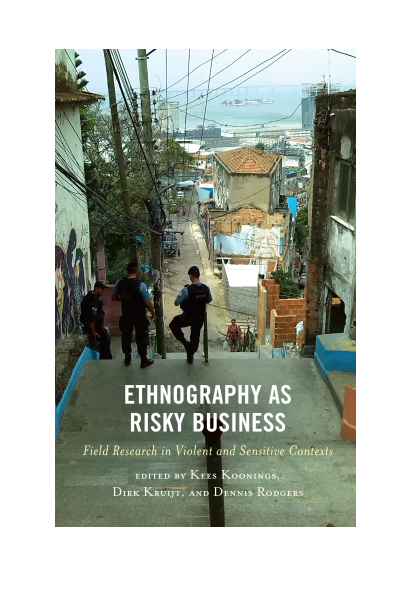
Ethnography As Risky Business
Field Research in Violent and Sensitive Contexts
Editors:
| |
Publisher:
2019
Summary
Ethnography as Risky Business: Field Research in Violent and Sensitive Contexts offers a hands-on, critical appraisal of how to approach ethnographic fieldwork on socio-political conflict and collective violence, focusing on the global south. The volume’s contributions are all based on extensive firsthand qualitative social science research conducted in sensitive--and often hazardous--field settings. The contributors reflect on real-life methodological problems as well as the ethical and personal challenges such as the protection of participants, research data and the ‘ethnographic self’. In particular, the authors highlight how ‘risky ethnography’ requires careful maneuvering before, during, and after fieldwork on the basis of a ‘situated’ ethics, yet also point to the rewards of such an endeavor. If these methodological, ethical and personal risks are managed adequately, the yields in terms of generating a deep understanding of, and critical engagement with, conflict and violence may be substantial.
Keywords
Search publication
Bibliographic data
Edition
1/2019
Copyright Year
2019
ISBN-Print
978-1-4985-9843-9
ISBN-Online
978-1-4985-9844-6
Publisher
Lexington, Lanham
Language
English
Pages
245
Product Type
Edited Book
Table of contents
ChapterPages
Contents No access
Acknowledgments No access
Introduction No access Pages 1 - 20
Chapter One: Researching the Politics of Aid in War-Torn Societies No access Pages 21 - 32
Chapter Two: Dealing with Distrust No access Pages 33 - 44
Chapter Three: Researching Security in Africa as the “Sierra Foxtrot Golf” No access Pages 45 - 54
Chapter Four: A Wolf in Sheep’s Clothing No access Pages 55 - 68
Chapter Five: “Doctor, How Can We Improve Our Image in Europe?” No access Pages 69 - 88
Chapter Six: Interviewing Revolutionary Generations in Latin America No access Pages 89 - 100
Chapter Seven: “You Are Not Like the Ladinos at All” No access Pages 101 - 112
Chapter Eight: Keeping a Distance? No access Pages 113 - 122
Chapter Nine: From “Broder” to “Don” No access Pages 123 - 138
Chapter Ten: Interpretation of Dreams and Humor in Affective Fieldwork on State Violence in Argentina No access Pages 139 - 150
Chapter Eleven: Swimming with Former Combatants No access Pages 151 - 160
Chapter Twelve: Ethical Issues Raised by Legal Anthropological Research on Local Dispute Settlement in Ecuador No access Pages 161 - 170
Chapter Thirteen: Security at Stake No access Pages 171 - 190
Chapter Fourteen: Among Comrades No access Pages 191 - 204
Chapter Fifteen: Embedded Ethnography No access Pages 205 - 218
Chapter Sixteen: Fieldwork Frontiers No access Pages 219 - 228
Appendix 1 No access Pages 229 - 232
Index No access Pages 233 - 240
About the Contributors No access Pages 241 - 245
Similar publications
from the topics "Soziologie allgemein"
Edited Book Full access
Karen Kastenhofer, Marius Albiez, Pauline Riousset, Constanze Scherz, Michael Decker