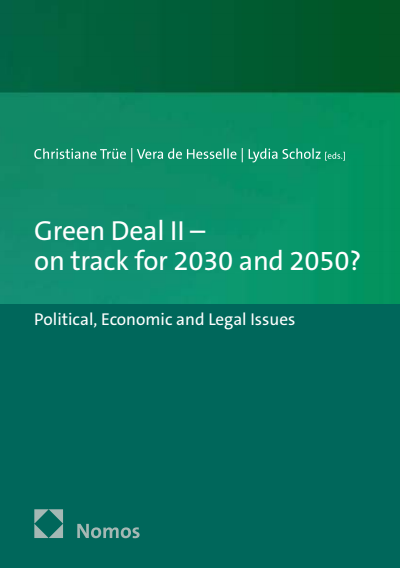
Green Deal II – on track for 2030 and 2050?
Political, Economic and Legal Issues- Editors:
- | |
- Publisher:
- 2025
Summary
The European Green Deal appears to have lost some of its impetus: political priorities have changed. Competitiveness, resilience and less bureaucracy are the topics of the day, even used as arguments to reverse achievements of the Green Deal. However, mitigating climate change, and adapting to its consequences, have lost none of their importance: failure to act now risks imposing a disproportionate burden on the young generation; greater resilience against the uncertainties of our time depends on suitable environmental conditions, the availability of workforce, and good and stable international relations. The stocktake offered by this volume establishes where we stand, and whether we can really afford to shift the focus to other priorities. This title is also available as open access.
Search publication
Bibliographic data
- Edition
- 1/2025
- Copyright Year
- 2025
- ISBN-Print
- 978-3-7560-3115-3
- ISBN-Online
- 978-3-7489-5456-9
- Publisher
- Nomos, Baden-Baden
- Language
- English
- Pages
- 291
- Product Type
- Edited Book
Table of contents
- Introduction
- Inhaltsverzeichnis
- Authors:Download chapter (PDF)
- Abstract
- 1. Introduction
- What the European Green Deal does not do
- What can be done
- Conclusions
- References
- Authors: |Download chapter (PDF)
- Abbreviations
- Abstract
- 1. Introduction
- 2.1 Short introduction to taxes, fees and improvement contribution
- 2.2 Ecological transformation in Brazil – an overview
- 2.3 Ecological transformation in Germany – an overview
- 2.4 Challenges and prospects for Brazil
- 2.5 Challenges and prospects for Germany
- 3.1.1 The recent Tax Reform approved in Brazil
- 3.1.2.1 Ad Valorem Calculation Basis – art. 415
- 3.1.2.2 Specific Calculation Basis
- 3.2.1 Justification of incentive taxes
- 3.2.2 Legislative competence
- 3.2.3 Limits to tax creation
- 3.2.4 Excise Tax
- 4. Future granting of the new excise taxes in Brazil
- 5. Improvement
- 6. Conclusion
- Bibliography
- Authors:Download chapter (PDF)
- Abstract
- 1. Introduction
- 2.1 Use of tax as a vehicle to promote taxpayer behavior and stimulate economic development
- 2.2.1 Imperfections of the market mechanism
- 2.2.2.1 Intervention by absorption or participation
- 2.2.2.2 Intervention by direction
- 2.2.2.3 Intervention by induction
- 2.3 Compatibility of the use of extrataxation with the principle of tax capacity
- 3. Main characteristics of the selective tax introduced by the recent Tax Reform
- 4. Conclusion
- Authors:Download chapter (PDF)
- Abstract
- A. Einleitung
- 1. Was ist unter Nachhaltigkeit bzw. nachhaltigem Management zu verstehen?
- 2. Warum ist Nachhaltigkeit bedeutsam?
- 3. Welche Nachhaltigkeitsentwicklungen sind bei Unternehmen auszumachen?
- 4. Welche Standards haben sich bisher entwickelt?
- 5. Nachhaltigkeitsreporting: Welche EU-Anforderungen sind zu erfüllen?
- 6. Wesentlichkeitsanalyse: Warum ist sie wichtig und wie ist sie zu erstellen?
- (1) CSRD-Umsetzungsprojekt
- (2) Aufbauprojekt Nachhaltigkeitsmanagement und -controlling
- (3) Projekt über Nachhaltigkeitsnormen und -werte
- C. Ausblick
- Literaturverzeichnis
- Authors:Download chapter (PDF)
- Global climate policy
- The Green Deal
- Regional climate policy
- Literature:
- Authors:Download chapter (PDF)
- A. Preliminary considerations
- B. Levels of Theory
- C.1. Power as Coercion and Effective Mediation
- (a) Base of power
- (b) Amount of power
- (c) Scope of power
- C.3. Collective Mobilization Power in Transformation Processes
- D.1. The Key Objectives of the EU
- D.2. Integration of the Power Matrix and Objectives
- E. Outlook
- References
- Authors: |Download chapter (PDF)
- A. Introduction
- B. EU Competitiveness and Industrial Strategy Framework for Creative Industries
- C. Decisive Innovation and Governmental Strategies
- 1. A concept of Cultural and Creative Industry in Latvia
- 2. The Government approach to Cultural and Creative Industries
- 3. Are Cultural and Creative Industries in Latvia a remedy to increase technological improvements and economic advances?
- 4. Knowledge and future-proofing skills
- E. Conclusion and Potential for Future Research
- List of References
- Authors: |Download chapter (PDF)
- A. Introduction
- B. Management of Human Resources in the Health Sector
- 1. The Survey’s results
- 2. Training and attracting young resident doctors
- 3. Possible solutions for solving human resource problems
- D. Conclusions
- List of References
- Authors:Download chapter (PDF)
- I. Workforce migration and climate conditions
- II. Social features of work integration in host communities
- B. Psychological features of work integration in a climate change context
- C. Conclusion
- List of References
- Authors:Download chapter (PDF)
- Abkürzungsverzeichnis
- 1.1 Thema
- 1.2 Forschungsfrage
- 1.3 Aufbau der Arbeit
- 2.1.1 Menschliche Nutzung von Energiequellen und ihre Auswirkungen
- 2.1.2 Eigenschaften von Wasserstoff und seine Gewinnung
- 2.2.1 Abgrenzung des Marktes und Datenlage
- 2.2.2 Wasserstoffangebot
- 2.2.3 Wasserstoffnachfrage
- 2.2.4 Kosten der Wasserstoffproduktion und Break-Even-Preis für erneuerbaren Wasserstoff
- 2.3.1 Anfänge und internationaler Rahmen
- 2.3.2 EU-Wasserstoffstrategie
- 2.3.3 Bekräftigung des strategischen Kurses angesichts neuer Herausforderungen
- 2.3.4 Nationale Ebene und Gesamtbetrachtung
- 3.1 Funktionsweise des europäischen Mehrebenensystems im EWR
- 3.2 Regulierung des Wasserstoffangebots durch Zertifizierung
- 3.3.1 Netzanschluss und -zugang
- 3.3.2 Netzplanung
- 3.3.3 Entflechtung
- 3.3.4 Netzentgelte
- 3.3.5 Gesamtbetrachtung
- 3.4 Regulierung der Wasserstoffnachfrage
- 4.1.1 Zielsetzung und Aufbau der Europäischen Wasserstoffbank
- 4.1.2 Rechtlicher Rahmen
- 4.1.3 Mittelherkunft
- 4.2.1 Einleitung der Auktionsverfahren
- 4.2.2 Prüfung der Proposals auf Zulässigkeit und Förderfähigkeit
- 4.2.3 Einstufungsverfahren und finale Auswahl
- 4.3.1 Rechtsnatur
- 4.3.2 Ausgestaltung
- 5.1.1 Stellenwert des Wettbewerbs
- 5.1.2 Anwendbarkeit auf den EWR
- 5.1.3 Eigenschaften des Wettbewerbs
- 5.2.1 Eingriffscharakter
- 5.2.2 Wettbewerbliche Gestaltung des Fördermechanismus
- 5.3 Rechtfertigung des Eingriffs
- 6. Fazit und Ausblick
- Literaturverzeichnis