, to see if you have full access to this publication.
Monograph No access
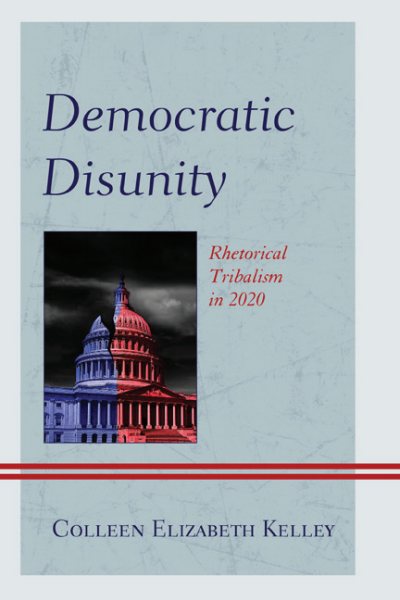
Democratic Disunity
Rhetorical Tribalism in 2020
Authors:
Publisher:
2022
Summary
Democratic Disunity: Rhetorical Tribalism in 2020 addresses that while attention has recently and rightly been paid to the tribal bifurcation of the GOP, the Democratic Party is similarly divided. Americans live in a democratic republic rather than a direct democracy and choices regarding governing concerns are configured through communicative action. These choices include those made between and within American political parties. Without rhetorical mediation and intervention, toxic partisan tribalism within the two major American political parties is likely to destabilize the nations’ federalist system of government. Kelley argues that intraparty tribalism poisons public life and consumes public space within which electoral politics, including discussion, deliberation and compromise, should be thriving. Democratic Disunity considers intraparty tribalism as a rhetorical form, uniquely positioned within the twenty-first century. Details are provided regarding language-in-use strategies with which to anchor a rhetoric of governing through a mindful, deliberative dialogue which diminishes the effect of political partisanship, including its toxic variations both between and within American political parties. Scholars and students of rhetoric, political communication, and political science will find this book particularly interesting.
Keywords
Search publication
Bibliographic data
Edition
1/2022
Copyright Year
2022
ISBN-Print
978-1-7936-3985-1
ISBN-Online
978-1-7936-3986-8
Publisher
Lexington, Lanham
Language
English
Pages
228
Product Type
Monograph
Table of contents
ChapterPages
Contents No access
Preface No access
Introduction No access Pages 1 - 6
Democratic Intraparty Tribalism No access Pages 7 - 20
Rhetorical Tribalism No access Pages 21 - 34
American Rhetorical Tribes No access Pages 35 - 50
Congressional Tribalism No access Pages 51 - 66
Mediated Tribalism No access Pages 67 - 82
Caucuses, Primaries, and Convention No access Pages 83 - 104
The Election No access Pages 105 - 120
The Legacy of Intraparty Tribalism No access Pages 121 - 136
Tribalism as a Rhetorical Form No access Pages 137 - 154