Summary
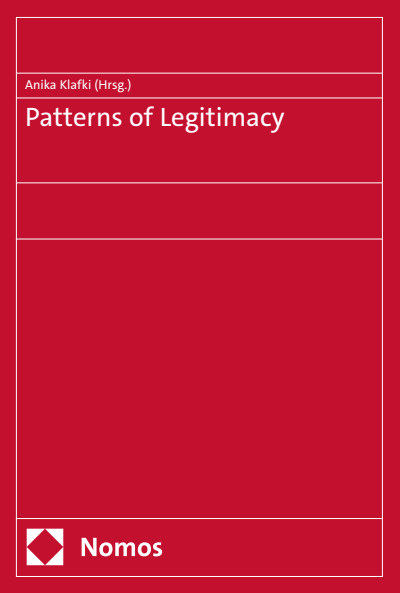
Legitimacy is the basis of any exercise of authority. However, legitimacy has received relatively little attention in legal scholarship. This book explores the legitimacy discourse in an interdisciplinary and comparative manner to identify contemporary patterns of legitimacy and their relevance to legal sciences. This provides a theoretical framework for addressing current legal issues in the nation-state, as well as at the European and international level. With contributions byProf. Dr. Michaela Hailbronner, LL.M. (Yale) | Prof. Dr. Anna-Bettina Kaiser, LL.M. (Cambridge) | Jun.-Prof. Dr. Anika Klafki | Prof. Dr. Markus Kotzur, LL.M. (Duke) | Prof. Dr. Birgit Peters | Prof. Dr. Gesine Schwan | Prof. Dr. Alexander Somek
Keywords
Search publication
Bibliographic data
- Edition
- 1/2024
- Copyright Year
- 2024
- ISBN-Print
- 978-3-8487-7571-2
- ISBN-Online
- 978-3-7489-3546-9
- Publisher
- Nomos, Baden-Baden
- Language
- English
- Pages
- 166
- Product Type
- Edited Book
Table of contents
ChapterPages
- Titelei/InhaltsverzeichnisPages 1 - 8 Download chapter (PDF)
- Authors:Download chapter (PDF)
- I. Legitimacy Concepts
- II. Research Potential of Legitimacy for Legal Sciences
- III. Legitimacy and the Threat of Populism
- IV. Legality as a Threat to Legitimacy? Vermeule’s Conception of the Administrative State
- V. Legitimacy of International and Supranational Organisations
- VI. Legitimacy in Times of Crisis
- Bibliography
- Authors:Download chapter (PDF)
- I. Introduction: Are Democracies on the Retreat?
- 1. Democracy and Democratic Politics
- 2. Legitimacy and Legitimation
- 3. Democratic Politics under Conditions of Globalization
- III. Individual Freedom and Social Diversity in Representative Democracy
- IV. Legitimation through Orientation toward the Common Good and Participation as a Democratic Learning Process
- V. Municipal Development Advisory Councils Strengthen the Legitimation of Democratic Politics in Globalization through System Trust
- VI. Multi-Stakeholder Trialogues Increase Output Legitimation
- VII. Conclusion
- Authors:Download chapter (PDF)
- I. Legality and Rationality
- II. Three Consequences of this Asymmetry
- III. Unravelling the Original Compromise
- IV. Uncertainty and Rationally Arbitrary Decisions
- V. What are Second-Order Reasons?
- VI. The Elusiveness of the Distinction
- VII. Transitive Inconclusiveness
- VIII. Epiphanies of Sovereignty
- IX. Delegation Awakens the Leviathan
- X. The Constitution Interpreting the Constitution
- XI. Determinatio
- XII. Political Theology
- Bibliography
- Authors:Download chapter (PDF)
- I. Framing a Global Legal Space
- II. Identifying Legitimacy Principles Relevant for the Global Legal Space – Three Preliminary Questions
- III. Legitimacy Principles Identified
- IV. Instead of a Conclusion: An Ongoing Quest for Legitimacy
- Bibliography
- Authors:Download chapter (PDF)
- I. Introduction
- 1. What Counts as EU Administrative Law?
- 2. Is EU Administrative Law Networked? Union of Law, the Verbund Theorem, Network Theory, Constitutionalism and Governance in EU Administrative Law
- 1. Legitimacy in the EU
- 2. Legitimacy Challenges in EU Administrative Law
- 1. The Role of Principles
- 2. The Principles Providing Legitimacy in EU Administrative Law Contexts
- 1. Verbund Administration in State-aid Proceedings: Affirming Sustainability?
- 2. Administrative Review in Environmental Decision-Making
- VI. Conclusion
- Bibliography
- Authors:Download chapter (PDF)
- I. Introduction
- II. The Three Ls
- III. Schmitt’s Narrative
- IV. Measures to Control the Pandemic
- V. Through Schmitt’s Eyes
- 1. The Legislature
- 2. The Judiciary
- 3. The Executive
- VII. Resilience in the Administrative State
- VIII. Conclusion
- Bibliography
- Authors:Download chapter (PDF)
- I. Staking Out the Problem
- II. Output Legitimacy and Legality
- III. Effectiveness and Its Place in Constitutional Theory
- IV. Conclusion
- Bibliography