, to see if you have full access to this publication.
Monograph No access
Fluid Preservation
A Comprehensive Reference
Authors:
Publisher:
2014
Summary
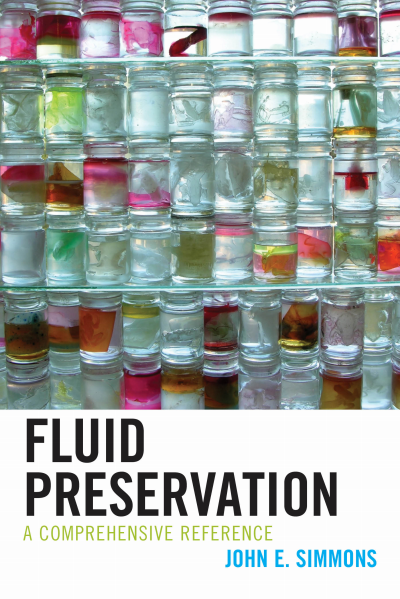
Fluid preservation refers to specimens and objects that are preserved in fluids, most commonly alcohol and formaldehyde, but also glycerin, mineral oil, acids, glycols, and a host of other chemicals that protect the specimen from deterioration. Some of the oldest natural history specimens in the world are preserved in fluid.
Despite the fact that fluid preservation has been practiced for more than 350 years, this is the only handbook that summarize all that is known about this complex and often confusing topic. Fluid Preservation: A Comprehensive Reference covers the history and techniques of fluid preservation and how to care for fluid preserved specimens in collections.
More than 900 references on fluid preservation were reviewed for this project.
An historical survey of preservative recipes provides for guidance for museums with older collections (many fluid preservatives contain hazardous chemicals).
Current standards and best practices for collection care and management are presented.
Current and controversial topics (e.g., the preservation of DNA, alternatives to alcohol and formaldehyde) are discussed and fully referenced.
Health and safety issues involved with caring for fluid preserved collections are discussed.
The final chapter addresses fluid preserved specimens as cultural products and their use in art, literature, film, and song.
Although most fluid-preserved specimens are found in natural history and medical museums, it is not at all uncommon to find them in art museums, history museums, and science centers. In addition to animals, plants, and anatomical specimens, fluid preserved collections include some minerals and fossils and many other objects.
Fluid Preservation is an essential reference for:
Natural history curators
Natural history collections managers
Conservators
Medical and anatomical museum collections managers and curators
Art and history museum staff who have fluid preserved specimens and objects in their care (e.g., works by Damien Hirst)
Private collectors
Researchers using museum collections as sources of DNA, isotopes, etc.
Health and safety professionals
Exhibit planners and designers
Museum facilities planners and managers
People interested in the history of science
People interested in the history of natural history museums
Museum studies students
Keywords
Search publication
Bibliographic data
Copyright Year
2014
ISBN-Print
978-1-4422-2965-5
ISBN-Online
978-1-4422-2966-2
Publisher
Rowman & Littlefield, Lanham
Language
English
Pages
348
Product Type
Monograph
Table of contents
ChapterPages
Contents No access
List of Figures No access
List of Tables No access
Preface No access
Acknowledgments No access
Chapter 1. The History of Fluid Preservation No access
Chapter 2. Fixation No access
Chapter 3. Preservation No access
Chapter 4. Effects of Fixatives and Preservatives on Specimens No access
Chapter 5. Managing Fluid-Preserved Collections No access
Chapter 6. Fluid-Preserved Collections as Cultural Patrimony No access
Yusif Idies, Sven Bergmann, Kathrin Eitel, Friederike Gesing, Tobias Gumbert, Johanna Kramm, Stefan Laser, Aleksandra Ross, Nicolas Schlitz, Sarah Schönbauer, Waste in Motion-Kollektiv