, to see if you have full access to this publication.
Edited Book No access
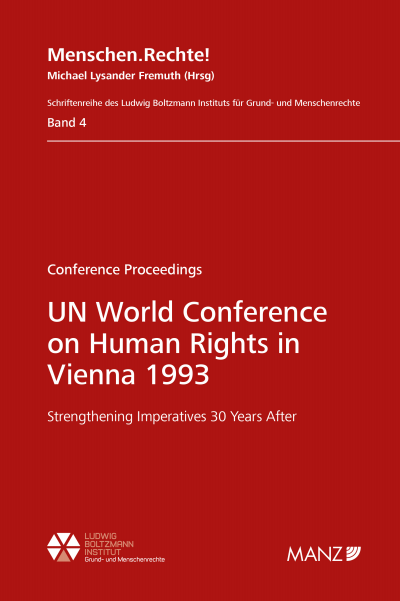
UN World Conference on Human Rights in Vienna 1993
Strengthening Imperatives 30 Years After - Conference Proceedings- Editors:
- Series:
- Menschen.Rechte! – Schriftenreihe des Ludwig Boltzmann Instituts für Grund- und Menschenrechte, Volume 4
- Publisher:
- 2026
Search publication
Bibliographic data
- Edition
- 1/2026
- Copyright Year
- 2026
- ISBN-Print
- 978-3-214-26725-4
- ISBN-Online
- 978-3-214-26994-4
- Publisher
- MANZ, Wien
- Series
- Menschen.Rechte! – Schriftenreihe des Ludwig Boltzmann Instituts für Grund- und Menschenrechte
- Volume
- 4
- Language
- English
- Pages
- 321
- Product Type
- Edited Book
Table of contents
ChapterPages
- Acknowledgements No access
- Table of Contents No access
- List of Contributors No access
- Introduction No access Pages 1 - 8Authors: |
- Welcome Addresses No access Pages 9 - 26
- Authors:
- Overview No access
- I. Introduction No access
- II. The 1993 World Conference and the Vienna Declaration and Programme of Action as Milestones No access
- A. Advances: Takeaways from the 1993 World Conference and the VDPA No access
- B. Negative Trends: Human Rights under Pressure No access
- IV. 2023 Onwards: Takeaways from the World Conference – An Increased ‘Vernacularisation’ of Human Rights within Societies? No access
- A. Background and Structure of the European Urban Charter III (2023) No access
- B. Principles: How are the Current Challenges Transposed in the European Urban Charter III? No access
- C. Evaluation No access
- VI. Final Appreciation No access
- Authors:
- Overview No access
- I. Felix Ermacora – Pioneer of Human Rights No access
- II. Vienna World Conference on Human Rights 1993 No access
- A. Normative and Institutional Implementation of the VDPA No access
- B. Current State of Human Rights No access
- IV. Conclusions No access
- Authors:
- Overview No access
- I. Introduction No access
- II. A Historical Contextualisation No access
- III. Increasing Weakening of Minority Rights Recognition and Protection in Europe No access
- A. The Rise and Rise of Hate Speech No access
- B. Hate Speech, Discrimination and Violent Conflict No access
- V. 30 Years after the VDPA: Reversing the Regression of Rights of Minorities No access
- VI. Conclusion No access
- Authors:
- Overview No access
- I. Introduction No access
- II. Racial Discrimination versus Minority Rights No access
- III. National and Ethnic Minorities No access
- IV. Ethno-religious and Ethno-linguistic Minorities No access
- V. Conclusion No access
- Authors:
- Overview No access
- I. Introduction No access
- II. Human Rights and Refuge: An Intrinsic Connection No access
- A. A Region of Coexistence between Legal Regimes No access
- B. Regional Humanitarian Approaches to Refugee Protection No access
- 1. Human Rights Principles No access
- 2. Solidarity and Responsibility-Sharing No access
- 1. Regionalism No access
- 2. PlansofAction No access
- 3. Whole-of-Society Approach No access
- 4. Humanitarian Focus No access
- 1. Vulnerability No access
- 2. Development No access
- V. Summary No access
- Authors:
- Overview No access
- I. Introduction No access
- II. Theoretical Framework: Critical Race Theory and Refugee Studies No access
- A. Racial Bias in Asylum Procedures No access
- B. Reception Conditions and Racial Discrimination No access
- C. Structural Gaps and Opportunities in Legal and Policy Frameworks No access
- A. Racism in the Labour Market No access
- B. Racial Discrimination in Education No access
- V. Gender, Race, and Refugee Status: A Triple Burden No access
- VI. Mental Health Implications No access
- VII. Towards an Intersectional Approach to Refugee Protection No access
- VIII. Conclusion No access
- Authors:
- Overview No access
- I. Introduction No access
- A. Review of Resolutions and Initiatives at the UN Focused on LGBTQI Rights No access
- B. International Convention for the Protection of the Rights of LGBTQI People No access
- C. Regional Dynamics: Europe and Latin America No access
- D. Examination ofLGBTQI-Related Policies and Practices within International Economic Institutions – The Example of the World Bank No access
- A. Analysis of Cultural, Political and Religious Factors Influencing Policy Decisions No access
- B. Consideration of Limitations Hindering the Implementation of LGBTQI-Inclusive Policies Internationally No access
- IV. Summary No access
- Authors:
- Overview No access
- I. Introduction No access
- II. We Are Not Speaking the Same Language No access
- III. Regional Focus No access
- V. Text versus Practice No access
- VI. The Weaponising of Homophobia and Transphobia No access
- VII. What Next? No access
- Authors:
- Overview No access
- I. Introduction No access
- II. The Right to Science as a Cultural Human Right No access
- A. Freedom from Interference in Science No access
- B. Freedom to Participate in Science No access
- C. Freedom to Access Science No access
- A. Intellectual Property Protection No access
- B. Science scepticism No access
- V. Concluding Remarks No access
- Authors:
- Overview No access
- I. Introduction No access
- II. First Moment: The San José Declaration of Human Rights No access
- A. Poverty and Economic, Social and Cultural Rights No access
- B. Women No access
- IV. Conclusion No access
- Authors:
- Overview No access
- I. Introduction No access
- II. Overview of the African Commission on Human and Peoples’ Rights No access
- III. Special Mechanisms within the African Commission on Human and Peoples’ Rights No access
- A. Special Rapporteurs No access
- B. Working Groups No access
- 1. Malawi No access
- 2. Nigeria No access
- 3. SouthAfrica No access
- 4. South Sudan No access
- 5. The Democratic Republic of Congo No access
- 1. Burkina Faso No access
- 2. Nigeria No access
- VI. Contributory Factors No access
- A. Constraints on Self-Critique No access
- B. Political Interference No access
- C. The Reliance on NGOs No access
- D. Inadequate Funding No access
- E. The Dual RoleofSpecial Rapporteurs No access
- F. State Consent No access
- VIII. Conclusion No access
- Authors:
- Overview No access
- I. Introduction No access
- II. The ASEAN Intergovernmental Commission on Human Rights No access
- III. The ASEAN Human Rights Declaration No access
- IV. Progressive Steps No access
- V. Environment No access
- VI. Prospects No access
- Authors:
- Overview No access
- I. Introduction – Problems Then and Now No access
- A. Step One – The Primary Responsibility of Committees No access
- B. Step Two –The Implementation of Reform Proposals No access
- A. Basic Premise for Any Attempt at Reform No access
- B. Putting It to the Test –The Implementation of Regular Reviews in the Absence of a Report No access
- A. Moving Closer in Terms of Procedural Harmonisation No access
- B. Moving Closer in Terms of Substantive Overlap No access
- C. More Institutionalised Cooperation No access
- V. Conclusion No access
- Authors:
- Overview No access
- I. Introduction No access
- A. The Political Activation of Temporary Protection: An Implementing Decision No access
- B. The Rights Associated with Temporary Protection: Wide-Ranging and Profound Difficulties No access
- A. The Endemic Violations of Migrants’ Human Rights at European Borders No access
- B. The Persistent Problem of Search-and-Rescue Operations for Persons in Distress at Sea No access
- IV. Conclusion No access
- Authors:
- Overview No access
- I. Introduction No access
- II. Background: Vienna Declaration and Recognition of the Role of the Ombudsman in the Promotion and Protection of Human Rights No access
- III. Are Ombuds Institutions Apt (Appropriate) for Promoting and Protecting Human Rights? No access
- A. A Rights-Based Approach to Handling Complaints No access
- B. Participation No access
- C. Empowerment No access
- D. Accountability No access
- E. Special and Thematic Reports by the Ombudsman Institution No access
- V. Have Ombuds Institutions Met the Vienna Declaration’s Expectations? No access
- A. Promotion and Protection of Human Rights: Mandate Implications for the Public Protector No access
- B. Responding to Human Rights Abuses as Threats to the Realisation of Democratic Principles No access
- C. Dealing with the Impact of Governance Failures and Poor Service Delivery on HumanRights No access
- D. Endemic Levels of Corruption: Impact and Responsibility of the Public Protector No access
- E. Vision of the Public Protector in Responding to Human Rights Aspects of Its Mandate No access
- F. Accessibility and the Digital Divide No access
- A. Respond Effectively to the Changing Global Environment and Human Rights Challenges No access
- B. Collaboration and Building Relationship with International Human Rights Bodies No access
- C. Developing Relations with Civil Society No access
- D. Planning and Implementing Development Policies No access
- E. Establish Key Relations with Other Stakeholders No access
- F. Enhancing Social Accountability as a Measure against the Impact of Corruption on Human Rights No access
- G. Ombudsmen and the 4IR: Opportunities and Challenges in Advancing Human Rights No access
- VIII. Conclusion No access
- Authors:
- Overview No access
- I. Introduction No access
- A. Easy Access No access
- B. Individual Complaints – Few Formality Requirements and Flexible Procedures No access
- C. Own Motion Procedure – Granting Anonymity and Investigating Systematic Failures No access
- D. Investigation Powers No access
- E. Impartial and Independent No access
- F. Promoting Participation No access
- G. Forward Thinking No access
- H. Strengthening the Rule of Law No access
- III. Special Potential to Translate Certain Aspects of Human Rights No access
- IV. How Ombuds Institutions Can Contribute to the Development of Human Rights Standards No access
- V. Available Tools No access
- VI. Conclusion No access
- Authors:
- Overview No access
- I. Introduction No access
- A. Human Rights Defenders: Their Situation, Risks and Challenges No access
- B. Changes over the Past 30 Years? No access
- C. How Can Human Rights Defenders Be Most Effective? No access
- D. Outlook No access
- III. Summary No access
- Editorial Note: In memoriam Lorenz Wielenga No access Pages 305 - 310