, to see if you have full access to this publication.
Monograph No access
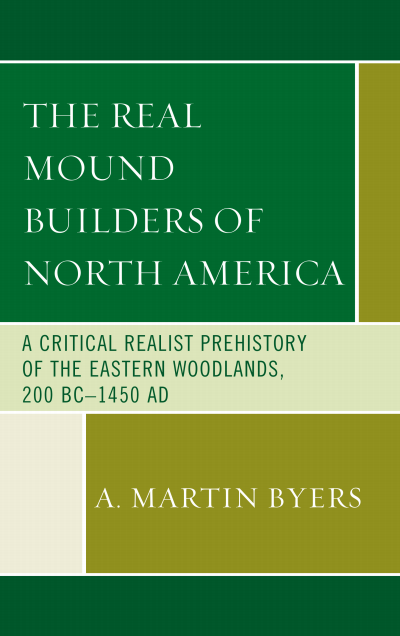
The Real Mound Builders of North America
A Critical Realist Prehistory of the Eastern Woodlands, 200 BC–1450 AD
Authors:
Publisher:
2018
Summary
The Real Mound Builders of North America takes the standard position that the cultural communities of the Late Woodland period hiatus—when little or no transregional monumental mound building and ceremonialism existed—were the linear cultural and social ancestors of the communities responsible for the monumental earthworks of the unique Mississippian ceremonial assemblage, and further, these Late Woodland communities were the direct linear cultural and social descendants of those communities responsible for the great Hopewellian earthwork mounds and embankments and its associated unique ceremonial assemblage. Byers argues that these communities persisted largely unchanged in terms of their essential social structures and cultural traditions while varying only in terms of their ceremonial practices and their associated sodality organizations that manifested these deep structures. This continuist historical trajectory view stands in contrast to the current dominant evolutionary view that emphasizes abrupt social and cultural discontinuities with the Hopewellian ceremonial assemblage and earthworks, mounds and embankments.
Search publication
Bibliographic data
Edition
1/2018
Copyright Year
2018
ISBN-Print
978-1-4985-7062-6
ISBN-Online
978-1-4985-7063-3
Publisher
Lexington, Lanham
Language
English
Pages
460
Product Type
Monograph
Table of contents
ChapterPages
Contents No access
Acknowledgments No access
Introduction. Continuist and Discontinuist Histories No access Pages 1 - 20
Chapter One. The Incomplete Debunking of the Mound Builder Mythology No access Pages 21 - 28
Chapter Two. Unitary Polities or Dual Heterarchies: The Archaeological Record from Alternative Social Systems Perspectives No access Pages 29 - 48
Chapter Three. The Dual Complementary Heterarchical Community/Cult Sodality Heterarchy Model No access Pages 49 - 86
Chapter Four. The Symbolic Pragmatic Model of Material Cultural Style and the Custodial Franchising of Sacred Bundles No access Pages 87 - 106
Chapter Five. The Mourning/World Renewal Mortuary Model: The Postmortem Human Sacrificial Chaîne Opératoire Mortuary Trajectory No access Pages 107 - 128
Chapter Six. Settlement, Subsistence, and Ceremonialism: The Deontic Ecology of the Prehistoric Eastern Woodlands No access Pages 129 - 156
Chapter Seven. The Dissolution of a Transregional Hopewellian Second-Order Ceremonial Sphere No access Pages 157 - 178
Chapter Eight. Community Polities or Dual Heterarchies: Extreme Displaced Mortuary Deposition and Demonstrating the “Best Fit” Truth No access Pages 179 - 200
Chapter Nine. The Emergence of the Complementary Heterarchical Chiefdom Community: Singular-Selective Candidature Practice No access Pages 201 - 224
Chapter Ten. The Emergence of Vacant Quarters and the Late Prehistoric Period→Post-Late Prehistoric Period Transition No access Pages 225 - 236
Chapter Eleven. The Lower Chattahoochee River Valley: A Primary Southeastern Mississippian Ceremonial Sphere No access Pages 237 - 292
Chapter Twelve. The Late Prehistoric Period Savannah River Valley: A First-Order Southern Appalachian Complicated Stamped Ceremonial Sphere No access Pages 293 - 326
Chapter Thirteen. The Etowah Site of the Etowah River Valley Late Prehistoric Period: Paramount Chiefdom Polity or Dispersed Third-Order Cult Sodality Heterarchy? No access Pages 327 - 362
Chapter Fourteen. The Formation and Transformation of Mound C of the Etowah Site No access Pages 363 - 412
Conclusion. The Real Mound Builder Social Systems No access Pages 413 - 432
Bibliography No access Pages 433 - 446
Index No access Pages 447 - 458
About the Author No access Pages 459 - 460
Similar publications
from the topics "Soziologie allgemein"
Edited Book Full access
Christoph T. Burmeister, Thorsten Hertel, Sophia Richter