, to see if you have full access to this publication.
Monograph No access
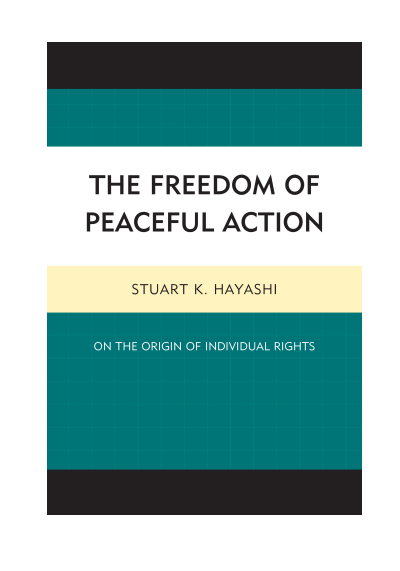
The Freedom of Peaceful Action
On the Origin of Individual Rights
Authors:
Publisher:
2014
Summary
The Freedom of Peaceful Action is the first installment of the trilogy The Nature of Liberty, which makes an ethical philosophic case for individual liberty and the free market against calls for greater government regulation and control. The trilogy makes a purely secular and nonreligious ethical case for the individual’s rights to life, liberty, private property, and the pursuit of happiness as championed by the U.S. Founding Fathers. Inspired by such philosophic defenders of free enterprise as John Locke, Herbert Spencer, and Ayn Rand, The Nature of Liberty shows that such individual rights are not imaginary or simply assertions, but are institutions of great practical value, making prosperity and happiness possible to the degree that society recognizes them. The trilogy demonstrates the beneficence of the individual-rights approach by citing important findings in the emerging science of evolutionary psychology. Although the conclusions of evolutionary psychology have been long considered to be at odds with the philosophies of individual liberty and free markets, The Nature of Liberty presents a reconciliation that reveals their ultimate compatibility, as various important findings of evolutionary psychology, being logically applied, confirm much of what philosophic defenders of liberty have been saying for centuries. Moreover, proceeding from the viewpoint of Rand, this work argues that the structure of society most conducive to practical human well-being is commensurately the most moral and humane approach as well.
The trilogy’s first installment, The Freedom of Peaceful Action, focuses on the secular, philosophic foundation for a society based on individual rights. Starting from a defense of the efficacy of observational reason against criticisms from Immanuel Kant and Karl Popper, it demonstrates how a philosophic position of individual liberty and free markets is the logical result of the consistent application of human reason to observing human nature. This installment demonstrates that any political system that wishes for its citizens to thrive must take human nature into account, and that an accounting of human nature reveals that a system of maximum liberty and property protection is the one must conducive to peace and human well-being.
Keywords
Search publication
Bibliographic data
Edition
1/2014
Copyright Year
2014
ISBN-Print
978-0-7391-8666-4
ISBN-Online
978-0-7391-8667-1
Publisher
Lexington, Lanham
Language
English
Pages
465
Product Type
Monograph
Table of contents
ChapterPages
Contents No access
Acknowledgments No access
Preface No access
Chapter One: Why Free-Market Advocates Need Objectivism No access
Chapter Two: Inductive Reason No access
Chapter Three: The Unity of Reality No access
Chapter Four: Coming to Our Senses No access
Chapter Five: Ascertaining Causal Connections No access
Chapter Six: Absolving Absolutes from Ridicule No access
Chapter Seven: Contextual Absolutes No access
Chapter Eight: The Biological Basis of Morality No access
Chapter Nine: The Rule of Peace No access
Chapter Ten: Reclaiming Liberalism No access
Chapter Eleven: The Swarm of Voters No access
Chapter Twelve: “The State of Nature” and the Nature of the State No access
Chapter Thirteen: The Invisible Gun No access
Chapter Fourteen: Regulation as Spoliation No access
Chapter Fifteen: Contracts, Real Versus Imaginary No access
Chapter Sixteen: By Definition, You Cannot Consent to Being Coercively Taxed No access
Chapter Seventeen: The Contractual Financing of the Ideal State No access
Chapter Eighteen: The Peaceful Sector and the Violence Sector No access
Chapter Nineteen: GODvernment No access
Chapter Twenty: The Revolution Will Be Privatized No access
Chapter Twenty-one: The Most Vital Privatization No access
Chapter Twenty-two: Savage Predation Against Self-Ownership No access
Chapter Twenty-three: Applying the Principles of Self-Ownership No access
BIBLIOGRAPHY No access Pages 397 - 438
Index No access Pages 439 - 464
About the Author No access Pages 465 - 465
Similar publications
from the topics "Soziologie allgemein"
Edited Book Full access
Karen Kastenhofer, Marius Albiez, Pauline Riousset, Constanze Scherz, Michael Decker