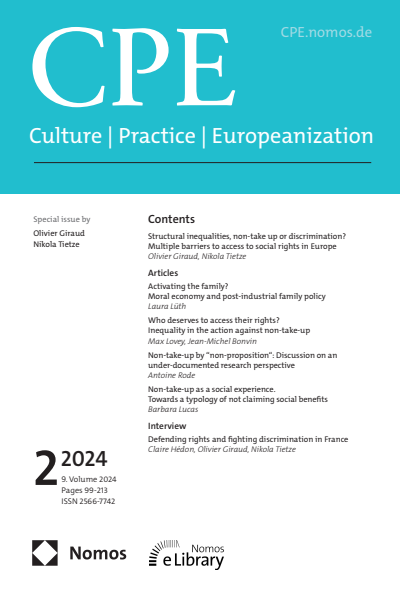
Cover of Volume: Culture, Practice & Europeanization Volume 9 (2024), Edition 2
Volume Open Access Full access

Volume 9 (2024), Edition 2

Culture, Practice & Europeanization
Authors:
Journal:
Culture, Practice & Europeanization
Publisher:
 2024

Summary

Culture, Practice and Europeanization (CPE) is an open access peer reviewed platform for publishing research-based articles predominantly dealing with research into the multiplicity of social processes, interactions, and policies relating to Europeanization and international encounters in Europe. Perspectives may be interdisciplinary. Empirical, theoretical and conceptual texts of significant originality will be considered for publication. CPE publishes foremost full-length original articles, but will also consider original reviews, conference speeches, and notes in order to inform the research community of most recent developments. CPE welcomes contributions that seek to enhance understanding of social processes relating to internationalization and further trans-national activities and processes in Europe.


Bibliographic data

ISSN-Print
2566-7742
ISSN-Online
2566-7742
Publisher
Nomos, Baden-Baden
Language
English
Product type
Volume

Articles

Cover of Volume: Culture, Practice & Europeanization Volume 9 (2024), Edition 2
Article
Open Access Full access

Page I - II
Nomos Verlagsgesellschaft mbH & Co. KG, Baden-Baden 2024

Cover of Volume: Culture, Practice & Europeanization Volume 9 (2024), Edition 2
Article
Open Access Full access

Page 99 - 106
Nomos Verlagsgesellschaft mbH & Co. KG, Baden-Baden 2024
Authors:

Cover of Volume: Culture, Practice & Europeanization Volume 9 (2024), Edition 2
Article
Open Access Full access

Page 107 - 133
Expanding on the concept of the moral economy, the article investigates implicit justice assumptions connected to family policies in post-industrial European welfare states. Most authors argue that family policies support new understandings of...
Nomos Verlagsgesellschaft mbH & Co. KG, Baden-Baden 2024
Authors:

Cover of Volume: Culture, Practice & Europeanization Volume 9 (2024), Edition 2
Article
Open Access Full access

Page 134 - 152
The issue of non-take-up has increasingly been brought to light by scholars and field actors during the past decade. As a result, the issue gained political traction, and programs have been designed to reduce it. In canton Geneva, Switzerland, a...
Nomos Verlagsgesellschaft mbH & Co. KG, Baden-Baden 2024
Authors:

Cover of Volume: Culture, Practice & Europeanization Volume 9 (2024), Edition 2
Article
Open Access Full access

Page 153 - 175
Non-take-up, describing the situation in which an eligible person does not benefit from one or more rights to which he or she is entitled, is a topic of growing interest in most European welfare states. A large volume of literature now documents the...
Nomos Verlagsgesellschaft mbH & Co. KG, Baden-Baden 2024
Authors:

Cover of Volume: Culture, Practice & Europeanization Volume 9 (2024), Edition 2
Article
Open Access Full access

Page 176 - 201
Non-take-up of financial social benefits is a prominent issue for contemporary welfare states, and studies exploring its causes have proliferated recently. However, most analyses are based on an “incapacity framework” or refer to a “rational...
Nomos Verlagsgesellschaft mbH & Co. KG, Baden-Baden 2024
Authors:

Cover of Volume: Culture, Practice & Europeanization Volume 9 (2024), Edition 2
Article
Open Access Full access

Page 202 - 213
Nomos Verlagsgesellschaft mbH & Co. KG, Baden-Baden 2024
Authors:

Bibliography (269 entries)

  1. Amiraux, V. & Guiraudon, V. (2010). Discrimination in comparative perspective: Policies and practices. American Behavioral Scientist 53 (12), 1691–1714. Open Google Scholar doi.org/10.5771/2566-7742-2024-2-99
  2. Béland, D. (2019). How Ideas and Institutions Shape the Politics of Public Policy, Cambridge. Cambridge University Press. Open Google Scholar doi.org/10.5771/2566-7742-2024-2-99
  3. Béland, D., Campbell, A. L. & Weaver, K. R. (2022). Policy Feedback: How Policies Shape Politics. Cambridge: Cambridge University Press. Open Google Scholar doi.org/10.5771/2566-7742-2024-2-99
  4. Bell, M. (2002). Anti-Discrimination Law and the European Union. Oxford: Oxford University Press. Open Google Scholar doi.org/10.5771/2566-7742-2024-2-99
  5. Brunovskis A. & Skilbrei, M. L. (2018). Individual or structural inequality? Access and barriers in welfare services for women who sell sex. Social Inclusion. 6(3), 310–318. Open Google Scholar doi.org/10.5771/2566-7742-2024-2-99
  6. Castel, R. (2002). From Manual Workers to Wage Laborers: Transformation of the Social Question. New York & London: Routledge. Open Google Scholar doi.org/10.5771/2566-7742-2024-2-99
  7. Chappe, V.-A. (2019). L’Egalité au travil: Justice et mobilisations contre les discriminations. Paris: Presses des Mindes. Open Google Scholar doi.org/10.5771/2566-7742-2024-2-99
  8. Chevalier, J. (2003). Lutte contre les discriminations et Etat-providence. In D. Borillo (Ed.), Lutter contre les discriminations (38–54). Paris: La Découverte. Open Google Scholar doi.org/10.5771/2566-7742-2024-2-99
  9. de Witte, B. (2010). From a ‘common principle of equality’ to ‘European anti-discrimination law’. American Behavioral Scientist. 53(12), 1715–1730. Open Google Scholar doi.org/10.5771/2566-7742-2024-2-99
  10. Défenseur des droits (2022). Actes – De la mobilisation collective à la reconnaissance des discriminations systémiques en droit. Retrieved from: https://www.defenseurdesdroits.fr/fr/actes-de-rencontre/2022/03/actes-de-la-mobilisation-collective-a-la-reconnaissance-des (last accessed: 2022, October 15). Open Google Scholar doi.org/10.5771/2566-7742-2024-2-99
  11. Deming, D. & Dynarski, S. (2008). The lengthening of childhood (NBER Working Paper No. 14214). Open Google Scholar doi.org/10.5771/2566-7742-2024-2-99
  12. Dubois, V. (2021). Contrôler les assistés. Genèses et usages d’un mot d’ordre. Paris: Raison d’agir. Open Google Scholar doi.org/10.5771/2566-7742-2024-2-99
  13. Esping-Andersen, Gøsta (1998). The Three Worlds of Welfare Capitalism. Princeton, N.J: Princeton University Press. Open Google Scholar doi.org/10.5771/2566-7742-2024-2-99
  14. Facci, A., Parolari, P. & Riva, N. (2019). Values in the Charters of Fundamental Rights – A Legal-Philosophical Analysis with a Focus on Migrants’ Rights. Torino: G. Giappichelli Editore. Open Google Scholar doi.org/10.5771/2566-7742-2024-2-99
  15. Geddes, A. (2004). Britain, France, and EU anti-discrimination policy: The emergence of an EU policy paradigm. West European Politics 27(2), 334–353. Open Google Scholar doi.org/10.5771/2566-7742-2024-2-99
  16. Guiraudon, V. (2009). Equality in the making: Implementing European non-discrimination law. Citizenship Studies 13(5), 527–549. Open Google Scholar doi.org/10.5771/2566-7742-2024-2-99
  17. Hall, Peter (1986). Governing the Economy: The Politics of State Intervention in Britain and France, Oxford: Oxford University Press. Open Google Scholar doi.org/10.5771/2566-7742-2024-2-99
  18. Heidenreich, M. (2022). Territorial and Spatial Inequalities in Europe: Challenges of European Integration. Cham: Springer Nature. Open Google Scholar doi.org/10.5771/2566-7742-2024-2-99
  19. Jackson, A. (2007). New approaches to drug therapy: A journal article. Psychology Today and Tomorrow, 27(1), 54–59. Open Google Scholar doi.org/10.5771/2566-7742-2024-2-99
  20. Kilpatrick, C. (2018). The displacement of Social Europe: A productive lens of inquiry. European Constitutional Law Review 14(1), 62–74. Open Google Scholar doi.org/10.5771/2566-7742-2024-2-99
  21. Lewis, J. (1992). Gender and the development of welfare regimes. Journal of European Social Policy 2(3), 159–173. Open Google Scholar doi.org/10.5771/2566-7742-2024-2-99
  22. Lombardo, E. & Rolandsen Augustín, L. (2012). Framing gender intersection in the European Union: What implications for quality of intersectionality in policies? Social Politics: International Studies in Gender, State and Society 19(4), 482–512. Open Google Scholar doi.org/10.5771/2566-7742-2024-2-99
  23. Martin Rein, M. & Schön, D. (1996). Reframing policy discourse. In F. Fischer & J. Forester (Eds.), The Argumentative Turn in Policy Analysis and Planning (145–166), Durham: Duke University Press. Open Google Scholar doi.org/10.5771/2566-7742-2024-2-99
  24. Marx-Ferree, M. (2011). Varieties of Feminism – German Gender Politics in Global Perspectives. Stanford: Stanford University Press. Open Google Scholar doi.org/10.5771/2566-7742-2024-2-99
  25. Mau, S., Lux, T. & Gützlau, F. (2020). Die drei Arenen der neuen Ungleichheitskonflikte. Eine sozialstrukturelle Positionsbestimmung der Einstellungen zu Umverteilung, Migration und sexueller Diversität. Berliner Journal für Soziologie 30, 317–346. Open Google Scholar doi.org/10.5771/2566-7742-2024-2-99
  26. Mehta, J. (2011.) The varied roles of ideas in politics: From “whether” to “how”. In D. Béland & R. H. Cox (Eds), Ideas and Politics in Social Sciences Research (23–46). Oxford: Oxford University Press. Open Google Scholar doi.org/10.5771/2566-7742-2024-2-99
  27. Mercat-Bruns, M. (2016). Discrimination at Work: Comparing European, French, and American Law. California: University of California Press. Open Google Scholar doi.org/10.5771/2566-7742-2024-2-99
  28. Prechal, S. (2004). Equality of treatment, non-discrimination and social policy: Achievements in three themes. Common Market Law Review, 41(2), 533–551. Open Google Scholar doi.org/10.5771/2566-7742-2024-2-99
  29. Shaw, J. (2005). Mainstreaming equality and diversity in European Union law and policy. Current Legal Problems 58(1), 255–312. Open Google Scholar doi.org/10.5771/2566-7742-2024-2-99
  30. Somek, A. (2011). Engineering Equality: An Essay on European Anti-Discrimination Law. Oxford: Oxford Academic (online edition). Retrieved from: https://doi.org/10.1093/acprof:oso/9780199693375.001.0001 (last accessed: 2024, October 29). Open Google Scholar doi.org/10.5771/2566-7742-2024-2-99
  31. Streeck, W. & Thelen, K. (Eds.) (2005). Beyond continuity: Institutional change in advanced political economies. Oxford: Oxford University Press. Open Google Scholar doi.org/10.5771/2566-7742-2024-2-99
  32. Treib, O. (2006). Les conflits politiques en Allemagne autour de la transposition de la directive européenne contre le racisme. Critique internationale 4(33), 27–38. Open Google Scholar doi.org/10.5771/2566-7742-2024-2-99
  33. van Oorschot, W. (1991). Non-take-up of social security benefits in Europe. Journal of European Social Policy Nr. 1(1), 15–30. Open Google Scholar doi.org/10.5771/2566-7742-2024-2-99
  34. Verloo, M. (2006) Multiple inequalities, intersectionality and the European Union. European Journal of Women’s Studies 13(3), 211–228. Open Google Scholar doi.org/10.5771/2566-7742-2024-2-99
  35. Warin, P. (Ed.) (2017). Le non-recours aux politiques sociales. Grenoble: Grenoble Presses Universitaires de Grenoble. Open Google Scholar doi.org/10.5771/2566-7742-2024-2-99
  36. Zaccaroni, G. (2021). Equality and Non-Discrimination in the EU – The Foundations of the EU Legal Order. Northampton: Edward Elgar. Open Google Scholar doi.org/10.5771/2566-7742-2024-2-99
  37. Aurich, P. (2011). Activating the unemployed — Directions and divisions in Europe. European Journal of Social Security, 13(3), 294–316. Open Google Scholar doi.org/10.5771/2566-7742-2024-2-107
  38. Auth, D. & Peukert, A. (2022). Gender equality in care: policy goals and outcomes during the merkel era. German Politics, 31(1), 177–196. Open Google Scholar doi.org/10.5771/2566-7742-2024-2-107
  39. Avlijaš, S., Hassel A. & Palier B. (2021). Growth strategies and welfare reforms in Europe. In A. Hassel & B. Palier (Eds.), Growth and Welfare in Advanced Capitalist Economies: How Have Growth Regimes Evolved? (372–436), Oxford: Oxford University Press. Open Google Scholar doi.org/10.5771/2566-7742-2024-2-107
  40. Bambra, C. (2004). The worlds of welfare: Illusory and gender-blind? Social Policy and Society, 3, 201–212. Open Google Scholar doi.org/10.5771/2566-7742-2024-2-107
  41. Betzelt, S. & Bothfeld, S. (2011). Incoherent Strategies – Fragemented Outcomes: Raising Women’s Employment Rate in Germany. German Policy Studies, 7(1), 73–106. Open Google Scholar doi.org/10.5771/2566-7742-2024-2-107
  42. Bonoli, G. (2007). New social risks and the politics of post-industrial social policies. In K. Armingeon & G. Bonoli (Eds.). The politics of post-industrial welfare states (21–44). London: Routledge. Open Google Scholar doi.org/10.5771/2566-7742-2024-2-107
  43. Branco, R., Miró, J. & Natili, M. (2024). Back from the Cold? Progressive Politics and Social Policy Paradigms in Southern Europe after the Great Recession. Politics & Society, 52(4), 630–661. Open Google Scholar doi.org/10.5771/2566-7742-2024-2-107
  44. Bundesministerium für Familie, Senioren, Frauen und Jugend. (2024). Familienportal. Retrieved from: https://familienportal.de/familienportal (last accessed: 2024, November 8). Open Google Scholar doi.org/10.5771/2566-7742-2024-2-107
  45. Ciccia, R. & Bleijenbergh, I. (2014). After the male breadwinner model? childcare services and the division of labor in European countries. Social Politics: International Studies in Gender, State & Society, 21(1), 50–79. Open Google Scholar doi.org/10.5771/2566-7742-2024-2-107
  46. Clasen, J. & Clegg, D. (2007). Levels and levers of conditionality: measuring change within welfare states. In J. Clasen and NA. Siegel (Eds), Investigating Welfare State Change: The ‘Dependent Variable Problem’ in Comparative Analysis (166–197). Cheltenham, Northampton: Edward Elgar Publishing. Open Google Scholar doi.org/10.5771/2566-7742-2024-2-107
  47. Daly, M. (2011). What adult worker model? A critical look at recent social policy reform in Europe from a gender and family perspective. Social Politics: International Studies in Gender, State & Society, 18(1), 1–23. Open Google Scholar doi.org/10.5771/2566-7742-2024-2-107
  48. Daly, M. & Ferragina, E. (2018). Family policy in high-income countries: Five decades of development. Journal of European Social Policy, 28(3), 255–270. Open Google Scholar doi.org/10.5771/2566-7742-2024-2-107
  49. Daly, M. & Scheiwe, K. (2010). Individualisation and personal obligations – social policy, family policy, and law reform in Germany and the UK. International Journal of Law, Policy and the Family, 24(2), 177–197. Open Google Scholar doi.org/10.5771/2566-7742-2024-2-107
  50. Dingeldey, I. (2016). Changes in labour market policies, the gender model and social inequality: Institutional dualization revisited. In M. Wulfgramm M. et al. (Eds.), Welfare State Transformations and Inequality in OECD Countries, Transformations of the State (219 – 243). London: Palgrave. Open Google Scholar doi.org/10.5771/2566-7742-2024-2-107
  51. Dobrotić, I. & Blum, S. (2020). Inclusiveness of parental-leave benefits in twenty-one European countries: Measuring social and gender inequalities in leave eligibility. Social Politics: International Studies in Gender, State & Society, 27(3), 588–614. Open Google Scholar doi.org/10.5771/2566-7742-2024-2-107
  52. Eggers, T., Grages, C. & Pfau-Effinger, B. (2019). Self-responsibility of the “active social citizen”: Different types of the policy concept of “active social citizenship” in different types of welfare states. American Behavioural Scientist, 63(1), 43–64. Open Google Scholar doi.org/10.5771/2566-7742-2024-2-107
  53. Eggers, T., Grages, C. & Pfau-Effinger, B. (2021). Politiken zur familialen Care-Arbeit und Gleichstellung der Geschlechter: eine theoretische Diskussion. In S. Scherger et al. (Eds), Geschlechterungleichheiten in Arbeit, Wohlfahrtsstaat und Familie (165–189). Frankfurt am Main: Campus Verlag. Open Google Scholar doi.org/10.5771/2566-7742-2024-2-107
  54. Eggers, T., Grages, C. & Pfau-Effinger, B. (2023). How culture influences the strengthening of market principles in conservative welfare states: The case of long-term care policy. International Journal of Social Welfare, 33, 413–426. Open Google Scholar doi.org/10.5771/2566-7742-2024-2-107
  55. Esping-Andersen, G. (1990). The three worlds of welfare capitalism. Princeton, N.J.: Princeton University Press. Open Google Scholar doi.org/10.5771/2566-7742-2024-2-107
  56. Esping-Andersen, G. (2003). Why we need a new welfare state. Oxford: Oxford University Press. Open Google Scholar doi.org/10.5771/2566-7742-2024-2-107
  57. Estévez-Abe, M. & Naldini, M. (2016). Politics of defamilialization: A comparison of Italy, Japan, Korea and Spain. Journal of European Social Policy, 26(4), 327–343. Open Google Scholar doi.org/10.5771/2566-7742-2024-2-107
  58. Evers, A. & Guillemard, AM. (Eds). (2013). Social Policy and Citizenship: The Changing Landscape. Oxford: Oxford University Press. Open Google Scholar doi.org/10.5771/2566-7742-2024-2-107
  59. Eydal, B., Gíslason, I., Rostgaard, T., Brandth, B., Duvander A.-Z. & Lammi-Taskula, J. (2015). Trends in parental leave in the Nordic countries: has the forward march of gender equality halted? Community, Work & Family, 18(2), 167–181. Open Google Scholar doi.org/10.5771/2566-7742-2024-2-107
  60. Ferragina, E. (2022). Welfare state change as a double movement: Four decades of retrenchment and expansion in compensatory and employment‐oriented policies across 21 high‐income countries. Social Policy & Administration, 56(5), 705–725. Open Google Scholar doi.org/10.5771/2566-7742-2024-2-107
  61. Fraser, N. (1994). After the family wage. Gender equity and the welfare state. Political Theory, 22(4), 591–618. Open Google Scholar doi.org/10.5771/2566-7742-2024-2-107
  62. Frericks, P., Höppner, J. & Och, R. (2018). The difficulty of measuring institutions: A methodological approach to the comparative analysis of institutions. Social Indicators Research, 137(3), 847–865. Open Google Scholar doi.org/10.5771/2566-7742-2024-2-107
  63. Frericks, P. & Höppner, J. (2019). Self-responsibility readdressed: Shifts in financial responsibility for social security between the public realm, the individual, and the family in Europe. American Behavioural Scientist, 63(1), 65–84. Open Google Scholar doi.org/10.5771/2566-7742-2024-2-107
  64. Garritzmann, J.L., Häusermann, S. & Palier, B. (2023). Social investments in the knowledge economy: The politics of inclusive, stratified, and targeted reforms across the globe. Social Policy & Administration, 57(1), 87–101. Open Google Scholar doi.org/10.5771/2566-7742-2024-2-107
  65. Goijaerts, J. (2022). Ambiguous policy paradigms in the Dutch welfare state: A gender-blind mix of social investment and conservative care. Social Politics: International Studies in Gender, State & Society, 29 (4), 1403–1424. Open Google Scholar doi.org/10.5771/2566-7742-2024-2-107
  66. Hassel. A. & Palier, B. (Eds) (2021). Growth and Welfare in Advanced Economies. How Have Growth Regimes Evolved? Oxford: Oxford University Press. Open Google Scholar doi.org/10.5771/2566-7742-2024-2-107
  67. Hemerijck, A. (2018). Social investment as a policy paradigm. Journal of European Public Policy, 25(6), 810–827. Open Google Scholar doi.org/10.5771/2566-7742-2024-2-107
  68. Heuer, J-O., Lux, T., Mau, S., Zimmermann, K. (2020). Legitimizing Inequality. Comparative Sociology, 19(4–5), 542–584. Open Google Scholar doi.org/10.5771/2566-7742-2024-2-107
  69. Ibáñez, Z., León, M., Soler, L., Alvarino, M. (2021). Fostering work-life balance for precarious workers: culture and social protection systems in comparative perspective (Euroship Working Paper No.5). Open Google Scholar doi.org/10.5771/2566-7742-2024-2-107
  70. International Network on Leave Policies and Research [LP&R] (2020) Annual reviews. Retrieved from: https://www.leavenetwork.org/annual-review-reports/archive-reviews (last accessed: 2023, January 13). Open Google Scholar doi.org/10.5771/2566-7742-2024-2-107
  71. International Network on Leave Policies and Research [LP&R] (2021) Annual reviews. Retrieved from: https://www.leavenetwork.org/annual-review-reports/archive-reviews (last accessed: 2023, January 13). Open Google Scholar doi.org/10.5771/2566-7742-2024-2-107
  72. Jenson, J. (2008). Writing Women Out, Folding Gender In: The European Union “Modernises” Social Policy. Social Politics: International Studies in Gender, State & Society, 15(2), 131–153. Open Google Scholar doi.org/10.5771/2566-7742-2024-2-107
  73. Jenson, J. (2013). Changing perspectives on social citizenship: a cross-time comparison. In A. Evers & A.M., Guillemard (Eds.), Social Policy and Citizenship: The Changing Landscape (57–59). Oxford: Oxford University Press. Open Google Scholar doi.org/10.5771/2566-7742-2024-2-107
  74. Jenson, J. & Saint-Martin, D. (2003). New Routes to Social Cohesion? Citizenship and the Social Investment State. Canadian Journal of Sociology, 28(1), 77–79. Open Google Scholar doi.org/10.5771/2566-7742-2024-2-107
  75. Johansson, H. & Hvinden, B. (2008). Nordic activation reforms in a European context: a distinct universalistic model? In B. Hvinden & H. Johansson (Eds), Citizenship in Nordic welfare states: Dynamics of choice, duties and participation in a changing Europe (53–66). London: Routledge. Open Google Scholar doi.org/10.5771/2566-7742-2024-2-107
  76. Knijn, T. & Kremer, M. (1997). Gender and the caring dimension of welfare states: Toward inclusive citizenship. Social Politics: International Studies in Gender, State & Society, 4(3), 328–361. Open Google Scholar doi.org/10.5771/2566-7742-2024-2-107
  77. Korpi, W. (2000). Faces of Inequality: Gender, Class, and Patterns of Inequalities in Different Types of Welfare States. Social Politics, International Studies in Gender, State & Society, 7(2), 127–191. Open Google Scholar doi.org/10.5771/2566-7742-2024-2-107
  78. Leitner, S. (2017). De-Familisierung im Adult Worker Model: Wo bleibt die Sorgearbeit? In Widersprüche e.V. (Eds.), „In and against the State!“ – aktuelle staatstheoretische Perspektiven für eine Politik des Sozialen (55–68). Münster: Westfälisches Dampfboot. Open Google Scholar doi.org/10.5771/2566-7742-2024-2-107
  79. Letablier M-T., Eydoux, A. & Betzelt, S. (2011). Social Citizenship and Activation in Europe: A gendered Perspective. In S. Betzelt & S. Bothfeld (Eds), Activation and Labour Market Reforms in Europe: Challenges to Social Citizenship (79–100). New York: Palgrave Macmillan. Open Google Scholar doi.org/10.5771/2566-7742-2024-2-107
  80. León, M. (2009). Gender Equality and the European Employment Strategy: The Work/Family Belance Debate. Social Policy and Society, 8(2), 197–209. Open Google Scholar doi.org/10.5771/2566-7742-2024-2-107
  81. León, M., Palomera, D., Ibáñez, G., Martínez-Virto, L. & Gabaldón-Estevan, D. (2022). Entre la equidad y la conciliación: similitudes y disparidades en el diseño institucional del primer ciclo de educación infantil en España. Revista de Sociologia, 107(3), e3084. Open Google Scholar doi.org/10.5771/2566-7742-2024-2-107
  82. León, M. & Pavolini, E. (2014). ‘Social investment’ or back to ‘familism’: The impact of the economic crisis on family and care policies in Italy and Spain. South European Society and Politics, 19(3), 353–369. Open Google Scholar doi.org/10.5771/2566-7742-2024-2-107
  83. Lessenich, S. (2010). Constructing the socialized self: Mobilization and control in the “active society”. In U. Bröckling, S. Krasmann & T. Lemke (Eds.), Governmentality: Current Issues and Future Challenges (304–320). London: Routledge. Open Google Scholar doi.org/10.5771/2566-7742-2024-2-107
  84. Lessenich, S. (2012). Das Anerkennungsdefizitsyndrom des Wohlfahrtsstaats. Österreichische Zeitschrift für Soziologie, 37(1), 99–115. Open Google Scholar doi.org/10.5771/2566-7742-2024-2-107
  85. Lewis, J. (2001). The Decline of the male breadwinner model: Implications for work and care. Social Politics: International Studies in Gender, State & Society, 8(2), 152–169. Open Google Scholar doi.org/10.5771/2566-7742-2024-2-107
  86. Lewis, J. (1992). Gender and the development of welfare regimes. Journal of European Social Policy, 2(3), 159–173. Open Google Scholar doi.org/10.5771/2566-7742-2024-2-107
  87. Lewis, J. & West, A. (2017). Early childhood education and care in England under austerity: Continuity or change in political ideas, policy goals, availability, affordability and quality in a childcare market? Journal of Social Policy, 46(2), 331–348. Open Google Scholar doi.org/10.5771/2566-7742-2024-2-107
  88. Lister, R. (1994). “She Has Other Duties”: Women, Citizenship and Social Security. in S. Baldwin & J. Falkingham (Eds.), Social Security and Social Change: New Challenges to the Beveridge Model. New York: Harvester Wheatsheaf. Open Google Scholar doi.org/10.5771/2566-7742-2024-2-107
  89. Marshall, TH. (1992). Bürgerrecht und soziale Klassen: Zur Soziologie des Wohlfahrsstaates. Frankfurt, New York: Campus Verlag. Open Google Scholar doi.org/10.5771/2566-7742-2024-2-107
  90. Mau, S. (2003). The moral economy of welfare states: Britain and Germany compared. London, New York: Routledge. Open Google Scholar doi.org/10.5771/2566-7742-2024-2-107
  91. McLaughlin, E. & Glendinning, C. (1994). Paying for Care in Europe: Is There a Feminist Approach? 52–69 in L. Hantrais & S. Mangen (Eds.), Family Policy and the Welfare of Women, Cross-National Research Papers. Leicestershire: European Research Centre. Open Google Scholar doi.org/10.5771/2566-7742-2024-2-107
  92. MISSOC. (2020). Comparative Tables on Social Protection. Retrieved from: https://www.missoc.org/missoc-database/comparative-tables (last accessed: 2023, January 13). Open Google Scholar doi.org/10.5771/2566-7742-2024-2-107
  93. Offe, C. (1970). Leistungsprinzip und industrielle Arbeit. Mechanismen der Statusverteilung in Arbeitsorganisationen der industriellen Leistungsgesellschaft. Frankfurt am Main: Europäische Verlags-Anstalt. Open Google Scholar doi.org/10.5771/2566-7742-2024-2-107
  94. Orloff, A.S. (1993). Gender and the social rights of citizenship. The comparative analysis of gender relations and welfare states. American Sociological Review, 58(3), 303–328. Open Google Scholar doi.org/10.5771/2566-7742-2024-2-107
  95. Palier, B., Palme, J. & Morel, N. (Eds). (2012). Towards a social investment welfare state? Ideas, policies and challenges. Bristol: Policy Press. Open Google Scholar doi.org/10.5771/2566-7742-2024-2-107
  96. Parolin, Z. & van Lancker, W. (2021). What a social investment ‘litmus test’ must address: A response to Plavgo and Hemerijck. Journal of European Social Policy, 31(3), 297–308. Open Google Scholar doi.org/10.5771/2566-7742-2024-2-107
  97. Pavolini, E. & Van Lacker, W. (2018). The Matthew effect in childcare use: A matter of policies or preferences? Journal of European Public Policy, 25(6), 878–893. Open Google Scholar doi.org/10.5771/2566-7742-2024-2-107
  98. Pérez, B. & Laparra, M. (2011). Chances and pitfalls of flexible labour markets: The case of the Spanish strategy of labour market flexibility. In S. Betzelt & S. Bothfeld (Eds), Activation and Labour Market Reforms in Europe: Challenges to Social Citizenship (147–172). Basingstoke: Palgrave Macmillan. Open Google Scholar doi.org/10.5771/2566-7742-2024-2-107
  99. Peukert, A., Beblo, M., Lüth, L., Zimmermann, K. (2022). Erwerbs- und Familienarbeit im Homeoffice? Innerfamiliale Arbeitsteilung in der Corona-Krise auf dem Prüfstand. Sozialer Fortschritt, 71(1), 29–51. Open Google Scholar doi.org/10.5771/2566-7742-2024-2-107
  100. Pfau-Effinger, B. (2005). Culture and welfare state policies: Reflections on a complex interrelation. Journal of Social Policy, 34(1), 3–20. Open Google Scholar doi.org/10.5771/2566-7742-2024-2-107
  101. Sachweh, P. (2016). Social justice and the welfare state: Institutions, outcomes, and attitudes in comparative perspective. In C. Sabbagh & M. Schmitt (Eds.), Handbook of Social Justice Theory and Research (293–313). New York, NY: Springer New York. Open Google Scholar doi.org/10.5771/2566-7742-2024-2-107
  102. Sachweh, P. (2012). The moral economy of inequality: popular views on income differentiation, poverty and wealth. Socio-Economic Review, 10(3), 419–445. Open Google Scholar doi.org/10.5771/2566-7742-2024-2-107
  103. Sachweh, P. & Münnich, S. (2017). Kapitalismus als Lebensform? Wiesbaden: Springer Fachmedien Wiesbaden. Open Google Scholar doi.org/10.5771/2566-7742-2024-2-107
  104. Sainsbury, D. (1999). Gender and social‐democratic welfare states. In D. Sainsbury (Ed.), Gender and Welfare State Regimes (75–114). Oxford: Oxford University Press. Open Google Scholar doi.org/10.5771/2566-7742-2024-2-107
  105. Saraceno, C. (2015). A Critical Look to the Social Investment Approach from a Gender Perspective. Social Politics: International Studies in Gender, State & Society, 22(2), 257–269. Open Google Scholar doi.org/10.5771/2566-7742-2024-2-107
  106. Saraceno, C. & Keck, W. (2011). Towards an integrated approach for the analysis of gender equity in policies supporting paid work and care responsibilities. Demographic Research, 25, 371–406. Open Google Scholar doi.org/10.5771/2566-7742-2024-2-107
  107. Spanish Government. (2022). Información general sobre la Educación Infantil. Retrieved from: https://educagob.educacionyfp.gob.es/ensenanzas/infantil/informacion-general/organizacion.html (last accessed: 2023, January 05). Open Google Scholar doi.org/10.5771/2566-7742-2024-2-107
  108. Soler-Buades, L. (2024). No welfare without workfare? Revisiting varieties of minimum income schemes in Europe (2008–2022). Social Policy & Administration, online first: https://doi.org/10.1111/spol.13077. Open Google Scholar doi.org/10.5771/2566-7742-2024-2-107
  109. Taylor-Gooby, P., Hvinden, B., Mau, S., Leruth, B., Schoyen, M. & Gyory, A. (2019) Moral economies of the welfare state: A qualitative comparative study. Acta Sociologica, 62(2), 119–134. Open Google Scholar doi.org/10.5771/2566-7742-2024-2-107
  110. UK Government. (2022). Benefits. Retrieved from: https://www.gov.uk/browse/benefits (last accessed 18 July 2022). Open Google Scholar doi.org/10.5771/2566-7742-2024-2-107
  111. Van Lancker, W. & Ghysels, J. (2016). Explaining patterns of inequality in childcare service use across 31 developed economies: A welfare state perspective. International Journal of Comparative Sociology, 57(5), 310–337. Open Google Scholar doi.org/10.5771/2566-7742-2024-2-107
  112. Weber, M. (Ed) (1922). Gesammelte Aufsätze zur Wissenschaftslehre. Tübingen: Mohr. Open Google Scholar doi.org/10.5771/2566-7742-2024-2-107
  113. Ylöstalo, H. (2022). Feminism at the crossroads of Neoliberalism and Neoconservatism: Restructuring women’s labor in the context of family leave reform in Finland. Social Politics: International Studies in Gender, State & Society, 29 (4), 1336–1359. Open Google Scholar doi.org/10.5771/2566-7742-2024-2-107
  114. Zagel, H. & Lohmann, H. (2020). Conceptual approaches in comparative family policy. In R. Nieuwenhuis & W. van Lancker (Eds.), The Palgrave Handbook of Family Policy (119–140). Cham: Palgrave Macmillan. Open Google Scholar doi.org/10.5771/2566-7742-2024-2-107
  115. Banting, K. & Koning, E. (2017). Just Visiting? The Weakening of Social Protection in a Mobile World. In A. Triandafyllidou (Ed.), Multicultural Governance in a Mobile World. Edinburgh Universi-ty Press, 108–136. Open Google Scholar doi.org/10.5771/2566-7742-2024-2-134
  116. Battaglio, R. P., Belardinelli, P., Bellé, N. & Cantarelli, P. (2019). Behavioral Public Administration ad fontes : A Synthesis of Research on Bounded Rationality, Cognitive Biases, and Nudging in Public Organizations. Public Administration Review, 79(3), 304–320. Open Google Scholar doi.org/10.5771/2566-7742-2024-2-134
  117. Baumberg Geiger, B. (2016). The stigma of claiming benefits : A quantitative study. Journal of So-cial Policy, 45(2), 181–199. Open Google Scholar doi.org/10.5771/2566-7742-2024-2-134
  118. Bonvin, J.-M., Tabin, J.-P., Perriard, A., Rosenstein, E. & Lovey, M. (2023). Social Policies, Vulnerabil-ity and the Life Course: A Complex Nexus. In: Spini, D., Widmer, E. (eds) Withstanding Vulnerability throughout Adult Life. Palgrave Macmillan, Singapore, 123–38. Open Google Scholar doi.org/10.5771/2566-7742-2024-2-134
  119. Boost, D., Raeymaeckers, P., Hermans, K. & Elloukmani, S. (2020). Overcoming non-take-up of rights : A realist evaluation of Integrated Rights-Practices. Journal of Social Work, 21(4), 831–852. Open Google Scholar doi.org/10.5771/2566-7742-2024-2-134
  120. Braun, V. & Clarke, V. (2021a). Can I use TA? Should I use TA? Should I not use TA? Comparing re-flexive thematic analysis and other pattern‐based qualitative analytic approaches. Counselling and Psychotherapy Research, 21(1), 37–47. Open Google Scholar doi.org/10.5771/2566-7742-2024-2-134
  121. Braun, V. & Clarke, V. (2021b). One size fits all? What counts as quality practice in (reflexive) the-matic analysis? Qualitative Research in Psychology, 18(3), 328–352. Open Google Scholar doi.org/10.5771/2566-7742-2024-2-134
  122. Brodkin, E. Z. & Majmundar, M. (2010). Administrative Exclusion : Organizations and the Hidden Costs of Welfare Claiming. Journal of Public Administration Research and Theory, 20(4), 827–848. Open Google Scholar doi.org/10.5771/2566-7742-2024-2-134
  123. Byrne, D. (2022). A worked example of Braun and Clarke’s approach to reflexive thematic analysis. Quality & Quantity, 56(3), 1391–1412. Open Google Scholar doi.org/10.5771/2566-7742-2024-2-134
  124. Careja, R. & Harris, E. (2022). Thirty years of welfare chauvinism research : Findings and challeng-es. Journal of European Social Policy, 32(2), 212–224. Open Google Scholar doi.org/10.5771/2566-7742-2024-2-134
  125. Currie, J. (2004). The Take Up of Social Benefits. IZA Discussion Paper Series, 1103. Open Google Scholar doi.org/10.5771/2566-7742-2024-2-134
  126. Daigneault, P.-M., Jacob, S. & Tereraho, M. (2012). Understanding and Improving the Take-up of Public Programs : Lessons Learned from the Canadian and International Experience in Human Ser-vices. International Journal of Business and Social Science, 3(1), 39–50. Open Google Scholar doi.org/10.5771/2566-7742-2024-2-134
  127. DiMaggio, P. J. & Powell, W. W. (1983). The Iron Cage Revisited : Institutional Isomorphism and Collective Rationality in Organizational Fields. American Sociological Review, 48(2), 147–160. Open Google Scholar doi.org/10.5771/2566-7742-2024-2-134
  128. Dubois, H. & Ludwinek, A. (Eds.). (2015). Access to social benefits : Reducing non-take-up. Publica-tions Office of the European Union. Open Google Scholar doi.org/10.5771/2566-7742-2024-2-134
  129. Farrell, M., Smith, J., Reardon, L. & Obara, E. (2016). Framing the Mesage : Using Behavioral Eco-nomics to Engage TANF Recipients (p. 43) [OPRE Report]. Open Google Scholar doi.org/10.5771/2566-7742-2024-2-134
  130. Finkelstein, A. & Notowidigdo, M. J. (2019). Take-Up and Targeting : Experimental Evidence from SNAP*. The Quarterly Journal of Economics, 134(3), 1505–1556. Open Google Scholar doi.org/10.5771/2566-7742-2024-2-134
  131. Ford, R. (2015). Who Should We Help? An Experimental Test of Discrimination in the British Wel-fare State. Political Studies, 64(3), 630–650. Open Google Scholar doi.org/10.5771/2566-7742-2024-2-134
  132. Hanratty, M. J. (2006). Has the Food Stamp program become more accessible? Impacts of recent changes in reporting requirements and asset eligibility limits. Journal of Policy Analysis and Man-agement, 25(3), 603–621. Open Google Scholar doi.org/10.5771/2566-7742-2024-2-134
  133. Hupe, P. L., Hill, M. & Buffat, A. (Eds.). (2015). Understanding street-level bureaucracy. Policy Press. Open Google Scholar doi.org/10.5771/2566-7742-2024-2-134
  134. Kerr, S. A. (1982). Deciding about Supplementary Pensions : A Provisional Model. Journal of Social Policy, 11(04), 505. Open Google Scholar doi.org/10.5771/2566-7742-2024-2-134
  135. Kim, J. & Joo, M. (2020). The Effects of Direct Certification in the U.S. National School Lunch Pro-gram on Program Participation. Journal of the Society for Social Work and Research, 11(3), 393–413. Open Google Scholar doi.org/10.5771/2566-7742-2024-2-134
  136. Knotz, C. M., Gandenberger, M. K., Fossati, F. & Bonoli, G. (2022). A Recast Framework for Welfare Deservingness Perceptions. Social Indicators Research, 159(3), 927–943. Open Google Scholar doi.org/10.5771/2566-7742-2024-2-134
  137. Kootstra, A. (2016). Deserving and Undeserving Welfare Claimants in Britain and the Netherlands : Examining the Role of Ethnicity and Migration Status Using a Vignette Experiment. European Socio-logical Review, 32(3), 325–338. Open Google Scholar doi.org/10.5771/2566-7742-2024-2-134
  138. Laenen, T., Rossetti, F. & van Oorschot, W. (2019). Why deservingness theory needs qualitative re-search : Comparing focus group discussions on social welfare in three welfare regimes. Internatio-nal Journal of Comparative Sociology, 60(3), 190–216. Open Google Scholar doi.org/10.5771/2566-7742-2024-2-134
  139. Leresche, F. (2019). La critique portée par le non-recours aux droits sociaux : Propositions pour dé-velopper une approche subalterne. SociologieS. Open Google Scholar doi.org/10.5771/2566-7742-2024-2-134
  140. Lipsky, M. (2010). Street-Level Bureaucracy, 30th Anniversary Edition : Dilemmas of the Individual in Public Service. Russell Sage Foundation. Open Google Scholar doi.org/10.5771/2566-7742-2024-2-134
  141. Lucas, B., Bonvin, J.-M. & Hümbelin, O. (2021). The Non-Take-Up of Health and Social Benefits : What Implications for Social Citizenship? Swiss Journal of Sociology, 47(2), 161–180. Open Google Scholar doi.org/10.5771/2566-7742-2024-2-134
  142. Mazé, A. & Rode, A. (2019). Adapter l’aide et l’action sociales des collectivités territoriales. In P. Warin (Ed.), Agir contre le non-recours aux droits sociaux : Scènes et enjeux politiques. Presses Uni-versitaires de Grenoble. Open Google Scholar doi.org/10.5771/2566-7742-2024-2-134
  143. Moffitt, R. (1983). An Economic Model of Welfare Stigma. The American Economic Review, 73(5), 1023–1035. Open Google Scholar doi.org/10.5771/2566-7742-2024-2-134
  144. ODENORE. (2012). L’envers de la « fraude sociale »: Le scandale du non-recours aux prestations sociales. Paris: La Découverte. Retrieved from: https://www.editionsladecouverte.fr/l_envers_de_la__fraude_sociale_-9782707173706 (last accessed: 2024, November 11). Open Google Scholar doi.org/10.5771/2566-7742-2024-2-134
  145. Revillard, A. (2018). Saisir les conséquences d‘une politique à partir de ses ressortissants. La récep-tion de l’action publique. Revue francaise de science politique, 68(3), 469–491. Open Google Scholar doi.org/10.5771/2566-7742-2024-2-134
  146. Schwabish, J. A. (2012). Downloading benefits: The impact of online food stamp applications on participation. In Association for Public Policy Analysis and Management, Fall Research Conference. Baltimore (2012, November 10). Open Google Scholar doi.org/10.5771/2566-7742-2024-2-134
  147. Thomann, E. & Rapp, C. (2018). Who Deserves Solidarity? Unequal Treatment of Immigrants in Swiss Welfare Policy Delivery. Policy Studies Journal, 46(3), 531–552. Open Google Scholar doi.org/10.5771/2566-7742-2024-2-134
  148. Van Gestel, R., Goedemé, T., Janssens, J., Lefevere, E. & Lemkens, R. (2023). Improving Take-Up by Reaching Out to Potential Beneficiaries. Insights from a Large-Scale Field Experiment in Belgium. Journal of Social Policy, 1–21. Open Google Scholar doi.org/10.5771/2566-7742-2024-2-134
  149. Van Mechelen, N. & Van der Heyden, M. (2017). La lutte contre le non-take-up : Un inventaire des mesures de politiques et réflexion à la lumière de la littérature scientifique et des expériences de politique au Royaume-Uni et en Suède (TAKE Policy brief 1/2017). Herman Deleeck Centre for So-cial Policy – University of Antwerp. Open Google Scholar doi.org/10.5771/2566-7742-2024-2-134
  150. van Oorschot, W. (1991). Non-Take-Up of Social Security Benefits in Europe. Journal of European Social Policy, 1(1), 15–30. Open Google Scholar doi.org/10.5771/2566-7742-2024-2-134
  151. van Oorschot, W. (1998). Failing selectivity: On the extent and causes of non-take-up of social se-curity benefits. In Empirical Poverty Research in a Comparative Perspective. Routledge. Open Google Scholar doi.org/10.5771/2566-7742-2024-2-134
  152. van Oorschot, W. (2000). Who should get what, and why? On deservingness criteria and the condi-tionality of solidarity among the public. Policy & Politics, 28(1), 33–48. Open Google Scholar doi.org/10.5771/2566-7742-2024-2-134
  153. van Oorschot, W. (2006). Making the difference in social Europe: Deservingness perceptions among citizens of European welfare states. Journal of European Social Policy, 16(1), 23–42. Open Google Scholar doi.org/10.5771/2566-7742-2024-2-134
  154. van Oorschot, W., Roosma, F., Meuleman, B. & Reeskens, T. (2017). The social legitimacy of target-ed welfare: Attitudes to welfare deservingness. Edward Elgar Publishing. Open Google Scholar doi.org/10.5771/2566-7742-2024-2-134
  155. van Oorschot, W. & Uunk, W. (2007). Welfare Spending and the Public’s Concern for Immigrants: Multilevel Evidence for Eighteen European Countries. Comparative Politics, 40(1), 63–82. Open Google Scholar doi.org/10.5771/2566-7742-2024-2-134
  156. Warin, P. (2016). Le non-recours aux politiques sociales. Grenoble: Presses universitaires de Gre-noble. Open Google Scholar doi.org/10.5771/2566-7742-2024-2-134
  157. Assouline, M., Sharon, G. & Ben-Nun Bloom, P. (2022). Discrimination of Minority Wel-fare Claimants in the Real World: The Effect of Implicit Prejudice. Journal of Public Ad-ministration Research and Theory, 32(1), 75–96. Open Google Scholar doi.org/10.5771/2566-7742-2024-2-153
  158. Astier, I. (2000). Présentation du dossier “Les magistratures sociales”. Droit et Société, (44–45), 85–89. Open Google Scholar doi.org/10.5771/2566-7742-2024-2-153
  159. Baudot, P. (2016). Le handicap comme catégorie administrative Instrumentation de l’action publique et délimitation d’une population. Revue française des affaires sociales, (4), 63–87. Open Google Scholar doi.org/10.5771/2566-7742-2024-2-153
  160. Bell, E. & Smith, K. (2022). Working Within a System of Administrative Burden: How Street-Level Bureaucrats’ Role Perceptions Shape Access to the Promise of Higher Educa-tion. Administration & Society, 54(2), 167–211. Open Google Scholar doi.org/10.5771/2566-7742-2024-2-153
  161. Bouckaert, N. & Schokkaert E. (2011). Une première évaluation du non-recours au revenu d’intégration. Revue belge de sécurité sociale, 53(4), 609–634. Open Google Scholar doi.org/10.5771/2566-7742-2024-2-153
  162. Bourgois, L. (2020). Limiter l’accès aux services de droit commun pour mieux insérer? Le « non-recours par interdiction temporaire » dans les politiques locales des bidonvilles. Revue française des affaires sociales, La documentation française, 245–266. Open Google Scholar doi.org/10.5771/2566-7742-2024-2-153
  163. Chevallier, C. & Perona, M. (2022). Homo sapiens dans la cité. Comment adapter l’action publique à la psychologie humaine, Paris: Odile Jacob. Open Google Scholar doi.org/10.5771/2566-7742-2024-2-153
  164. Daigneault, P.-M. (2023). Evaluation of the non-take up of public services and social be-nefits. In F. Varone, S. Jacob & P. Bundi (Eds.), Handbook of public policy evaluation (408–424). Cheltenham: Edward Elgar. Open Google Scholar doi.org/10.5771/2566-7742-2024-2-153
  165. Damon, J. (2012). La question SDF: Critique d’une action publique. Presses Universitaires de France. Open Google Scholar doi.org/10.5771/2566-7742-2024-2-153
  166. De Schutter, O. (2022). Non-take-up of rights in the context of social protection. Report of the Special Rapporteur on extreme poverty and human rights. United Nations. Open Google Scholar doi.org/10.5771/2566-7742-2024-2-153
  167. Döring, M. & Jilke, S. (2023). Cream-skimming at the frontline: The role of administrative literacy. Public Administration, 101(4), 1569–1586. Open Google Scholar doi.org/10.5771/2566-7742-2024-2-153
  168. DREES (2023), Le handicap en chiffres – Édition 2023. Retrieved from: https://drees.solidarites-sante.gouv.fr/publications-communique-de-presse/panoramas-de-la-drees/le-handicap-en-chiffres-edition-2023 (last accessed: 2024, November 11). Open Google Scholar doi.org/10.5771/2566-7742-2024-2-153
  169. Dubois, H. & Ludwinek, A. (2015). Access to social benefits: Reducing non-take-up. Luxembourg: Publications Office of the European Union. Open Google Scholar doi.org/10.5771/2566-7742-2024-2-153
  170. Dussuet, A., Ledoux, C. & Sonnet, C. (2022). Gouverner le pouvoir discrétionnaire des street-level bureaucrats. Le cas de la mise en œuvre de l’APA, Revue française des af-faires sociales, 67–89. Open Google Scholar doi.org/10.5771/2566-7742-2024-2-153
  171. Halling, A. & Bækgaard, M. (2023). Administrative burden in citizen-state interactions: A systematic literature review. Journal of Public Administration Research and Theory. Open Google Scholar doi.org/10.5771/2566-7742-2024-2-153
  172. Herd, P. & Moynihan, D. P. (2018). Administrative burden: Policymaking by other means, Russell Sage Foundation. Open Google Scholar doi.org/10.5771/2566-7742-2024-2-153
  173. Hernanz, V., Malherbet, F. & Pellizzari., M. (2004). Take-Up of Welfare Benefits in OECD Countries: A Review of the Evidence, OECD Social, Employment and Migration Working Papers 17, OECD Publishing. Open Google Scholar doi.org/10.5771/2566-7742-2024-2-153
  174. Hupe, P. & Buffat, A. (2014). A Public Service Gap: Capturing contexts in a comparative approach of street-level bureaucracy. Public Management Review, 16(4), 548–569. Open Google Scholar doi.org/10.5771/2566-7742-2024-2-153
  175. Janssens, J. & Van Mechelen, N. (2017). Who is to blame? An overview of the factors con-tributing to the non-takeup of social rights. CSB Working Paper. Open Google Scholar doi.org/10.5771/2566-7742-2024-2-153
  176. Jilke S., Van Dooren W. & Rys S. (2018). Discrimination and Administrative Burden in Public Service Markets: Does a Public–Private Difference Exist?, Journal of Public Admi-nistration Research and Theory, 28(3), 423–439. Open Google Scholar doi.org/10.5771/2566-7742-2024-2-153
  177. Kerr, S. (1982). Deciding about Supplementary Pensions, Journal of Social Policy, 11, 505517. Open Google Scholar doi.org/10.5771/2566-7742-2024-2-153
  178. Ko, W. & Moffitt, R. (2022). Take-up of Social Benefits. National Bureau of Economic Re-search Working paper 30148. Open Google Scholar doi.org/10.5771/2566-7742-2024-2-153
  179. Koning, P. & Heinrich, C.J. (2013). Cream-skimming, parking and other intended and un-intended effects of high-powered, performance-based contracts, Journal of Policy Analy-sis and Management, 32(3), 461–483. Open Google Scholar doi.org/10.5771/2566-7742-2024-2-153
  180. Korpela, T. (2020). Register-based study on benefit receipt before and after centralising the administration of social assistance in Finland. Expert workshop non-take-up and coverage of social benefits, Brussels, Belgium. Open Google Scholar doi.org/10.5771/2566-7742-2024-2-153
  181. Laumet, D. (2013) Le droit à l’épreuve du lien? Pour une compréhension de la non-mobilisation du droit au logement opposable par les acteurs des dispositifs de l’urgence sociale grenobloise. Grenoble: Master degree Institute of political science. Open Google Scholar doi.org/10.5771/2566-7742-2024-2-153
  182. Leduc, S. (2008). Le non-recours et les logiques discriminatoires dans laccès aux soins: Le rôle des agents de l‘Assurance maladie en question, Vie sociale, 1 (1), 69–93. Open Google Scholar doi.org/10.5771/2566-7742-2024-2-153
  183. Leresche F. (2019). La critique portée par le non-recours aux droits sociaux : propositions pour développer une approche subalterne, SociologieS [in ligne], Premiers textes. Open Google Scholar doi.org/10.5771/2566-7742-2024-2-153
  184. Lévy, J. (2016). Les « grands exclus » aux prises avec l‘institution: entre normativité de l'insertion et réconciliation institutionnelle. AISLF Congress. Open Google Scholar doi.org/10.5771/2566-7742-2024-2-153
  185. Lima, L. (2013). L’expertise sur autrui comme nouveau mode de régulation de la protec-tion sociale. Principes et dispositifs. Working paper. Open Google Scholar doi.org/10.5771/2566-7742-2024-2-153
  186. Lima, L., Trombert, C. (2013), L’assistance-chômage des jeunes sous condition d’accompagnement. De quelques mécanismes du non-recours par éviction. Lien social et Politiques, (70), 29–43. Open Google Scholar doi.org/10.5771/2566-7742-2024-2-153
  187. Lipsky, M. (1980). Street-Level Bureaucracy: The Dilemmas of the Individual in Public Service. New-York: Russell Sage Foundation. Open Google Scholar doi.org/10.5771/2566-7742-2024-2-153
  188. Lucas B., Ludwig C., Chappuis J., Maggi J. & Crettaz E. (2019). Le non-recours aux presta-tions sociales à Genève. Quelles adaptations de la protection sociale aux attentes des familles en situation de précarité? Rapport de recherche. Genève: Haute école de travail social. Open Google Scholar doi.org/10.5771/2566-7742-2024-2-153
  189. Lucas, B., Bonvin, J.-M. & Hümbelin, O. (2021). The non-take-up of health and social be-nefits: What implications for social citizenship? Revue Suisse de Sociologie, 47(2), 161–180. Open Google Scholar doi.org/10.5771/2566-7742-2024-2-153
  190. Lucas, B. & Warin, P. (2022). Le non-recours aux prestations: éléments d’une analyse critique des politiques sociales, In Giraud O., Perrier G., Politiques sociales: l’état des savoirs. Open Google Scholar doi.org/10.5771/2566-7742-2024-2-153
  191. Mallet, M. 2021. Caseworker Prejudice: Exploring Secondary Non-Take-Up from Below Among Latino Immigrants in Madrid, London, and New York City, Swiss Journal of Socio-logy, 47 (2), 201–220. Open Google Scholar doi.org/10.5771/2566-7742-2024-2-153
  192. Marc, C., Portela, M., Hannafi, C., Le Gall, R., Rode, A. & Laguérodie, S. (2022), Non-take-up of minimum social benefits: quantification in Europe. Paris: DREES REPORTS no. 94. Open Google Scholar doi.org/10.5771/2566-7742-2024-2-153
  193. Masood A. & Nisar A. M. (2021). Administrative Capital and Citizens’ Responses to Admi-nistrative Burden, Journal of Public Administration Research and Theory, 31(1), 56–72. Open Google Scholar doi.org/10.5771/2566-7742-2024-2-153
  194. Moynihan, D., Herd, P.,& Harvey, H. (2015). Administrative burden: Learning, psychologi-cal, and compliance costs in citizen-state interactions. Journal of Public Administration Research and Theory, 25(1), 43–69. Open Google Scholar doi.org/10.5771/2566-7742-2024-2-153
  195. Noël, L. (2017). Aperçus du non-recours aux droits sociaux et de la sous-protection so-ciale en Région bruxelloise. Observatoire de la santé et du social de Bruxelles-Capitale. Open Google Scholar doi.org/10.5771/2566-7742-2024-2-153
  196. Perrier, G. (2013). Mettre l’usager au cœur du dispositive? Regards croisés sur quatre maisons départementales des personnes handicapées. Terrains & travaux, 23(2), 93–112. Open Google Scholar doi.org/10.5771/2566-7742-2024-2-153
  197. Rode, A. (2009). L’émergence du non-recours aux soins des populations précaires: entre droit aux soins et devoirs de soins. Lien social et Politiques, (61), 149–158. Open Google Scholar doi.org/10.5771/2566-7742-2024-2-153
  198. Rode, A., El Fahli, R. & Revil, H. (2021). Observer la précarité énergétique: Retour sur une démarche de ‘baromètre précarité énergétique’ croisant santé et non-recours. Odenore working paper, 32. Open Google Scholar doi.org/10.5771/2566-7742-2024-2-153
  199. Rode, A. (2024). Access to social rights under tension: The growing role of third-party actors in dealing with the administrative burden and its implications. International jour-nal of social welfare, 33(4), 819–831. Open Google Scholar doi.org/10.5771/2566-7742-2024-2-153
  200. Saikkonen, P. & Ylikännö, M. (2020). Is There Room for Targeting within Universalism? Finnish Social Assistance Recipients as Social Citizens. Social Inclusion, 8(1), 145–154. Open Google Scholar doi.org/10.5771/2566-7742-2024-2-153
  201. Tabin, J.-P. & Leresche, F. (2019). Une critique furtive de l’État social: Une perspective théorique pour comprendre le non-recours raisonné aux prestations sociales, Emulations – Revue de sciences sociales, 999. Open Google Scholar doi.org/10.5771/2566-7742-2024-2-153
  202. Tervola, J., Jokela, M. & Ollonqvist, J. (2021). Smaller net or just fewer to catch? Disen-tangling the causes for the varying sizes of minimum income schemes. International Journal of social welfare. Retrieved from: https://doi.org/10.1111/ijsw.12553 (last acces-sed: 2024, November 11). Open Google Scholar doi.org/10.5771/2566-7742-2024-2-153
  203. Tiggelaar, M. & George, B. (2023). No two-party game: how third-sector organisations alter administrative burden and improve social equity. Public Management Review. Ret-rieved from: https://www-tandfonline-com.uni-flensburg.idm.oclc.org/doi/full/10.1080/14719037.2023.2215233 (last accessed: 2024, November 11). Open Google Scholar doi.org/10.5771/2566-7742-2024-2-153
  204. Tummers, L., Bekkers, V., Vink, E. & Musheno, M. (2015). Coping During Public Service Delivery: A Conceptualization and Systematic Review of the Literature. Journal of Public Administration Research and Theory. Open Google Scholar doi.org/10.5771/2566-7742-2024-2-153
  205. Van Oorschot, W. (1991). Non-take-up of Social Security Benefits in Europe, Journal of European Social Policy, 1, 15–30. Open Google Scholar doi.org/10.5771/2566-7742-2024-2-153
  206. Vial, B. (2016). Ne pas se sentir concerné par ses droits. Une analyse du non-recours dans les parcours sociaux juvéniles. Agora débats/jeunesses, 3(74), 77–88. Open Google Scholar doi.org/10.5771/2566-7742-2024-2-153
  207. Vial, B. (2018). Le non-recours des jeunes adultes à l’aide publique. Paris: INJEP. Open Google Scholar doi.org/10.5771/2566-7742-2024-2-153
  208. Vial, B. (2020). L’expérience du non-recours dans les parcours d’insertion des jeunes peu ou pas diplômés. Thèse de science politique. Université Grenoble Alpes. Open Google Scholar doi.org/10.5771/2566-7742-2024-2-153
  209. Vial, B. (2022). Agir contre le non-recours des jeunes en rupture de logement. Apports et limites d’un dispositif de lutte contre le non-recours. Paris: INJEP. Open Google Scholar doi.org/10.5771/2566-7742-2024-2-153
  210. Warin, P. (2014). L’action sur le non-recours devant des résistances du travail social. Re-vue française des affaires sociales, 64–77. Open Google Scholar doi.org/10.5771/2566-7742-2024-2-153
  211. Warin, P. (2016). Le non-recours. Définitions et typologie. Odenore working paper, 1. Open Google Scholar doi.org/10.5771/2566-7742-2024-2-153
  212. Warin, P. (2018). What non-demand demands. On the non-take-up of social welfare. Books & ideas. Retrieved from: https://laviedesidees.fr/What-Non-Demand-Demands (last accessed: 2024, November 11). Open Google Scholar doi.org/10.5771/2566-7742-2024-2-153
  213. Warin, P. (2020). Petite introduction à la question du non-recours aux droits sociaux. Pa-ris: ESF Editeur. Open Google Scholar doi.org/10.5771/2566-7742-2024-2-153
  214. Warin, P., Chauveaud, C., Rode, A. (2018). Le non-recours par non-orientation. Un cas concernant le handicap psychique. Odenore working paper, 24. Open Google Scholar doi.org/10.5771/2566-7742-2024-2-153
  215. Warin, P., Chauveaud, C. & Rode, A. (2018). La compensation du handicap psychique face au risque de non-recours. Grenoble: research report for the Caisse Nationale de Solidari-té pour l’Autonomie. Open Google Scholar doi.org/10.5771/2566-7742-2024-2-153
  216. Weill, P.-E. (2015). L’exercice collectif du pouvoir discrétionnaire. Les commissions Droit au logement opposable (DALO), Politix, 4(112), 223–244. Open Google Scholar doi.org/10.5771/2566-7742-2024-2-153
  217. Amiraux, V. & Guiraudon, V. (2010). Discrimination in comparative perspective: policies and practices. American Behavioral Scientist, SAGE Publications (UK and US), 2010, 53(10), 1691–1714. Open Google Scholar doi.org/10.5771/2566-7742-2024-2-176
  218. Baumberg, B. (2016). The stigma of claiming benefits: a quantitative study. Journal of Social Policy, 45(2), 181–199. Open Google Scholar doi.org/10.5771/2566-7742-2024-2-176
  219. Bennett, F. (2024). Take-up of social security benefits: past, present-and future? Journal of Poverty and Soical Justice. 32(1), 2–25. Open Google Scholar doi.org/10.5771/2566-7742-2024-2-176
  220. Beltran, G. (2017). Explications et modes de justification du renoncement aux soins dans une population ruralo-agricole. Rôles et ajustements d’un modèle de masculinité traditionnelle. Recherches sociologiques et anthropologique 48(1), 87–107. Open Google Scholar doi.org/10.5771/2566-7742-2024-2-176
  221. Bettrich, B. (2022). Les causes de la pauvreté féminine dans une Suisse riche. Caritas. Almanach Social: 43–56. Open Google Scholar doi.org/10.5771/2566-7742-2024-2-176
  222. Bertozzi, F., Bonoli G. & Gay-des-Combes, B. (2008). La réforme de l’Etat social en Suisse: vieillissement, emploi, conflit travail-famille. Lausanne : Presses polytechniques et universitaires romandes, coll. Le savoir suisse. Open Google Scholar doi.org/10.5771/2566-7742-2024-2-176
  223. Bozec, G. & Réguer-Petit, M. (2015). Les femmes plus vulnérables, mais résistantes. Dans Braconnier, C. et Mayer, N. (dir.). Les inaudibles Sociologie politique des précaires. Paris, Presses de Sciences Po: 235–272. Open Google Scholar doi.org/10.5771/2566-7742-2024-2-176
  224. Braun, V. & Clarke, V. (2006). Using thematic analysis in psychology. Qualitative Reseach in Psychology. 3, 77–101. Open Google Scholar doi.org/10.5771/2566-7742-2024-2-176
  225. Brodkin, E. Z. & Majmundar, M. (2010). Administrative Exclusion: Organizations and the Hidden Costs of Welfare Claiming. Journal of Public Administration Research and Theory, 20: 827–848. Open Google Scholar doi.org/10.5771/2566-7742-2024-2-176
  226. Bütschi, D. & Cattacin, S. (1993). The Third Sector in Switzerland: The Transformation of the Subsidiarity Principle. West European Politics 16(3), 362 -379. Open Google Scholar doi.org/10.5771/2566-7742-2024-2-176
  227. Cantonal Statistical Office (2019). Information statistique. Bilan et état de la population en 2018. Genève, Statisique Genève. Office cantonal de la statisique. Open Google Scholar doi.org/10.5771/2566-7742-2024-2-176
  228. Geneva statistics (2024): Retrieved from: https://statistique.ge.ch/actualites/welcome.asp?actu=4771&Actudomaine=15_03&mm1=08/01&aaaa1=2022&mm2=11/8&aaaa2=2024 (last accessed: 2024, November 11). Open Google Scholar doi.org/10.5771/2566-7742-2024-2-176
  229. Connell, R. W., & Messerschmidt, J. W. (2005). Hegemonic Masculinity: Rethinking the Concept. Gender & Society, 19(6), 829–859. Open Google Scholar doi.org/10.5771/2566-7742-2024-2-176
  230. Crettaz, E. (2018). La pauvreté laborieuse en Suisse: étendue et mécanismes. Social Change in Switzerland, N° 15. Open Google Scholar doi.org/10.5771/2566-7742-2024-2-176
  231. Currie, J. (2006). The Take-up of Social Benefits in Poverty, The Distribution of Income, and Public Policy, edited by A. Auerbach, D. Card, and J. Quigley, New York: Russell Sage: 80–148. Open Google Scholar doi.org/10.5771/2566-7742-2024-2-176
  232. Daigneault, Pierre-Marc (2023). Evaluation of the Non-Take-Up of Public Services and Social Benefits, In F. Varone, S. Jacob,& P. Bundi (Eds.), Handbook of public policy evaluation. Cheltenham: Edward Elgar: 408–424. Open Google Scholar doi.org/10.5771/2566-7742-2024-2-176
  233. De Schutter, O. (2022). Non-take-up of rights in the context of social protection, A/HRC/50/38, United Nations General Assembly, 19 April. Retrieved from: https://documents-dds-ny.un.org/doc/UNDOC/GEN/G22/322/17/PDF/G2232217.pdf?OpenElement (last accessed: 2024, November 11). Open Google Scholar doi.org/10.5771/2566-7742-2024-2-176
  234. Dubet, F. (2016). Sociologie de l’expérience. Paris, Editions du Seuil, Points. Open Google Scholar doi.org/10.5771/2566-7742-2024-2-176
  235. Eurofound (2015). Access to social benefits: reducing non-take-up. Luxembourg: Publications Office of the European Commission. Open Google Scholar doi.org/10.5771/2566-7742-2024-2-176
  236. Federal Statistical Office (2024)Pauvreté. Retrieved from: https://www.bfs.admin.ch/bfs/fr/home/statistiques/situation-economique-sociale-population/bien-etre-pauvrete/pauvrete-privations/pauvrete.html (last accessed: 2024, November 11). Open Google Scholar doi.org/10.5771/2566-7742-2024-2-176
  237. Federal Statistical Office (2017). Les familles en Suisse. Rapport statistique 2017. Neuchâtel. Open Google Scholar doi.org/10.5771/2566-7742-2024-2-176
  238. Fraser, N. & Gordon L. (1994). A Genealogy of Dependency. Tracing a key world of US Welfare State. Journal of Women in Culture and Society. 19 (2), 309–336. Open Google Scholar doi.org/10.5771/2566-7742-2024-2-176
  239. Fredrich, B. (2022). Les causes de la pauvreté féminine dans une Suisse riche. in Almanach Social. (In)égalités: la pauvreté féminine. Caritas Suisse, Lucerne, 43–56. Open Google Scholar doi.org/10.5771/2566-7742-2024-2-176
  240. Giraud, O. & B. Lucas (2014). Overcoming Privacy Preserving Federalism: A multiscalar approach to the Swiss and German shifts in Gender Regime, Fédéralisme Régionalisme [En ligne], Volume 14: 2014, Étudier les systèmes fédéraux à travers le prisme du genre. Open Google Scholar doi.org/10.5771/2566-7742-2024-2-176
  241. Goodman, A, Fleming, K, Markwick, M; Morrison, T; Lagimodiere L, Kerr, T. & Western Aboriginal Harm Reduction Society (2017). They treated me like crap and I know it was because I was Native: The healthcare experiences of Aboriginal Peoples living in Vancouver’s inner city. Soc Sci Med. 2017 April; 178: 87–94. Open Google Scholar doi.org/10.5771/2566-7742-2024-2-176
  242. Hernanz, V., F. Malherbet et M. Pellizzari (2004), Take-Up of Welfare Benefits in OECD Countries: A Review of the Evidence, Documents de travail de l’OCDE sur les questions sociales, l’emploi et les migrations, n° 17, Éditions OCDE, Paris. Open Google Scholar doi.org/10.5771/2566-7742-2024-2-176
  243. Hernes, H. M. (1987). Welfare State and Women Power. Esssyas in State feminism. Oslo, Norwegian University Press. Open Google Scholar doi.org/10.5771/2566-7742-2024-2-176
  244. Hümbelin, O, Richard, T., Schuwey, C., Luchsinger, L. & Fluder, R. (2021). Nichtbezug von bedarfsabhängigen Sozialleistungen im Kanton Basel-Stadt – Ausmass und Beweggründe Bern: Bericht im Auftrag des Amtes für Sozialbeiträge des Kantons Basel-Stadt. Open Google Scholar doi.org/10.5771/2566-7742-2024-2-176
  245. Hümbelin, O. (2019). Non-Take-Up of Social Assistance: Regional Differences and the Role of Social Norms, 45(1), 7–33. Open Google Scholar doi.org/10.5771/2566-7742-2024-2-176
  246. Lucas, B., Bonvin, J.-M. & Hümbelin, O. (2021). The non-take-up of health and social benefits: What implications for social citizenship? Revue Suisse de Sociologie Vol 47(2), 161–180. Open Google Scholar doi.org/10.5771/2566-7742-2024-2-176
  247. Lucas, B. (2020). La pauvreté caché. Les raisons du non-recours à l’assistance sociale. Almanach Social 2020. Quand l’assistance sociale changera. Lucerne, Ed. Caritas: 113–128. Open Google Scholar doi.org/10.5771/2566-7742-2024-2-176
  248. Lucas, B. (2020b). Non Recours. In Bonvin, J.-M., Knöpfel, C., Hugentobler, V. et U. Tecklenburg (Eds.). Dictionnaire de politique sociale suisse. Seismo: 342–344. Open Google Scholar doi.org/10.5771/2566-7742-2024-2-176
  249. Lucas, B. & Ludwig, C. (2019). Non-recours aux aides sociales et santé perçue REISO, Revue d’information sociale. Published online November 19, 2019. Retrieved from: https://www.reiso.org/articles/themes/precarite/5199-non-recours-aux-aides-sociales-et-sante-percue. In German: Lucas, B. & Ludwig, C. (2019). Macht der Verzicht auf Sozialleistungen krank? Impuls. 3, BFH, Bern: 4–7 (last accessed: 2024, November 11). Open Google Scholar doi.org/10.5771/2566-7742-2024-2-176
  250. Lucas, B., Ludwig, C., Chapuis, J., Maggi J. & Crettaz, E. (2019). Non-take-up of social benefits in Geneva. What adaptations of social protection to the expectations of families in precarious situations? Geneva, Haute école de travail social, HES–SO. Open Google Scholar doi.org/10.5771/2566-7742-2024-2-176
  251. Mallet, M. & Garcia, E. (2021). Caseworker Prejudice: Exploring Secondary Non-Take-Up from Below among Latino Immigrants in Madrid, London and New York City, Swiss Journal of Sociology, 47(2) 201–220, Open Google Scholar doi.org/10.5771/2566-7742-2024-2-176
  252. Mazet, Pierre (2014). Analysis of the non take-up of benefits: a public policy assessment tool 1. Pauvreté et ineffectivité des droits. Service de lutte contre la pauvreté, la précarité et l’exclusion sociale. Bruxelles, Belgium. halshs-01816099 Open Google Scholar doi.org/10.5771/2566-7742-2024-2-176
  253. Molinier, P. (2000). Virilité défensive, masculinité créatrice. Travail, Genre et Société. (3) 25–44. Open Google Scholar doi.org/10.5771/2566-7742-2024-2-176
  254. Moffitt, R. (1983). An Economic Model of Welfare Stigma. The American Economic Review, 73(5), 1023–1035. Open Google Scholar doi.org/10.5771/2566-7742-2024-2-176
  255. Nadai, E., Gonon, A., Hübscher, R. & John, A. (2021). Dynamiken von Beschäftigungsfähigkeit – Erwerbsverläufe von gering qualifizierten Arbeitskräften. Zeitschrift für Sozialreform, 67(3), 183–210. Open Google Scholar doi.org/10.5771/2566-7742-2024-2-176
  256. Neuenschwander, P., Hümbelin, O., Kalbermatter, M. & Ruder, R. (2012). Der schwere Gang zum Sozialdienst. Zürich, Switzerland: Seismo. Open Google Scholar doi.org/10.5771/2566-7742-2024-2-176
  257. Simmel, G. (2009). Le pauvre. Alia. Petite collection. Open Google Scholar doi.org/10.5771/2566-7742-2024-2-176
  258. Spicker, P. (2011). Stigma and Social Welfare. London: Croom Helm; New York: St. Martin’s Press. Open Google Scholar doi.org/10.5771/2566-7742-2024-2-176
  259. Van Mechelen, N. & Janssens, J. (2017). Who is to Blame? An Overview of the Factors Contributing to the Non-Take-Up of Social Rights. Working Paper Nr. 1708. Herman Deleeck Centre for Social Policy, University of Antwerp. Published on 15.1.2021. Retrieved from: https://econpapers.repec.org/paper/hdlwpaper/1708.htm (last acceessed: 2024, November 11). Open Google Scholar doi.org/10.5771/2566-7742-2024-2-176
  260. Warin, P. (2006), L’Accès aux droits sociaux, Grenoble, Presses universitaires de Grenoble. Open Google Scholar doi.org/10.5771/2566-7742-2024-2-176
  261. Warin, P. (2016). Le Non-Recours aux Politiques Sociales, Grenoble: Presses Universitaires de Grenoble. Open Google Scholar doi.org/10.5771/2566-7742-2024-2-176
  262. Warin, P. & B. Lucas (2020). Non-take-up. A critical Analysis Category. Working Paper n° 26, Grenoble, ODENORE, Observatoire des non-recours aux droits et services. Retrieved from: https://www.researchgate.net/publication/353192748_NON-TAKE-UP_A_CRITICAL_ANALYSIS_CATEGORY (last accessed: 2024, November 11) Open Google Scholar doi.org/10.5771/2566-7742-2024-2-176
  263. Cour des Comptes, Who we are and what we do. Retrieved from: https://www.ccomptes.fr/en/nous-decouvrir/cour-des-comptes (last accessed: 2024, October, 24). Open Google Scholar doi.org/10.5771/2566-7742-2024-2-202
  264. Défenseur des droits (2021a). Travellers: breaking down barriers to rights. Contribution to the National Strategy. Retrieved from: https://www.defenseurdesdroits.fr/sites/default/files/2023-07/ddd_rapport_gens-du-voyage_2021_EN_20211004.pdf (last accessed: 2024, October 24). Open Google Scholar doi.org/10.5771/2566-7742-2024-2-202
  265. Défenseur des droits (2021b). For effective protection of the rights of Roma. Retrieved from: https://www.defenseurdesdroits.fr/sites/default/files/2023-07/ddd_rapport_droits-des-personnes-roms_EN_20220110.pdf (last accessed: 2024, October 24). Open Google Scholar doi.org/10.5771/2566-7742-2024-2-202
  266. Défenseur des droits (2022). Report. Dematerialisation of public services: three years later, where are we? Retrieved from: https://www.defenseurdesdroits.fr/sites/default/files/2023-07/ddd_rapport_dematerialisation_EN_2022_202205.pdf (last accessed: 2024, October 24). Open Google Scholar doi.org/10.5771/2566-7742-2024-2-202
  267. Défenseur des droits (2023). How do we work to defend your rights? Retrieved from: https://www.defenseurdesdroits.fr/defender-rights-311 (last: 2024, October 24). Open Google Scholar doi.org/10.5771/2566-7742-2024-2-202
  268. Latraverse, S. (2018). 20 ans de non-discrimination en France: du droit aux pratiques. Cahiers de la LCD (6), 121–137. Open Google Scholar doi.org/10.5771/2566-7742-2024-2-202
  269. Giraud, O. & Tietze, N. (forthcoming). “Non-take up”, “Access to social rights”, “Anti-discrimination”: Reframing equality in France. Zeitschrift für Politik Sonderband. Open Google Scholar doi.org/10.5771/2566-7742-2024-2-202

Latest issues

Culture, Practice & Europeanization
See all issues
Cover of Volume: Culture, Practice & Europeanization Volume 10 (2025), Edition 2
Volume Full access
Culture, Practice & Europeanization
Volume 10 (2025), Edition 2
Cover of Volume: Culture, Practice & Europeanization Volume 10 (2025), Edition 1
Volume Full access
Culture, Practice & Europeanization
Volume 10 (2025), Edition 1
Cover of Volume: Culture, Practice & Europeanization Volume 9 (2024), Edition 2
Volume Full access
Culture, Practice & Europeanization
Volume 9 (2024), Edition 2
Cover of Volume: Culture, Practice & Europeanization Volume 9 (2024), Edition 1
Volume Full access
Culture, Practice & Europeanization
Volume 9 (2024), Edition 1
Cover of Volume: Culture, Practice & Europeanization Volume 8 (2023), Edition 2
Volume Full access
Culture, Practice & Europeanization
Volume 8 (2023), Edition 2