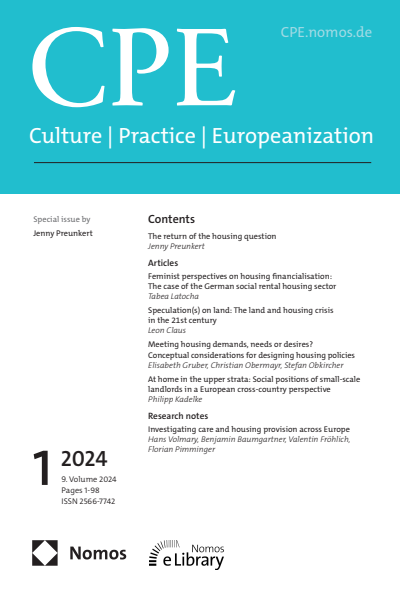
Cover der Ausgabe: Culture, Practice & Europeanization Jahrgang 9 (2024), Heft 1
Ausgabe Open Access Vollzugriff

Jahrgang 9 (2024), Heft 1

Culture, Practice & Europeanization
Autor:innen:
Zeitschrift:
Culture, Practice & Europeanization
Verlag:
 2024

Über die Zeitschrift

Culture, Practice and Europeanization (CPE) ist ein peer reviewtes open access Journal für die Veröffentlichung forschungsbasierter Artikel, die sich mit den vielfältigen sozialen Prozessen, Interaktionen und Policies im Zusammenhang mit der Europäisierung und internationalen Begegnungen in Europa befassen. Für die Veröffentlichung kommen Beiträge aus verschiedenen Disziplinen in Betracht, diese können empirischer, theoretischer und konzeptioneller Natur sein.CPE veröffentlicht in erster Linie Originalartikel in voller Länge, berücksichtigt aber auch Rezensionen, Konferenzbeiträge und Nachrichten aus der Wissenschaft.
Publikation durchsuchen


Bibliographische Angaben

ISSN-Print
2566-7742
ISSN-Online
2566-7742
Verlag
Nomos, Baden-Baden
Sprache
Englisch
Produkttyp
Ausgabe

Artikel

Cover der Ausgabe: Culture, Practice & Europeanization Jahrgang 9 (2024), Heft 1
Artikel
Open Access Vollzugriff

Seite I - II
Nomos Verlagsgesellschaft mbH & Co. KG, Baden-Baden 2024

Cover der Ausgabe: Culture, Practice & Europeanization Jahrgang 9 (2024), Heft 1
Artikel
Open Access Vollzugriff

Seite 1 - 7
Nomos Verlagsgesellschaft mbH & Co. KG, Baden-Baden 2024
Autor:innen:

Cover der Ausgabe: Culture, Practice & Europeanization Jahrgang 9 (2024), Heft 1
Artikel
Open Access Vollzugriff

Seite 8 - 28
Nomos Verlagsgesellschaft mbH & Co. KG, Baden-Baden 2024
Autor:innen:

Cover der Ausgabe: Culture, Practice & Europeanization Jahrgang 9 (2024), Heft 1
Artikel
Open Access Vollzugriff

Seite 29 - 48
Nomos Verlagsgesellschaft mbH & Co. KG, Baden-Baden 2024
Autor:innen:

Cover der Ausgabe: Culture, Practice & Europeanization Jahrgang 9 (2024), Heft 1
Artikel
Open Access Vollzugriff

Seite 49 - 65
Nomos Verlagsgesellschaft mbH & Co. KG, Baden-Baden 2024
Autor:innen:

Cover der Ausgabe: Culture, Practice & Europeanization Jahrgang 9 (2024), Heft 1
Artikel
Open Access Vollzugriff

Seite 66 - 90
Nomos Verlagsgesellschaft mbH & Co. KG, Baden-Baden 2024
Autor:innen:

Cover der Ausgabe: Culture, Practice & Europeanization Jahrgang 9 (2024), Heft 1
Artikel
Open Access Vollzugriff

Seite 91 - 98
Nomos Verlagsgesellschaft mbH & Co. KG, Baden-Baden 2024
Autor:innen:

Literaturverzeichnis (275 Einträge)

  1. Aalbers, M. B. (2008). The Financialization of Home and the Mortgage Market Crisis. Competition & Change 12, 148–166. Google Scholar öffnen doi.org/10.5771/2566-7742-2024-1-1
  2. Almeida-García, F., Cortés-Macías, R. & Parzych, K. (2021). Tourism Impacts, Tourism-Phobia and Gentrification in Historic Centers: The Cases of Málaga (Spain) and Gdansk (Poland). Sustainability 13. Google Scholar öffnen doi.org/10.5771/2566-7742-2024-1-1
  3. Arundel, R. & Ronald, R. (2021). The false promise of homeownership: Homeowner soci-eties in an era of declining access and rising inequality. Urban Studies 58, 1120–1140. Google Scholar öffnen doi.org/10.5771/2566-7742-2024-1-1
  4. Arundel, R. (2017). Equity Inequity: Housing Wealth Inequality, Inter and Intra-generational Divergences, and the Rise of Private Landlordism. Housing, Theory and Soci-ety 34, 176–200. Google Scholar öffnen doi.org/10.5771/2566-7742-2024-1-1
  5. Blackwell, T. & Kohl, S. (2018). The origins of national housing finance systems: a com-parative investigation into historical variations in mortgage finance regimes. Review of International Political Economy 25, 49–74. Google Scholar öffnen doi.org/10.5771/2566-7742-2024-1-1
  6. Borg, I. (2015). Housing Deprivation in Europe: On the Role of Rental Tenure Types. Hou-sing, Theory and Society 32, 73–93. Google Scholar öffnen doi.org/10.5771/2566-7742-2024-1-1
  7. Bundesministerium für Wohnen, Stadtentwicklung und Bauwesen (2022). Bündnis be-zahlbarer Wohnraum stellt Maßnahmenpaket vor. Pressemitteilung 12.10.2022. Retrieved from: https://www.bmwsb.bund.de/Webs/BMWSB/DE/startseite/startseite-node.html. (last accessed: 2024, October 1). Google Scholar öffnen doi.org/10.5771/2566-7742-2024-1-1
  8. Christophers, B. (2017). Intergenerational Inequality? Labour, Capital, and Housing Through the Ages. Antipode 50, 101–121. Google Scholar öffnen doi.org/10.5771/2566-7742-2024-1-1
  9. Clair, A., Reeves, A., McKee, M. & Stuckler, D. (2019). Constructing a housing precarious-ness measure for Europe. Journal of European Social Policy 29, 13–28. Google Scholar öffnen doi.org/10.5771/2566-7742-2024-1-1
  10. Cocola-Gant A. (2018): Tourism gentrification. In: Lees L, Phillips M. (Eds.): Handbook of Gentrification Studies. Cheltenham: Edward Elgar Publishing, 281–293. Google Scholar öffnen doi.org/10.5771/2566-7742-2024-1-1
  11. Czischke, D. & van Bortel, G. (2023). An exploration of concepts and polices on “afforda-ble housing” in England, Italy, Poland and The Netherlands. Journal of Housing and the Built Environment 38, 283–303. Google Scholar öffnen doi.org/10.5771/2566-7742-2024-1-1
  12. Dewilde, C. (2017). Do housing regimes matter? Assessing the concept of housing re-gimes through configurations of housing outcomes. International Journal of Social Welfare 26, 384–404. Google Scholar öffnen doi.org/10.5771/2566-7742-2024-1-1
  13. Dewilde, C. (2022). How housing affects the association between low income and living conditions-deprivation across Europe. Socio-Economic Review 20, 373–400. Google Scholar öffnen doi.org/10.5771/2566-7742-2024-1-1
  14. EURACTIV (2023). Dutch Housing associations eager to solve crisis, need direction from housing minister. Retrieved from: https://www.euractiv.com/section/politics/news/dutch-housing-associations-eager-to-solve-crisis-need-direction-from-housing-minister/ (last accessed: 2024, October 1). Google Scholar öffnen doi.org/10.5771/2566-7742-2024-1-1
  15. Fernandez, R. & Aalbers, M. B. (2016). Financialization and housing: Between globaliza-tion and Varieties of Capitalism. Competition & Change 20, 71–88. Google Scholar öffnen doi.org/10.5771/2566-7742-2024-1-1
  16. Fuller, G. W., Johnston, A. & Regan, A. (2020). Housing prices and wealth inequality in Western Europe. West European Politics 43, 297–320. Google Scholar öffnen doi.org/10.5771/2566-7742-2024-1-1
  17. Heeg, S. (2020). Wohnungen als Finanzanlage. Auswirkungen von Responsibilisierung und Finanzialisierung im Bereich des Wohnens. In S. Schipper, & L. Vollmer (Eds.), Wohnungs-forschung. Ein Reader. Bielefeld: transcript. 391–420. Google Scholar öffnen doi.org/10.5771/2566-7742-2024-1-1
  18. Hick, R. & Stephens, M. (2023). Housing, the welfare state and poverty: On the financiali-zation of housing and the dependent variable problem. Housing, Theory and Society 40(1), 78–95. Google Scholar öffnen doi.org/10.5771/2566-7742-2024-1-1
  19. Hick, R., Pomati, M. & Stephens, M. (2022). Severe Housing Deprivation in the European Union: a Joint Analysis of Measurement and Theory. Social Indicators Research 164, 1271–1295. Google Scholar öffnen doi.org/10.5771/2566-7742-2024-1-1
  20. Holm, A., Regnault, V., Sprengholz, M. & Stephan, M. (2021). Die Verfestigung sozialer Wohnversorgungsprobleme. Entwicklung der Wohnverhältnisse und der sozialen Wohnversorgung von 2006 bis 2018 in 77 deutschen Großstädten. Working Paper For-schungsförderung 217. Google Scholar öffnen doi.org/10.5771/2566-7742-2024-1-1
  21. Johnston, A., Fuller, G. W. & Regan, A. (2020). It takes two to tango: mortgage markets, labor markets and rising household debt in Europe. Review of International Political Economy 28, 843–873. Google Scholar öffnen doi.org/10.5771/2566-7742-2024-1-1
  22. Kemeny, J. (2001). Comparative housing and welfare: Theorising the relationship. Journal of Housing and the Built Environment 16, 53–70. Google Scholar öffnen doi.org/10.5771/2566-7742-2024-1-1
  23. Kholodilin, K. & Kohl, S. (2019). Die Regulierung des Wohnungsmarktes hat weltweit zum Siegeszug des Eigenheims beigetragen. DIW-Wochenbericht 38/2019, 701–709. Google Scholar öffnen doi.org/10.5771/2566-7742-2024-1-1
  24. Kronauer, M. & Siebel, W. (2022). Die neue Wohnungsfrage. WSI-Mitteilungen 75, 178. Google Scholar öffnen doi.org/10.5771/2566-7742-2024-1-1
  25. Paredes-Rodriguez, A. A. & Spierings, B. (2020). Dynamics of protest and participation in the governance of tourism in Barcelona: a strategic action field perspective. Journal of Sustainable Tourism 28(12), 2118–2135. Google Scholar öffnen doi.org/10.5771/2566-7742-2024-1-1
  26. Scanlon, K. (2017). Social housing in Europe: Affordable “housing for all”? In: B. Schönig, J., Kadi, S. Schipper (Eds.), Wohnraum für alle? Perspektiven auf Planung, Politik und Ar-chitektur. Bielefeld: Transcript 61-71. Google Scholar öffnen doi.org/10.5771/2566-7742-2024-1-1
  27. Schwartz, H. & Seabrooke, L. (2008). Varieties of Residential Capitalism in the Interna-tional Political Economy: Old Welfare States and the New Politics of Housing. Compara-tive European Politics 6, 237–261. Google Scholar öffnen doi.org/10.5771/2566-7742-2024-1-1
  28. Aalbers, M. (2016). The financialization of housing: A political economy approach. London: Routledge. Google Scholar öffnen doi.org/10.5771/2566-7742-2024-1-8
  29. Aalbers, M. (2017). The Variegated Financialization of Housing. International Journal of Urban and Regional Research 41(4), 542–554. Google Scholar öffnen doi.org/10.5771/2566-7742-2024-1-8
  30. Aalbers, M. (2023). Financialization. In International Encyclopedia of Geography (Eds D. Richardson, N. Castree, M.F. Goodchild, A. Kobayashi, W. Liu and R.A. Marston). Google Scholar öffnen doi.org/10.5771/2566-7742-2024-1-8
  31. Aalbers, M. B., C. Hochstenbach, J. Bosma, and R. Fernandez (2021). “The Death and Life of Private Landlordism: How Financialized Homeownership Gave Birth to the Buy-To-Let Market.” Housing, Theory, and Society 38(5), 541–563. Google Scholar öffnen doi.org/10.5771/2566-7742-2024-1-8
  32. Arendt, R. & Gralke, T. & Vollmer, L. (2023). Bezahlbar und klimagerecht wohnen? Antworten sozial-ökologischer Bewegungsakteur*innen auf institutionalisierte Zielkonflikte in der Wohnraumversorgung. PROKLA. Zeitschrift für Kritische Sozialwissenschaft, 53(210), 117–135. Google Scholar öffnen doi.org/10.5771/2566-7742-2024-1-8
  33. Atkinson, R. (2020), Alpha city how London is bought and sold by the super-rich. Verso Books. Google Scholar öffnen doi.org/10.5771/2566-7742-2024-1-8
  34. Bernt, M. & Colini, L. & Förste, D. (2017). Privatization, Financialization and State Restructuring in Eastern Germany: The case of Am südpark: Privationzation, Financialization and State Restructuring In Eastern Germany. International Journal of Urban and Regional Research 41, 555–571. Google Scholar öffnen doi.org/10.5771/2566-7742-2024-1-8
  35. Bernt, M. (2022). The Commodification Gap: Gentrification and Public Policy in London, Berlin and St. Petersburg. John Wiley & Sons. Google Scholar öffnen doi.org/10.5771/2566-7742-2024-1-8
  36. Beswick, J. & Penny, J. (2018). Demolishing the Present to Sell off the Future? The Emergence of ‘Financialized Municipal Entrepreneurialism’ in London. International Journal of Urban and Regional Research 42(4), 612–632. Google Scholar öffnen doi.org/10.5771/2566-7742-2024-1-8
  37. Betz, J., Kubitza, T. & Schipper, S. (2019). Gentrifizierung im Frankfurter Gallus. Sozialstruktur, Mietbelastung und Verdrängung in der Vonovia-Siedlung Knorrstraße. Forschungsbericht. Frankfurt a.M.: Goethe Universität. Google Scholar öffnen doi.org/10.5771/2566-7742-2024-1-8
  38. Czischke, D. (2009). Managing Social Rental Housing in the EU: A Comparative Study. European Journal of Housing Policy 9, 121–151. Google Scholar öffnen doi.org/10.5771/2566-7742-2024-1-8
  39. Della Costa, M. (2019). Women and the Subversion of the Community: A Mariarosa Dalla Costa Reader. Oakland, Cal.: PM Press. Google Scholar öffnen doi.org/10.5771/2566-7742-2024-1-8
  40. Deutscher Mieterbund (n.D.): Zahlen & Fakten. Retrieved from: https://mieterbund.de/themen-und-positionen/zahlen-fakten/ (last accessed: 2024, July 21). Google Scholar öffnen doi.org/10.5771/2566-7742-2024-1-8
  41. Doling, J. (1994). The Privatisation of Social Housing in European Welfare States. Environment and Planning C: Government and Policy, 12, 243–255. Google Scholar öffnen doi.org/10.5771/2566-7742-2024-1-8
  42. Donner, C. (2000). Wohnungspolitiken in der Europäischen Union. Selbstverlag, Wien. Google Scholar öffnen doi.org/10.5771/2566-7742-2024-1-8
  43. Droste, C. & Knorr‐Siedow, T. (2014). Social housing in Germany. In: Scanlon, K./Whitehead, C.M.E. & Fernández Arrigoitia, M. (Eds.) Social housing in Europe, Wiley Blackwell, Chichester, United Kingdom. 183–202. Google Scholar öffnen doi.org/10.5771/2566-7742-2024-1-8
  44. Easthope, H., Power, E., Rogers, D. & Dufty-Jones, R. (2020). Thinking relationally about housing and home. Housing Studies 35, 1493–1500. Google Scholar öffnen doi.org/10.5771/2566-7742-2024-1-8
  45. Egner, B., Georgakis, N., Heinelt, H., Bartholomäi, R.C., Schader-Stiftung (Eds.) (2004). Wohnungspolitik in Deutschland: Positionen, Akteure, Instrumente, Praxis + Theorie. Darmstadt. Google Scholar öffnen doi.org/10.5771/2566-7742-2024-1-8
  46. Egner, B. (2014). Wohnungspolitik seit 1945. APuZ 64, 13–19. Google Scholar öffnen doi.org/10.5771/2566-7742-2024-1-8
  47. Federici, S. (2012). Revolution at Point Zero: Housework, Reproduction and Feminist Struggle. Oakland, CA: Common Notions/PM Press. Google Scholar öffnen doi.org/10.5771/2566-7742-2024-1-8
  48. Ferreri, M. (2020) Painted Bullet Holes and Broken Promises: Understanding and Challenging Municipal Dispossession in London’s Public Housing ‘Decanting.’ International Journal of Urban and Regional Research, 1007–1022. Google Scholar öffnen doi.org/10.5771/2566-7742-2024-1-8
  49. Fields, D. & Uffer, S. (2016). The financialisation of rental housing: A comparative analysis of New York City and Berlin. Urban Studies 53, 1486–1502. Google Scholar öffnen doi.org/10.5771/2566-7742-2024-1-8
  50. Fields, D. (2017a). Unwilling Subjects of Financialization. International Journal of Urban and Regional Research 41, 588–603. Google Scholar öffnen doi.org/10.5771/2566-7742-2024-1-8
  51. Fields, D. (2017b). Urban struggles with financialization. Geography Compass 11 (11). Google Scholar öffnen doi.org/10.5771/2566-7742-2024-1-8
  52. Forrest, R. & Williams, P. (1984): Commodification and Housing: Emerging Issues and Contradictions. Environment and Planning A: Economy and Space, 16(9), 1163–1180. Google Scholar öffnen doi.org/10.5771/2566-7742-2024-1-8
  53. Gabor, D. & Kohl, S. (2022): My home is an asset class.: The Financialization of Housing in Europe. Retrieved from: https://www.greens-efa.eu/en/article/document/my-home-is-an-asset-class (last accessed: 2024, July 21). Google Scholar öffnen doi.org/10.5771/2566-7742-2024-1-8
  54. Godechot, O. (2020). “Financialization and the increase in inequality”. In: P. Mader, D. Mertens, and N. van der Zwan (Eds.), The Routledge International Handbook of Financialization, 413–424. London/New York: Routledge. Google Scholar öffnen doi.org/10.5771/2566-7742-2024-1-8
  55. Gotham, K.F. (2009). Creating Liquidity out of Spatial Fixity: The Secondary Circuit of Capital and the Subprime Mortgage Crisis. International Journal of Urban and Regional Research. 33, 355–371. Google Scholar öffnen doi.org/10.5771/2566-7742-2024-1-8
  56. Graziani, T., Montano, J., Roy, A. & Stephens, P. (2020). Who Profits from Crisis? Housing Grabs in Time of Recovery. UCLA Luskin Institute for Inequality and Democracy. Google Scholar öffnen doi.org/10.5771/2566-7742-2024-1-8
  57. Harlander, T. (2008) Wohnungspolitik. In M.H. Geyer and H.G. Hockerts (Eds.), Geschichte der Sozialpolitik in Deutschland seit 1945, Band 6, 1974–1982: Bundesrepublik Deutschland––neue Herausforderungen, wachsende Unsicherheiten. Google Scholar öffnen doi.org/10.5771/2566-7742-2024-1-8
  58. Häußermann, H. & Siebel, W. (1996). Soziologie des Wohnens: eine Einführung in Wandel und Ausdifferenzierung des Wohnens. Juventa-Verl, Weinheim. Google Scholar öffnen doi.org/10.5771/2566-7742-2024-1-8
  59. Harvey, D. (1975 [1973]). Social Justice and the City. London: Arnold. Google Scholar öffnen doi.org/10.5771/2566-7742-2024-1-8
  60. Heindl, G. (2022). Stadtkonflikte: Radikale Demokratie in Architektur und Stadtplanung. Mandelbaum Verlag. Google Scholar öffnen doi.org/10.5771/2566-7742-2024-1-8
  61. Jupp, E., Bowlby, S., Franklin, J., & Hall, S.M. (2019). The New Politics of Home: Housing, Gender and Care in Times of Crisis, 1st ed. Policy Press. Google Scholar öffnen doi.org/10.5771/2566-7742-2024-1-8
  62. Kadıoğlu, D. & Kellecioğlu, I. (2023). Flowing Capital-Disrupted Homes: Financialisation and Maintenance of Rental Housing in Sweden. In: Antipode Antipode, 56(2), 516–537. Google Scholar öffnen doi.org/10.5771/2566-7742-2024-1-8
  63. Künstler, F. & Schipper, S. (2021). Prekäre Wohnverhältnisse, Verdrängungsdruck und die Entstehung politischer Kollektivität in Frankfurt Westhausen. Soziale Passagen, 13(2), 273–292. Google Scholar öffnen doi.org/10.5771/2566-7742-2024-1-8
  64. Kuschinski, E. (2019). Profitable Wohnungspolitik und die Reproduktionskrise der ›Anderen‹ – das Hamburger Bündnis für das Wohnen. Femina Politica 1, 125–129. Google Scholar öffnen doi.org/10.5771/2566-7742-2024-1-8
  65. Latocha, T. (2021). „Beziehungsweise(n) wohnen – Feministische Gedanken zum Wohnen in der Krise“. weiter denken. Journal für Philosophie, Februar 2021. Retrieved from: https://weiter-denken-journal.de/herbst_2021_wohnen/Beziehungsweise_Wohnen.php (last accessed: 2024, July 21). Google Scholar öffnen doi.org/10.5771/2566-7742-2024-1-8
  66. Latocha, T. (2022). "Krisenhaftes Wohnen aus Perspektive der Feministischen Politischen Ökonomie verstehen." Feministische Geo-RundMail Nr. 88, 42–50 Google Scholar öffnen doi.org/10.5771/2566-7742-2024-1-8
  67. Lees, L. & White, H. (2020). The social cleansing of London council estates: everyday experiences of ‘accumulative dispossession.’ Housing Studies 35, 1701–1722. Google Scholar öffnen doi.org/10.5771/2566-7742-2024-1-8
  68. Longhurst, R. (2012). Feminist perspectives on home. In: Smith, S. (Ed.), International Encyclopedia of Housing and Home. Oxford: Elsevier Sience, 158–162. Google Scholar öffnen doi.org/10.5771/2566-7742-2024-1-8
  69. Madden, D. (2020). Housing and the Crisis of Social Reproduction. In: e-flux Architecture. Retrieved from: https://www.e-flux.com/architecture/housing/333718/housing-and-the-crisis-of-social-reproduction/ (last accessed: 2024, July 21). Google Scholar öffnen doi.org/10.5771/2566-7742-2024-1-8
  70. Madden, D. & Marcuse, P. (2016). In defense of housing: the politics of crisis. Verso, London New York. Google Scholar öffnen doi.org/10.5771/2566-7742-2024-1-8
  71. Metzger, P. (2020). Die Finanzialisierung der deutschen Ökonomie am Beispiel des Wohnungsmarktes. Westfälisches Dampfboot. Google Scholar öffnen doi.org/10.5771/2566-7742-2024-1-8
  72. Molyneux, M. (1979). Beyond the Domestic Labour Debate. New Left Review 116. Google Scholar öffnen doi.org/10.5771/2566-7742-2024-1-8
  73. Niethammer, L. (1988). Rückblick auf den sozialen Wohnungsbau. In: Prigge, W. & Kaib, W. (Eds.), Sozialer Wohnungsbau im internationalen Vergleich. Frankfurt a.M.: Vervuert, 288–308. Google Scholar öffnen doi.org/10.5771/2566-7742-2024-1-8
  74. Power, E.R. & Mee, K.J. (2020). Housing: an infrastructure of care. Housing Studies. 35, 484–505. Google Scholar öffnen doi.org/10.5771/2566-7742-2024-1-8
  75. Rinn, M. (2021). (Nicht-)Konflikte um Verdrängung von unten verstehen. In: J. Glatter, M. Mießner (Eds.), Gentrifizierung und Verdrängung . Bielefeld: transcript Verlag. 295–312. Google Scholar öffnen doi.org/10.5771/2566-7742-2024-1-8
  76. Scanlon, K., Whitehead, C.M.E., & Fernández Arrigoitia, M. (Eds.) (2014). Social housing in Europe, Real estate issues. Wiley Blackwell, Chichester, United Kingdom. Google Scholar öffnen doi.org/10.5771/2566-7742-2024-1-8
  77. Schipper, S. (2021). Gentrifizierung powered by Vonovia. Verdrängung im Frankfurter Gallus. In: J. Glatter, M. Mießner (Eds.). Gentrifizierung und Verdrängung. Aktuelle theoretische, methodische und politische Herausforderungen. Bielefeld: transcript, 167–186. Google Scholar öffnen doi.org/10.5771/2566-7742-2024-1-8
  78. Schönig, B., Kadi, J. & Schipper, S. (Eds.) (2017): Wohnraum für alle?! Perspektiven auf Planung, Politik und Architektur. Transcript, Bielefeld. Google Scholar öffnen doi.org/10.5771/2566-7742-2024-1-8
  79. Schönig, B. (2020). Paradigm Shifts in Social Housing After Welfare‐State Transformation: Learning from the German Experience. International Journal of Urban and Regional Research. 1023–1040. Google Scholar öffnen doi.org/10.5771/2566-7742-2024-1-8
  80. Soederberg, S. (2018). The rental housing question: Exploitation, eviction and erasures. Geoforum 89, 114–123. Google Scholar öffnen doi.org/10.5771/2566-7742-2024-1-8
  81. Uhlmann, S. (2023). Urbane Reproduktionskämpfe: Eine materialistische Deutung wohnungs-und stadtpolitischer Bewegungen. Forschungsjournal Soziale Bewegungen 36(1), 30–48. Google Scholar öffnen doi.org/10.5771/2566-7742-2024-1-8
  82. Unger, K. (2016). Financialization of Mass Rental Housing in Germany: Understanding the Transaction Cycles in the Mass Rental Housing Sector 1999–2015, In: B. Schönig, S., Schipper (Eds.), Urban Austerity: Impacts of the Global Financial Crisis on Cities in Europe. Berlin: ‎ Theater der Zeit. 295–312. Google Scholar öffnen doi.org/10.5771/2566-7742-2024-1-8
  83. Unger, K. (2021). Die Fusion (der Täuscher). Vonovias «Zukunfts- und Sozialpakt Wohnen» im Faktencheck. Retrieved from: https://www.rosalux.de/news/id/44404/die-fusion-der-taeuscher?cHash=cce80b690eab78cf093cd6a08c55e102 (last accessed: 2023, March 20). Google Scholar öffnen doi.org/10.5771/2566-7742-2024-1-8
  84. Unger, K. (2022). Vonovia: ein Problem, das immer größer wird. Berlin: Rosa-Luxemburg-Stiftung. Google Scholar öffnen doi.org/10.5771/2566-7742-2024-1-8
  85. Valli, Ch. (2016). A Sense of Displacement: Long-time Residents' Feelings of Displacement in Gentrifying Bushwick, New York, International Journal of Urban and Regional Research 39(6), 1191–1208. Google Scholar öffnen doi.org/10.5771/2566-7742-2024-1-8
  86. Wijburg, G. & Aalbers, M.B. (2017). The alternative financialization of the German housing market. Housing Studies. 32, 968–989. Google Scholar öffnen doi.org/10.5771/2566-7742-2024-1-8
  87. Wijburg, G., Aalbers, M.B. & Heeg, S. (2018). The Financialisation of Rental Housing 2.0: Releasing Housing into the Privatised Mainstream of Capital Accumulation. Antipode 50, 1098–1119. Google Scholar öffnen doi.org/10.5771/2566-7742-2024-1-8
  88. Barth, J., Richters, O. & Siemoneit, A. (2019). Wider die Wohnungsnot: Besteuert den Boden! In U. Kriese, D. Löhr & H. Wilke (Eds.), Grundsteuer: Zeitgemäß! Der Reader zum Aufruf. (17–22). Münster: Verlag Thomas Kubo. Google Scholar öffnen doi.org/10.5771/2566-7742-2024-1-29
  89. Belina, B. & Heinz, W. (2019). Die kommunale Bodenfrage – Hintergrund und Lösungsstrategien. Studien. Berlin: Rosa-Luxemburg-Stiftung. Retrieved from: https://www.rosalux.de/fileadmin/rls_uploads/pdfs/Studien/Studien_2-19_Bodenpolitik.pdf (last accessed: 2019, April 3). Google Scholar öffnen doi.org/10.5771/2566-7742-2024-1-29
  90. Bertocchi, D., Camatti, N., Giove, S. & Van Der Borg, J. (2020). Venice and Overtourism: Simulating Sustainable Development Scenarios through a Tourism Carrying Capacity Model. Sustainability, 12(2), 512. Google Scholar öffnen doi.org/10.5771/2566-7742-2024-1-29
  91. Bourdieu, P. (2017). Ortseffekte. In P. Bourdieu, A. Accardo, G. Balazs & S. Beaud (Eds.), Das Elend der Welt: Zeugnisse und Diagnosen alltäglichen Leidens an der Gesellschaft, Édition discours, 159–169. Köln: Herbert von Halem Verlag. Google Scholar öffnen doi.org/10.5771/2566-7742-2024-1-29
  92. Brandelhuber, A., Grawert, O. & Ngo, A.-L. (Eds.). (2020). The property issue: Politics of space and data. ARCH+/English Version. Berlin: Arch. Retrieved from: https://www.gbv.de/dms/tib-ub-hannover/1679513192.pdf (last accessed: 2024, January 15). Google Scholar öffnen doi.org/10.5771/2566-7742-2024-1-29
  93. Brede, H., Dietrich, B. & Kohaupt, B. (1976). Politische Ökonomie des Bodens und Wohnungsfrage. Frankfurt am Main: Suhrkamp. Google Scholar öffnen doi.org/10.5771/2566-7742-2024-1-29
  94. Cittá di Venezia. (2023). About the Access Fee. Retrieved from: https://cda.veneziaunica.it/en/access-fee (2024, January 29). Google Scholar öffnen doi.org/10.5771/2566-7742-2024-1-29
  95. Claus, L. & Sommer, L. & Sommer, T. (2021). Wohnungsmarkt. In A. Holm & VSA-Verlag für das Studium der Arbeiterbewegung (Eds.), Wohnen zwischen Markt, Staat und Gesellschaft. Ein sozialwissenschaftliches Handbuch, 97–122. Google Scholar öffnen doi.org/10.5771/2566-7742-2024-1-29
  96. Davies, J. S. & Blanco, I. (2017). Austerity urbanism: Patterns of neo-liberalisation and resistance in six cities of Spain and the UK. Environment and Planning A: Economy and Space, 49(7), 1517–1536. Google Scholar öffnen doi.org/10.5771/2566-7742-2024-1-29
  97. Der Spiegel (2023, September 13). Venedig führt Eintrittskarten für Touristen ein: Wer künftig wie viel zahlen muss. Der Spiegel. Retrieved from https://www.spiegel.de/reise/staedte/venedig-fuehrt-eintrittskarten-fuer-touristen-ein-wer-kuenftig-wie-viel-zahlen-muss-a-06bcd60f-84e8-432d-a6ff-2e9d89790be5 (last accessed: 2024, April 4). Google Scholar öffnen doi.org/10.5771/2566-7742-2024-1-29
  98. Dierks, B. (2019). Overtourism in Europa—Tourismus nicht mehr um jeden Preis. Retrieved from: https://www.deutschlandfunk.de/overtourism-in-europa-tourismus-nicht-mehr-um-jeden-preis-100.html (last accessed: 2024, April 4). Google Scholar öffnen doi.org/10.5771/2566-7742-2024-1-29
  99. Doujak, I. & Barker, J. (2023). The commons are invisible until enclosed. In H. Czech (Ed.), Partecipazione: Akt & Hermann Czech, Austrian Pavillon Biennale Architettura 2023 = Beteiligung, 119–129. Presented at the Biennale Architettura, Wien: Luftschaft Verlag. Google Scholar öffnen doi.org/10.5771/2566-7742-2024-1-29
  100. Engels, F. (1947). Die Lage der arbeitenden Klasse in England. Berlin: Dietz. Google Scholar öffnen doi.org/10.5771/2566-7742-2024-1-29
  101. Engels, F. (1989). Zur Wohnungsfrage. In K. Marx & F. Engels (Eds.), Werke. Bd. 18: März 1872 bis Mai 1875 (8. Ed.), 209–287. Berlin: Dietz. Google Scholar öffnen doi.org/10.5771/2566-7742-2024-1-29
  102. Fregolent, L. (2023). Diritto alla città e trasformazioni urbane a Venezia/Right to the city and urban transformation in Venice. In H. Czech (Ed.), Partecipazione: Akt & Hermann Czech, Austrian Pavillon Biennale Architettura 2023 = Beteiligung, 246–265. Presented at the Biennale Architettura, Wien: Luftschaft Verlag. Google Scholar öffnen doi.org/10.5771/2566-7742-2024-1-29
  103. Frey, B. S. (2020). Venedig ist überall: Vom Übertourismus zum Neuen Original. Wiesbaden: Springer Fachmedien Wiesbaden. Retrieved from: https://link.springer.com/10.1007/978-3-658-30279-5 (last accessed: 2024, April 4). Google Scholar öffnen doi.org/10.5771/2566-7742-2024-1-29
  104. George, H. (2006). Progress and Poverty: Why there are recessions and poverty amid plenty: and what to do about it! New York, NY: Robert Schalkenbach Foundation. Google Scholar öffnen doi.org/10.5771/2566-7742-2024-1-29
  105. Harvey, D. (1982a). Land Rent and the Transition to the Capitalist Mode of Production. Antipode, 14(3), 17–25. Google Scholar öffnen doi.org/10.5771/2566-7742-2024-1-29
  106. Harvey, D. (1982b). The limits to capital. Oxford: B. Blackwell. Google Scholar öffnen doi.org/10.5771/2566-7742-2024-1-29
  107. Harvey, D. (2010). A companion to Marx’s Capital. London ; New York: Verso. Google Scholar öffnen doi.org/10.5771/2566-7742-2024-1-29
  108. Häußermann, H. (2003). Armut in der Großstadt. Die Stadtstruktur verstärkt soziale Ungleichheit. Informationen zur Raumentwicklung (IzR), Heft 3(4), 147–159. Google Scholar öffnen doi.org/10.5771/2566-7742-2024-1-29
  109. Holm, A. (2014). Mietenwahnsinn: Warum Wohnen immer teurer wird und wer davon profitiert. Knaur. München: Knaur. Google Scholar öffnen doi.org/10.5771/2566-7742-2024-1-29
  110. Kington, T. (2023, March 24). Venice cracks down on Airbnb tourists as residents drift away from ci…. The Times. Rome. Retrieved from: https://www.thetimes.co.uk/article/venice-airbnb-limit-tourists-shl597v0w (last accessed: 2024, January 29). Google Scholar öffnen doi.org/10.5771/2566-7742-2024-1-29
  111. Krätke, S. (1991). Strukturwandel der Städte: Städtesystem und Grundstücksmarkt in der “post-fordistischen” Ära. Frankfurt [am Main] ; New York: Campus. Google Scholar öffnen doi.org/10.5771/2566-7742-2024-1-29
  112. Lefebvre, H. (1991). The production of space. Oxford, OX, UK ; Cambridge, Mass., USA: Blackwell. Google Scholar öffnen doi.org/10.5771/2566-7742-2024-1-29
  113. Luft, C. (2019). Für eine soziale Bodenordnung – Wie der Grundbesitz schrittweise dem Markt entzogen werden kann. Rosa-Luxemburg-Stiftung. Retrieved from https://www.rosalux.de/fileadmin/rls_uploads/pdfs/Online-Publikation/2-19_Online-Publ_Bodenordnung.pdf (last accessed: 2019, June 24). Google Scholar öffnen doi.org/10.5771/2566-7742-2024-1-29
  114. Marcuse, P., & Madden, D. (2016). In Defense of Housing: The Politics of Crisis. London ; New York: Verso Books. Google Scholar öffnen doi.org/10.5771/2566-7742-2024-1-29
  115. Marx, K. & Engels, F. (1988). Collected works. 23. New York: International Publ. Google Scholar öffnen doi.org/10.5771/2566-7742-2024-1-29
  116. Marx, K., Fowkes, B. & Fernbach, D. (1982). Capital: A critique of political economy. v. 1: Penguin classics. London ; New York, N.Y: Penguin Books in association with New Left Review. Google Scholar öffnen doi.org/10.5771/2566-7742-2024-1-29
  117. Musterd, S. (Ed.). (2020). Handbook of urban segregation. Research handbooks in urban studies. Cheltenham, UK ; Northampton, MA, USA: Edward Elgar Publishing. Google Scholar öffnen doi.org/10.5771/2566-7742-2024-1-29
  118. Ocio – Osservatorio Civico sulla casa e la residenza (2022, November 23). OCIO | “A mente fredda” sullo spopolamento di Venezia. Ocio-venezia.it. Retrieved from: https://ocio-venezia.it/report/a-mente-fredda-sullo-spopolamento-di-venezia (last accessed: 2024, April 4). Google Scholar öffnen doi.org/10.5771/2566-7742-2024-1-29
  119. Ocio – Osservatorio Civico sulla casa e la residenza (2023). Venezia oltre lo spopolamento: Non solo case, ma la casa al centro/Venice beyond the depopulation: Not just housing, but housing at the centre. In H. Czech (Ed.), Partecipazione: Akt & Hermann Czech, Austrian Pavillon Biennale Architettura 2023 = Beteiligung. Presented at the Biennale Architettura, Wien: Luftschaft Verlag, 62–85. Google Scholar öffnen doi.org/10.5771/2566-7742-2024-1-29
  120. Polanyi, K. (2001). The great transformation: The political and economic origins of our time (2nd Beacon Paperback ed.). Boston, MA: Beacon Press. Google Scholar öffnen doi.org/10.5771/2566-7742-2024-1-29
  121. Rajagopal, B. & UN Human Rights Council Special Rapporteur on Adequate Housing as a Component of the Right to an Adequate Standard of Living. (2022). Towards a just transformation: Climate crisis and the right to housing: report of the Special Rapporteur on Adequate Housing as a Component of the Right to an Adequate Standard of Living, and on the Right to Non-Discrimination in this Context, Balakrishnan Rajagopal. UN: The United Nations. Retrieved from: https://policycommons.net/artifacts/8325248/towards-a-just-transformation/9250814/ (last accessed: 2024, January 22). Google Scholar öffnen doi.org/10.5771/2566-7742-2024-1-29
  122. Rupp, L. N. (2021). Soziologische Perspektiven auf die Wohnungsfrage. Wohnen zwischen Markt, Staat und Gesellschaft. Ein sozialwissenschaftliches Handbuch, VSA: Hamburg. 30–48. Google Scholar öffnen doi.org/10.5771/2566-7742-2024-1-29
  123. Ryan-Collins, J. (2018). Why Can’t You Afford a Home? Cambridge, UK; Medford, MA: Polity. Google Scholar öffnen doi.org/10.5771/2566-7742-2024-1-29
  124. Ryan-Collins, J., Lloyd, T. & Macfarlane, L. (2017). Rethinking the Economics of Land and Housing. London: Zed Books. Google Scholar öffnen doi.org/10.5771/2566-7742-2024-1-29
  125. Scheppe, W. (2020). The Ground-Rent of Art and Exclusion form the City – The Exemplary Quality of Venice’s Singularity. In A. Brandlhuber, O. Grawert, & A.-L. Ngo (Eds.), The property issue: Politics of space and data, ARCH+/English Version, Berlin: Arch+, 16–35. Google Scholar öffnen doi.org/10.5771/2566-7742-2024-1-29
  126. Scheppe, W. (2023). At the cost of the City/Um den Preis der Stadt. In H. Czech (Ed.), Partecipazione: Akt & Hermann Czech, Austrian Pavillon Biennale Architettura 2023 = Beteiligung. Presented at the Biennale Architettura, Wien: Luftschaft Verlag, 313–383. Google Scholar öffnen doi.org/10.5771/2566-7742-2024-1-29
  127. Schönig, B. (2018). Sechs Thesen zur wieder mal “neuen” Wohnungsfrage—Plädoyer für ein interdisziplinäres Gespräch. In B. Schönig, J. Kadi & S. Schipper (Eds.), Wohnraum für alle?! Perspektiven auf Planung, Politik und Architektur, Schriftenreihe / Bundeszentrale für Politische Bildung. Bonn: Bundeszentrale für politische Bildung, 11–30. Google Scholar öffnen doi.org/10.5771/2566-7742-2024-1-29
  128. Settis, S. (2014). Se Venezia muore. Vele. Torino: Giulio Einaudi editore. Google Scholar öffnen doi.org/10.5771/2566-7742-2024-1-29
  129. Smith, N. (1987). Gentrification and the Rent Gap. Annals of the Association of American Geographers, 77(3), 462–465. Google Scholar öffnen doi.org/10.5771/2566-7742-2024-1-29
  130. The Governing Mayor of Berlin – Senate Chancellery. (2023, September 29). Aids and Relief Packages. Retrieved from: https://www.berlin.de/energie/en/aid/ (last accessed: 2024, January 22). Google Scholar öffnen doi.org/10.5771/2566-7742-2024-1-29
  131. Trapp, H. (2018). Kapital Heim. In A.-L. Ngo, G. Uhlig, & ARCH+ Verlag GmbH (Eds.), The property issue: Von der Bodenfrage und neuen Gemeingütern, Arch+: Zeitschrift für Architektur und Urbanismus, Aachen: ARCH Verlag GmbH, 34–39. Google Scholar öffnen doi.org/10.5771/2566-7742-2024-1-29
  132. Vittadello, R. (2023, December 22). Abitazioni di lusso e seconde case, boom a Venezia: Si investe di più…. Il Gazzettino. Retrieved from: https://www.ilgazzettino.it/nordest/venezia/mercato_immobiliare_case_lusso_seconde_case_acquisto_senza_mutuo-7830401.html (last accessd: 2024, January 29). Google Scholar öffnen doi.org/10.5771/2566-7742-2024-1-29
  133. YTALI (2022, November 20). No al ticket d’ingresso, Venezia è una città. Le immagini. Ytali. Retrieved from https://ytali.com/2022/11/20/no-al-ticket-dingresso-venezia-e-una-citta-le-immagini/ (last accessed: 2024, January 29). Google Scholar öffnen doi.org/10.5771/2566-7742-2024-1-29
  134. ZEIT online (2019, August 14). Sozialer Wohnungsbau: Mehr als 42.000 Sozialwohnungen weniger in Deutschland. Die Zeit. Hamburg. Retrieved from: https://www.zeit.de/politik/deutschland/2019-08/sozialer-wohungsbau-weniger-sozialwohnungen-deutschland (last accessed: 2024, August 14). Google Scholar öffnen doi.org/10.5771/2566-7742-2024-1-29
  135. Aalbers, M. B. (2016). The financialization of housing: A political economy approach. Routledge. Google Scholar öffnen doi.org/10.5771/2566-7742-2024-1-49
  136. Aigner, A. (2019). Housing entry pathways of refugees in Vienna, a city of social housing. Housing Studies, 34(5), 779–803. Google Scholar öffnen doi.org/10.5771/2566-7742-2024-1-49
  137. Aurand, A. (2010). Density, housing types and mixed land use: Smart tools for affordable housing? Urban studies, 47(5), 1015–1036. Google Scholar öffnen doi.org/10.5771/2566-7742-2024-1-49
  138. Bergold, Jarg & Thomas, S. (2012). Partizipative Forschungsmethoden: Ein methodischer Ansatz in Bewegung [110 Absätze]. Forum Qualitative Sozialforschung, 13(1), Art. 30. Google Scholar öffnen doi.org/10.5771/2566-7742-2024-1-49
  139. Bernt, M. (2022). The commodification gap: gentrification and public policy in London, Berlin and St. Petersburg. John Wiley & Sons. Google Scholar öffnen doi.org/10.5771/2566-7742-2024-1-49
  140. Bohnsack, R. (2013). Gruppendiskussionen. In: Qualitative Forschung. Ein Handbuch, Hrsg. Flick, U., Kardorff, E. & Steinke, I., 369–384. 10. Auflage. Reinbek: Rowohlt Google Scholar öffnen doi.org/10.5771/2566-7742-2024-1-49
  141. Bramley, G., Pawson, H., White, M., Watkins, D. & Pleace, N. (2010). Estimating housing need. Research Report. Communities and Local Government, London. Google Scholar öffnen doi.org/10.5771/2566-7742-2024-1-49
  142. Braun, V. & Clarke, V. (2006). Using thematic analysis in psychology. Qualitative Research in Psychology, 3 (2), 77–101. Google Scholar öffnen doi.org/10.5771/2566-7742-2024-1-49
  143. Burby, R. J., & Rohe, W. M. (1990). Providing for the housing needs of the elderly. Journal of the American Planning Association, 56(3), 324–340 Google Scholar öffnen doi.org/10.5771/2566-7742-2024-1-49
  144. Cullingworth, J. B. (1960). Housing Needs and Planning Policy: A Restatement of the Prob-lems of Housing Need and “overspill” in England and Wales (Vol. 183). Psychology Press. Google Scholar öffnen doi.org/10.5771/2566-7742-2024-1-49
  145. Dangschat, J. (2005). Qualitative Sozialforschung und Partizipation. Vhw Forum Wohnei-gentum, 6, 302–306. Google Scholar öffnen doi.org/10.5771/2566-7742-2024-1-49
  146. European Commission (2024). Is housing affordable? Recieved from: https://ec.europa.eu/eurostat/cache/digpub/housing/bloc-2b.html?lang=en (last accessed: 2024, October 1). Google Scholar öffnen doi.org/10.5771/2566-7742-2024-1-49
  147. Einem, E. v. (Ed.) (2016). Wohnen. Markt in Schieflage – Politik in Not. Wiesbaden: Springer. Google Scholar öffnen doi.org/10.5771/2566-7742-2024-1-49
  148. Fox, S., Kenny, L., Day, M. R., O’Connell, C., Finnerty, J. & Timmons, S. (2017). Exploring the housing needs of older people in standard and sheltered social housing. Gerontology and geriatric medicine, 3. Google Scholar öffnen doi.org/10.5771/2566-7742-2024-1-49
  149. Flick, U., Kardorff, E. & Steinke, I. (2013). Qualitative Forschung: Ein Handbuch, 10. Aufla-ge, Reinbek: Rowohlt. Google Scholar öffnen doi.org/10.5771/2566-7742-2024-1-49
  150. Franz, Y. & Gruber, E. (2018). Wohnen “für alle” in Zeiten der Wohnungsmarktkrise? Der soziale Wohnungsbau in Wien zwischen Anspruch und Wirklichkeit. Standort, 42, 98–104. Google Scholar öffnen doi.org/10.5771/2566-7742-2024-1-49
  151. Gallent, N. (2019). Whose housing crisis? In Whose Housing Crisis? (109–130). Policy Press. Google Scholar öffnen doi.org/10.5771/2566-7742-2024-1-49
  152. Humphries, J. & Canham, S. L. (2021). Conceptualizing the shelter and housing needs and solutions of homeless older adults. Housing Studies, 36(2), 157–179. Google Scholar öffnen doi.org/10.5771/2566-7742-2024-1-49
  153. Jarvis, A. (2008). Disabled children and housing needs. Housing, Care and Support, 11(2), 9–12 Google Scholar öffnen doi.org/10.5771/2566-7742-2024-1-49
  154. Kam, K. J., Lim, A. S. H., Al-Obaidi, K. M. & Lim, T. S. (2018). Evaluating housing needs and preferences of generation Y in Malaysia. Planning Practice & Research, 33(2), 172–185. Google Scholar öffnen doi.org/10.5771/2566-7742-2024-1-49
  155. Kadi, J. & Lilius, J. (2022). The remarkable stability of social housing in Vienna and Helsin-ki: a multi-dimensional analysis, Housing Studies, 39(7), 1607–1631. Google Scholar öffnen doi.org/10.5771/2566-7742-2024-1-49
  156. Kintrea, K., St Clair, R. & Houston, M. (2015). Shaped by place? Young people’s aspirations in disadvantaged neighbourhoods, Journal of Youth Studies, 18(5), 666–684. Google Scholar öffnen doi.org/10.5771/2566-7742-2024-1-49
  157. Land Tirol (2024). Wohnbauförderung. Retrieved from: https://www.tirol.gv.at/bauen-wohnen/wohnbaufoerderung/ (last accessed: 2024, October 1). Google Scholar öffnen doi.org/10.5771/2566-7742-2024-1-49
  158. Matznetter, W. (2002). Social housing policy in a conservative welfare state: Austria as an example. Urban Studies, 39(2), 265–282. Google Scholar öffnen doi.org/10.5771/2566-7742-2024-1-49
  159. Matznetter, W. & Mundt, A. (2012). Housing and welfare regimes, in: David Clapham (Eds) Google Scholar öffnen doi.org/10.5771/2566-7742-2024-1-49
  160. The SAGE Handbook of Housing Studies, 274–294 (Los Angeles, SAGE). Google Scholar öffnen doi.org/10.5771/2566-7742-2024-1-49
  161. Mayring, P. (2022). Qualitative Inhaltsanalyse. Grundlagen und Techniken, 13. Überarbei-tete Auflage, Weinheim: Beltz. Google Scholar öffnen doi.org/10.5771/2566-7742-2024-1-49
  162. Megbolugbe, I., Marks, A. & Schwartz, M. (1991). The Economic Theory of Housing De-mand: A Critical Review. Journal of Real Estate Research. Google Scholar öffnen doi.org/10.5771/2566-7742-2024-1-49
  163. Mundt, A., Wagner, K., Angel, S. & Amann, W. (2024). Homeownership of young adults in Austria from a national and regional perspective since 2010 – a fading dream? Interna-tional Journal of Housing Policy, 24(3), 446–473. Google Scholar öffnen doi.org/10.5771/2566-7742-2024-1-49
  164. Obermayr, C. (2023). Housing the Poor. The Right to the City and Policy Arrangements in Urban Indonesia. Stuttgart: Franz Steiner Verlag (Megacities and Global Change, 27). Google Scholar öffnen doi.org/10.5771/2566-7742-2024-1-49
  165. Pamer, V. (2019). Urban planning in the most liveable city: Vienna. Urban Research & Practice, 12(3), 285–295. Google Scholar öffnen doi.org/10.5771/2566-7742-2024-1-49
  166. Preece, J., Crawford, J. McKee, K. Flint, J. & Robinson, D. (2020). Understanding changing housing aspirations: a review of the evidence, Housing Studies, 35(1), 87–106. Google Scholar öffnen doi.org/10.5771/2566-7742-2024-1-49
  167. Reich, K. (2010). Methodenpool. Place-Mat Methode. Retrieved from: http://methodenpool.uni-koeln.de 2010 ff (last accessed: 2024, October 1). Google Scholar öffnen doi.org/10.5771/2566-7742-2024-1-49
  168. RIS (2024a). Mietrechtsgesetz. Retrieved from: https://www.ris.bka.gv.at/GeltendeFassung.wxe?Abfrage=Bundesnormen&Gesetzesnummer=10002531 (last ac-cessed: 2024, October 1). Google Scholar öffnen doi.org/10.5771/2566-7742-2024-1-49
  169. RIS (2024b). Bodenbeschaffungsgesetz. Retrieved from: https://www.ris.bka.gv.at/GeltendeFassung.wxe?Abfrage=Bundesnormen&Gesetzesnummer=10011459&FassungVom=2023-01-04 (last accessed: 2024, September 24). Google Scholar öffnen doi.org/10.5771/2566-7742-2024-1-49
  170. Stadt Innsbruck (2024). Retrieved from: Leerstandsmonitoring. https://www.ibkinfo.at/leerstandsmonitoring-feb24 (last accessed: 2024, September 26). Google Scholar öffnen doi.org/10.5771/2566-7742-2024-1-49
  171. Statcube (2024). Statistische Datenbank. Statistik Austria. Retrieved from: https://statcube.at (last accessed: 2024, October 1). Google Scholar öffnen doi.org/10.5771/2566-7742-2024-1-49
  172. Statistik Austria (2023). Wohnen 2022. Zahlen, Daten und Indikatoren der Wohnstatistik. Retrieved from: https://www.statistik.at/fileadmin/user_upload/Wohnen-2022_barrierefrei.pdf (last accessed: 2024, October 1). Google Scholar öffnen doi.org/10.5771/2566-7742-2024-1-49
  173. Statistik Austria (2024). Immobilien-Durchschnittspreise. Retrieved from: https://www.statistik.at/statistiken/volkswirtschaft-und-oeffentliche-finanzen/preise-und-preisindizes/immobilien-durchschnittspreise (last accessed: 2024, October 1). Google Scholar öffnen doi.org/10.5771/2566-7742-2024-1-49
  174. Tan, T. H. (2012). Meeting first-time buyers’ housing needs and preferences in greater Kuala Lumpur. Cities, 29(6), 389–396. Google Scholar öffnen doi.org/10.5771/2566-7742-2024-1-49
  175. Unger, H. von, (2014). Partizipative Forschung: Einführung in die Forschungspraxis. Wies-baden: Springer VS. Google Scholar öffnen doi.org/10.5771/2566-7742-2024-1-49
  176. UNHRC – United Nations Human Rights Council (2007). Adequate housing as a compo-nent of the right to an adequate standard of living. UN doc. A/HRC/RES/6/27, 14 Decem-ber. Retrieved from: https://ap.ohchr.org/documents/E/HRC/resolutions/A_HRC_RES_6_27.pdf (last ac-cessed: 2024, October 1). Google Scholar öffnen doi.org/10.5771/2566-7742-2024-1-49
  177. Walser, M., Moosbrugger, H. & Obkircher, S. (2016). Angemessene Beteiligung in der Raumplanung. Bregenz: Amt der Vorarlberger Landesregierung Eigenverlag. Google Scholar öffnen doi.org/10.5771/2566-7742-2024-1-49
  178. Weidinger, T. & Kordel, S. (2023). Access to and exclusion from housing over time: Refu-gees’ experiences in rural areas. International Migration, 61(3), 5471. Google Scholar öffnen doi.org/10.5771/2566-7742-2024-1-49
  179. Ytrehus, S. (2000). Interpretation of Housing Needs? A Critical Discussion. Housing, Theory and Society, 17(4), 166–174. Google Scholar öffnen doi.org/10.5771/2566-7742-2024-1-49
  180. Aalbers, M., Hochstenbach, C., Bosma, J. & Fernandez, R. (2021). The death and life of private landlordism: How financialized homeownership gave birth to the buy-to-let mar-ket. Housing, Theory and Society, 38(5), 541–563. Google Scholar öffnen doi.org/10.5771/2566-7742-2024-1-66
  181. Arundel, R. (2017). Equity inequity: Housing wealth inequality, inter and intra-generational divergences, and the rise of private landlordism. Housing, Theory and Socie-ty, 34(2), 176–200. Google Scholar öffnen doi.org/10.5771/2566-7742-2024-1-66
  182. Auspurg, K., Schneck, A. & Hinz, T. (2019). Closed doors everywhere? A meta-analysis of field experiments on ethnic discrimination in rental housing markets. Journal of Ethnic and Migration Studies, 45(1), 95–114. Google Scholar öffnen doi.org/10.5771/2566-7742-2024-1-66
  183. Balzarini, J. & Boyd, M. L. (2021). Working with them: Small-scale landlord strategies for avoiding evictions. Housing Policy Debate, 31(3–5), 425–445. Google Scholar öffnen doi.org/10.5771/2566-7742-2024-1-66
  184. Bierre, S., Howden-Chapman, P. & Signal, L. (2010). “Ma and Pa” landlords and the “risk” tenant: Discourses in the New Zealand private rental sector. Housing Studies, 25(1), 21–38. Google Scholar öffnen doi.org/10.5771/2566-7742-2024-1-66
  185. Bourdieu, P. (1983). Ökonomisches Kapital, kulturelles Kapital, soziales Kapital. In R. Kre-ckel (Ed.), Soziale Ungleichheiten (183–198). Göttingen: Schwartz. Google Scholar öffnen doi.org/10.5771/2566-7742-2024-1-66
  186. Bourdieu, P. (1985). Sozialer Raum und “Klassen”. Zwei Vorlesungen. Frankfurt: Suhrkamp. Google Scholar öffnen doi.org/10.5771/2566-7742-2024-1-66
  187. Bourdieu, P. (1993). Sozialer Sinn. Kritik der theoretischen Vernunft. Frankfurt: Suhrkamp. Google Scholar öffnen doi.org/10.5771/2566-7742-2024-1-66
  188. Bourdieu, P. (1998). Praktische Vernunft. Zur Theorie des Handelns. Frankfurt: Suhrkamp. Google Scholar öffnen doi.org/10.5771/2566-7742-2024-1-66
  189. Bourdieu, P. & Wacquant, L. J. D. (1996). Reflexive Anthropologie. Frankfurt: Suhrkamp. Google Scholar öffnen doi.org/10.5771/2566-7742-2024-1-66
  190. Byrne, M. (2020). Generation rent and the financialization of housing: A comparative ex-ploration of the growth of the private rental sector in Ireland, the UK and Spain. Housing Studies, 35(4), 743–765. Google Scholar öffnen doi.org/10.5771/2566-7742-2024-1-66
  191. Christophers, B. (2021). A tale of two inequalities: Housing-wealth inequality and tenure inequality. Environment and Planning A: Economy and Space, 53(3), 573–594. Google Scholar öffnen doi.org/10.5771/2566-7742-2024-1-66
  192. Cohen Raviv, O. & Hinz, T. (2022). Intergenerational wealth transmission and homeowner-ship in Europe. A comparative perspective. PLOS ONE, 17(9), e0274647. Google Scholar öffnen doi.org/10.5771/2566-7742-2024-1-66
  193. Decker, N. (2023). How landlords of small rental properties decide who gets housed and who gets evicted. Urban Affairs Review, 59(1), 170–199. Google Scholar öffnen doi.org/10.5771/2566-7742-2024-1-66
  194. DeLuca, S. & Rosen, E. (2022). Housing insecurity among the poor today. Annual Review of Sociology, 48(1), 343–371. Google Scholar öffnen doi.org/10.5771/2566-7742-2024-1-66
  195. Desmond, M. & Perkins, K. L. (2016). Are landlords overcharging housing vouchers hold-ers? City & Community, 15(2), 137–162. Google Scholar öffnen doi.org/10.5771/2566-7742-2024-1-66
  196. Dewilde, C. (2017). Do housing regimes matter? Assessing the concept of housing re-gimes through configurations of housing outcomes. International Journal of Social Wel-fare, 26(4), 384–404. Google Scholar öffnen doi.org/10.5771/2566-7742-2024-1-66
  197. Dewilde, C. & Waitkus, N. (2023). Inequality in housing. In K. Zimmermann (Ed.), Hand-book of labour, human resources and population economics. Cham: Springer. Google Scholar öffnen doi.org/10.5771/2566-7742-2024-1-66
  198. European Central Bank. (2020). Euro area questionnaire on Household Finance and Con-sumption plus paradata: 2017 wave. Google Scholar öffnen doi.org/10.5771/2566-7742-2024-1-66
  199. European Central Bank. (2023a). Household Finance and Consumption Survey: Methodo-logical report for the 2021 wave. Google Scholar öffnen doi.org/10.5771/2566-7742-2024-1-66
  200. European Central Bank. (2023b). The Household Finance and Consumption Survey: Wave 2021. Statistical Tables. Google Scholar öffnen doi.org/10.5771/2566-7742-2024-1-66
  201. Eurostat. (2023). Data browser: Living conditions. Google Scholar öffnen doi.org/10.5771/2566-7742-2024-1-66
  202. Federal Statistics Office of Germany. (2019). EU-SILC household questionnaire. Google Scholar öffnen doi.org/10.5771/2566-7742-2024-1-66
  203. Flage, A. (2018). Ethnic and gender discrimination in the rental housing market: Evidence from a meta-analysis of correspondence tests 2006–2017. Journal of Housing Economics, 41, 251–273. Google Scholar öffnen doi.org/10.5771/2566-7742-2024-1-66
  204. German Bundesbank (2016). Die Studie zur wirtschaftlichen Lage privater Haushalte (PHF). Google Scholar öffnen doi.org/10.5771/2566-7742-2024-1-66
  205. Gomory, H. (2022). The social and institutional contexts underlying landlords’ eviction practices. Social Forces, 100(4), 1774–1805. Google Scholar öffnen doi.org/10.5771/2566-7742-2024-1-66
  206. Greif, M. (2018). Regulating landlords: Unintended consequences for poor tenants. City & Community, 17(3), 658–674. Google Scholar öffnen doi.org/10.5771/2566-7742-2024-1-66
  207. Hulse, K., Reynolds, M. & Martin, C. (2020). The everyman archetype: Discursive refram-ing of private landlords in the financialization of rental housing. Housing Studies, 35(6), 981–1003. Google Scholar öffnen doi.org/10.5771/2566-7742-2024-1-66
  208. Haffner, M., Hegedüs, J. & Knorr-Siedow, T. (2018). The private rental sector in Western Europe. In J. Hegedüs, M. Lux & V. Horváth (Eds.), Private rental housing in transition countries: An Alternative to Owner Occupation? (3–40). London: Palgrave Macmillan. Google Scholar öffnen doi.org/10.5771/2566-7742-2024-1-66
  209. Hochstenbach, C. (2022). Landlord elites on the Dutch housing market: Private landlord-ism, class, and social inequality. Economic Geography, 98(4), 327–354. Google Scholar öffnen doi.org/10.5771/2566-7742-2024-1-66
  210. Howard, A., Hochstenbach, C. & Ronald, R. (2024). Understanding generational housing inequalities beyond tenure, class and context. Economy and Society, 53(1), 135–162. Google Scholar öffnen doi.org/10.5771/2566-7742-2024-1-66
  211. Howell, J., Whitehead, E. & Korver-Glenn, E. (2023). Still separate and unequal: Persistent racial segregation and inequality in subsidized housing. Socius: Sociological Research for a Dynamic World, 9, 1–16. Google Scholar öffnen doi.org/10.5771/2566-7742-2024-1-66
  212. Kaas, L, Kocharkov, G. & Preugschat, E. (2019). Wealth inequality and homeownership in Europe. Annals of Economics and Statistics, (136), 27–54. Google Scholar öffnen doi.org/10.5771/2566-7742-2024-1-66
  213. Kadelke, P. (2023a). Landlords vs tenants = top vs bottom? Class positions in rental hous-ing in Germany. Critical Housing Analysis, 10(1), 66–76. Google Scholar öffnen doi.org/10.5771/2566-7742-2024-1-66
  214. Kadelke, P. (2023b). Private Kleinervermieter*innen in Deutschland: Ein Sozialprofil der größten Anbietergruppe auf dem Mietwohnungsmarkt. Easy_social_sciences, (Mixed 2), 1–11. Google Scholar öffnen doi.org/10.5771/2566-7742-2024-1-66
  215. Kadi, J., Hochstenbach, C. & Lennartz, C. (2020). Multiple property ownership in times of late homeownership: A new conceptual vocabulary. International Journal of Housing Poli-cy, 20(1), 6–24. Google Scholar öffnen doi.org/10.5771/2566-7742-2024-1-66
  216. Kemp, P. A. (Ed.). (2023). Private renting in the advanced economies. Growth and change in a financialised world. Bristol: Policy Press. Google Scholar öffnen doi.org/10.5771/2566-7742-2024-1-66
  217. Kettunen, H. & Ruonavaara, H. (2021). Rent regulation in 21 st century Europe. Compara-tive perspectives. Housing Studies, 36(9), 1446–1468. Google Scholar öffnen doi.org/10.5771/2566-7742-2024-1-66
  218. McKee, K. (2012). Young people, homeownership and future welfare. Housing Studies, 27(6), 853–862. Google Scholar öffnen doi.org/10.5771/2566-7742-2024-1-66
  219. OECD (2024). Affordable housing database. Google Scholar öffnen doi.org/10.5771/2566-7742-2024-1-66
  220. Office for National Statistics. (2012). Wealth and assets survey questionnaire. Google Scholar öffnen doi.org/10.5771/2566-7742-2024-1-66
  221. Pfeffer, F., Waitkus, N. (2021). The wealth inequality of nations. American Sociological Review, 86(4), 567–602. Google Scholar öffnen doi.org/10.5771/2566-7742-2024-1-66
  222. Piketty, T. (2014). Capital in the twenty-first century. Harvad University Press. Google Scholar öffnen doi.org/10.5771/2566-7742-2024-1-66
  223. Power, E. R. & Gillon, C. (2022). Performing the ‘Good Tenant’. Housing Studies, 37(3), 459–482. Google Scholar öffnen doi.org/10.5771/2566-7742-2024-1-66
  224. Rolfe, S., McKee, K., Feather, J., Simcock, T. & Hoolachan, J. (2023). The role of private landlords in making a rented house a home. International Journal of Housing Policy, 23(1), 113–137. Google Scholar öffnen doi.org/10.5771/2566-7742-2024-1-66
  225. Ronald, R., Kadi, J. & Lennartz, C. (2017). What ever happened to assed-based welfare? Policy & Politics, 45(2), 173–193. Google Scholar öffnen doi.org/10.5771/2566-7742-2024-1-66
  226. Ronald, R. & Kadi, J. (2018). The revival of private landlords in Britain’s post-homeownership society. New Political Economy, 23(6), 786–803. Google Scholar öffnen doi.org/10.5771/2566-7742-2024-1-66
  227. Rose, D., McMillian, C. & Carter, O. (2023). Pet-friendly rental housing: Racial and spatial inequalities. Space and Culture, 26(1), 116–129. Google Scholar öffnen doi.org/10.5771/2566-7742-2024-1-66
  228. Rosen, E., Garboden, P. M. E, Cossyleon, J. E. (2023). Racial discrimination in housing: How landlords use algorithms and home visits to screen tenants. American Sociological Review, 86(5), 787–822. Google Scholar öffnen doi.org/10.5771/2566-7742-2024-1-66
  229. Rosen, E. (2014). Rigging the rules of the game: How landlords geographically sort low-income renters. City & Community, 13(4), 310–340. Google Scholar öffnen doi.org/10.5771/2566-7742-2024-1-66
  230. Sagner, P. (2022). Wohneigentumspuzzle (German Economic Institute, Short Report 17). Google Scholar öffnen doi.org/10.5771/2566-7742-2024-1-66
  231. Shiffer–Sebba, D. (2020). Understanding the divergent logics of landlords: Circumstantial versus deliberate pathways. City & Community, 19(4), 1011–1037. Google Scholar öffnen doi.org/10.5771/2566-7742-2024-1-66
  232. So, W. (2022). Which information matters? Measuring landlord assessment of tenant screening reports. Housing Policy Debate, 1–27. Google Scholar öffnen doi.org/10.5771/2566-7742-2024-1-66
  233. Soaita, A. M., Maclennan, D., Gibb, K. (2020). The social and economic consequences of housing wealth inequalities. Housing Finance International, Winter, 27–35. Google Scholar öffnen doi.org/10.5771/2566-7742-2024-1-66
  234. Torgersen, U. (1987). Housing: The wobbly pillar under the welfare state. Scandinavian Housing and Planning Research, 4(Supplement 1), 116–126. Google Scholar öffnen doi.org/10.5771/2566-7742-2024-1-66
  235. Verstraete, J. & Moris, M. (2019). Action-reaction. Survival strategies of tenants and land-lords in the private rental sector in Belgium. Housing Studies, 34(4), 588–608. Google Scholar öffnen doi.org/10.5771/2566-7742-2024-1-66
  236. Whitehead, C., Monk, S., Scanlon, K., Markkanen, S. & Tang, C. (2012). The private rented sector in the new century: A comparative approach. Copenhagen: Centre for Housing Economics. Google Scholar öffnen doi.org/10.5771/2566-7742-2024-1-66
  237. Wind, B., Dewilde, C. & Doling, J. (2020). Secondary property ownership in Europe: Con-tributing to asset-based welfare strategies and the ‘really big trade-off’. International Journal of Housing Policy, 20(1), 25–52. Google Scholar öffnen doi.org/10.5771/2566-7742-2024-1-66
  238. Aalbers, M. (2017). The financialization of housing: A political economy approach. Lon-don, New York: Routledge. Google Scholar öffnen doi.org/10.5771/2566-7742-2024-1-91
  239. Abraham, M. & Aulenbacher, B. (2019). Contested capitalism: Some reflections on coun-termovements, social justice and the task for sociology. In K. Dörre, H. Rosa, K. Becker, S. Bose & B. Seyd (Eds.), Große Transformation? Zur Zukunft moderner Gesellschaften (S. 527–547). Wiesbaden: Springer Fachmedien. Google Scholar öffnen doi.org/10.5771/2566-7742-2024-1-91
  240. Aulenbacher, B. & Dammayr, M. (Eds.) (2014). Für sich und andere sorgen: Krise und Zu-kunft von Care in der modernen Gesellschaft. Weinheim: Beltz Juventa. Google Scholar öffnen doi.org/10.5771/2566-7742-2024-1-91
  241. Aulenbacher, B. (2020). Auf neuer Stufe vergesellschaftet: Care und soziale Reproduktion im Gegenwartskapitalismus. In K. Becker, K. Binner & F. Décieux (Eds.), Gespannte Ar-beits- und Geschlechterverhältnisse im Marktkapitalismus. 125–147. Wiesbaden: Springer Fachmedien. Google Scholar öffnen doi.org/10.5771/2566-7742-2024-1-91
  242. Aulenbacher, B., Riegraf, B. & Theobald, H. (Eds.) (2014). Sorge: Arbeit, Verhältnisse, Re-gime. Baden-Baden: Nomos. Google Scholar öffnen doi.org/10.5771/2566-7742-2024-1-91
  243. Bärnthaler, R. & Dengler, C. (2023). Universal basic income, services, or time politics? A critical realist analysis of (potentially) transformative responses to the care crisis. Journal of Critical Realism, 22(4), 670–691. Google Scholar öffnen doi.org/10.5771/2566-7742-2024-1-91
  244. Bärnthaler, R., Novy, A. & Stadelmann, B. (2023). A Polanyi-inspired perspective on social-ecological transformations of cities. Journal of Urban Affairs, 1–25. Google Scholar öffnen doi.org/10.5771/2566-7742-2024-1-91
  245. Baumgartner, B., Fröhlich, V., Pimminger, F. & Volmary, H. (Eds.) (2021). The Contested Provisioning of Care and Housing. Retrieved from: https://www.contestedcareandhousing.com/_files/ugd/3be10a_4c3d147af11b470991ce1304760edb45.pdf (last accessed: 2024, October 1). Google Scholar öffnen doi.org/10.5771/2566-7742-2024-1-91
  246. Baumgartner, B. & Volmary, H. (2024). Wohnraumregime. Ein Schlüsselkonzept der ver-gleichenden Wohnforschung im Wandel. In Wohnen erforschen. Method(ologi)sche und forschungspraktische Reflexionen. Bielefeld: transcript. Google Scholar öffnen doi.org/10.5771/2566-7742-2024-1-91
  247. Baumgartner, B. & Volmary, H. (2022). Variegated Housing Regimes. A Comparison of Housing Provision Across European Countries. 2021. Retrieved from: https://www.contestedcareandhousing.com/_files/ugd/3be10a_7f5ce74f088840a7a84eacd8e158925f.pdf (last accessed: 2024, October 1). Google Scholar öffnen doi.org/10.5771/2566-7742-2024-1-91
  248. Berndt, C., Peck, J. & Rantisi, N. M. (Eds.) (2020). Market/place: Exploring spaces of ex-change. Newcastle upon Tyne: Agenda Publishing. Google Scholar öffnen doi.org/10.5771/2566-7742-2024-1-91
  249. Boterman, W. & Gent, W. V. (2023). Making the Middle-class City: The Politics of Gentrify-ing Amsterdam. London: Palgrave Macmillan. Google Scholar öffnen doi.org/10.5771/2566-7742-2024-1-91
  250. Bruquetas‐Callejo, M. (2020). Long‐Term Care Crisis in The Netherlands and Migration of Live‐in Care Workers: Transnational Trajectories, Coping Strategies and Motivation Mixes. International Migration, 58(1), 105–118. Google Scholar öffnen doi.org/10.5771/2566-7742-2024-1-91
  251. Clapham, D. (2019). Remaking housing policy: An international study. London: Routledge. Google Scholar öffnen doi.org/10.5771/2566-7742-2024-1-91
  252. Czischke, D. (2018). Collaborative housing and housing providers: Towards an analytical framework of multi-stakeholder collaboration in housing co-production. International Journal of Housing Policy, 18(1), 55–81. Google Scholar öffnen doi.org/10.5771/2566-7742-2024-1-91
  253. Dowling, E. (2021). The care crisis: What caused it and how can we end it?. London: Ver-so. Google Scholar öffnen doi.org/10.5771/2566-7742-2024-1-91
  254. Fanning, A. L., O’Neill, D. W. & Büchs, M. (2020). Provisioning systems for a good life within planetary boundaries. Global Environmental Change, 64, 102135. Google Scholar öffnen doi.org/10.5771/2566-7742-2024-1-91
  255. Farris, S. R. & Marchetti, S. (2017). From the Commodification to the Corporatization of Care: European Perspectives and Debates. Social Politics: International Studies in Gender, State & Society, 24(2), 109–131. Google Scholar öffnen doi.org/10.5771/2566-7742-2024-1-91
  256. Federici, S. (1975). Wages against housework. Bristol: Falling Wall Press. Google Scholar öffnen doi.org/10.5771/2566-7742-2024-1-91
  257. Fraser, N. (2016). Contradictions of Capital and Care. New Left Review, 99–117. Google Scholar öffnen doi.org/10.5771/2566-7742-2024-1-91
  258. Fröhlich, V. (2023). Analysing Senior Care in its Change—The Twofold Hybridity in the So-cietal Embedding of Marketised and Communitised Care. International Karl Polanyi Socie-ty Debates: The Contested Provisioning of Care and Housing. https://www.karlpolanyisociety.com/2023/05/10/analysing-senior-care-in-its-change/ Google Scholar öffnen doi.org/10.5771/2566-7742-2024-1-91
  259. Fröhlich, V., Pillinger, A. & Pimminger, F. (2024). Sich um die Sorge sorgen. Umkämpfte Sorgeerbringung zwischen Vermarktlichung, Technologisierung und Vergemeinschaftung. In R. Atzmüller, K. Binner, F. Décieux, R. Deindl, J. Grubner, & K. Kreissl (Eds.), Gesellschaft in Transformation: Sorge, Kämpfe und Kapitalismus. Weinheim: Beltz Juventa. Google Scholar öffnen doi.org/10.5771/2566-7742-2024-1-91
  260. Goodwin, G. (2018). Rethinking the Double Movement: Expanding the Frontiers of Polany-ian Analysis in the Global South: Rethinking the Double Movement. Development and Change, 49(5), 1268–1290. Google Scholar öffnen doi.org/10.5771/2566-7742-2024-1-91
  261. Gottschlich, D., Hackfort, S. K. & Schmitt. (2022). „Care“. In D. Gottschlich, S. K. Hackfort, T. Schmitt, & U. von Winterfeld (Eds.), Handbuch Politische Ökologie: Theorien, Konflikte, Begriffe, Methoden (307–314). Bielefeld: Transcript. Google Scholar öffnen doi.org/10.5771/2566-7742-2024-1-91
  262. Katona, N. & Melegh, A. Towards a scarcity of care?: Tensions and contradictions in trans-national elderly care systems in Central and Eastern Europe. (2020). Budapest: Friedrich-Ebert-Stiftung Budapest. Google Scholar öffnen doi.org/10.5771/2566-7742-2024-1-91
  263. Lang, R., Carriou, C. & Czischke, D. (2020). Collaborative Housing Research (1990–2017): A Systematic Review and Thematic Analysis of the Field. Housing, Theory and Society, 37(1), 10–39. Google Scholar öffnen doi.org/10.5771/2566-7742-2024-1-91
  264. Leichsenring, K. (2017). The Austrian welfare state system: With special reference to the long-term care system. In C. Aspalter (Eds.), The Routledge international handbook to welfare state systems. Routledge. Google Scholar öffnen doi.org/10.5771/2566-7742-2024-1-91
  265. Matznetter, W. (2002). Social Housing Policy in a Conservative Welfare State: Austria as an Example. Urban Studies, 39(2), 265–282. Google Scholar öffnen doi.org/10.5771/2566-7742-2024-1-91
  266. Novy, A., Baumgartner, B., Grabow, S., Plank, L. & Volmary, H. (2024). Greening Red Vien-na: Lessons for social-ecological housing provision. Sustainability: Science, Practice and Policy, 20(1), 1–19. Google Scholar öffnen doi.org/10.5771/2566-7742-2024-1-91
  267. Peck, J. (2013). For Polanyian Economic Geographies. Environment and Planning A: Econ-omy and Space, 45(7), 1545–1568. Google Scholar öffnen doi.org/10.5771/2566-7742-2024-1-91
  268. Plank, L., Volmary, H., Krenn, M. & Blaas, W. (2023). Shareholderorientierte Transnationa-le Investoren in der kritischen sozialen Infrastruktur. Vienna: Verlag der Arbeiterkammer Wien. Google Scholar öffnen doi.org/10.5771/2566-7742-2024-1-91
  269. Polanyi, K. (1977). The livelihood of man. Cambridge, MA: Academic Press. Google Scholar öffnen doi.org/10.5771/2566-7742-2024-1-91
  270. Polanyi, K. (2001). The great transformation: The political and economic origins of our time. Boston: Beacon Press. Google Scholar öffnen doi.org/10.5771/2566-7742-2024-1-91
  271. Spash, C. L. (2024). Foundations of social ecological economics: The fight for revolution-ary change in economic thought. Manchester: Manchester University Press. Google Scholar öffnen doi.org/10.5771/2566-7742-2024-1-91
  272. Stephens, M., Lux, M. & Sunega, P. (2015). Post-Socialist Housing Systems in Europe: Housing Welfare Regimes by Default? Housing Studies, 30(8), 1210–1234. Google Scholar öffnen doi.org/10.5771/2566-7742-2024-1-91
  273. The Contested Provisioning of Care and Housing (2024). Retrieved from: https://www.contestedcareandhousing.com/ (last accessed: 2024, October 1). Google Scholar öffnen doi.org/10.5771/2566-7742-2024-1-91
  274. Wegleitner, K. & Schuchter, P. (2020). Handbuch Caring Communities. Sorgenetze stär-ken—Solidarität leben. Retrieved from: https://fgoe.org/sites/fgoe.org/files/inline-files/Handbuch_Caring_Communities.pdf (last accessed: 2024, April 12). Google Scholar öffnen doi.org/10.5771/2566-7742-2024-1-91
  275. Zängl, P. (2023). Was ist eine Caring Community? In R. Sempach, C. Steinebach & P. Zängl (Eds.), Care schafft Community – Community braucht Care (3–23). Wiesbaden: Springer Fachmedien. Google Scholar öffnen doi.org/10.5771/2566-7742-2024-1-91

Neuesten Ausgaben

Culture, Practice & Europeanization
Alle Ausgaben anzeigen
Cover der Ausgabe: Culture, Practice & Europeanization Jahrgang 10 (2025), Heft 2
Ausgabe Vollzugriff
Culture, Practice & Europeanization
Jahrgang 10 (2025), Heft 2
Cover der Ausgabe: Culture, Practice & Europeanization Jahrgang 10 (2025), Heft 1
Ausgabe Vollzugriff
Culture, Practice & Europeanization
Jahrgang 10 (2025), Heft 1
Cover der Ausgabe: Culture, Practice & Europeanization Jahrgang 9 (2024), Heft 2
Ausgabe Vollzugriff
Culture, Practice & Europeanization
Jahrgang 9 (2024), Heft 2
Cover der Ausgabe: Culture, Practice & Europeanization Jahrgang 9 (2024), Heft 1
Ausgabe Vollzugriff
Culture, Practice & Europeanization
Jahrgang 9 (2024), Heft 1
Cover der Ausgabe: Culture, Practice & Europeanization Jahrgang 8 (2023), Heft 2
Ausgabe Vollzugriff
Culture, Practice & Europeanization
Jahrgang 8 (2023), Heft 2